- 496 pages
- English
- ePUB (mobile friendly)
- Available on iOS & Android
eBook - ePub
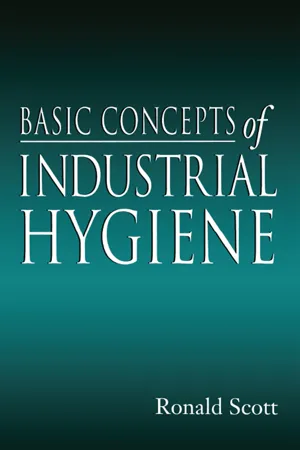
Basic Concepts of Industrial Hygiene
About this book
Basic Concepts of Industrial Hygiene covers the latest and most important topics in industrial hygiene today. The textbook begins with a look at the history and basis for industrial hygiene, which provides students with a foundation for understanding later developments. The book contains an in-depth discussion of new OSHA regulations, such as HAZWOPER and Process Safety, which deal with high hazard situations. It also features a chapter on biological hazards of current concern in health care, including tuberculosis, AIDS, and hepatitis B.
Information
Section I
The Scope of Industrial Hygiene
The Scope of Industrial Hygiene
Chapter 1 introduces the field of industrial hygiene from a historical standpoint and describes the range of concerns of the professional industrial hygienist.Chapter 2 continues with a description of the role of the federal government in occupational health and safety concerns. In the U.S. since the passage of the OSH Act, OSHA and industrial health and safety have become totally entwined. Therefore, a foundation for understanding the responsibilities, approaches, powers, and procedures of OSHA is presented. As a general pattern throughout the book, discussions of hazards are followed by descriptions of OSHA regulations.
CHAPTER 1
History and Basis of Industrial Hygiene:
The Historical View
The Historical View
The first occupational injury victim may well have been a cave man with a chip of stone in the eye from trying to form a spear point or an ax head. The development of civilized society led to a division of labor with individuals providing specialized services. In these ancient civilizations, the variety of ways to injure oneself increased with the sophistication of jobs. Citizens had a disdain for manual labor in classical societies, so high-risk work such as mining and construction was done by slaves, provided in plentiful supply by wars. There was thus a minimum of concern with job injuries or illnesses. The embryonic medical professions targeted cure of the citizen, not the slave. Plinius Secundus described the use of a bladder across the face to filter out dusts during mercury or lead processing. Galen, a physician of the second century AD, observed hazards of mining copper, but did not suggest ways to protect or treat workers.
During the middle ages medical knowledge waned in Europe, and earlier gains would have been lost had it not been for the Arab societies. Other than farming, work was primarily cottage industries, and workers essentially protected themselves.
In 1473 Ellenbog published a pamphlet about occupational diseases, and in 1556 Agricola, a mining town physician, wrote a book that included descriptions of injuries and sicknesses of miners, describing both treatments and preventions. Bernardo Ramazzini published the first real comprehensive work concerned with occupational diseases in 1700. A few other advances were made in the 18th century, particularly the observation by Percival Pott that the scrotal warts of chimney sweeps were caused by the soot they rarely washed away. This was the first linkage of cancer to chemical exposure.
The industrial revolution altered the nature of work and sharply increased the numbers of industrial workers. Large industrial sites exposed many more people to an increased variety of both physical and chemical work hazards. Laws at that time protected the employer by placing blame for work injury on the employee. Government finally became concerned with the welfare of workers with the English Factory Acts of 1833. These acts focused on worker’s compensation rather than safe practices, but led to improved safety because they gave employers a financial incentive to prevent accidents.
During the first decade of the 20th century Alice Hamilton, an American physician dedicated to the welfare of workers, identified hazards and raised public consciousness about the safety of workers. Universities began studies of and courses in occupational health. At about that time the U.S. Public Health Service and the Bureau of Mines initiated studies of workplace hazards. In 1911 New York passed the first worker’s compensation law, and within a decade all but a few states passed similar laws. In 1918 the first college degree in industrial hygiene was earned.
The 1930s saw significant advances in promotion of worker safety. The industrial hygiene profession formed and gained recognition. A few university programs trained specialists in the field. The American Public Health Association created an industrial hygiene section, the American Conference of Governmental Industrial Hygienists organized in 1938, and the American Industrial Hygiene Association originated in 1939.
Although the U.S. moved rapidly to improve the health and safety of workers through regulation and research, public expectations grew faster. As the workforce became increasingly unionized, issues of job safety became the subject of labor-management negotiations. The social activism of the 1960s led to three significant pieces of legislation. The Metal and Nonmetal Mine Safety Act of 1966 created advisory committees with representatives of mine owners, miners, and mine inspectors, required reporting of accidents and occupational diseases, and regularized mine inspection. The Federal Coal Mine Health and Safety Act of 1969 empowered the federal government to close unsafe mines. It set standards for respirable dust, roof supports, and electrical distribution systems, and required medical examinations of miners. Finally the Occupational Safety and Health Act of 1970 (OSH Act) created the Occupational Safety and Health Administration (OSHA) to establish and enforce uniform national work safety standards, and generated a research agency, the National Institute for Occupational Safety and Health (NIOSH) to develop and recommend new standards. The OSH Act has the goal to “assure so far as possible every working man and woman in the nation safe and healthful working conditions and to preserve our human resources.” Since its passage, a succession of new regulations have defined aspects of safe working conditions in quantitative terms.
OSHA inspects a great many workplaces each year. The right-to-know law mandates that workers are trained and informed about workplace hazards and have direct access to OSHA to voice concerns. Research results improve our understanding of hazardous situations, create new protective equipment, and lead to safer work practices. Initial concerns regarding hazards of equipment and chemicals are now expanded to include the spread of disease, injury from awkward task design or repetitive operations, air quality in offices, and many other issues. Today’s workplace is safer in many ways than when the OSH Act was passed. Deaths in the workplace have been cut in half since the OSH Act was passed (Pompei, 1995).
OSHA has vastly expanded the need for occupational safety professionals. For example, membership in the American Industrial Hygiene Association has grown from 160 in 1940 to more than 10,000 today (Cralley et al., 1995).
INDUSTRIAL HYGIENISTS
The American Industrial Hygiene Association defines industrial hygiene as “that science or art devoted to the anticipation, recognition, evaluation, and control of those environmental factors (stresses) arising in or from the workplace which may cause sickness, impaired health and well being, or significant discomfort among workers or among citizens of the community.” An industrial hygienist is one of a group of health professionals trained to address these concerns. More than 30 university programs provide formal professional training in industrial hygiene. In 1960 the American Board of Industrial Hygiene was formed to test and certify individuals as meeting high professional standards. This testing is not done immediately on completion of university training, as is the general case in specialties in the medical sciences, but comes after a mandatory period of practice in the field and only after recommendation of the candidate by other certified professionals. Successful completion of this examination entides individuals to place the letters CIH (Certified Industrial Hygienist) after their name. Once certified, the individual may join the American Academy of Industrial Hygiene. This group has established a Code of Ethics which describes worker protection as the primary responsibility of industrial hygiene professionals.
Academic requirements of university industrial hygiene programs are interdisciplinary in nature, reflecting the broadly based requirements of the profession. The focus of the industrial hygienist is not a narrow specialized field, but is the workplace itself. The industrial hygienist must therefore be able to recognize the hazards inherent in a wide range of workplace circumstances. These include harm from contact with chemicals, whether due to their short- or long-term toxic characteristics, corrosive or irritant impact on the skin or eyes, or behavior-altering properties such as narcotic effects. Physical hazards involve exposure to harmful radiation (ionizing or nonionizing), excessive sound levels, vibration, or extremes of temperature. Biological hazards arise from the possibility of infectious, allergic, or other damaging effects from organisms or their products found in the workplace, such as bacteria, viruses, fungi, or plant products. Many jobs are performed outdoors, and others bring the indoor worker into contact with living or once living materials. Finally, the worker may be harmed by the design of the workplace or the nature of the work itself. Good workplace design includes guards around moving machinery, handrails on stairs, nonslip surfaces on floors, and a host of other accident-preventing installations. Procedures should exist to prevent injury from start-up of machi...
Table of contents
- Cover
- Title Page
- Copyright Page
- Table of Contents
- SECTION 1 THE HISTORY AND PRESENT STATE OF WORKPLACE HEALTH AND SAFETY
- SECTION II BASICS OF TOXICOLOGY
- SECTION III CHEMICAL HAZARDS IN THE WORKPLACE
- SECTION IV PHYSICAL AND BIOLOGICAL HAZARDS IN THE WORKPLACE
- Glossary
- Answers
- Appendix A: Statistical Calculations
- Appendix B: MSDS
- Appendix C: Safety Phone Numbers
- Appendix D: Useful Addresses
- Appendix E: Fire Diamond
- Appendix F: Confined Space Entry Form
- Appendix G: Conversion Factors
- Index
Trusted by 375,005 students
Access to over 1.5 million titles for a fair monthly price.
Study more efficiently using our study tools.
Frequently asked questions
Yes, you can cancel anytime from the Subscription tab in your account settings on the Perlego website. Your subscription will stay active until the end of your current billing period. Learn how to cancel your subscription
No, books cannot be downloaded as external files, such as PDFs, for use outside of Perlego. However, you can download books within the Perlego app for offline reading on mobile or tablet. Learn how to download books offline
Perlego offers two plans: Essential and Complete
- Essential is ideal for learners and professionals who enjoy exploring a wide range of subjects. Access the Essential Library with 800,000+ trusted titles and best-sellers across business, personal growth, and the humanities. Includes unlimited reading time and Standard Read Aloud voice.
- Complete: Perfect for advanced learners and researchers needing full, unrestricted access. Unlock 1.5M+ books across hundreds of subjects, including academic and specialized titles. The Complete Plan also includes advanced features like Premium Read Aloud and Research Assistant.
We are an online textbook subscription service, where you can get access to an entire online library for less than the price of a single book per month. With over 1.5 million books across 990+ topics, we’ve got you covered! Learn about our mission
Look out for the read-aloud symbol on your next book to see if you can listen to it. The read-aloud tool reads text aloud for you, highlighting the text as it is being read. You can pause it, speed it up and slow it down. Learn more about Read Aloud
Yes! You can use the Perlego app on both iOS and Android devices to read anytime, anywhere — even offline. Perfect for commutes or when you’re on the go.
Please note we cannot support devices running on iOS 13 and Android 7 or earlier. Learn more about using the app
Please note we cannot support devices running on iOS 13 and Android 7 or earlier. Learn more about using the app
Yes, you can access Basic Concepts of Industrial Hygiene by RonaldM. Scott,Ronald M. Scott in PDF and/or ePUB format, as well as other popular books in Technology & Engineering & Toxicology. We have over 1.5 million books available in our catalogue for you to explore.