This title was first published in 2000: This text demonstrates the mutual effects of, and interconnections between, globalization, urbanization and rural stagnation, both theoretically and empirically. It places its comprehensive empirical investigation on two levels of urbanization - the peri-urban and the fully urbanized areas - and includes the analysis of the rural conditions into the context of the Southern African region, and also into the context of global processes in an historical and interdisciplinary perspective. The text analyzes the magnitude of the two gaps and the process of social change between the three areas objectively, by showing the changing social interaction patterns, the differences in housing and other socio-economic variables, and subjectively, through showing the judgement of the people of these variables the degree of satisfaction and depression. As the majority of variables reveal poverty, the root causes for it in Mozambique, Africa and the Third World are analyzed and aspects of an alternative development and an alternative globalization are presented.
eBook - ePub
Globalization, Urban Progress, Urban Problems, Rural Disadvantages
Evidence from Mozambique
- 348 pages
- English
- ePUB (mobile friendly)
- Available on iOS & Android
eBook - ePub
Globalization, Urban Progress, Urban Problems, Rural Disadvantages
Evidence from Mozambique
About this book
Information
Part II
The Twofold Gap and the Rural – Peri-Urban – Urban Changes
3
Socio-economic characteristics of the three investigated areas: poverty and relative prosperity
An attempt was made in the previous chapter to show briefly the history of the peri-urban areas and what distinguishes them from the fully urbanized areas and the countryside. In addition, the interrelation between urbanization and globalization was discussed as well as the positive and negative effects of the latter. The discussion of over-urbanization made it clear that rapid urbanization is never the cause, neither for urban nor for rural poverty. In this chapter, using the results of the empirical investigation, the dimensions of rural and urban poverty as well as relative prosperity in Mozambique should be analyzed. The discussion of other socio-economic characteristics and their differences between the investigated areas will show how social change can be observed from the rural via the peri-urban to the fully urbanized areas, called cement cities in Mozambique.
Income of households
The results concerning the income situation do not have the same degree of reliability – not even in the peri-urban areas – as most other results. Firstly, it is very difficult to assess the total incomes of households in industrialized countries and even more so in developing countries. Secondly, income assessment was not the prime objective of this study. The respective questions were included in the questionnaire only to get some reference as at the time of the survey no recent data on income in Mozambique existed. In the meantime we have the IAF,1 the results of which can be considered very reliable. Nevertheless, the results of this research will be presented too, because in the IAF there is no separate data on the fully urbanized areas, the cement cities. However, the results of the IAF are of great value insofar as they show that income from employment makes up only for 52 per cent of the total household income in Maputo, 42 per cent in the provincial capitals and 47 per cent of the urban areas in general.2 According to the IAF income from small trading (selling on the black market, called ‘dumba nenge’ in Maputo and ‘chunga moio’ in Beira) accounts for 24 per cent, income from family production for 8 per cent, from remittances for 5 per cent, (mainly from family members working in South Africa), and income from other sources for 11 per cent. The distribution of the kind of household income is very similar in Maputo and Beira (IAF Outubro 1994,21).
We also tried to find out all productive activities of the wives including urban agriculture as well as the quantity of the remittances, (see questionnaire V19 to 21 and V28 to 35) and after all these lengthy questions we simply asked ‘what is the total income of your household per month approximately?’ An immediate answer was expected. Therefore it is almost certain that the answers reflect the regular monthly money income mainly of the employed household members since adding all the other bits and pieces would have been too lengthy a process. Taking into account the findings of the IAF, it is justified to double the family income from employment indicated by the household heads in this survey.3 The new results achieved this way for Maputo only (in order to be able to compare them with the results of the IAF because only the structure of the kind of income is available for Beira) are presented in the following graph.
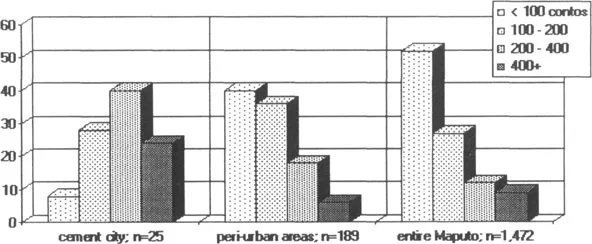
Figure 3.1 Household income of the lower strata of the cement city of Maputo, the peri-urban areas and entire Maputo4
If we put the poverty line at 100 contos family income per month, (no official poverty line exists for the time being in Mozambique, however, according to a lot of oral information it was extremely difficult to live with less than 100 contos per month, approximately US$ 70) we are confronted with the very sad facts, namely that on the basis of the results of the IAF 52 per cent of the entire population of Maputo and on the basis of this research 40 per cent of the population in the peri-urban areas of Maputo live under the poverty line and 8 per cent belong to these very poor, even in the cement city. However, it must be noted that, even in this investigated lower strata of the cement city about two thirds live in relative prosperity, which would increase considerably if a representative sample of the fully urbanized area would have been chosen. At least here, in the fully urbanized areas, where one fifth of the city population lives, the majority can enjoy urban progress.
The population in the peri-urban areas of Beira is still poorer than the one of the peri-urban areas of Maputo, 52 per cent of the households live under the poverty line and in the cement city of Beira 15 per cent are still very poor. (The tables 3.1a to 3.1e in appendix 3 show the monthly wage of household heads as well as the household income and both in the breakdown by province; table 3.1e corresponds with the above shown graph.) Keeping in mind the poverty line of 100 contos per month per household, the tables show that it is not possible for the majority of the families to survive on one wage only. Therefore a big difference exists between the income of the head of a household and the total income of a household.
In view of these facts it is not surprising that more than half of the urban population of Maputo can only acquire half of the biologically necessary food and that one third of the children of Mozambique is undernourished (Ministerio de Comercio 1988).
In 36 per cent of the households of all three areas with husbands and wives, the wives are involved in money earning in addition to housework and child rearing. The percentage is the same in Maputo and Beira. About 20 per cent work most of the day on the family field, about 8 per cent in formal employment, the rest works in the informal sector or as traders or is involved in other activities (chapter 8).
When we asked if apart from husband and wife other family members work we did not distinguish between formal employment, informal sector, trading, agricultural work or others. The following should give an overview over the proportions of families with additional bread winners and the low proportions that receive remittances:
| urban | peri-urban | rural | |
| additional family members work | 26 | 32 | 13 |
| family members send remittances | 7 | 14 | 11 |
| relatives send remittances | 11 | 9 | 6 |
The income situation is clearly worst in the villages. However, as the sample of this study was very small and particularly on the questions of income the missing cases were high (in the villages of Sofala only 20 per cent replied) we rely on a investigation carried out in five provinces (Direcção Nacional de Estatística et al. 1990).5 In large parts of the rural areas of Mozambique people do not really live in a subsistence economy as they cannot sustain themselves but live in absolute poverty and misery. In the study of the ‘five provinces’ mentioned above, it was found that the poorer part of the population in the rural areas even near the district centres only had 7 contos per household per month:
2 contos came from the production for self-consumption
5 contos from wages
0.2 from selling fruits and animals.
However, for a minimum diet 7 contos per capita would have been necessary in October 1989, which means 5.6 times more per household as the study of the ‘five provi...
Table of contents
- Cover
- Half Title
- Dedication
- Title
- Copyright
- Contents
- List of maps and figures
- List of tables
- Preface and acknowledgements
- List of abbreviations and explanation of terms
- General information on Mozambique
- PARTI: INTRODUCTION AND THEORETICAL BASIS
- PART II: THE TWOFOLD GAP AND THE RURAL – PERI-URBAN – URBAN CHANGES
- PART III: GLOBALIZATION AND POVERTY
- Bibliography
- Appendices
Trusted by 375,005 students
Access to over 1.5 million titles for a fair monthly price.
Study more efficiently using our study tools.
Frequently asked questions
Yes, you can cancel anytime from the Subscription tab in your account settings on the Perlego website. Your subscription will stay active until the end of your current billing period. Learn how to cancel your subscription
No, books cannot be downloaded as external files, such as PDFs, for use outside of Perlego. However, you can download books within the Perlego app for offline reading on mobile or tablet. Learn how to download books offline
Perlego offers two plans: Essential and Complete
- Essential is ideal for learners and professionals who enjoy exploring a wide range of subjects. Access the Essential Library with 800,000+ trusted titles and best-sellers across business, personal growth, and the humanities. Includes unlimited reading time and Standard Read Aloud voice.
- Complete: Perfect for advanced learners and researchers needing full, unrestricted access. Unlock 1.5M+ books across hundreds of subjects, including academic and specialized titles. The Complete Plan also includes advanced features like Premium Read Aloud and Research Assistant.
We are an online textbook subscription service, where you can get access to an entire online library for less than the price of a single book per month. With over 1.5 million books across 990+ topics, we’ve got you covered! Learn about our mission
Look out for the read-aloud symbol on your next book to see if you can listen to it. The read-aloud tool reads text aloud for you, highlighting the text as it is being read. You can pause it, speed it up and slow it down. Learn more about Read Aloud
Yes! You can use the Perlego app on both iOS and Android devices to read anytime, anywhere — even offline. Perfect for commutes or when you’re on the go.
Please note we cannot support devices running on iOS 13 and Android 7 or earlier. Learn more about using the app
Please note we cannot support devices running on iOS 13 and Android 7 or earlier. Learn more about using the app
Yes, you can access Globalization, Urban Progress, Urban Problems, Rural Disadvantages by Stefanie Knauder in PDF and/or ePUB format, as well as other popular books in Social Sciences & Sociology. We have over 1.5 million books available in our catalogue for you to explore.