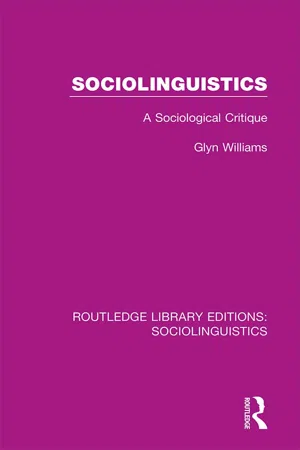
Originally published in 1992. This provocative and controversial book calls for a critical analysis of the philosophical assumptions underpinning sociolinguistics. Going back to the philosophical roots of the study of language in society, it argues that they lie in the consensual attitude to society derived from eighteenth and nineteenth-century social thought. The leading figures in the field are challenged for their unequivocal acceptance of the sociological theory on which they draw. For researchers of language in society, this book emphasises the sociological rather than the linguistic side of the subject.
- 294 pages
- English
- ePUB (mobile friendly)
- Available on iOS & Android
eBook - ePub
About this book
Information
1 Historical antecedents
The end of the eighteenth century and the beginning of the nineteenth century marked a period of considerable turmoil, not only in the world of politics but also in the world of ideas. The discourse on language and society which emerged during this period laid the ground for what is contemporary sociolinguistics. In this opening chapter I intend to survey these antecedents in order to ground the subsequent critical discussion of contemporary work on language and society. In so doing it is necessary to treat ideas as a philosophical discourse so that the inherent logic which holds statements about language and society together in a ‘taken for granted’ manner is made explicit. By so doing it becomes possible to evaluate critically the limitations of any thesis premised upon the background assumptions of such a discourse.
THE IDEA OF PROGRESS
By the end of the seventeenth century the scientific endeavour based upon rational assumptions had been firmly established. Furthermore, humankind was seen as firmly in control of its own destiny, thereby allowing the emergence of debates about the social nature of human endeavour. These developments coincided with the emergence of a distinctive political order in Europe and much of the ensuing discussion focused upon the nature of humankind and its relationship to authority.
Clearly, many of the ideas circulating in Europe during this period derived from Greek philosophy and an awareness of this continuity was responsible for the heavy emphasis upon the idea of progress as a phenomenon that is never ending. This involved two assumptions. First, that knowledge was cumulative, a central proposition of science, and second, that knowledge was equivalent to ability. Thus, by linking these two beliefs, progress was inevitable in that time alone led to a more able society. As we shall see, the second assumption also had profound implications for the legitimation of European superiority in that it served as the basis for comparison within the evolutionary framework.
From the time of Bacon in the seventeenth century the progressive development of knowledge was viewed as natural and normal. It was in the following century that the idea of progress was set in the context of civilisation, with the concept of civilisation involving culture as well as ideas and institutions. This was the inception of linking progress with the idea of social complexity. However, this emphasis did not come to the forefront until the nineteenth century; prior to which the tendency was to relate progress to civilisation. Perhaps it was Leibniz, writing as early as 1697, who was the forerunner of Spencer and Darwin in emphasising that change did not occur in stages but rather was a gradual and cumulative affair. It was Leibniz also who claimed that the future was predictable from a knowledge of the present, much as did Marx, Comte and others in the nineteenth century. This view evidently encompassed the idea that progress is the natural and normal trend of humankind. Yet it was also felt that it relied upon the periodic obliteration of institutions and beliefs which stood in the way. As in any period, these views were in general circulation within the intellectual community, and at about the same time Vico sought to view history as progress in terms of his thesis on the Three Ages of Man.
These views also appear in Kant’s Idea for a Universal History where he presents mankind as proceeding through a steady and progressive evolution towards a state of perfection. As in the futurology of Leibniz, Kant’s work constituted a form of conjectural history that was the forerunner of social evolutionism involving a search for a law of progress, a preoccupation that persisted from the Enlightenment to the nineteenth century. Such a conjectural history allowed Kant to demonstrate the reality of progress while simultaneously seeing evolution as culminating in an inevitable social perfection. This optimistic discourse on mankind was the converse of the prior, pessimistic view of mankind as inherently sinful.
Perhaps the work which tended to foresee the preoccupations of the nineteenth century was Condorcet’s Progress of the Human Mind, published in 1797, in that it was, simultaneously, a statement of belief in never-ending human progress, psychological principles and a preoccupation with an extensive social and cultural history of civilisation. In this he anticipated the work of the nineteenth-century philosophers who took a global perspective on human society and sought to demonstrate that the progress of civilisation rested in the human mind by tracing human evolution from one type of society to another. Thus, he traced the evolution of social organisation from clans, through tribes to ‘modern’ polities. It is here that we witness the equation of progress over time with the idea of an evolving social complexity. This is a theme we shall return to in due course. Condorcet’s conception of human society as a ‘developing’ feature was not restricted to social organisation but also encompassed theories of the origin and evolution of language, writing and the arts which were the diacritica of civilisation, thereby relegating those societies without one or other of these traits to a condition outside civilisation. The ethnocentrism of a view where the highest form is equated with the features of Condorcet’s own society was not considered. It is an idea that culminates in Spencer’s focus on progress as development from a homogeneous to a heterogeneous social form.
Herder placed this theme of progress and social development within the analogy of the life cycle by referring to human progress in terms of stages of child, youth, mankind and old age. By inference, the course of civilisation was seen as childlike thus linking with the belief that progress was hindered by ignorance. Hegel adopted a somewhat similar position later in comparing human progress with a biological analogy involving plant life.
Although many such philosophers conceived of future society in terms of egalitarianism, democracy and a rationality fostered by universal education, they also insisted that conflict served as a motor for progress, claiming that conflict had to be overcome if society was not to stagnate. In a sense this was a statement about an ideal future in terms of the present, since it was claimed that progress was hindered by ignorance, inequality, economic exploitation and religious superstition – the bases of conflict. Yet the French Enlightenment claimed that the state, through legislation, could eliminate any interference to progress thereby making progress a feature inseparable from the polity. The state was to be the custodian and guarantor of cohesion and harmony.
On the other hand, the Scottish moral philosophers doubted that progress based on the accumulation of knowledge could enable one to predict the future. Thus Ferguson stated that he could see no evidence for consistent progress in the history of nations and that the converse of progress was as predictable as progress itself. He was also highly critical of the ethnocentrism of the arguments which saw progress as tied to the superiority of European nations.
It was from these antecedents that the main thrust of evolution as a process emerged during the nineteenth century. The emphasis was on the successive stages through which human society had passed and how the past helped explain the present. It involved a transition between the extremes of primitive and civilised, with the latter seen as superior, thereby allowing the moral philosophers to see part of their goal as ascertaining how to promote development towards a more perfect society. A central feature of this work was the concept of nature in the sense of an uncorrupted condition. It was felt that by looking at the origin of things the true essence or the nature of things could be encountered.
It should be evident that the seeds of nineteenth-century evolutionism had already been sown in the previous century and, indeed, even earlier. No one acknowledged this inheritance more than Comte who stressed his debt to Condorcet, Hume and the Scottish moral philosophers and recognised that his work derived ultimately from Aristotelian philosophy. However, before proceeding to a discussion of the work of Comte and other nineteenth-century social evolutionists including Hegel, Spencer, Morgan and Tyler, it is necessary to consider the important distinction made by Nisbet (1969:161-4), whereby social evolution is distinguished from biological evolutionism, for, even though the social evolutionists did play heavily on the biological analogy, their evolutionism was, in one sense at least, quite different from biological evolutionism. Nisbet (1969:162) emphasises the distinction between biological theory’s standing as a population and statistical theory with organisms and organic phenomena capable of being described collectively only in statistical terms, and the theory of social evolution’s dependence upon typological construction. The typologies tend to be constructed out of social constructs such as social class, kinship, units of culture etc., which are held to be institutional and normative bases of human behaviour. This emphasis upon typological construction is one we will return to time after time in subsequent chapters.
Comte’s work leaned heavily on that of Condorcet, particularly with reference to history as science, which foresaw the ‘progression of the human species’ and the associated belief in the social analyst’s ability to plan the future. The historical perspective allowed an understanding of the central developmental tendencies of social evolution which could be projected to the future:
The aim of every science is foresight. For the laws established by observation of phenomena are generally employed to foresee their succession … it is quite in accordance with the nature of the human mind that observation of the past should unveil the future in politics, as it does in astronomy, physics, chemistry and physiology ... it is clear that knowledge of what social system the elite of mankind is called to by the progress of mankind is called to by the progress of civilisation – knowledge forming the true practical object of positive science – involves a general determination of the next social future as it results from the past.
(Comte 1896:94-5)
This confidence in science was merely a reiteration of Condorcet’s belief that science was to guide and shape social development. A new science, social science, by assimilating the methods of the natural sciences, was to become equally objective, as precise and as predictive.
The observation that there was order with continuity was central to Comte’s views on social evolution. This does not mean that he saw evolution as unilinearly inevitable, for, while he held that change in time was natural or normal, there was also what he referred to as statics. He emphasised that a great mistake among his predecessors was to think in terms of a false dichotomy involving order and change, for if change was natural within a dynamic context, then order existed in change. The driving force of that change was human knowledge. While the principle of order in change was accepted by his successors their understanding of the motor of change differed.
It should be clear that by Comte’s time the idea that evolution was not haphazard, but directional, was well established. Thus Comte envisaged three stages, each characterised by different types of human knowledge which co-varied with the intellectual disciplines. Hegel held similar ideas concerning his spirit of freedom, and Marx’s conception of change involved the same directional inevitability. By and large an air of Eurocentrism prevailed in that the direction of change was inevitably towards the qualities of nineteenth-century Europe. It has been suggested (Peel 1971:198) that conservatives such as Spencer favoured their own societies over all past ages, whereas nineteenth-century social critics such as Comte or Marx saw their own society as merely a stage on the way to a superior form.
Since the main objective of social evolutionists was to discover the provisions for change within the nature or structure of the entity being observed, immanence was inevitable (Nisbet 1969:170). Thus the directional nature of change derived from the inherent forces which engendered growth. Not that change proceeded at a single pace; it could be arrested. In this discussion of an inherent force, once again we witness the analogy with the growth of an organism. Of course, this was no more than an elaboration of what Liebniz had stated at the beginning of the eighteenth century. It was the inner composition of the social system that was the driving force of change, whether it be Marx’s economic laws of motion, or Comte’s laws of social dynamics.
Whereas the eighteenth-century philosophers postulated numerous stages prior to the present, each one seemingly with his own magic number, the nineteenth century witnessed the emergence of a view which merely contrasted the past with the present. Thus this opposition was collapsed into two logically and sociologically contrasting states or types of society. Saint-Simon was an important contributor to such developments, arguing that modern society was the society of production, contrasting with previous society which was preoccupied with power and domination. At the time he was writing the emerging production was industrial production, a period of profound change which affected the way in which the new batch of sociologists interpreted human society. Industrialisation, as a productive process, was accompanied by urbanisation, secularisation and institutional change, as well as by numerous changes in family life, politics and culture, all of which were to be lumped together and referred to as ‘modernisation’. The eighteenth-century philosophers, in pursuing ‘natural history’, rejected any conception of accidental causes of change and adopted an outline of ‘ideal’ states through which society progressed. This led to a focus on the generalised, idealised elements of the society at any one moment in time. Even though a society might only have displayed some elements of the typology, clarity insisted that this was sufficient to fit into the general framework. The emphasis was on the integrating principles of the type, the ordered interrelated patterns that lent meaning to the whole and served to sustain it. This much was also true of the nineteenth-century proto-sociologists with reference to a uniform industrial society as a type. If society was progressive then the converse of industrial society was pre-industrial society.
The tendency to a polarisation involving past and present was presented as a succession of two logically and sociologically contrasting types of society. There are numerous examples: Spencer’s militant and industrial society, Toennies’ Gemeinschaft and Gesell-schaft, Maine’s contrasting social orders involving status and contract, Durkheim’s mechanical and organic solidarity, and Weber’s two forms of rationality. It was a common theme during the nineteenth century. When the polarisation was linked with progress in terms of social complexity, we encounter another of the main concerns of nineteenth-century sociologists – the concern with social breakdown. Of course this did nothing to dent faith in inevitable progress, for it was linked with the idea of adaptation. Progress was seen as an integral part of the change from a state of primitiveness to civilisation.
… whether man has won or lost in this change (from the primitive to the civilisation state) is no longer an open question if one considers the destiny of his species. This consists in nothing less than the progress towards perfection.
(Kant, 1963:60)
The inevitability of progress is clear. One form of civilisation replaces a previous form which was unimproved, as a consequence of which its demise was inevitable. It was a clear expression of the survival of the fittest, a theme to be echoed by later followers such as Hegel and Spencer.
The voices raised against the inevitability of progress were lost in the biological analogies which permeated what has become known as Social Darwinism, and which is most characteristic of the work of Herbert Spencer. Spencer conceived of social changes in terms of evolution, a process which involved the increasing differentiation of society. This differentiation was premised upon the increasing specialisation of functions. Society involved integration, that is, the mutual interdependence of the structurally differentiated parts and the coordination of their functions, an idea which derived from Montesquieu. It is here, together with the work of Comte that we witness the emergence of what later became known as structural functionalism. Social change involved the displacement of mechanical solidarity, and progress involved the integration of the organic solidarity within a new form of the quest for order. It was held that the new, more complex, social organisation required a new form of control. According to Spencer this was evident when a historical dimension was introduced in that there was a temporal coincidence between the emergence of the state as a source of control and the emergence of the idea of the individual and progress.
The biological analogy, characteristic of medieval philosophy and well developed in the ideas of Hobbes, was strong in the work of Spencer. He maintained that societies and institutions competed for living space and that the only ones which survived were those which were able to adapt themselves to the changing environment. If the structural parts of a culture do not adapt to the demands of the environment, the culture will be destroyed by its competitors. The idea of progress as involving the change to a more complex, more differentiated and more integrated society ordained a greater sense of power in the struggle for survival. Thus the more complex society will displace the less complex.
Within this argument Spencer combines the Montesquiean idea of a closely knit interdependence of institutions with the ideas of Comte and Condorcet on progress by postulating a global and permanent trend towards increasing interdependence or integration. As we have seen, Condorcet and other Enlightenment writers emphasised that the progress of civilisation depended upon the accumulation of knowledge. Although Comte did discuss the problem of coherence of social institutions, his main emphasis was similar to that of Condorcet. Their interest was in the development of a social system conducive to moral improvement whereas Spencer was concerned mainly with deducing ethical norms from social evolution. The displacement of the least powerful, be it a social or a cultural group, was the consequence of that very lack of power. The issue of survival of the fittest justified their demise as the price of progress.
This evolutionary perspective which sees progress, not only as inevitable, but also as involving a very specific social form, presents numerous problems. Among them is that the inevitability of the process means that the existing social form will, in time, disappear, because it is inferior in the sense that it is unable to make the adaptive adjustments which constitute progress. It would appear to impose the blame for the disappearance upon the very form which disappears rather than upon that which survives. It becomes a self-justifying prophecy. It is also an inherently conservative perspective in that the function of adaptation is to generate a condition of equilibrium and harmony. Within Spencer’s work there is a tendency to superimpose a typological construction of society, which derived from existing ethnographic work, upon a philosophical conception of society in change. It was essentially an inductive process which created ‘types’. These ‘types’ were labelled in ...
Table of contents
- Cover
- Half Title
- Title Page
- Copyright Page
- Table of Contents
- Foreword by Joshua Fishman
- Preface
- Introduction
- 1 Historical antecedents
- 2 Parsonian structural functionalism
- 3 Speech variation
- 4 Language contact
- 5 Language planning
- 6 Conversation analysis
- 7 The ethnography of communication
- 8 Ethnolinguistic vitality
- 9 Conclusion
- References
- Index
Trusted by 375,005 students
Access to over 1.5 million titles for a fair monthly price.
Study more efficiently using our study tools.
Frequently asked questions
Yes, you can cancel anytime from the Subscription tab in your account settings on the Perlego website. Your subscription will stay active until the end of your current billing period. Learn how to cancel your subscription
No, books cannot be downloaded as external files, such as PDFs, for use outside of Perlego. However, you can download books within the Perlego app for offline reading on mobile or tablet. Learn how to download books offline
Perlego offers two plans: Essential and Complete
- Essential is ideal for learners and professionals who enjoy exploring a wide range of subjects. Access the Essential Library with 800,000+ trusted titles and best-sellers across business, personal growth, and the humanities. Includes unlimited reading time and Standard Read Aloud voice.
- Complete: Perfect for advanced learners and researchers needing full, unrestricted access. Unlock 1.5M+ books across hundreds of subjects, including academic and specialized titles. The Complete Plan also includes advanced features like Premium Read Aloud and Research Assistant.
We are an online textbook subscription service, where you can get access to an entire online library for less than the price of a single book per month. With over 1.5 million books across 990+ topics, we’ve got you covered! Learn about our mission
Look out for the read-aloud symbol on your next book to see if you can listen to it. The read-aloud tool reads text aloud for you, highlighting the text as it is being read. You can pause it, speed it up and slow it down. Learn more about Read Aloud
Yes! You can use the Perlego app on both iOS and Android devices to read anytime, anywhere — even offline. Perfect for commutes or when you’re on the go.
Please note we cannot support devices running on iOS 13 and Android 7 or earlier. Learn more about using the app
Please note we cannot support devices running on iOS 13 and Android 7 or earlier. Learn more about using the app
Yes, you can access Sociolinguistics by Glyn Williams in PDF and/or ePUB format, as well as other popular books in Languages & Linguistics & Linguistics. We have over 1.5 million books available in our catalogue for you to explore.