Originally published in 2001, Forming the Academic Profession in East Asia, examines the changing shape of the academic profession in South Korea, Malaysia and Singapore since the colonial period, and as a reflection of both the inherited models of higher education and their redefinition after the colonial period. The analysis takes into account the connections and disconnections between the colonial and postcolonial periods in shaping the academic profession.
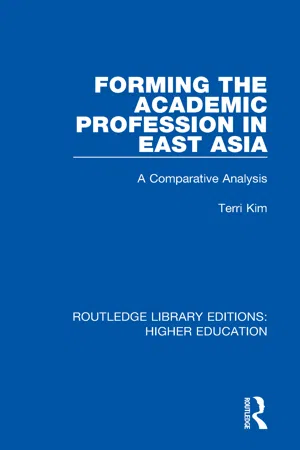
- 354 pages
- English
- ePUB (mobile friendly)
- Available on iOS & Android
eBook - ePub
About this book
Information
CHAPETR ONE
Introduction
The purpose of this book is to examine comparatively the formation of the academic profession in Korea and Malaya (and later South Korea, Malaysia and Singapore) from colonial times. The main argument is that the academic professions in these places have been affected by their colonial genesis and by the particular State formations in the three East Asian countries. The comparative analysis of this book thus takes account of the connections and disconnections between the colonial and postcolonial periods in the shaping of the academic profession.
The initial proposition of the book is that the Western notions of the ‘idea’ of the university, of the State and of the academic profession are not always appropriate ways in which to approach East Asia.1 Part of the work of the book is to show why this is so, starting with the colonial period in Korea and Malaya. However, this book is not in itself an historical narrative.
This book is a comparative inquiry into the relations of the State and the university which define some of the dynamics of the social construction of the academic profession in the three countries. By investigating the different formations of the State and relations of the State and the University at different times, the book attempts to locate comparatively the forces shaping the academic profession in these countries.
To create its analytic frame—the theme of ‘the shaping’ of the academic profession—the book critically assesses the concept of the academic profession as this is treated in the existing literature, establishes ideal typical models of the university (through the writings of Newman and Jaspers and Confucius), looks at conventional views of the East Asian State, and by the end of Chapter Two sets out a way to think about the shape of the academic profession, without imposing on the analysis some of the assumptions made in the classic and recent literature on professions.
Chapter Three analyses the emergent academic profession in Korea and Malaya, in the context of Japanese and British colonial policies. The colonial political, economic and cultural milieux in Korea and Malaya define variations in, and close some of the options for, the formation and the subsequent shape of those two academic professions.
Chapter Four looks at the academic profession in the postcolonial period, within the processes of decolonisation and ‘indigenisation’. (Indigenisation is here taken to mean the political processes by which each State redefined the national culture against colonial legacies in a postcolonial context.) Subsequently, all of these three East Asian States have recently taken up the theme of ‘internationalisation’ of higher education and this theme is also incorporated in the analysis.
Thus the themes that run through the book are: (i) the continuing cultural legacy of the pre-colonial and the colonial origins of what became the academic profession in the post-colonial period; (ii) the role of the East Asian States as actors in defining, legitimating, and implementing the political, economic and cultural contexts within which the academic profession was shaped in the postcolonial indigenisation process; and (iii) the challenges of internationalisation and globalisation as contemporary influences on the academic profession.
The book, in its closing argument, will analyse the overlap and contradiction of the various State projects in the colonial and postcolonial shaping of the academic profession, including the redefinition of imported models of the university, and the consequent ‘peculiar’ shape(s) of the academic profession in these East Asian countries.
The next chapter will begin the task of sorting out ways to think about the social construction of the academic profession in the countries selected for analysis. However, before that effort at rethinking begins, it is important to explain why existing approaches in the literature are not, simply and directly, incorporated into the book.
There is a considerable literature on the academic profession in general, but the book begins in disappointment with this literature, notably with the Carnegie Commission Report and subsequent analyses of the Korean academic profession. Perhaps, as in most books, there is also a personal element. My own family for several generations has included academics. Currently, both my parents are academics. The conventional literature on the academic profession seems to me to capture little of the anxieties, tensions and social struggles within which the academic profession in South Korea, at least, has been formed.
So the book begins in both professional and personal curiosity about the social contexts, the political power, and the economic forces which have shaped the academic profession in different places. Is it really the case that the academic profession is everywhere becoming the same (‘converging’)? Is it really the case that university academics everywhere are working within the same ‘idea of the university’, although this is now under pressure from ‘the market’? Is it really the case that these East Asian governments, as in North Western Europe (with some exceptions) or North America, have respected academic autonomy and freedom? And even if the academic profession is under pressure to be ‘relevant and useful’, why is this so and what does ‘relevant and useful’ mean in particular times and places? Thus, the first issue in the book—reviewed in the remainder of this chapter—is what theoretical purchase does the existing comparative literature offer to clarify such puzzles about the academic profession? How useful and relevant in theoretical terms is the existing literature for examining the academic profession in the context of East Asia, especially during the times when the academic professions were in process of formation?
It will be suggested that some of the best existing analyses of the academic profession in the literature are not directly useful for this book.
The existing literature has examined the academic profession within the general concept of profession as this has been constructed in Western sociology. In the existing sociological literature on ‘professions’, ‘a profession’ is often specified through criteria such as cognitive base, institutionalised training, licensing, work autonomy, collégial control over entry and exit, and codes of ethics.2 For example, according to Myron Lieberman, a profession “performs a unique and essential social service; is founded upon intellectual techniques; has a long period of specialised training; offers a high degree of autonomy both to the individual practitioner and to the occupational group as a whole; accepts responsibility for judgements made and acts performed within the scope of professional autonomy; puts emphasis upon the service it performs rather than the economic rewards that the practitioner gets; is a self-governing organisation of practitioners, and finally operates on the basis of a code of ethics.”3
However, it is important to be clear, immediately, that this book is not asking and answering the question of whether “academics” constitute ‘a profession’ in such a traditional sociological sense.4 In other words, this book does not set out to utilise as a tertium comparationis such a standard concept of profession. Such models are normally static and distract attention from the question of the dynamics of the construction of professions. Even where there has been some effort to tackle the issue of power, and to locate the State and its role in the construction of the professions, the work has remained at a high level of abstraction and does not close down the issue comparatively and descriptively.5
The existing literature on the academic profession itself falls into two groups. One group uses an explicit comparative approach.6 The other group offers case studies e.g. of America or of Britain, with implicit implications for comparison.
Most comparative analyses of the professions in the existing literature focus on Anglo-American and European examples and Anglo-American issues. These local issues have been extended to the international level to conduct “comparisons”; for example, by academics in books, and by major agencies such as the Carnegie Foundation, the Rockefeller Foundation, and the Organisation for Economic Cooperation and Development (OECD).7 Among the analyses by academics8, P. G. Atbach wrote on the academic profession as early as the 1970s, in his Comparative Perspectives on the Academic Profession.
The book deals with eight cases: Britain, Italy, Japan, Australia, Canada, Latin America, India and North America.10 The rationale for selecting these countries is not explained. There is no common conceptual framing for the analysis of the national academic professions. Nor is there any suggestion of the need to conceptualise the academic profession differently in Asia, Europe, Latin America and North America.11
The main analytic theme of the volume is the Anglo-American concern with “academic drift” in the 1960s and 1970s, a period marked by rapid expansion of higher education in many countries.12 The main issues identified in the book are that “...general economic problems have caused governments to cut back on funding for universities. Demographic and economic factors have caused a downturn in enrollment in the industrialised nations”.13 The issues regarded as central in this book thus stem primarily from Anglo-American contexts and concerns.
The book makes no effort to synthesise the issues discussed in each chapter in a comparative conclusion, a point which Altbach, as Editor, notes in his Introduction:
Comparative analysis of higher education in general and of the academic profession in particular is rare, and difficult to undertake because of the many national differences involved and the expense of such research (see Altbach, 1977). The chapters in this volume are case studies of sjpecific countries, and it is left to the reader to discern relevant comparison [sic].14
Thus, the book offers little, conceptually and descriptively, for the comparative analysis of the formation of the academic profession in other social contexts and other times.
Similarly, Burton Clark’s comparative discussion in The Academic Profession: National, Disciplinary, and Institutional Settings15 is limited to northwestern Europe and the United States. The countries in this volume are the United Kingdom, the Federal Republic of Germany, France and the United States. The rationale is that they are considered “the major international centres of learning”. Although Burton Clark indicates that this book is an international comparison to explore the variety and uniformity of the academic profession, the main emphasis in the text is on the enormous variety in “American higher education”.16 The conceptual apparatus used for the comparative analysis of the academic profession in this book is based on three categories: nation, discipline and institution.17 However, they are used only to analyse the structural foundations of the Western academic profession in the 1980s.18 The book does not cover a wide range of time and space—and does not consider East Asia.
Among the work by the agencies, a wide-ranging comparison of the academic profession was made by the Carnegie Foundation in 1994 in its Report, The Academic Profession: an International Perspective. The fourteen countries included in the survey were Australia, Brazil, Chile, Germany, Hong Kong, Israel, Japan, (South) Korea, Mexico, the Netherlands, Russia [sic], Sweden, the United Kingdom, and the United States.19 The point of the comparison:
... was to learn more about the condition of the professoriate from a larger perspective and, in the process, define priorities that could strengthen the academy worldwide....The result is, we believe, the most comprehensive view of the professoriate available today [1994].20
The Carnegie Foundation Report offers contemporary portraits of the academic profession in these fourteen countries through seven major themes: (i) the individual national contexts of the institutional framing of the professoriate; (ii) access to higher education; (iii) professional activities; (iv) working conditions of faculty; (v) governing the academy; (vi) higher education and society; and (vii) the international dimensions of academic life. Within these seven themes, the information provided in this report is analysed in two categories: (i) variations (e.g. on student access, teaching and research, and support for academic freedom) (ii) similarities among faculty (e.g. the need for better methods of evaluating teaching, a commitment to service to help solve societal problems, as well as concern over the governance of higher education).21 The Carnegie Foundation survey offers, in these categories, substantial descriptions of the academic profession in the fourteen countries.
However, the weakness of the Report is its lack of theoretical foundation. The Report discusses differences and similarities among the participating countries on issues such as salary, job satisfaction, means of governance and evaluation. The Carnegie Foundation Report is concerned with the socio-psychological aspects of academic life, on the assumption that there are common characteristics of the academic profession across different cultures.22
This is empirical research—a survey—without an account of why the seven themes were selected. The Carnegie Foundation research does not provide a new typology of the academic professions in different countries and different time periods, nor does it provide a theoretical analysis of the “changing shape” of the academic profession in the respective countries. For the purposes of this book, the comparative usefulness of the Carnegie Foundation Report is mainly in its statistical information about the academic profession in 1994 in South Korea and in other participating countries.23
The Carnegie Report was however influential. It affected the work of Sungho Lee24, U. Teichler and F. Van Vught25; and the recent work of Anthony Welch, on the academic profession.26 The work of Van Vught and Teichler concentrates primarily on Europe.27 The work of Welch, however, is more interesting as he raises fresh concerns, although the work by no means solves the problem of how to look at the academic profession in East Asia.28
In the Special Issue of Higher Education: the International journal of Higher Education and Educational Planning which he edited, Welch stresses in his editorial introduction the changing pedagogical traditions in the contemporary university.29 He points out new relationships between teacher and learner, following the massive growth of higher education and the introduction of new technology in higher education.30 Welch also edited another Special Issue on the academic profession (Comparative Education Review Vol. 42, No. 1, February 1998).31 In the first article, The End of Certainty? The Acade...
Table of contents
- Cover
- Half Title
- Title Page
- Copyright Page
- Original Title Page
- Original Copyright Page
- Dedication
- Table of Contents
- Foreword
- Preface
- List of Tables
- Chapter One: Introduction
- Chapter Two: Ideal Typical Models
- Chapter Three: The Colonial Period
- Chapter Four: The Postcolonial Period
- Chapter Five: The Conclusion
- Bibliography
- Index
Trusted by 375,005 students
Access to over 1.5 million titles for a fair monthly price.
Study more efficiently using our study tools.
Frequently asked questions
Yes, you can cancel anytime from the Subscription tab in your account settings on the Perlego website. Your subscription will stay active until the end of your current billing period. Learn how to cancel your subscription
No, books cannot be downloaded as external files, such as PDFs, for use outside of Perlego. However, you can download books within the Perlego app for offline reading on mobile or tablet. Learn how to download books offline
Perlego offers two plans: Essential and Complete
- Essential is ideal for learners and professionals who enjoy exploring a wide range of subjects. Access the Essential Library with 800,000+ trusted titles and best-sellers across business, personal growth, and the humanities. Includes unlimited reading time and Standard Read Aloud voice.
- Complete: Perfect for advanced learners and researchers needing full, unrestricted access. Unlock 1.5M+ books across hundreds of subjects, including academic and specialized titles. The Complete Plan also includes advanced features like Premium Read Aloud and Research Assistant.
We are an online textbook subscription service, where you can get access to an entire online library for less than the price of a single book per month. With over 1.5 million books across 990+ topics, we’ve got you covered! Learn about our mission
Look out for the read-aloud symbol on your next book to see if you can listen to it. The read-aloud tool reads text aloud for you, highlighting the text as it is being read. You can pause it, speed it up and slow it down. Learn more about Read Aloud
Yes! You can use the Perlego app on both iOS and Android devices to read anytime, anywhere — even offline. Perfect for commutes or when you’re on the go.
Please note we cannot support devices running on iOS 13 and Android 7 or earlier. Learn more about using the app
Please note we cannot support devices running on iOS 13 and Android 7 or earlier. Learn more about using the app
Yes, you can access Forming the Academic Profession in East Asia by Terri Kim in PDF and/or ePUB format, as well as other popular books in Education & Education General. We have over 1.5 million books available in our catalogue for you to explore.