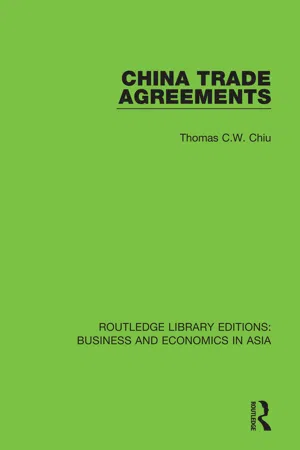
This book, first published in 1988, examines the nature of trade agreements with Chinese companies, and is divided into three parts which are arranged in accordance with the stages of development: from a trade talk to the final stage of a contract. At the time, China trade was mainly a kind of trade involving China traders and respective Chinese authorities, as Chinese businessmen were government officials. For this reason, paperwork such as the Memorandum of Discussion and Letter of Intent, while of no legal binding effect, were of vital importance to the trade system.
- 336 pages
- English
- ePUB (mobile friendly)
- Available on iOS & Android
eBook - ePub
About this book
Information
INTRODUCTION
China, under the leadership of Deng, is approaching an era of multinational business transactions. China trader is no longer a terminology that appears to be alien in the business world. Since 1979, many China trade agreements have been signed to mark the milestone of China's Open Door Policy.
Unlike those of the outside world or her trading counterparts, China's legal system, as lots of China traders have complained, is incomplete and cannot adapt to the international trading system. The worst thing is the 1981 promulgation of Provisional Regulations of Lawyers that hampered foreign lawyers (including lawyers of Chinese origin but not being a Chinese national) from practising in China and giving advice to their clients engaged in China trade. However, this does not necessarily mean that nothing can be done about this. An experienced businessman will try various methods to get around this hurdle and prevents oneself from trading with China without legal protection. This feeling or trend is more or less shared by those international lawyers, in fact, I would rather call them flying lawyers. Legal advice and support are indoubtedly valuable but not every China trader will need a lawyer from a stage as early as a simple trade talk or to enter into Letter of Intent with trading counterparts. For this reason, this book is compiled to suit this need.
Lawyers and anyone who render professional services to clients engaging in China trade will also find this book a must for their reference.
The agreements or their preliminary forms (e.g. Memorandum of Discussion, Letter of Intent) in this book were compiled and rewritten with reference to those agreements signed since 1979. Although these agreements do not cover every area of China trade, readers and/or China traders may modify some of the wordings in an individual agreement which they are going to sign and is of similar nature to the sample agreements lister in this book.
In order to provide background knowledge about Commercial Contract practice in China, I have listed have under full tent of “Foreign Economic Contract Law of the PRC” which was adopted at the Tenth Session of the Standing Committee of the National People's Congress on March 21, 1985.
The Law
Chapter 1 : General Provisions
Article 1: The Law is enacted with a view to protecting the lawful rights and interests of the concerned parties to foreign economic contracts and promoting the development of China's foreign economic relations.
Article 2: This Law applies to economic or trade contracts (hereinafter referred to as Contracts), but exclusive of international transport contracts, concluded between enterprises or other economic organizations of the People's Republic of China and foreign enterprises and other economic organizations or individuals.
Article 3: Contracts should be made in conformity with the principles of equality and mutual benefit, and of achieving unanimity through consultations.
Article 4: Contracts must be made in accordance with the law of the People's Republic of China and should not be prejudicial to the public interests of society of the People's Republic of China.
Article 5: The parties to a foreign trade contract may choose the law applicable to the settlement of disputes arising over the contract. In the absence of such a choice by the parties concerned, the law of the country which has the closest connection with the contract applies.
The equity of contractual joint venture contracts and the contracts of cooperative exploration and development of natural resources which are performed within the territory of the People's Republic of China must be governed by the law of the People's Republic of China.
In case no relevant provision is stipulated in the law of the People's Republic of China, international practice may apply.
Article 6: When a provision in a certain international treaty, which the People's Republic of China has concluded or participated in, concerning contracts, is different from those stipulated in the law of the People's Republic of China, the provision of the international treaty applies, with the exception of clauses that the People's Republic of China has publicly stated its reservation.
Chapter II : Formation of Contract
Article 7: A contract is established when the terms of the contract are aggreed upon in writing and signed by the parties to it. However, where an agreement is reached through correspondence by mail, cable or telex and one party requests that a confirmation letter be signed, the contract is established when the confirmation letter is signed.
Contracts subject to approval by the state as stipulated by the law or administrative regulations of the People's Republic of China shall be established only when the approval is granted.
Article 8: All appendices stipulated in a contract are an integral part of that contract.
Article 9: Contracts that violate the law or the public interests of the People's Republic of China are invalid.
In case where provisions of a contract are found to be inconsistent with the law or the public interests of the People's Republic of China, the validity of the contract is not derogated after the said provisions are nullified or revised through consultations by the parties to the contract.
Article 10: Contracts concluded by means of fraud or under duress are invalid.
Article 11: The payty who is responsible for the invalidity of the contract is obligated to pay the other party concerned a sum equal to the loss arising from the invalidation of the contract.
Article 12: In general, the following terms should be included in a contract:
(1) name and address, nationality, place of business or domicile of the parties;
(2) date and place where the contract is signed;
(3) type of contract, and the kind and scope of the subject matter of the contract;
(4) technical conditions, quality, standard, specifications and quality of the subject matter of the contract;
(5) time limit, place and method of performance;
(6) terms on price, amount and way of payment and various incidental expenses;
(7) whether the contract can be assigned of the terms and conditions for assignment;
(8) damages and other liabilities for breach of contract;
(9) ways for settlement of disputes when disputes arise over contract;
(10) language to be used in the contract and its effectiveness.
Article 13: The limits of risks borne by each party for the subject matter to be performed should be specified in the contract depending on the situation, and the range of insurance for the subject matter should also be specified when necessary.
Article 14: With regard to a contract that needs to be performed continuously over a rather long period, the parties shall set the time limit for the contract, and conditions for extending or terminating the contract before expiration.
Article 15: A guaranteeclause may be agreed upon by the parties in the contract. The guarantor assumes the liability within the agreed scope of guarantee.
Chapter III : Performance of Contract and Liabilities for Breach of Contract
Article 16: Once established in accordance with law, a contract is legally binding. The parties should fulfill all obligations stipulated in the contract. No party should arbitrarily alter or terminate the contract.
Article 17: A party may suspend performance of his obligations when it is proved by conclusive evidence that the other party cannot perform his obligations accordingly, but in so doing the other party must be promptly notified. When the other party provides full guarantee for performing his obligations, contract performance shall be resumed. A party who suspends his performance without furnishing conclusive evidence should assume the liability for breach of contract.
Article 18: When a party fails to perform, or his performance does not conform to the agreed contractual obligations, namely, the contract is breached, the other party is entitled to ask the party in default to adopt reasonable remedial measures or claim for damages. If the losses suffered by the other party are not paid in full after the remedial measures are taken, that other party retains the right to claim for damages.
Article 19: Damages for breach of contract by a party consist of a sum equal to the loss suffered by the other party as a consequence of the breach. However, the damages may not exceed the loss which the party in breach ought to have foreseen at the time of the conclusion of the contract as a possible consequence of breach of the contract.
Article 20: The parties may agree upon in a contract that a certain amount of liquidated damages shall be paid to the other party if one party violates the contractual obligations, and may also agree upon a method for calculating the damages arising over such a breach of contract.
The liquidated damages shall be regarded as damages caused by a breach of contract. However, if the fixed amount of the liquidated damages is substantially more or substantially less than the resultant loss, the parties may request a court or arbitration agency to have it appropriately lowered or increased.
Article 21: In case both parties are in breach of the contract, both parties shall bear the relevant losses in accordance with the responsibilities due to them.
Article 22: A party who suffers a loss arising from a breach of contract by the other party should take appropriate measures in time to prevent the loss from aggravating. If he fails to take such measures and consequently aggravation of the loss results, he shall lose the right to claim damages for the aggravated part of the loss.
Article 23: If a party fails to pay at the appointed time the amount agreed upon in the contract or any other amount related to the contract that should have been paid, the other party is entitled to payment of principal plus interest for the delay. The rate of interest and how it should be calculated may be specified in the contract.
Article 24: A party should be exempted from his obligations in whole or in part in case he fails to implement all or part of his obligations as a result of force majeure.
In case a party cannot perform his obligations within the time limit set in the contract due to force majeure, he should be relieved of the liability for late performance for the period during which the consequence of the force majeure is being felt. Force majeure means an event which the parties cannot foresee at the time of conclusion of the contract and whose occurrence or consequences the parties can neither avoid nor overcome. The range of force majeure may be specified in the contract by the parties.
Article 25: The party who fails to perform, in whole or in part, t...
Table of contents
- Cover
- Half Title
- Title Page
- Copyright Page
- Original Title Page
- Original Copyright Page
- Dedication
- Table of Contents
- Preface
- Acknowledgements
- Introduction
- Appendices
Trusted by 375,005 students
Access to over 1.5 million titles for a fair monthly price.
Study more efficiently using our study tools.
Frequently asked questions
Yes, you can cancel anytime from the Subscription tab in your account settings on the Perlego website. Your subscription will stay active until the end of your current billing period. Learn how to cancel your subscription
No, books cannot be downloaded as external files, such as PDFs, for use outside of Perlego. However, you can download books within the Perlego app for offline reading on mobile or tablet. Learn how to download books offline
Perlego offers two plans: Essential and Complete
- Essential is ideal for learners and professionals who enjoy exploring a wide range of subjects. Access the Essential Library with 800,000+ trusted titles and best-sellers across business, personal growth, and the humanities. Includes unlimited reading time and Standard Read Aloud voice.
- Complete: Perfect for advanced learners and researchers needing full, unrestricted access. Unlock 1.5M+ books across hundreds of subjects, including academic and specialized titles. The Complete Plan also includes advanced features like Premium Read Aloud and Research Assistant.
We are an online textbook subscription service, where you can get access to an entire online library for less than the price of a single book per month. With over 1.5 million books across 990+ topics, we’ve got you covered! Learn about our mission
Look out for the read-aloud symbol on your next book to see if you can listen to it. The read-aloud tool reads text aloud for you, highlighting the text as it is being read. You can pause it, speed it up and slow it down. Learn more about Read Aloud
Yes! You can use the Perlego app on both iOS and Android devices to read anytime, anywhere — even offline. Perfect for commutes or when you’re on the go.
Please note we cannot support devices running on iOS 13 and Android 7 or earlier. Learn more about using the app
Please note we cannot support devices running on iOS 13 and Android 7 or earlier. Learn more about using the app
Yes, you can access China Trade Agreements by Thomas C.W. Chiu in PDF and/or ePUB format, as well as other popular books in Politics & International Relations & Asian Politics. We have over 1.5 million books available in our catalogue for you to explore.