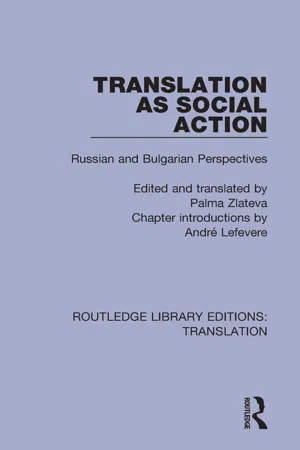
Originally published in 1993, Translation as Social Action is a varied collection of essays, which addresses translation as social action as its central theme, the book proposes a model of the translator as an agent in his or her own right. Translation is seen not just as a transfer of meanings from one language to another, but rather as an arena in which different cultures meet in the person of the translator. This perspective provides a complete contrast to Western translation studies, concerned with whether or not translation is really possible. Together the essays reveal a distinct tradition grappling with the most important topics in translation studies in ways that are different and challenging. The collection is essential reading for translation studies, as well as providing an interesting perspective on comparative literature and Eastern European studies.
- 138 pages
- English
- ePUB (mobile friendly)
- Available on iOS & Android
eBook - ePub
About this book
Information
Chapter 1
Categories for the study of translation
Anna Lilova
The categories proposed in the essay that follows may strike the reader as somewhat grandiose, or even chimeric, but this reaction itself is symptomatic of a fundamental problem in the study of translation in the West and, to a lesser extent, also still in the East.
Lilova points out, and rightly so, that translation is the product of history, not science. In other words, translation arose in response to specific social, historical, and cultural demands. Translations have been produced for centuries in Europe, but because the activity of translating as such has never been able to claim a relatively high social status, the study of translation has rarely been institutionalized in the educational programs of the very countries that produced translations over the centuries.
Because the production of translations has never been held in high esteem in the West, the study of both the process and the product has been relegated to the margins of educational institutions. There are many departments of language, linguistics, and literature in the universities of Eastern and Western Europe and the Americas, but very few departments of translation studies.
This situation has not changed much since translation studies as a discipline began to come into its own about ten to fifteen years ago. Translation studies is therefore still a discipline without an institutional base. This, more than anything else, explains the categories proposed here and the grandiose schemes in which they are embedded in similar essays written by translation scholars in East and West: they are born of frustration to no small extent. They are, if you will, radically and unrepentingly nominalist: by building up a viable discipline in words, they hope to somehow conjure up the institutional support for those words.
They have never been very successful in doing so, and this very fact opens up another debate: is it necessary to establish an independent “megadiscipline” of translation studies, complete with all the trappings of the trade, or is it more realistic to view translation studies as a concept that can be studied within existing disciplines and their institutional bases? The debate is by no means over.
A. L.
Translation is a multilevel and multilateral phenomenon, each aspect of which is just as important as any other. Any reduction of the complexity, any subordination of one aspect to another, would widen the gap between our knowledge of translation and the actual phenomenon of translation itself. The generic notion of “transla-tion” covers such drastically distinct forms of translation as oral translation (interpretation), written translation, machine translation, literary translation, scientific, technical, and socio-political translation. Translation has linguistic, literary, aesthetic, psychological, and other characteristic features. They should all be taken into consideration in any study of translation.
The system of different types of translation has evolved historically in the process of the social and spiritual development both of mankind as a whole and of every separate country and people in particular. In other words, the system of translation as an entity, made up of different forms, types, and genres, is the product of history, not the product of science, and it develops in the context of history which makes it richer and more perfect. Therefore, the historical category should play a basic part in the study of the system and the clarification of its typological problems. The system of the various forms of translation is an objective historical entity, governed by laws, because it is the very flow of human history that brought the forms of translation, both oral and written, to life.
The system of the various forms of translation is a dynamic one. When sound was added to the silent movie, film translation was born with its specific artistic and cinematographic demands, such as the synchronization of dialogue and its coordination with the action that takes place on the screen. Film translation was followed by translation for television with its own specific demands tailored to the small screen.
In my opinion, the functional category should also play a basic part in any attempt to study translation. Undoubtedly the system of translation has been shaped in history as a whole and in the development of separate nations according to the social needs, artistic (in all their variants), scientific, technical, political, and others depending on the social functions of translation. The process of differentiation of the types of translation is the result of continuous and stable social needs. Certain types or genres of translation may lose their significance or change their function as the social or individual need for them dies out. That is why any approach to the study of translation should be based on the historical and social concept of culture as a whole. We should relate the process of appearance, development, and disappearance, of differentiation and unification of the various forms, types, and genres of translation to functional needs and national prerequisites.
The next category, which I shall conventionally call the genetic one, addresses the genetic connection between the typology of translation and the typology of original literature. To ignore this obvious connection would be both baseless and wrong. It is only too clear that the various types of translation, though relatively autonomous, are not formed independently and in isolation from the types and genres of the originals they attempt to translate.
The genesis and development of the system of different kinds of translations and its typology is a function of the mutual cultural ties among peoples. The interaction between the system of various kinds of original texts and that of translations as an integral part of the mutual relations between two cultures is not mechanical in nature. It is a process that takes place either directiy, as a result of the interaction between two given cultures, or indirectly, with a third culture acting as a mediator between two other cultures. This process is characterized by numerous tendencies and phenomena, which accounts for the complexity and even delicacy of the genetic ties between translation typology and the typology of the original literature.
Another category, just as important, in my opinion, for the study of translation, is that of structure and content. To grasp the specific nature of the forms, types, and genres of translation we should first of all analyze the translated text, its structure and its content, and ask ourselves the following three questions: (i) What does this text express or contain? (ii) Who is it meant for? (iii) For what purpose is it translated?
In spite of all the positive features of structural analysis I believe that, no matter what the structure of the translated text is, it does not exist by itself as an abstract, static value. Rather it is connected both to the original, which belongs to a given historical and social context, and to its own new social, cultural, and linguistic reality.
A psychological category is also needed in the study of translation. This covers translation as a whole, both in the manner of its production and in the manner of its reception, the specific work the translator does in various forms, types, and genres of translation, and the degree of creativity characteristic of each of them.
The degree of creativity in different genres and forms of translation plays a very important part in the study of translation. The laws defining translation as a specific creative act are objective in character. Let us take translation on the level of language, for instance, even though the levels of talent, erudition, and general culture are also extremely significant. The whole transition from the primary verbal text of the original to the newly created secondary text of the translation is an activity connected with language. Unlike a literary text, in which the expressive potential of the form – the language – strongly resists the translator’s efforts, a scientific text is not as sensitive to form. The Bulgarian scholar A. Lyudskanov was therefore right to remark on the existence of regulated and non-regulated choices in the translation process. The different degrees of resistance of the verbal material are responsible for the typological and generic discrimination between literary and non-literary translation (Lyudskanov 1967).
Shveitser also pointed out that “the creative and the non-creative beginning is present in every type of translation; they are closely interwoven, even though their distribution changes according to the genre of translation” (1973: 18).
Creative moments exist in all forms of translation, but if we take the specific character of the literary text into account we cannot deny that the level of creativity in literary translation is higher indeed. Creativity in translation should, in my opinion, be understood as (i) creativity on the level of language (which can therefore be present in all types of translation) and (ii) creativity on the level of artistic and imaginative thinking and recreation.
The specificity of literary translation would therefore appear to lie beyond the limit of linguistic creativity which is present in all forms, types, and genres of translation. This implies that we also leave the sphere behind in which all variations of translation begin: the sphere of language, since language cannot fully account for the process of translation and its results. The difference between the language of literature and that of science is not just a difference of form but also a difference of content. This difference in turn demands different ways of shaping the original, and of reshaping it in translation.
This brings us to the basic and most important category in the study of translation: the linguistic category which includes the specific nature of languages, the peculiarities of linguistic means of expression, of lexical and phraseological elements, of grammatical forms and syntactic constructions, and of the different styles connected with different types of genres of translation.
Why do I select the linguistic category as one of the major categories underlying any study of translation? Because of the basic and indisputable fact that language is the building material, the tangible entity present in both original and translation. Consequently, this principle reflects the real linguistic characteristics and peculiarities of literary, scientific, and socio-political translation which in their turn represent the basic qualities and distinguishing features of the various types of translation.
This does not mean, however, that the linguistic category should be the only category on which distinctions between the different types and genres of translations are to be based. In fact, this is precisely the weakness of many current typologies, in particular those elaborated by Katharina Reiss and Hans J. Vermeer. Exclusive reliance on this category is, in my opinion, both methodologically and factually wrong, simply because no single category, no matter how important, can exhaust the complex nature and systematicity of translation as a specific social, cultural, and creative activity.
The basic categories enumerated above should be supplemented by a number of additional features that play their part in the differentiation of forms, types, and genres of translation. Such features are the physical peculiarities of the language of the written translation, which has a fixed dimension and exists in time, as well as the various ways in which receivers (readers or listeners) perceive the translated text through the intermediary of various senses, as in the case of visual, audio-visual, or auditory translation.
WORKS CITED
Lyudskanov, A. (1967) Prevezhdat chovekat i mashinata [Man and Machine Translate], Sofia: Nauka i izkustvo.
Reiss, K. (1976) Texttyp und Übersetzungsmethode, [Texttype and Translation Method], Kronberg: Taurus.
Reiss, E.L. and Vermeer, H.J. (1984) Grundlegung einer allgemeinen Translationstheorie [The Foundation of a General Theory of Translation], Tübingen: Niemeyer.
Shveitser, A. (1973) Perevod i lingvistika [Translation and Linguistics], Moscow: Voenizdat.
Chapter 2
Essential features and specific manifestations of historical distance in original texts and their translations
Iliana Vladova
Time is an important factor in translation. It makes re-translations of already translated texts necessary, but it also makes internal translations necessary, that is, translations within the same language, from one historical period (say, the medieval period) to another (say, the modern period). But time can also be manipulated by authors of original texts. They may go back to an older stage of the language and weave it into their text for all kinds of reasons. Similarly, they may also refer to things or concepts no longer current in their own time.
The translation of these archaizing elements in the original poses a problem. If they are simply leveled in the translation, that is, if they are translated into the same stage of the target language as the rest of the text, they obviously will no longer achieve any effect at all. Yet, what stage of the target language could be said to be “equivalent” to the stage of the source language the original author weaves into the original text? Or what things and concepts contemporary in the translator’s world can be said to be “equivalent” to the things and objects no longer contemporary in the writer’s world when he or she wrote the original?
These features of translation make “theorists” uneasy, especially theorists who think of translators as “transparent rule-following mechanical entities,” because they highlight aspects of the original text that will always point to the “translatedness” of the translation. No matter what solution the translator provides, it will inevitably draw the reader’s attention to the fact that he or she is reading a translation that is the result of the process of the labor of one or more individuals, and this will undermine, or even destroy altogether, the cherished illusion of the “transparent” translation.
And once translation is no longer perceived as routinely transparent, it runs the risk of being thematized as problematic beyond the charmed circle of translation scholars.
Russian and Bulgarian scholars of translation have probably been confronted with this problem more often than their colleagues in the West because of the avowed cultural policy of the Soviet state that called for the classics of the non-Russian republics to be translated into Russian. Translators were forced to think about the matter in more detail and to come up with their own solutions.
A. L.
The term “historical distance” is not unambiguous. Translation theorists tend to invest it with different meanings, expanding or contracting its radius of application as they do so. They also devise different approaches to the solution of the problem of distance in time manifested in works of fiction.
The most generally held normative assumption wants a translator to reveal and stress the historical setting of the original as much as possible (Antokol’skij et al 1955: passim). This assumption can be considered axiomatic for every adequate literary translation, but the features that constitute the historical specificity of the original differ in nature.
In his long article “Distance in time and translation” devoted to Russian translations of Benjamin Constant’s Adolphe, Jakobsen’s Frau Mana Grube, and Rabelais’ Gargantua and Pantagruel, Andres does not distinguish between different types of historical distance. Rather, he reduces them all to a common denominator and suggests that the problem of historical distance can simply be solved by projecting the translation on the stylistic peculiarities of the receiving literature (Andres 1964:129).
L’vov (1967) takes a more differentiated approach to the study of historical distance. His analysis, situated within the framework of linguistics, distinguishes between three types ...
Table of contents
- Cover
- Half Title
- Title Page
- Copyright Page
- Original Title Page
- Original Copyright Page
- Table of Contents
- General editors’ preface
- Introduction
- 1 Categories for the study of translation
- 2 Essential features and specific manifestations of historical distance in original texts and their translations
- 3 The theory and practice of translation
- 4 Interlanguage asymmetry and the prognostication of transformations in translation
- 5 The problem of the unit of translation
- 6 Equivalence and adequacy
- 7 A note on phrasemic calquing
- 8 Norms in translation
- 9 Comprehension, style, translation, and their interaction
- 10 A psychological analysis of translation as a type of speech activity
- 11 A cognitive approach to translation equivalence
- 12 Sense and its expression through language
- 13 Realia in translation
- Index
Trusted by 375,005 students
Access to over 1.5 million titles for a fair monthly price.
Study more efficiently using our study tools.
Frequently asked questions
Yes, you can cancel anytime from the Subscription tab in your account settings on the Perlego website. Your subscription will stay active until the end of your current billing period. Learn how to cancel your subscription
No, books cannot be downloaded as external files, such as PDFs, for use outside of Perlego. However, you can download books within the Perlego app for offline reading on mobile or tablet. Learn how to download books offline
Perlego offers two plans: Essential and Complete
- Essential is ideal for learners and professionals who enjoy exploring a wide range of subjects. Access the Essential Library with 800,000+ trusted titles and best-sellers across business, personal growth, and the humanities. Includes unlimited reading time and Standard Read Aloud voice.
- Complete: Perfect for advanced learners and researchers needing full, unrestricted access. Unlock 1.5M+ books across hundreds of subjects, including academic and specialized titles. The Complete Plan also includes advanced features like Premium Read Aloud and Research Assistant.
We are an online textbook subscription service, where you can get access to an entire online library for less than the price of a single book per month. With over 1.5 million books across 990+ topics, we’ve got you covered! Learn about our mission
Look out for the read-aloud symbol on your next book to see if you can listen to it. The read-aloud tool reads text aloud for you, highlighting the text as it is being read. You can pause it, speed it up and slow it down. Learn more about Read Aloud
Yes! You can use the Perlego app on both iOS and Android devices to read anytime, anywhere — even offline. Perfect for commutes or when you’re on the go.
Please note we cannot support devices running on iOS 13 and Android 7 or earlier. Learn more about using the app
Please note we cannot support devices running on iOS 13 and Android 7 or earlier. Learn more about using the app
Yes, you can access Translation as Social Action by Palma Zlateva in PDF and/or ePUB format, as well as other popular books in Lingue e linguistica & Linguistica. We have over 1.5 million books available in our catalogue for you to explore.