
- 1,160 pages
- English
- ePUB (mobile friendly)
- Available on iOS & Android
eBook - ePub
Business Ethics and Strategy, Volumes I and II
About this book
This volume is intended as a reference for those interested in the relationship between business strategy and business ethics, broadly conceived. Several articles have been selected from various leading journals in management, strategy and ethics. An introductory chapter provides an overview of the articles but it also relates them systematically to a fundamental dualism involving values, ethics and politics, all viewed from the perspective of business and business studies.
Part I
Frameworks (Integrative Frameworks)
[1]
Mapping Moral Philosophies: Strategic Implications for Multinational Firms
CHRISTOPHER J. ROBERTSON* and WILLIAM F. CRITTENDEN
College of Business Administration, Northeastern University, Boston, Massachusetts, U.S.A.
College of Business Administration, Northeastern University, Boston, Massachusetts, U.S.A.
Strategic managers appear increasingly under pressure from stakeholder concerns regarding social and ethical issues. Partially in response, the supply of ethical decision-making models has grown rapidly. Business ethics scholars have broadened, their scope to incorporate moral philosophies into their research endeavors. Despite these positive trends, the international focus of business ethics research has been slow to evolve. Yet, diverse moral philosophies, often most apparent across international borders, have important strategic implications for multinational firms. The ethical norms pursued by cross-cultural alliance partners, distributors, suppliers, customers, financiers, and foreign government agencies can create public relations disasters, foster shareholder unrest, lead to consumer boycotts, and impact organizational outcomes. We seek to rectify the deficiency in international business ethics scholarship with two distinct contributions. First, we develop a new cross-cultural, macro-level model of societal ethics. Second, we map moral philosophies onto an established framework for assessing socioeconomic environments. These theoretical tools should assist managers of multinational organizations, international policy-makers, and researchers to recognize and prepare for the ethical consequences of international strategic decisions.
Key words: moral philosophy; cross-cultural ethics; strategic decision-making
Introduction
Business ethicists believe executives can achieve organizational and stakeholder benefits by effectively integrating moral philosophy into the strategic management process (Hosmer, 1994; Singer, 1994). Unfortunately, varying legal and cultural constraints across borders have made integrating an ethical component into international strategic decisions quite challenging. Further confounding the issue have been the criticisms and inconsistency of empirical research linking corporate social performance and financial performance (McWilliams and Siegel, 2000; Waddock and Graves, 1997).
Executives at multinational firms recognize that strategic implications exist at various levels of ethical decision-making in international operations. Concerns with environmentally sound packaging, workplace conditions, and 'living wages' are frequent subjects, among others, of media reports and shareholder referendums. The growth of nonprofit organizations devoted to corporate responsibility and the improvement of global work conditions highlight increasing expectations stakeholders have for multinationals.
The body of knowledge known as moral philosophy provides an important foundation for business ethics research (Ferrell, Fraedrich and Ferrell, 2000). Each of the various moral philosophies developed identifies a different basis for rationalizing ethical decisions. Unfortunately, cross-cultural and macro-level ethics research of moral philosophies has been extremely limited (Husted, 1999; Robertson, 1993). However, if strategists are going to successfully satisfy evolving moral expectations across multiple cultures they need models to alert them to those factors that shape each society's norms and values.
The purpose of this research note is to create a macro-level model that incorporates dominant moral philosophies in a cross-cultural context. This will help managers sort through the complexity and cultural misunderstandings that lead to ethical controversies. To further this end, a socioeconomic map of moral philosophies is also developed. As the basis for our model a brief review of relevant developments in cross-cultural research is presented next. The research model, moral philosophy map, and research propositions are subsequently proposed. The paper concludes with implications for strategy researchers and practitioners.
Global patterns and trends
Two developments in cross-cultural research that provide insight into global variations of morality are cultural relativism and convergence. Ethical relativism, a subset of cultural relativism, infers that ethical standards vary from culture to culture (Donaldson, 1996). For example, if bribery, or bustarella, were acceptable in Italy then the cultural relativist would add that the U.S. intolerance of bribery is no more or less ethical than tolerance of bribery in Italy. The polar opposite of relativism is universalism, or ethical imperialism, which is an ethnocentric belief that there should be a global moral standard (Donaldson. 1996). Extending this concept. Sen (1999) has argued that all members of the world population share some common values, such as freedom.
Convergence suggests the shifting of standards and norms globally. Supporters of the convergence approach contend that managers in industrialized nations exhibit common values regarding economic and work-related behavior (Ralston et al, 1997). Thus, as nations become industrialized values change significantly toward behavior that embraces free market capitalism (Webber, 1969). Conversely, the divergence view asserts that individuals will preserve culturally unique values despite the power of outside influences. Supporters of this view contend that a society's values will be strong enough to fend off outside influences and will shape local managerial behavior regardless of economic changes or foreign influence (Ralston et al, 1997).
Difficulties associated with international research, coupled with a lack of global-scale antecedents, have tended to limit research focused on cross-cultural ethics. While a number of domestic ethical decision-making models have been developed (e.g.. Rest, 1986), efforts at the international and strategic level have lagged. We seek to cultivate this research stream by developing a macro-level, cross-cultural model, which is presented next.
A Moral Philosophy Model of Cross-Cultural Societal Ethics
Based on prior model development by business ethics scholars, and relationships established by cross-cultural researchers, a moral philosophy model of cross-cultural societal ethics is proposed (see Figure 1). There are three unique contributions of this model that distinguish it from the work of prior researchers. First, it is primarily focused on the macro-level moral environment whereas business ethics research has traditionally been grounded in individual-level phenomena. Second, the model is built around moral philosophies, which have received minimal attention in the cross-cultural management domain. And third, it is designed to provide managers with a tool for understanding the moral views of their foreign counterparts.
The model commences with the interaction of economic ideology and culture (Ralston et al., 1997) as the basis for the overall moral environment in a society. It is this socioeconomic environment that determines the dominant societal moral philosophy. Relatedly. a number of macro-level and societal factors moderate this relationship between the socioeconomic environment and the dominant moral philosophy. Macro level variables such as the munificence of natural
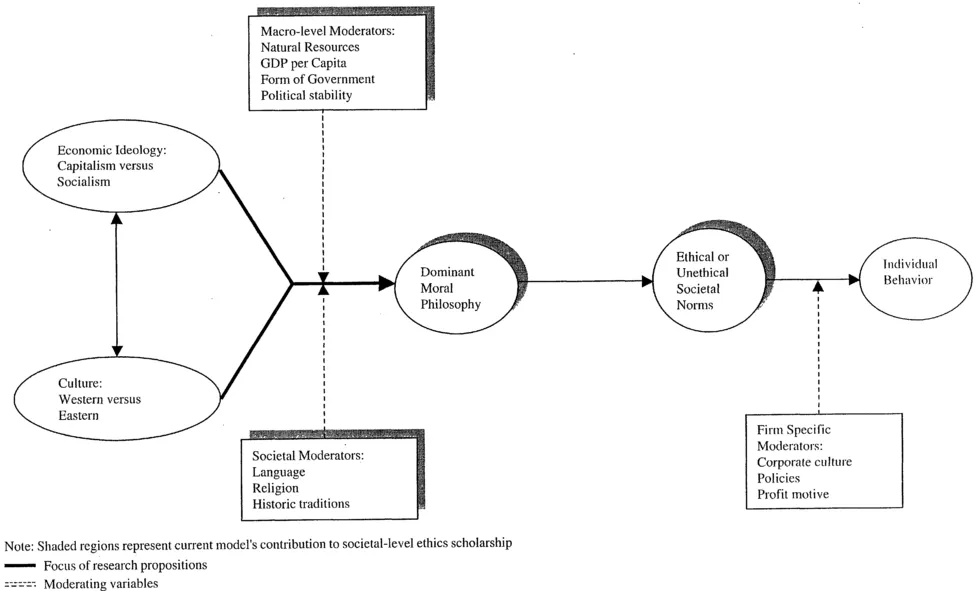
Figure 1. A moral philosophy model of cross-cultural societal ethics
resources, relative wealth, and the type of government and its stability, help shape the general public's moral paradigm (Husted, 1999). Societal moderators, such as language, religion, and historic traditions, also influence the determination of a generally accepted moral view (Wines and Napier, 1992). An additional set of moderators includes firm-specific factors such as corporate culture, policies related to unethical behavior, and the financial status of the firm. After traversing this macro-level model to ascertain the moral philosophy in a society, individual-level concepts such as situational contingency factors and moral reasoning can be examined (Treviño, 1986).
Moral Philosophy, Economic Ideology, and Culture
Although numerous moral philosophies have been developed, business ethics scholars have focused on the philosophies deemed most relevant to managerial practice (Ferrell et al, 2000). Consistent with this pattern we employ five theories that carry the strongest conceptual link to our macro-level, multicultural focus: egoism, utilitarianism, formalism, virtue ethics, and moral relativism. Each of these theories has received considerable attention in the literature (i.e., Fritzsche and Becker, 1984) and will be explained in the following 'Mapping moral philosophies' section. While other moral theories exist, such as justice (Rawls, 1971), we have selected the five theories above because they appear to be most applicable to our economic and cultural dimensions.
Economic ideology and culture
Two of the most fundamental influences organizations and managers face in an international setting are economic ideology and national culture (Ralston et al, 1997). Indeed these two variables set the tone for generally accepted business practices and the moral environment of a country. Economic ideology has been defined as a 'workplace philosophy' and essentially encompasses the continuum of beliefs that range from capitalism to socialism (Ralston et al., 1997). The distinction between these two polar views rests in the belief in the maximization of one's own interests (capitalism) vs. the maximization of the interests of the group (socialism). Moreover, the tree-market philosophy of capitalism suggests that individuals pursue self-interests which may ultimately promote societal good despite initial personal intentions (Smith, 1776).
Hofstede's (1980: 21) definition of culture as 'the collective programming of the mind which distinguishes the members of one human group from another' has been one of the most accepted by cross-cultural researchers. Ralston et al. (1997) extended this thinking and focused on keen differences between Eastern and Western cultures, with an eye toward economic ideology. They argued that the interface of this East-West dyad is relevant and salient because of sharp cultural differences and since the magnitude of trade between these groups has expanded rapidly in the past two decades. While the teachings of Confucius ...
Table of contents
- Cover
- Half Title
- Title
- Copyright
- Contents
- Acknowledgements
- Series Preface
- Foreword
- Introduction
- PART I FRAMEWORKS (INTEGRATIVE FRAMEWORKS)
- PART II ECONOMICS (ECONOMIC PRINCIPLES AND ETHICAL STRATEGIES)
- PART III GLOBALIZATION (CORPORATIONS AS GLOBAL CITIZENS)
- PART IV MARKET LIMITATIONS (STRATEGIC RESPONSES TO MARKET LIMITATIONS)
- PART V ENVIRONMENT (GREEN STRATEGY AND ENVIRONMENTAL POLICY)
- PART VI STAKEHOLDERS (STAKEHOLDER THEORIES AND STRATEGIES)
- PART VII MODELS (CHOOSING A CONCEPTUAL MODEL)
- Index
Trusted by 375,005 students
Access to over 1.5 million titles for a fair monthly price.
Study more efficiently using our study tools.
Frequently asked questions
Yes, you can cancel anytime from the Subscription tab in your account settings on the Perlego website. Your subscription will stay active until the end of your current billing period. Learn how to cancel your subscription
No, books cannot be downloaded as external files, such as PDFs, for use outside of Perlego. However, you can download books within the Perlego app for offline reading on mobile or tablet. Learn how to download books offline
Perlego offers two plans: Essential and Complete
- Essential is ideal for learners and professionals who enjoy exploring a wide range of subjects. Access the Essential Library with 800,000+ trusted titles and best-sellers across business, personal growth, and the humanities. Includes unlimited reading time and Standard Read Aloud voice.
- Complete: Perfect for advanced learners and researchers needing full, unrestricted access. Unlock 1.5M+ books across hundreds of subjects, including academic and specialized titles. The Complete Plan also includes advanced features like Premium Read Aloud and Research Assistant.
We are an online textbook subscription service, where you can get access to an entire online library for less than the price of a single book per month. With over 1.5 million books across 990+ topics, we’ve got you covered! Learn about our mission
Look out for the read-aloud symbol on your next book to see if you can listen to it. The read-aloud tool reads text aloud for you, highlighting the text as it is being read. You can pause it, speed it up and slow it down. Learn more about Read Aloud
Yes! You can use the Perlego app on both iOS and Android devices to read anytime, anywhere — even offline. Perfect for commutes or when you’re on the go.
Please note we cannot support devices running on iOS 13 and Android 7 or earlier. Learn more about using the app
Please note we cannot support devices running on iOS 13 and Android 7 or earlier. Learn more about using the app
Yes, you can access Business Ethics and Strategy, Volumes I and II by Alan E. Singer in PDF and/or ePUB format, as well as other popular books in Business & Business General. We have over 1.5 million books available in our catalogue for you to explore.