Originally published in 1994 this book concerns successful implementation of radical, technological innovations within business organizations. It extends and unifies paradigms for understanding implementation of radical innovations by modeling roles and interactions between key vending and buying firm players. It focuses on how interaction between certain players in buying and vending organizations affects successful implementation of the innovation and investigates the relationships between the user, buying change agent and vending change agent.
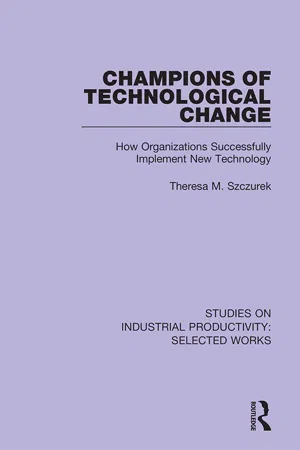
eBook - ePub
Champions of Technological Change
How Organizations Successfully Implement New Technology
- 230 pages
- English
- ePUB (mobile friendly)
- Available on iOS & Android
eBook - ePub
Champions of Technological Change
How Organizations Successfully Implement New Technology
1
Introduction
This research concerns successful implementation of radical, technological innovations within business organizations. It seeks to extend and unify paradigms for understanding implementation of radical innovations by modeling roles and interactions between key vending and buying firm players. This study focuses on how interaction between certain players in buying and vending organizations affects successful implementation of the innovation. Relationships between the user, buying change agent, and vending change agent are investigated. In investigating intra-organizational interactions, a sub-objective is to understand the relationship between a buying change agent and user and determine how this relationship affects user’s satisfaction with the innovation. In investigating inter-organizational interactions, a sub-objective is to understand how relationships between a vending change agent and buying change agent and between a vending change agent and user affect user’s satisfaction.
Foundations for a unified theory of player interaction are built from fundamental postulates of social change theory, interaction theory, and agency theory. The proposed theoretical framework is empirically evaluated using a hybrid methodology of interviews and surveys. Then, player interaction strategies that stimulate users’ satisfaction with the innovation are built from the framework.
This book is divided into 12 chapters: Chapter 1 introduces research objectives, an overview of the study, and contributions; Chapter 2 formulates the research problem and reviews significant prior research in the problem area; Chapter 3 develops a theoretical framework of player interaction and advances a series of hypotheses; Chapter 4 describes the research methodology used to test the hypotheses in terms of setting, variables, sampling procedures, data collection procedures, and analysis techniques; Chapter 5 presents a summary of the analysis findings detailed in Chapters 6 through 11. A reader’s guide to the analysis approach and tables is given. Chapters 6 through 11 describe quantitative and qualitative analyses for each hypothesis. Managerial recommendations are developed from the analysis conclusions.
Chapter 12 integrates findings into an updated Player Interaction Framework and summarizes recommended strategies for vending and buying organizations. Limitations of this research and future research extensions are also covered.
Summary of Findings
Despite millions of dollars spent annually on the introduction of technological innovations, some 35 to 96 percent fail (Calantone and Cooper 1979; Cooper and Calantone 1981; Wasson 1960). Fierce competition, large investment, and high risk are readily apparent reasons for failure in high-technology industry. Less apparent, and less adequately researched, are some of the human elements of the process.
Vending organizations (VOs) are interested in learning how this “human element” reduces risk and increases the likelihood of success with their innovations. Potential buying organizations (BOs), also subject to intense competition, strive to increase organizational effectiveness through improved revenues and reduced costs (Huff and Munro 1985). Results of technology choices substantially affect an organization’s future; consequently, BOs are interested in how human factors reduce uncertainty involved with adopting and implementing innovations. Thus, this study’s general research question is: How do human factors affect the success rate of radical, technological innovation?
The user is a key player in the buying center (Multinovich and Vlahovich 1984; Von Hippel 1976) because user satisfaction is usually a prerequisite for the technological innovation to deliver its full benefits. User satisfaction, which is the consequence of high usage and quality output of the innovation, is this study’s measure of successful implementation.
Other individuals, such as change agents in the buying and vending firms, are also significant to the outcome of the innovation process (Mankin, Bikson, and Gutek 1985). Change agents are individuals or small groups who actively advocate or discourage the acceptance of the innovation. As such, change agents (the buying change agent [BCA] from the buying firm and vending change agent [VCA] from vending firm) are clearly associated with radical, technological change (Maidique 1980; Rogers 1983; Zaltman, Duncan, and Holbek 1973).
Central to the buying center concept is distributed decision making, which requires interactions among buying center players. BO players also interact with vending firm players. While past research has studied some interaction among certain buying and vending players, there is a gap in interaction literature. Prior studies have emphasized inter-organizational interaction between buying and selling firms, the salesperson’s relationship with the purchasing agent, and interaction that affects the purchasing decision. In contrast, this study concentrates on: interaction both within and between firms; relationships between other key players, namely the users and change agents; and interaction that affects the implementation stage, when success is most likely to be determined.
By focusing on relationships which have received little attention in previous research and integrating theories from marketing, economics, and organizational development, this book offers a unified approach to answering the research question: How does intra- and inter-organizational interaction of key buying and vending players affect user satisfaction with the implementation of a radical, technological innovation? Three relationships are critical: VCA/BCA, VCA/user, and BCA/user.
A unified Player Interaction Framework is built from elements of interaction theory, social change theory, and agency theory. This hierarchical framework illustrates how interactions among change agents and users lead to greater user satisfaction with the innovation’s implementation. Change agent and user interaction during the implementation process, which allows for information, reward, and product exchanges, realign the user’s “force field” and lead to greater user satisfaction with the technological innovation. (A user’s satisfaction is determined by a field of positive and negative forces exerted on the user. Interaction among VCAs, BCAs, and users provides the necessary exchange to realign the forces. The exchange of information, rewards, and product serves as the impetus to unfreeze, alter, and refreeze the user’s forces.)
Hypotheses generated from this framework were empirically evaluated using a hybrid methodology of interviews and questionnaires. The BO questionnaire was administered at 45 BOs for a total of 125 respondents. Also, 27 respondents from two VOs completed the VO questionnaire. Seventy-five interviews were conducted with professionals from BOs, VOs, consulting firms, and educational institutions involved with radical, technological innovations.
Quantitative analysis of questionnaire data and qualitative analysis of interview data produced the following findings:
• The Player Interaction Framework is supported; however, the actual model developed from research results is different from the theoretical model. Theoretical and actual models are compared in Chapter 12.
• Vending and buying organizations have different opinions of what affects successful implementation of radical, technological innovations.
• Qualitative analysis supports that positive and negative forces exerted on users affect their level of satisfaction. When positive forces are greater than negative forces, users are more satisfied. Change agents can alter the forces’ impact.
• Reward and information exchanges between BCA and user bring greater user satisfaction. BO respondents also perceive that BCA/user product exchange affects the outcome. Only VO respondents perceive that reward and information exchanges between VCA and user bring greater user satisfaction.
• The intensity of BCA and VCA interaction with users affects level of exchange between parties. BO respondents perceive that frequent BCA/user and VCA/user interaction positively affects exchange; lengthy BCA/user interaction negatively affects exchange. In contrast, VOs perceive that frequent interaction between VCA and other BO players positively affects VCA/user exchange, but lengthy interaction between BCA and other BO players negatively affects BCA/user exchange.
Based on research results, recommendations for VO and BO actions are summarized in Chapter 12. Overall, VOs and BOs are encouraged to use the theoretical and updated (actual) Player Interaction Frameworks as a guide to implementation behaviors which bring greater intensity of interaction, greater exchange between parties, modification of user’s force fields, and greater user satisfaction.
Research Contributions
While contributions to knowledge can be theoretical, empirical, practical, and/or methodological (Sternberg 1981), this research contributes in all four areas.
One main contribution is developing and empirically testing the theoretical framework. This framework helps explain and predict behaviors of key vending and buying organization members which lead to greater user satisfaction with the implementation of a radical, technological innovation. Based on well-grounded theory, this framework increases understanding through a systematic structure. The framework offers consistent guidelines to VO and BO implementation behaviors and therefore, is practical.
Another contribution stems from the methodology employed. In contrast to prior studies, which have tried to investigate this problem without a clear definition of the dependent variable, “success,” this study defines a reliable measure of user satisfaction. The research design controls for technological, organizational, and environmental factors so that human factors involving change agents and users can be studied.
A third contribution results from practical application of the findings. Lewin (1945) stated, “nothing is so practical as a good theory.” In applying this theoretical framework, both vending and buying firms gain guidelines for appropriate inter- and intra-organizational interaction that leads to successful implementation. For example, the VCA who successfully nurtures a relationship with a BCA can indirectly yet positively influence the change agent’s ability to meet users’ needs and thus, can influence user satisfaction with the innovation’s implementation. This research provides an understanding of how best to nurture these critical relationships.
2
Prior Research
This chapter develops the research problem, delineates the scope of investigation of this study, and reviews prior research approaches to this problem.
Formulation of the Problem
In developing the research problem, this section describes the process by which radical, technological innovations are introduced and implemented, defines successful implementation, and explains methods to influence the implementation’s success. The general problem is narrowed in scope to the specific question of this study.
Implementing Radical Innovations
This study focuses on organizational implementation of radical, technological innovations. A radical technology is one which involves a risky departure from existing practices and which requires a significant change in users’ behavior (Daft and Becker 1978; Ettlie, Bridges, and O’Keefe 1984). An innovation is a new idea, which may be a recombination of old ideas, a scheme that challenges the present order, a formula, or a unique approach which is perceived as new by the relevant adopting unit (Van de Ven 1986; Zaltman, Duncan, and Holbek 1973). These adopters range from individuals to businesses. “Radical innovations … represent revolutionary changes in technology … They represent clear departures from existing practice” (Dewar and Dutton 1986, p.1422). Compared to incremental innovations, radical ones are more difficult to successfully implement, have a greater effect on buying firms, and are under-analyzed.
The process by which technological innovations are introduced, adopted, and implemented into a business organization is complex (Webster 1965, 1968, 1970; Kennedy 1983; Meyer and Goes 198-; Robinson, Faris, and Wind 1967). During this innovation process, modeled in Figure 2.1, the vendor strives to bring new technological innovations to market [a]. (Letters in brackets in the text are keyed to the figure.) The radical, technological innovation of interest in this study is a product which results from the innovation process. Throughout an innovation’s introduction and implementation in the market, many people within the vending and buying firm work as change agents to convince buying firms and individual users to adopt and implement the product [b]. These change agents and their relationships with key BO members during the product’s implementation are the focus of this study (see shaded area in Figure 2.1).

Figure 2.1
The Innovation Process Model
The Innovation Process Model
After the product is introduced into the marketplace [b], the potential buying organization takes part in a decision process concerning the innovation [c].
The innovation-decision process is the process through which … [the] decision-making unit passes from first knowledge of an innovation [b], to forming an attitude toward the innovation, to a decision to adopt or reject [c], to implementation of the new idea [...
Table of contents
- Cover
- Half Title
- Title Page
- Copyright Page
- Table of Contents
- 1. Introduction
- 2. Prior Research
- 3. Theoretical Framework and Hypotheses
- 4. Research Methodology
- 5. Summary of Findings
- 6. Forces Affecting User Satisfaction
- 7. Buying Change Agent/User Satisfaction Relationship
- 8. Exchange/User Satisfaction Relationship
- 9. Moderator Effects of Individual Characteristics
- 10. Interaction/Exchange Relationship
- 11. Moderators on the Exchange/Interaction Relationship
- 12. Conclusion
- Bibliography
- Appendix A
- Appendix B
- Appendix C
- Appendix D
- Appendix E
- Index
Trusted by 375,005 students
Access to over 1.5 million titles for a fair monthly price.
Study more efficiently using our study tools.
Frequently asked questions
Yes, you can cancel anytime from the Subscription tab in your account settings on the Perlego website. Your subscription will stay active until the end of your current billing period. Learn how to cancel your subscription
No, books cannot be downloaded as external files, such as PDFs, for use outside of Perlego. However, you can download books within the Perlego app for offline reading on mobile or tablet. Learn how to download books offline
Perlego offers two plans: Essential and Complete
- Essential is ideal for learners and professionals who enjoy exploring a wide range of subjects. Access the Essential Library with 800,000+ trusted titles and best-sellers across business, personal growth, and the humanities. Includes unlimited reading time and Standard Read Aloud voice.
- Complete: Perfect for advanced learners and researchers needing full, unrestricted access. Unlock 1.5M+ books across hundreds of subjects, including academic and specialized titles. The Complete Plan also includes advanced features like Premium Read Aloud and Research Assistant.
We are an online textbook subscription service, where you can get access to an entire online library for less than the price of a single book per month. With over 1.5 million books across 990+ topics, we’ve got you covered! Learn about our mission
Look out for the read-aloud symbol on your next book to see if you can listen to it. The read-aloud tool reads text aloud for you, highlighting the text as it is being read. You can pause it, speed it up and slow it down. Learn more about Read Aloud
Yes! You can use the Perlego app on both iOS and Android devices to read anytime, anywhere — even offline. Perfect for commutes or when you’re on the go.
Please note we cannot support devices running on iOS 13 and Android 7 or earlier. Learn more about using the app
Please note we cannot support devices running on iOS 13 and Android 7 or earlier. Learn more about using the app
Yes, you can access Champions of Technological Change by Theresa M. Szczurek in PDF and/or ePUB format, as well as other popular books in Economics & Business General. We have over 1.5 million books available in our catalogue for you to explore.