Certain small solid particles are surface-active at fluid interfaces and thus are able to stabilize materials previously considered impossible to stabilize in their absence. Liquid marbles, particle-coated non-sticking liquid droplets, represent one of these materials. Preparation of liquid marbles was described only about 15 years ago and they are now widely studied by many research groups and numerous applications of liquid marbles have been advanced. The book is written for postgraduates and researchers working on the area who are training to become chemists, soft matter physicists, materials scientists, and engineers.
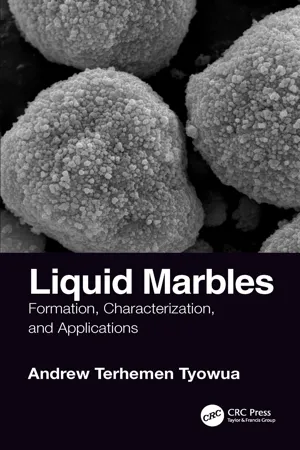
- 149 pages
- English
- ePUB (mobile friendly)
- Available on iOS & Android
eBook - ePub
1 | Interfaces and the Concept of Surface Tension |
1.1 DEFINITION AND TYPES OF INTERFACES
There exists a two-dimensional plane, frontier or boundary, with no thickness, when two surfaces meet known as an “interface”. A “surface”, an “interphase”, or “interfacial region” is a three-dimensional region, of finite thickness (few Å), where two homogeneous bulk phases meet. The properties of this region are entirely different from those of the two bulk phases. Interfaces are very common and are everywhere, e.g. they occur in the food we eat, bodies of living organisms, and natural and chemical environments. There are several types of interfaces, and they have been classified based on the nature of the surfaces involved in their formation. This classification yields five types of interfaces under two broad themes, namely
• Fluid interfaces: (1) liquid-air or gas and (2) liquid-liquid interfaces,
• Non-fluid or solid interfaces: (1) solid-air or gas, (2) solid-liquid and (3) solid-solid interfaces.
Because gases are miscible with one another, there are no gas-gas interfaces. Sometimes three surfaces meet in a line to form an interface. This line is called a triple interface.
1.2 SURFACE TENSION AND CURVED INTERFACES
1.2.1 SURFACE TENSION
Surface (or interfacial) tension is an important concept when studying fluid interfaces. Surface tension is force per unit length acting, perpendicularly, on an imaginary line drawn in the interface. Its SI units are Newton per metre (N m−1), but it is sometimes reported in Joule per metre square (J m−2) on the basis that 1 J is equivalent to 1 N m. Other units, e.g. dyne per centimetre, are also used. Note that 1 dyne cm−1 is equivalent to 1 mN m−1. The surface tension (25°C) of some liquids is given in Table 1.1. A liquid surface is basically a liquid-air interface. The cohesive forces between the molecules of the liquids are greater than the adhesive forces between the air and the liquid molecules. The result is a force imbalance with a net inward force in the liquid bulk phase. This causes the liquid surface to stretch as though it were covered with an elastic membrane. This is the origin of surface tension in liquids. Surface tension is responsible for many observed physical phenomena. For example, due to surface tension, liquid drops minimize their surface area by taking a spherical shape (geometry of least surface area). The rising of liquids in thin capillaries once submerged in them is also a consequence of surface tension. It is also because of surface tension that insects are able to walk on the surface of water.
TABLE 1.1
Surface Tension of Some Liquids at 25°C
Surface Tension of Some Liquids at 25°C
Liquid | γla/mN m−1 at 25°C |
Hexane | 17.89 |
Ethanol | 21.97 |
Methanol | 22.07 |
Cyclohexane | 24.65 |
Acetone | 24.02 |
Chloroform | 26.67 |
Acetic acid | 27.10 |
Toluene | 27.93 |
Benzene | 28.22 |
Hexadecane | 27.05 |
Formamide | 57.02 |
Water | 71.99 |
Source: Jasper, J.J., J. Phys. Chem. Ref. Data 1, 841–100...
Table of contents
- Cover
- Half Title
- Title Page
- Copyright Page
- Dedication
- Table of Contents
- Foreword
- Preface
- Acknowledgments
- About the Author
- Base Units, Derived Units, Prefixes, and Conversions
- Chapter 1 Interfaces and the Concept of Surface Tension
- Chapter 2 Nature of Solid Surfaces
- Chapter 3 Sticking and Non-sticking Drops
- Chapter 4 Principles and Properties of Liquid Marbles
- Chapter 5 Applications of Liquid Marbles
- Answers to Numerical Questions
- Index
Trusted by 375,005 students
Access to over 1.5 million titles for a fair monthly price.
Study more efficiently using our study tools.
Frequently asked questions
Yes, you can cancel anytime from the Subscription tab in your account settings on the Perlego website. Your subscription will stay active until the end of your current billing period. Learn how to cancel your subscription
No, books cannot be downloaded as external files, such as PDFs, for use outside of Perlego. However, you can download books within the Perlego app for offline reading on mobile or tablet. Learn how to download books offline
Perlego offers two plans: Essential and Complete
- Essential is ideal for learners and professionals who enjoy exploring a wide range of subjects. Access the Essential Library with 800,000+ trusted titles and best-sellers across business, personal growth, and the humanities. Includes unlimited reading time and Standard Read Aloud voice.
- Complete: Perfect for advanced learners and researchers needing full, unrestricted access. Unlock 1.5M+ books across hundreds of subjects, including academic and specialized titles. The Complete Plan also includes advanced features like Premium Read Aloud and Research Assistant.
We are an online textbook subscription service, where you can get access to an entire online library for less than the price of a single book per month. With over 1.5 million books across 990+ topics, we’ve got you covered! Learn about our mission
Look out for the read-aloud symbol on your next book to see if you can listen to it. The read-aloud tool reads text aloud for you, highlighting the text as it is being read. You can pause it, speed it up and slow it down. Learn more about Read Aloud
Yes! You can use the Perlego app on both iOS and Android devices to read anytime, anywhere — even offline. Perfect for commutes or when you’re on the go.
Please note we cannot support devices running on iOS 13 and Android 7 or earlier. Learn more about using the app
Please note we cannot support devices running on iOS 13 and Android 7 or earlier. Learn more about using the app
Yes, you can access Liquid Marbles by Andrew T. Tyowua in PDF and/or ePUB format, as well as other popular books in Physical Sciences & Chemistry. We have over 1.5 million books available in our catalogue for you to explore.