This book bears testimony to the value of a progressive form of academisation of social work education in most European countries, including former communist countries which had to re-establish social work education. It also manifests the confidence of contributors in belonging to a serious academic discipline, and the fruitfulness of bringing research 'home' from neighbouring disciplines such as sociology, psychology, social policy, or pedagogy into the mainstream of social work.
The contributions to this book converge on a small number of core issues for contemporary social work. These are methodologically the conceptualisation of different and interacting dimensions of diversity, and practically the defence of professionalism and discretion against encroachment by neo-liberal ideologies and cost-cutting regulations. In so doing, this underscores that theory matters in social work. Authentic social work research can demonstrate that social work practice has no reason to shy away from basing itself on evidence and being professionally accountable as long as its notion of evidence recognises and does justice to the complexity of social problems and acknowledges the value of inter-subjectivity in producing useable and ethically grounded evidence. This book was originally published as a special issue of the European Journal of Social Work.
Reconsidering the ‘idea’ of evidence in evidence-based policy and practice
Neuüberdenkung des “Konzepts” Evidenz in der evidenzbasierten Politik & Praxis
Edward J. Mullen
School of Social Work, Columbia University, New York, NY, USA
Evidence-based policy and practice (EBP) has become an important social work conceptual framework. Yet, the core EBP concept, the concept of evidence, remains ill-defined. I propose a modification of the concept of evidence as applied to EBP effectiveness questions. As a basis for this reformulation ideas about evidence are examined from cross-disciplinary and multidisciplinary perspectives including epistemology, philosophy of science, evidence-science, and law. I propose that for EBP effectiveness questions: (1) to be considered ‘relevant evidence’ an explanatory connection between an intervention and an outcome must be established rather than a mere association; (2) the EBP definition of ‘best available evidence’ should include total available evidence (rather than a subset) about effectiveness, causal roles (i.e., mechanisms), and support factors and be inclusive of high-quality experimental and observational studies as well as high-quality mechanistic reasoning; (3) the familiar five-step EBP process should be expanded to include formulation of warranted, evidence-based arguments and that evidence appraisal be guided by three high level criteria of relevance, credibility, and strength rather than rigid evidence hierarchies; (4) comparative effectiveness research strategies, especially pragmatic controlled studies, hold promise for providing relevant and actionable evidence needed for policy and practice decision-making and successful implementation.
Die evidenzbasierte Politik und Praxis (EBP) bildet in der Sozialarbeit einen wichtigen Begriffsrahmen. Der Kernbegriff der EBP, der Begriff Evidenz, ist jedoch immer noch ungenau definiert. Ich schlage eine Modifizierung des in EBP-Effektivitätsfragen benutzten Begriffs Evidenz vor. Als Grundlage dieser Neuformulierung dient eine Untersuchung der Evidenz-Konzepte aus bereichsübergreifender und interdisziplinärer Perspektive unter Einschluss der Epistemologie, Wissenschaftsphilosophie, Evidenzwissenschaft und der Gesetzgebung. Ich schlage folgendes für EBP-Effektivitätsfragen vor: (1) als ‘relevante Evidenz’ sollte gelten, wenn eine selbsterklärende Verbindung zwischen einer Intervention und einem Ergebnis existiert und nicht nur einfache Assoziation; (2) die EBP-Definition der ‘besten verfügbaren Evidenzen’ sollte die gesamten verfügbaren Evidenzen (keine Teilmenge) über Effektivität, kausale Rollen (d. h. Mechanismen) und Unterstützungsfaktoren beinhalten sowie erstklassige Experimentier- und Beobachtungsstudien und anspruchsvolle mechanistische Begründungen; (3) der bekannte fünfstufige EBP-Prozess sollte um die Formulierung einer begründeten, evidenzbasierten Argumentation erweitert werden, und die Beweiswürdigung sollte sich durch drei strenge Kriterien steuern lassen: Relevanz, Glaubwürdigkeit und Stärke anstatt feststehender Evidenzhierarchien; (4) Forschungs-strategien zur vergleichenden Bewertung der Effektivität, besonders pragmatische kontrollierte Studien, sind vielversprechend bei der Schaffung von relevanten und umsetzbaren Evidenzen, die für Entscheidungsfindung und erfolgreichen Einsatz in Politik und Praxis erforderlich sind.
For those with lingering doubts about the nature of evidence itself I remind them that while Gregor Mendel (1822–84) developed the monogenic theory of inheritance on the basis of experimentation, Charles Darwin (1809–82) conceived the theory of evolution as a result of close observation, and Albert Einstein’s (1879–1955) special theory of relativity was a mathematical description of certain aspects of the world around us. William Harvey’s discovery of the circulation of the blood—was based on an elegant synthesis of all three forms of evidence. (Rawlins, 2008, p. 2159)
Introduction
Evidence-based policy and practice (EBP) is an important conceptual framework across the human services. Yet the core EBP concept, the concept of evidence, remains ill-defined and controversial. I propose a reformulation of the concept of evidence as applied to EBP effectiveness questions. Effectiveness questions ask about the outcomes of interventions in contexts which are typical of where policies, programs, and services will actually be provided, in the complexity of service organizations, as distinct from efficacy questions which ask about outcomes in controlled, experimental contexts. As a basis for this reformulation ideas about evidence are examined from cross-disciplinary and multidisciplinary perspectives. I propose a modification of the EBP framework and draw out implications for researchers conducting effectiveness studies, for those conducting systematic reviews of such studies, and for those developing guidelines.
This topic is important and timely for two reasons: First, in a number of countries the research agenda and funding are being driven by EBP requirements. Regulatory and funding agencies are requiring policies and practices be evidence-informed. Second, human service professionals are being trained as evidence-based practitioners. Accordingly, research organizations and researchers are expected to produce and translate research findings into evidence that can support decisions about which policies, programs, and services to implement. Nevertheless, there is disagreement about what should be the meaning and role of evidence in the EBP context.
What is EBP?
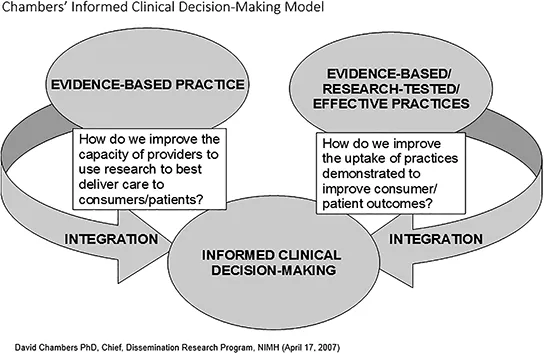
EBP is a policy and practice decision-making process with two complementary components, namely (1) the process of evidence-base practice and (2) the use of evidence-based, research-tested effective practices.
The evidence-based practice process, shown on the left side of Figure 1, is used by practitioners to make decisions about which evidence-based, research-tested effective practices to use, shown on the right side.1 The idea of evidence is central to both the process of evidence-based practice and to the identification of evidence-based, research-tested effective practices. The left oval, labeled ‘evidence-based practice’ is a process practitioners can use when providing services to individuals, communities, organizations, or, at the policy level, whole populations.
Figure 1. EBP as a policy and practice decision-making process (reproduced with permission from Institute for the Advancement of Social Work Research, 2007).
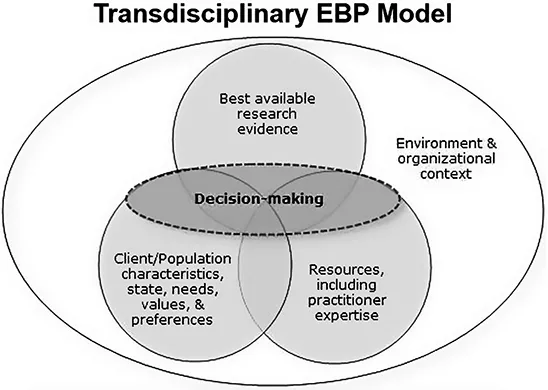
The EBP process involves a critical assessment of available evidence about each of the domains shown in Figure 2.
With decision-making at the center, consideration is to be given to the best available evidence: (1) about benefits, harms, and costs of alternative interventions; (2) client system characteristics, needs, state, preferences, and values; (3) resources required and available including practitioner expertise and experience as well as team and organizational resources; and (4) relevant environmental and organizational variables. For informed decision-making then, evidence is required about variables in each of these information domains. In this paper I only address the idea of evidence pertaining to the top circle, namely best available research evidence and even more specifically only to evidence about effectiveness questions.2
In EBP the emphasis is on the use of best evidence wherein best evidence typically refers to highest quality evidence (i.e., evidential credibility and trustworthiness). For both efficacy and effectiveness questions in EBP it is traditional to define evidence quality using a hierarchical scheme. Filtered evidence coming from systematic evidence reviews and critically appraised topical reviews are taken as providing the highest quality of evidence, especially those whose inclusion criteria limit eligible studies to randomized controlled trials, preferably those using placebo controls and double-blinded protocols (RCTs). Below these sources unfiltered evidence comes in descending order of quality from individual RCTs, cohort studies, case-controlled studies, and lastly from background information (e.g., such as from mechanistic reasoning about causes) and, at the bottom of the evidence hierarchy is expert opinion (Straus, Richardson, Glasziou, & Haynes, 2005). There are evidence hierarchies for other types of EBP questions but my concern is only with effectiveness questions.
Figure 2. Transdisciplinary model of evidence-based policy and practice (reproduced with permission from Satterfield et al., 2009).
This particular hierarchical view of evidence quality is viewed by many as too restrictive, especially the privileging of RCTs over other sources of evidence for addressing effectiveness questions (as distinct from efficacy questions where RCTs are widely acknowledged as providing the highest quality of evidence; Upshur & Tracy, 2004).
It is generally accepted that evidence quality does not guarantee evidential relevance, that is the applicability of the evidence to outcomes of interventions in contexts which are typical of where policies, programs, and services will actually be provided in the complexity of service organizations (Cartwright & Munro, 2010). Recently, evidential relevance has become an important concern for those working in implementation science where much progress is being made (Brownson, Colditz, & Proctor, 2012; Palinkas & Soydan, 2012).
After examining ideas about evidence from a cross-disciplinary and multidisciplinary perspective I will conclude with a recommendation that for effectiveness questions the notion of best evidence should be broadened and leveled (i.e., nonhierarchical) and the criterion of relevance should become a primary consideration alongside the criterion of evidential quality. I will also conclude that as is the case in disciplines such as law and philosophy evidential relevance can only be established through carefully crafted rational, evidential arguments (Cartwright, 2013).
Evidence
Evidence-based practice can be considered a rational process for making decisions in the face of uncertainties, that is, in situations wherein certainty is not attainable. This process involves making uncertain inferences, usually using qualitative probabilistic reasoning about hypotheses based on available evidence. As documented by Franklin in his detailed historical survey of methods of evidence evaluation or of how mankind has used rational methods for dealing with uncertainty, what he calls the science of conjecture, such methods have been used since ancient times in law, science, commerce, philosophy, and logic (Franklin, 2001, p. xiii).
A cross-disciplinary science of evidence
Recently there has been much interest in exploring commonalities across the disciplines regarding concepts, principles, and methods of evidence and inference. That interest has been peaked by the emphasis across disciplines in the idea of EBP. One such program, Evidence, inference and enquiry: Towards an integrated science of evidence was established at University College London (UCL) with participants from education, economics, forensic science, health sciences, history, law, philosophy of science, statistics, and psychology (Dawid, Twining, & Vasilaki, 2012). Twining notes that although a wide range of diverse projects within an array of disciplines were represented in the UCL evidence project commonalities could be found as to how evidence, and inferences from evidence, could be viewed: ‘Notwithstanding differences … all of our projects involve, as part of the enterprise, drawing inferences from evidence to test hypotheses and justify conclusions and that the logic of this kind of inquiry is governed by the same principles’ (Twining, 2012, p. 94).
Twining identifies a number of frameworks which could guide development of a common view of evidence. Of particular relevance to EBP conceptualizations, because of its focus on relevance, credibility, and the synthesis or combination of recurrent evidence sources is the classification developed by David Schum (2012).
Schum proposes a substance blind science of evidence which has at its core a scheme for classifying evidence in terms of inferential properties (Schum, 2012; Wigmore, 1937). Schum proposes two classificatory dimensions that describe all such forms...
Table of contents
Cover
Half Title
Title Page
Copyright Page
Table of Contents
Citation Information
Notes on Contributors
Introduction: Private troubles or public issues? Challenges for social work research
1 Reconsidering the ‘idea’ of evidence in evidence-based policy and practice
2 Science and social work: a sketch
3 Reaching the person—social work research as professional responsibility
4 Standing up to complexity: researching moral panics in social work
5 Social work education in a time of national crisis in Greece: educating the workforce to combat inequalities
6 Attitudes toward poverty among exit students of undergraduate social work programs in eight Latin American countries
7 The circle of social reform: the relationship social work—social policy in Addams and Richmond
8 The street-level delivery of activation policies: constraints and possibilities for a practice of citizenship
9 Active social policies revisited by social workers
10 Investigating the quality of social work. An experience of self-assessment with Italian social workers
11 Towards an interactional approach to reflective practice in social work
12 Critical factors of intensive family work connected with positive outcomes for child welfare clients
13 Migrant voices addressing social work: listening to Italian women in Germany
14 Culturally sensitive social work: promoting cultural competence
15 Education, ethnicity and gender. Educational biographies of ‘Roma and Sinti’ women in Germany
16 Social assistance trajectories in Switzerland: do they follow discernible patterns?
17 Standardisation—the end of professional discretion?
Index
Trusted by 375,005 students
Access to over 1.5 million titles for a fair monthly price.
Study more efficiently using our study tools.
Frequently asked questions
Yes, you can cancel anytime from the Subscription tab in your account settings on the Perlego website. Your subscription will stay active until the end of your current billing period. Learn how to cancel your subscription
No, books cannot be downloaded as external files, such as PDFs, for use outside of Perlego. However, you can download books within the Perlego app for offline reading on mobile or tablet. Learn how to download books offline
Perlego offers two plans: Essential and Complete
Essential is ideal for learners and professionals who enjoy exploring a wide range of subjects. Access the Essential Library with 800,000+ trusted titles and best-sellers across business, personal growth, and the humanities. Includes unlimited reading time and Standard Read Aloud voice.
Complete: Perfect for advanced learners and researchers needing full, unrestricted access. Unlock 1.5M+ books across hundreds of subjects, including academic and specialized titles. The Complete Plan also includes advanced features like Premium Read Aloud and Research Assistant.
Both plans are available with monthly, semester, or annual billing cycles.
We are an online textbook subscription service, where you can get access to an entire online library for less than the price of a single book per month. With over 1.5 million books across 990+ topics, we’ve got you covered! Learn about our mission
Look out for the read-aloud symbol on your next book to see if you can listen to it. The read-aloud tool reads text aloud for you, highlighting the text as it is being read. You can pause it, speed it up and slow it down. Learn more about Read Aloud
Yes! You can use the Perlego app on both iOS and Android devices to read anytime, anywhere — even offline. Perfect for commutes or when you’re on the go. Please note we cannot support devices running on iOS 13 and Android 7 or earlier. Learn more about using the app
Yes, you can access Private Troubles or Public Issues? by Walter Lorenz, Ian Shaw, Walter Lorenz,Ian Shaw in PDF and/or ePUB format, as well as other popular books in Social Sciences & Sociology. We have over 1.5 million books available in our catalogue for you to explore.