First published in 1988. The goal of this study is to explore the workings of a syllable theory which is an integral part of Prosodic Phonology. It will be shown that theory-internal considerations and a variety of empirical arguments converge on a conception of syllabification as continuous template matching governed by syllable wellformedness conditions and a directional parameter. This title will be of interest to students of language and linguistics.
- 236 pages
- English
- ePUB (mobile friendly)
- Available on iOS & Android
eBook - ePub
Syllable Theory in Prosodic Phonology
About this book
Information
CHAPTER I
THEORETICAL FRAMEWORK
1.0 Introduction
The recognition of the syllable as a prosodic constituent has led to a deeper understanding of various phonological processes related to syllable structure, and the advantages of a prosodic/nonlinear conception of the syllable over a linear model have been convincingly demonstrated in much recent generative work dealing with the subject (Kahn 1976, Selkirk 1978, Halle & Vergnaud 1978, Feinstein 1979, McCarthy 1979a,b, Prince 1980, Steriade 1982, Levin 1985, etc.). While the syllable has enjoyed its status as a structural unit for some time, I believe it has not yet faced the full responsibilities which such a status entails. Its recognition as a prosodic unit brings the syllable in line with other hierarchical structures such as the metrical foot, the phonological word and the intonational phrase, and it is therefore imperative that syllable theory maintain and adhere to certain principles and hypotheses inherent to Prosodic Phonology (Selkirk 1980, 1981, 1984b, McCarthy & Prince 1985, in preparation).
(1) Basic Principles of Prosodic Phonology
I. Prosodic Licensing: All phonological units must be prosodically licensed, i.e., belong to higher prosodic structure (modulo extraprosodicity).
II. Locality: Well-formedness of a prosodic structure is determined locally.
III. Directionality: Phonological mapping proceeds directionally: left to right, or right to left.
Syllable theory couched within the framework of Prosodic Phonology must not only maintain these principles but must also avoid duplicating their effects. If syllabification is merely compatible with Prosodic Phonology, the statements in (1) would be reduced to descriptive generalizations. What is necessary is that they have the status of operative principles guiding syllabification.
The goal of this dissertation is to explore the workings of a syllable theory which is an integral part of Prosodic Phonology. It will be shown that theory-internal considerations and a variety of empirical arguments converge on a conception of syllabification as continuous template matching governed by syllable wellformedness conditions and a directional parameter.
1.1 Principles of Prosodic Phonology
The basic principles of Prosodic Phonology – Prosodic Licensing, Locality, and Directionality – support a particular theory of syllabification. We will now consider each principle in turn and show how it bears on the question of the proper statement and role of syllable structure in the grammar.
1.1.1 Prosodic Licensing
The principle of Prosodic Licensing requires that all phonological units belong to higher prosodic structure. Segments must belong to syllables, syllables to metrical feet, and metrical feet to phonological words or phrases. Apparent exceptions to Prosodic Licensing fall under the theory of Extraprosodicity, which allows edges of well-defined domains to be special. In stress systems, we often find that the final syllables are not counted for metrical rules. For syllabification, the conditions which hold at word-edges are typically different from those encountered word-internally: We find edge segments not conforming to syllable sonority and different types of initial complex onsets and final complex codas. We will consider Extraprosodicity to be another licensing mechanism on a par with prosodic licensing (e.g. by syllabification).
By requiring that each segment be syllabically licensed (modulo extraprosodicity), Prosodic Licensing ensures that a phonological string is exhaustively syllabified. We can understand the mechanism of Stray Erasure (extensively motivated in earlier nonlinear work, e.g. McCarthy 1979b, Steriade 1982, Cairns & Feinstein 1982, Harris 1983) as eliminating unlicensed material from the phonological string so that Prosodic Licensing is satisfied.
Two theories of syllabification, broadly known as the template-approach (Selkirk 1978, Halle & Vergnaud 1978, etc.) and the rule-approach (Kahn 1976, Steriade 1982, Levin 1985, etc.), have been contrasted in the literature. I will argue that a syllable theory that does not duplicate the effects of the independent principle of Prosodic Licensing must be some version of the templatic approach, where syllabification consists of mapping the phonological string to the syllable template of the language. A syllable template is a kind of wellformedness condition defining the possible skeletal sequences of a language, e.g. [CCVC] (see 1.4 for other views on how templates can be defined). There are also other universal as well as language-specific wellformedness conditions on syllable structure beyond the simple skeletal sequencing. One such condition is the Universal Core Syllable Condition (2), which requires a sequence of -c-V- to be universally analyzed as tautosyllabic. (The interpretation of conditions like (2) will be discussed in detail in chapter 2, see also chapter 5).
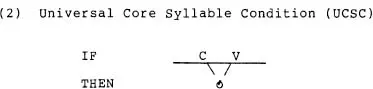
(‘The sequence CV must belong to a single syllable.’)
Language-specific wellformedness conditions, such as the coda conditions extensively discussed in chapter 2, typically place restrictions on the class of segments which can be mapped to a certain template position.
In such a template-approach to syllabification, syllable mapping can be identified with the universal association mechanism which is triggered by Prosodic Licensing and governed by the syllable templates and other wellformedness conditions of the language.
No such identification is possible in a rule-approach. Here the possible syllable structures of a language are only indirectly derived from the set of syllable-building rules such as those given in (3) posited in the phonology.
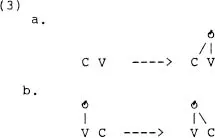
The existence of an Onset rule (3a) and a Rime Rule (3b) determines that CV and CVC syllables are allowed. If further (iterative or noniterative) adjunction rules are given in the grammar, more complex types of syllables will result.
Notice that the Principle of Prosodic Licensing is superfluous if syllable-building rules are normal obligatory phonological rules which apply whenever their structural description is met. Syllabification then takes place not because of Prosodic Licensing but because the rules are obligatory. Since Prosodic Licensing is an independently motivated principle of Prosodic Phonology, this kind of redundancy is a serious problem for the rule-approach and constitutes an argument in favor of a template-based syllable theory.
A related question concerns the interaction between syllabification and phonological rules. Our hypothesis (defended in chapter 3) is that syllable mapping takes place continuously throughout the phonological derivation.1 In the context of Prosodic Phonology, continuous syllabification merely reflects the fact that Prosodic Licensing is an operative principle triggering syllable mapping throughout the lexical and postlexical phonology.
1.1.2 Locality
The Principle of Locality requires local wellformedness of a prosodic structure. This means that the wellformedness of a syllable or a metrical foot is determined solely within the syllable or foot and is crucially not dependent on information outside of that structure.
Consider a language which only allows sonorants to be codas. In a template-approach, this can be stated as a wellformedness condition on codas (4) which blocks the mapping of an obstruent into template-final position.
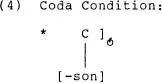
In a rule-approach, such a condition would be part of the structural description of the the syllable building rule which creates codas.
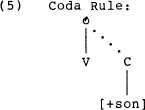
It would a priori seem that free syllable-mapping constrained by the Coda Condition (4) and the Coda Rule (5) are equivalent. In chapter 2, we will consider evidence relating to geminates which in fact distinguishes between the two approaches indicated above. I will argue that the principle of Locality can only be maintained if language-specific conditions are stated not over syllable rules but over syllable representations and are formulated as wellformedness conditions of the type given in (4). Such a condition on syllable structure presupposes the existence of a syllable template in the grammar. Hence the principle of Locality indirectly supports the templatic the principle of Locality indirectly supports the templatic approach to syllabification.
Locality also plays an important role in the domain of melody tier constraints. One type of melody tier constraint which is inherent to syllables is that of sonority.2 Within a syllable, a segment constituting a sonority peak must be preceded and/or followed by a sequence of segments with decreasing sonority values. Sonority has both universal and language-particular aspects. Language-particular sonority requirements in most cases consist of minimum dissimilarity requirements on adjacent tautosyllabic segments (see e.g. Steriade 1982, Selkirk 1984). In our view, this limitation to melody adjacency is another consequence of the principle of Locality.
1.1.3 Directionality
That phonological mapping is parametrized for directionality is considered uncontroversial in such areas as metrical theory (Hayes 1980, Prince 1983, etc.), root-and-pattern morphology (McCarthy 1979b, 1981), and reduplication (Marantz 1982, McCarthy & Prince 1985, in prep., Mester 1986).
I will argue that as a parameter available in Prosodic Phonology, directionality plays an explanatory role in Syllable Theory. A template-mapping approach to syllabification combined with the parameter on directionality can a...
Table of contents
- Cover
- Half Title
- Title Page
- Copyright Page
- Table of Contents
- CHAPTER I. THEORETICAL FRAMEWORK
- CHAPTER II. CONDITIONS ON SYLLABIFICATION
- CHAPTER III. CONTINUOUS SYLLABIFICATION AND STRAY ERASURE
- CHAPTER IV. SYLLABIFICATION AND STRAY OPERATIONS
- CHAPTER V. DIRECTIONALITY IN SYLLABIFICATION
- BIBLIOGRAPHY
Trusted by 375,005 students
Access to over 1.5 million titles for a fair monthly price.
Study more efficiently using our study tools.
Frequently asked questions
Yes, you can cancel anytime from the Subscription tab in your account settings on the Perlego website. Your subscription will stay active until the end of your current billing period. Learn how to cancel your subscription
No, books cannot be downloaded as external files, such as PDFs, for use outside of Perlego. However, you can download books within the Perlego app for offline reading on mobile or tablet. Learn how to download books offline
Perlego offers two plans: Essential and Complete
- Essential is ideal for learners and professionals who enjoy exploring a wide range of subjects. Access the Essential Library with 800,000+ trusted titles and best-sellers across business, personal growth, and the humanities. Includes unlimited reading time and Standard Read Aloud voice.
- Complete: Perfect for advanced learners and researchers needing full, unrestricted access. Unlock 1.5M+ books across hundreds of subjects, including academic and specialized titles. The Complete Plan also includes advanced features like Premium Read Aloud and Research Assistant.
We are an online textbook subscription service, where you can get access to an entire online library for less than the price of a single book per month. With over 1.5 million books across 990+ topics, we’ve got you covered! Learn about our mission
Look out for the read-aloud symbol on your next book to see if you can listen to it. The read-aloud tool reads text aloud for you, highlighting the text as it is being read. You can pause it, speed it up and slow it down. Learn more about Read Aloud
Yes! You can use the Perlego app on both iOS and Android devices to read anytime, anywhere — even offline. Perfect for commutes or when you’re on the go.
Please note we cannot support devices running on iOS 13 and Android 7 or earlier. Learn more about using the app
Please note we cannot support devices running on iOS 13 and Android 7 or earlier. Learn more about using the app
Yes, you can access Syllable Theory in Prosodic Phonology by Junko Itô in PDF and/or ePUB format, as well as other popular books in Languages & Linguistics & Linguistics. We have over 1.5 million books available in our catalogue for you to explore.