First published in 1999, this volume aims to describe and analyse the experience of cost containment in Europe over the last fifteen years in order to understand that experience and to determine, as best we can, which methods were successful and which were not. Part I provides an overview of healthcare in the European Union, an overview of recent expenditure trends. Part II complements the first, examining in detail cost containment policies in each EU Member State. The country-based chapters refer to developments up to mid-1997.
- 796 pages
- English
- ePUB (mobile friendly)
- Available on iOS & Android
eBook - ePub
Health Care and Cost Containment in the European Union
About this book
Trusted by 375,005 students
Access to over 1.5 million titles for a fair monthly price.
Study more efficiently using our study tools.
Information
Topic
MedicineSubtopic
Social Work1 Cost containment in the EU: an overview
ELIAS MOSSIALOS AND JULIAN LE GRAND
Introduction
Throughout Europe in the 1980s and early 1990s, health care was both a personal and a political priority. More and more Europeans were demanding quality health care: care that was delivered efficiently, equitably and with a due regard for the needs and wants of the patient. All Member States of the European Union have health care systems that are largely publicly funded; hence their governments faced enormous pressures to provide extra funds to meet these demands. Political debates were dominated by health issues; other government departments watched - and resented - scarce government resources being diverted to the Ministry of Health; employers and employees protested bitterly as taxes or social insurance contributions rose to meet health needs.
Moreover, government itself seemed partly to blame. More and more government officials and academic analysts subscribed to Aaron Wildavsky's Law of Medical Money: 'medical costs rise to equal the sum of all private insurance and government subsidy'. There seemed to be no mechanism by which health systems were self-stabilizing.1 So, inevitably and unsurprisingly, most governments began to look at methods of containing their own health expenditures. Budgets for health sectors and health providers were set; restrictions on publicly funded treatment were introduced; and direct and indirect controls over health service providers were imposed. Perhaps in consequence, the growth in health spending in many countries began to slow.
However, as we approach the twenty-first century, the problem has not gone away. The growth in health care spending in most countries has indeed been reduced; but it has not stopped. Indeed in some Member States it continues to grow as fast as ever. And many of the pressures that contributed to expansion are still there; in fact some, such as the rise in public expectations, are more intense than before. It may be that the early years of the new millennium will see a resumption of uncontrolled growth in health spending. It is therefore crucial that the experience of cost containment in Europe over the last fifteen years be described and analysed, so as to understand that experience, and to determine, as best we can, which methods were successful and which were not. That is the aim of this book.
The book is divided into two parts. In Part I we provide an overview of health policies and cost containment measures in the EU Member States during the last fifteen years. This begins with two background sections: a review of some aspects of the current systems of health care in the European Union, and a review of recent expenditure trends. The next section provides a new method of classifying cost containment measures. The following section uses this classification scheme to summarise the measures adopted by the different Member States and discusses such evidence as exists concerning their impact. It endeavours to draw some conclusions about the effectiveness of different measures: inevitably, given the methodological and data difficulties involved, these are rather tentative. Additional chapters examine the determinants of health expenditure trends in the EU, and whether there is convergence in these trends.
Part II complements the first, examining in detail cost containment policies in each EU Member State. The authors of the country-based chapters were given a specific framework and guidelines to produce their chapters. The aim was to address similar questions and issues and have a standardised structure. However, inevitably there has been some divergence in the way different authors decided to analyse and examine some of the policies and issues. Their analyses reflect particular priorities in different countries and the authors' own preferences and style. The country-based chapters refer to developments up to mid-1997.
I: Health care systems
Health care systems within the European Union have fundamental similarities; on the other hand, they also differ in a bewildering variety of ways. By way of background to the rest of this book, in this chapter we summarize some of the principal differences and similarities. We concentrate on eight key areas: finance, provision, payment systems for hospitals and doctors, the supply of doctors, the extent of patient choice and three areas where there previously has been little comparative information: dental care, out of hospital care and the regulation of pharmaceuticals.
1.1 Finance
This section begins with a general discussion of sources of finance for health care expenditure. It is followed by sub-sections looking in more detail at the three principal sources of funding: taxation and social insurance, voluntary health insurance and direct payments or charges.
1.1.1 Sources of finance
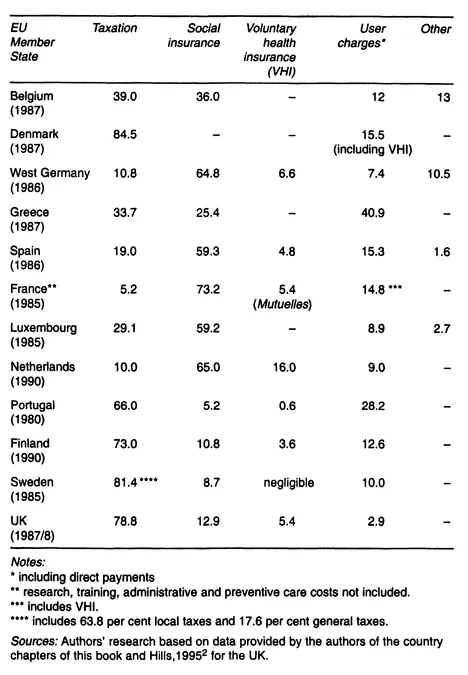
The principal sources of health care finance in the EU Member States are presented in Tables 1.1 and 1.2. Table 1.1 (overleaf) shows the sources of funding in selected Member States in the 1980s and Table 1.2 (page 6) the sources of funding in the 1990s. The data presented in the tables are those provided by the authors of the country chapters in this volume, unless otherwise stated. There are two limitations to the tables: it was not always possible to report data for the same year, and data for three countries (Austria, Ireland and Italy) were not available for the 1980s.
Most countries rely primarily on taxation or social insurance contributions. But it is worth noting that private expenditure in the form of direct payments is high in Greece (40 per cent of total funding), Italy (31 per cent), Portugal (37 per cent) and Finland (21 per cent). It is also relatively high in Belgium (17 per cent), Denmark (17 per cent), France (17 per cent), Sweden (17 per cent) and Spain (16 per cent). The systems of charging vary signif
Table 1.1 Sources of health care finance in the EU In the 1980s (percentages)
icantly from country to country and this is discussed in more detail below.
The picture becomes slightly different if premiums to voluntary health insurance (VHI) are added to direct payments. For instance, private expenditure expressed in these terms accounts for 19 per cent of total expenditure in Denmark, 23 per cent in Spain, 24 per cent in France, 22 per cent in Ireland, 22 per cent in the Netherlands, 22 per cent in Austria and 9 per cent in the UK.
Table 1.3 (page 8) summarizes the main methods of financing health care, illustrates their main variants and gives examples from the EU Member States.
1.1.2 Taxation and social insurance
In eight countries the principal source of funding is taxation. This takes the form of mainly central taxation (Spain, Portugal, Ireland and the UK), mainly local taxation (Denmark and Sweden), a combination of central and local taxation (Finland), and of general taxation with payroll taxes (Italy). Even where rights to health care are not based on the payment of employee and employer insurance contributions, payroll contributions may still be collected and used for health services as in Italy, Sweden, Finland and the UK.
The taxes in this group are mainly general in form. Hypothecated taxation is not very important in most EU Member States with the exception of Italy, where payroll and other earmarked taxes accounted for 36.7 per cent of total funding in 1995. Hypothecated taxes based on income also exist in the UK, Sweden and Finland, but they do not exceed more than 15 per cent of total funding. In Belgium hypothecated taxes - including so-called 'sin' taxes: taxes on alcohol and tobacco products - account for about 5 per cent of the total funding of health care. Austria is currently planning to introduce hypothecated sin taxes on a small scale.
Other member states rely more heavily on insurance of one kind or another. In the Netherlands the system is mainly financed by a mixture of social and private insurance. Those (about 40 per cent of the population) exceeding an income ceiling have to leave the statutory sickness funds and are encouraged to join a voluntary health insurance scheme. Only 1 per cent choose not to join a scheme - mainly the very wealthy. In Belgium and Greece finance is by a mixture of taxation and social insurance, with the proportion of public expenditure financed by social insurance being about half in Belgium and slightly under half in Greece. The majority of health
Table 1.2 Sources of health...
Table of contents
- Cover
- Half Title
- Title
- Copyright
- Contents
- About the authors
- Acknowledgements
- PART ONE
- PART TWO
- Index
Frequently asked questions
Yes, you can cancel anytime from the Subscription tab in your account settings on the Perlego website. Your subscription will stay active until the end of your current billing period. Learn how to cancel your subscription
No, books cannot be downloaded as external files, such as PDFs, for use outside of Perlego. However, you can download books within the Perlego app for offline reading on mobile or tablet. Learn how to download books offline
Perlego offers two plans: Essential and Complete
- Essential is ideal for learners and professionals who enjoy exploring a wide range of subjects. Access the Essential Library with 800,000+ trusted titles and best-sellers across business, personal growth, and the humanities. Includes unlimited reading time and Standard Read Aloud voice.
- Complete: Perfect for advanced learners and researchers needing full, unrestricted access. Unlock 1.5M+ books across hundreds of subjects, including academic and specialized titles. The Complete Plan also includes advanced features like Premium Read Aloud and Research Assistant.
We are an online textbook subscription service, where you can get access to an entire online library for less than the price of a single book per month. With over 1.5 million books across 990+ topics, we’ve got you covered! Learn about our mission
Look out for the read-aloud symbol on your next book to see if you can listen to it. The read-aloud tool reads text aloud for you, highlighting the text as it is being read. You can pause it, speed it up and slow it down. Learn more about Read Aloud
Yes! You can use the Perlego app on both iOS and Android devices to read anytime, anywhere — even offline. Perfect for commutes or when you’re on the go.
Please note we cannot support devices running on iOS 13 and Android 7 or earlier. Learn more about using the app
Please note we cannot support devices running on iOS 13 and Android 7 or earlier. Learn more about using the app
Yes, you can access Health Care and Cost Containment in the European Union by Elias Mossialos,Julian Le Grand in PDF and/or ePUB format, as well as other popular books in Medicine & Social Work. We have over 1.5 million books available in our catalogue for you to explore.