- 302 pages
- English
- ePUB (mobile friendly)
- Available on iOS & Android
eBook - ePub
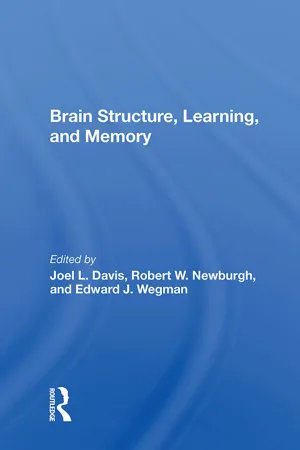
Brain Structure, Learning, And Memory
About this book
In science, a few areas particularly capture the imagination because of a combination of excitement, substantial technical progress, and implicit significance in affecting the nature and quality of life. Perhaps no area of science exhibits these characteristics more abundantly than that dealing with the brain. Once shrouded in the mystical, studies in modem brain science are dramatically enhancing our understanding of brain function and its impact on learning and memory. It is perhaps the union of pragmatic and mystical aspects that makes this such an exciting arena of science. The Office of Naval Research (ONR) began an intensive effort in 1983 on the topic of the neural basis for learning and memory. This effort was aimed at providing the scientific understanding of how learning takes place. It is the expectation that a neurological understanding of learning processes will lead to the formulation of learning strategies that will significantly enhance performance. This is important in a civilian and military population faced with serious manpower problems requiring a few individuals to be more expert with technologically intensive systems. With these motivations in mind, two of us (EJW and RN) formulated a full-day symposium at the AAAS annual meeting held in New York, May 1984.
Information
Table of contents
- Cover
- Half Title
- Series page
- Title
- Copyright
- Contents
- Preface
- Acknowledgments
- 1 LEARNING AND THE SINGLE CELL: CELLULAR STRATEGIES FOR INFORMATION STORAGE IN THE NERVOUS SYSTEM
- Habituation and Sensitization of the Gill and Siphon-Withdrawal Reflex
- Classical Conditioning of the Gill and Siphon-Withdrawal Reflex
- Learning and the Single Cell
- 2 RHYTHMIC ACTIVITY, SYNAPTIC CHANGES, AND THE "HOW AND WHAT" OF MEMORY STORAGE IN SIMPLE CORTICAL NETWORKS
- Introduction
- The Long-Term Potentiation Effect
- Activity Patterns and Long-Term Potentiation
- Some Network-Level Considerations
- LTP and Learning in Cortical Networks
- Discussion
- 3 LOCALIZATION OF THE ESSENTIAL MEMORY TRACE CIRCUIT FOR A LEARNED
- The Problem of Localization
- The Model Biological System Approach
- Cerebellum: The Locus of the Memory Trace?
- Conclusions and Speculations
- 4 KNOWLEDGE ACQUISITION ("LEARNING") BY THE SOMATOSENSORY CORTEX
- Introduction
- Experimental Bases for a Conceptual Model of Somatosensory Information Processing
- A Conceptual Model of Somatosensory Cortical Information Processing
- Mathematical Modeling of Neural Network Pattern Formation
- Discussion and Conclusions
- 5 STOCHASTIC MODELS OF NEURAL NETWORKS INVOLVED IN LEARNING AND MEMORY
- Introduction
- Stochastic Models for Subthreshold Neuronal Activities
- Randomly Stopped, Nonstationary Diffusion Processes
- Stochastic Point-Process Models and Applications to Neuronal Plasticity
- Cross-Correlation Surfaces of Simultaneously Recorded Spike Trains
- Estimation of Cross-Correlation Surfaces and Intensity Processes
- Applications to Multicellular Recordings in Studies of Neuronal Plasticity
- 6 LOCAL AND GLOBAL FACTORS IN LEARNING
- Networks That Remember
- Networks That Learn
- Summary of Related Visual Cortex Experimental Data
- Modification of Cortical Synapses: Local and Global Variables
- Extension to Networks
- Experimental Test of Changes in Inhibitory Activity Due to Visual Experience
- Possible Candidates for Global Controllers
- 7 COMPONENTS OF EXPERIMENTAL LEARNING
- The CEL Framework for Information Storage and Retrieval
- Contingency and Salience Assignment
- Latency: Learning When to Respond
- Related Work
- Conclusions
- 8 NEURAL DYNAMICS OF CATEGORY LEARNING AND RECOGNITION: ATTENTION, MEMORY CONSOLIDATION, AND AMNESIA
- Introduction: Self-Organization of Recognition Categories
- Bottom-Up Adaptive Filtering and Contrast-Enhancement in Short-Term Memory
- Top-Down Template Matching and Stabilization of Code Learning
- Attentional Gain Control and Attentional Priming
- Matching: The 2/3 Rule
- Direct Access to Subsets and Supersets
- Weber Law Rule and Associative Decay Rule for Long-Term Memory
- Fast Learning and Slow Learning: The Direct Access Rule
- Stable Choices in Short-Term Memory
- Order of Search and the Subset Recoding Property
- An Example of Code Instability
- Search of Subsets, Supersets, and Mixed Sets
- The Nature of Categorical Invariance During Learning
- Vigilance, Orienting, and Reset
- Distinguishing Signal from Noise in Patterns of Variable Complexity: Weighing the Evidence
- Vigilance Level Tunes Categorical Coarseness: Environmental Feedback
- Universal Recognition Design Across Modalities
- Interdisciplinary Relationship: Word Recognition, Evoked Potentials, and Medial Temporal Amnesia
- APPENDIX — Network Equations
- LTM Equations
- STM Reset System
- Contributors
- Index
Trusted by 375,005 students
Access to over 1.5 million titles for a fair monthly price.
Study more efficiently using our study tools.
Frequently asked questions
Yes, you can cancel anytime from the Subscription tab in your account settings on the Perlego website. Your subscription will stay active until the end of your current billing period. Learn how to cancel your subscription
No, books cannot be downloaded as external files, such as PDFs, for use outside of Perlego. However, you can download books within the Perlego app for offline reading on mobile or tablet. Learn how to download books offline
Perlego offers two plans: Essential and Complete
- Essential is ideal for learners and professionals who enjoy exploring a wide range of subjects. Access the Essential Library with 800,000+ trusted titles and best-sellers across business, personal growth, and the humanities. Includes unlimited reading time and Standard Read Aloud voice.
- Complete: Perfect for advanced learners and researchers needing full, unrestricted access. Unlock 1.5M+ books across hundreds of subjects, including academic and specialized titles. The Complete Plan also includes advanced features like Premium Read Aloud and Research Assistant.
We are an online textbook subscription service, where you can get access to an entire online library for less than the price of a single book per month. With over 1.5 million books across 990+ topics, we’ve got you covered! Learn about our mission
Look out for the read-aloud symbol on your next book to see if you can listen to it. The read-aloud tool reads text aloud for you, highlighting the text as it is being read. You can pause it, speed it up and slow it down. Learn more about Read Aloud
Yes! You can use the Perlego app on both iOS and Android devices to read anytime, anywhere — even offline. Perfect for commutes or when you’re on the go.
Please note we cannot support devices running on iOS 13 and Android 7 or earlier. Learn more about using the app
Please note we cannot support devices running on iOS 13 and Android 7 or earlier. Learn more about using the app
Yes, you can access Brain Structure, Learning, And Memory by Joel Lance Davis in PDF and/or ePUB format, as well as other popular books in Social Sciences & Sociology. We have over 1.5 million books available in our catalogue for you to explore.