~S~
Sample
Everyday use: a part used for purposes of testing the whole.
Research use: a group of informants selected from a larger group in the hope that they are representative of the larger group in the variable(s) under study. If this is the case, then studying the sample can reveal potentially important information about the population from which it is drawn.
Example: studying a sample of midwives should produce generalisable data concerning their attitudes and approaches which are in some ways true of all midwives.
Related terms: generalisability; population; representative; sampling frame.
Sampling
Everyday use: taking a proportion of subjects from a larger population.
Research use: used to reflect the generalisability of effects observed in the chosen group to the larger population.
Example: in a marketing survey (examining views of a shop product), choosing a systematic sample (e.g. every fifth person walking into a shop) and asking him/her to be an informant would ensure that people are represented from different backgrounds, cultures and age groups.
Related terms: random sample; sample.
Sampling bias
Everyday use: an error which means that the sample does not reflect the larger population from which it was chosen.
Research use: used to express the extent to which the findings are not generalisable.
Example: asking a sample of passers-by in a staunch Conservative area about their political loyalties and voting intentions prior to a General Election is unlikely accurately to reflect the views of the total British electorate.
Related term: sampling error.
Sampling distribution
Everyday use: the way the scores fall in any set of results.
Research use: how the scores from a specific sample are ordered. It is used to arrange the data to facilitate analysis.
Example: measuring the blood pressure of all men aged between 35 and 50 years working in a specific company could materially help to establish national norms. The data could be arranged from highest to lowest in systolic and diastolic phases. This ordering could then be ‘pooled’ with similar data to help establish population norms.
Related terms: frequency; norm; sample.
Sampling error
Everyday use: the extent of error in sampling.
Research use: a statistical measure to represent the amount of error in a research sample.
Example: if one were to ask 100 factory staff if they had ever misused equipment, and 30 per cent said they had, this may be a close enough sample of the entire population of factory staff. However, suppose the figure was ‘out’ by 5 per cent, the true figure could vary between 25 and 35 per cent. The sampling error here would therefore be plus or minus 5 per cent.
Related term: sampling bias.
Sampling frame
Everyday use: the group from which your sample will be chosen.
Research use: a carefully defined description of the ‘eligible group’ from which the study sample will be selected.
Example: if, in surveying staff morale, you decided to question every fifth driver parking his/her car in the car park, the total number of cars parked there on a defined occasion would constitute the sampling frame. Note that this sampling frame does not include the total number of staff, since some may not have cars.
Related terms: population; sample.
Scale/scalar
Everyday use: an instrument used to weigh or measure a quality or attribute (e.g. weight, height, density). The term scalar is an adjective meaning having the properties of, or related to, a scale. Scalar data are data which can be arranged in a logical order or sequence.
Research use: scales can vary between the finely calibrated, highly accurate instruments used in the natural sciences and the more global, verbal instruments typically used in the social sciences.
Examples: physical scales (e.g. manometer; micrometer screwgauge; haemocytometer; sphygmomanometer): psychological scales (e.g. Wechsler Intelligence Scale for Children (WISC); Wechsler Adult Intelligence Scale (WAIS); Minnesota Multiphasic Personality Inventory (MMPI); Eysenck Personality Inventory (EPI); General Health Questionnaire (GHQ)).
Related terms: calibration; interval scale; nominal scale; ordinal scale; ratio scale.
Scatter/scatter gram
Everyday use: the pattern produced by plotting two or more variables on a graph.
Research use: the pattern produced by the graph indicates the strength and direction of any relationship(s) between the variables.
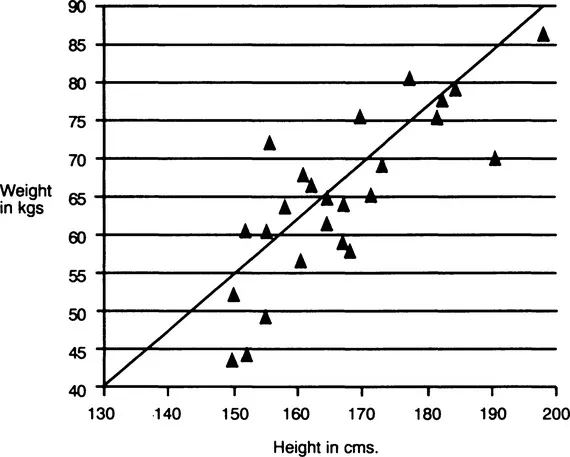
Example: height and weight are two closely correlated variables which might be plotted in this way to produce a scattergram within which any anomalies would be readily detectable.
Related terms: correlation; variable.
Schedule
Everyday use: a schedule is some form of orderly list.
Research use: typically a list setting out the order and format of questions to be asked during a research interview. Alternatively it may be a checklist of research activities to be completed during a typical data collection session.
Figure 5 Scattergram showing positive correlational pattern of height and weight (N = 25)
Example: an interview schedule may be very detailed or only indicate broad areas for questions. Specific questions in a survey of staff morale might include: ‘What do you feel is the main cause of low staff morale?’ or ‘What helps to promote high staff morale?’
Related term: interview.
Science
Everyday use: (1) the process of gaining knowledge by systematic study; (2) a body of accumulated expert knowledge.
Research use: investigation of the natural and social world by empirical methods, with observation and questioning as its two fundamental methods. Natural sciences study the properties of the natural world (e.g. physics; chemistry; biology). Social sciences focus on the study of human culture and interaction (e.g. anthropology; sociology; psychology).
Example: in a behavioural study, the contingencies surrounding a particular maladaptive behaviour are observed to determine which environmental factors are reinforcing the behaviour.
Related terms: descriptive; empirical; hypothesis; theory.
Scientific
Everyday use: of, or pertaining to, the pursuit of science. A person who carries out scientific research within a specific scientific discipline is known as a scientist.
Research use: adjective related to ‘science’, indicating systematic study and the precise, logical, sequenced stages by which a scientific investigation is carried out. Systematic and rigorous steps to ensure that research is credible and worthwhile.
Example: typical scientific research involves testing hypotheses by the collection, analysis and interpretation of research data.
Related term: science.
Score
Everyday use: to keep a record.
Research use: in order to keep a record of something the researcher marks a record or makes a note of something that happens. This may be a tally (making a mark every time something happens). Adding these together creates a score.
Example: during data collection a researcher uses a Likert type scale to record what people think about a food product. Using a 5 point Likert type scale liking the product would be a score of 1 through to not liking it which would be a score of 5. Adding these scores up would indicate, for example, the higher the score, the less people would like the product.
Related terms: frequency; questionnaire.
Secondary data
Everyday use: ‘second-hand’ data; not original.
Research use: data obtained in studies previously completed by self or others, which are now used to inform a further empirical investigation, or as a subject of further critical study.
Example: in carrying out a critical study of the work of Sigmund Freud, the research...