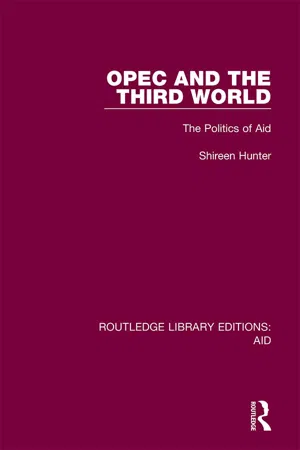
Originally published in 1984 this book focuses principally on the use of foreign aid by the members of OPEC in the 1970s and demonstrates how the divisive elements both within OPEC and between OPEC and the rest of the developing world prevented OPEC from using aid to advance developing world objectives. It explains why the OPEC countries filed to achieve the goals they set for themselves and will be of interest to all those concerned with the politics of the developing world, development assistance, Middle East regional economics and political and security issues.
- 334 pages
- English
- ePUB (mobile friendly)
- Available on iOS & Android
eBook - ePub
1 HISTORICAL FRAMEWORK
I The Genesis of OPEC
As is so often the case with a major historical event, the creation of the Organisation of Petroleum Exporting Countries was prompted by two sets of factors: those related to events occurring in the immediate past, and those connected with more deeply rooted forces that had shaped the pattern of international relations since the end of the Second World War.
The immediate factors were the two unilateral and arbitrary reductions of oil prices by the international oil companies in February 1959 and August 1960. These price reductions had a determining effect on the creation of OPEC by galvanising the oil producers to take action to counter the erosion of their economic position. Yet at the same time, the establishment of an association of oil producers would not have been possible if certain developments had not taken place within both these and other developing countries. Likewise, the emergence of new ideas and concepts regarding international economic relations, the relationship between developing and industrialised countries, and factors stimulating cooperation among developing countries all contributed to OPEC’s establishment.
International Factors
In the world that developed following the end of the Second World War, nationalism emerged as the main force animating Afro-Asian and Latin American countries. This rising nationalism – as developed over the years – has had diverse manifestations, of which the political and economic aspects have had the most far-reaching effect on the development of international political and economic relations. On the political level, the objectives of emerging Third World nationalism were to end colonial domination, to take charge of their own destinies, and to play a more effective role in global affairs – particularly in those matters that directly affected their vital interests.
On the economic level, their goals were to generate and encourage international cooperation in the field of development assistance, and to establish their sovereign rights over their natural resources. For several reasons, the oil producing countries in time came to play a major role in advancing these objectives, particularly in economics. First, a number of major oil producing countries – such as Iran and Venezuela – had been independent countries even at the beginning of the post-war era of rapid decolonisation, although they continued to be subjected to varying degrees of foreign influence and manipulation. Yet this relative independence meant that these countries could shift their focus from political liberation and the struggle for independence to economic independence. Second, the visibility of their oil industries – as the only developed sectors of their economies – inevitably made them the focus of their emerging nationalism, and thus gave rise to the phenomenon of oil nationalism. Third, a growing number of oil experts in these countries – or oil technocrats, as they were called – used their expertise to advance the nationalistic aims of their respective countries – a process that finally led to the setting up of OPEC.
The potential role of the oil producing countries as a harbinger of broader economic developments in the Third World was graphically illustrated by Iran’s decision in 1951 to nationalise its oil industry – though the importance of this act was imperfectly understood at the time. This was indeed a dramatic crystalisation of a trend which had been gradually gathering strength and was to gain even more. A year later, the UN General Assembly began to take cognisance of this trend in a broader sphere. In its seventh session, the United Nations General Assembly passed the first resolution recognising the right of the developing nations to exploit freely their natural wealth and resources. The language of the resolution was tame compared to later UN documents, such as The Charter of the Economic Rights and Duties of States, but this fact did not reduce its significance. Of course, it is not possible to prove a cause and effect relationship between Iranian oil nationalisation and the passage of this resolution, yet the fact remains that both acts were manifestations of the same trend.
In the years that followed, the oil producers and other Third World countries became more interactive, and thus their efforts gradually came to reinforce one another. For instance, when in the early 1950s the terms of trade of the Third World countries started to deteriorate, this development generated a debate among these states on the need to find remedial measures. The oil producing countries were among the first victims of this trend, although their situation was somewhat different from that of other developing countries, given the special characteristics of the international oil market. It was natural, therefore, that the oil producers were in the forefront of efforts by raw material producers to gain some real influence over market forces, and also that after the founding of OPEC its members should use the argument of deteriorating terms of trade as justification for their actions.1
OPEC was created in 1960 and – in a development analogous to what had happened a decade earlier with Iran’s nationalisation of oil industries – the UN again took a significant step forward on behalf of developing countries in general. In 1962, the UN General Assembly passed Resolution 1803 (XVII), recognising permanent sovereignty of states over their natural resources. Then in 1964, the first United Nations Conference on Trade and Development (UNCTAD) was held in Geneva. Again, although it is not easy to establish a cause and effect relationship between the creation of OPEC and these succeeding developments, the trend was evident.
It was also clear that the creation of OPEC did much to intensify the need felt among Third World countries for closer cooperation in order to achieve their political and economic objectives. Yet at the same time, OPEC to a certain extent owed its own existence to the cooperative trends that had emerged in the Third World and were manifested in such events as the Bandung Conference of Afro-Asian Countries in 1955.
The focus of these early efforts was mainly political – aimed at mitigating the effects of the polarisation of the world political system and the Cold War. But during the 1960s, as the Cold War subsided and the world started to move towards a more diffuse system of power relations – and as the process of decolonisation neared completion – the focus of Third World cooperation shifted towards economic issues. Already in 1962, a large number of developing countries held a conference in Cairo on the problems of development. Later, with the establishment .of UNCTAD (1964) and the emergence of the so-called Group of 77, Third World cooperative efforts became more focused and semi-institutionalised.
Since then, the OPEC countries have continued to interact with other Third World countries and, although economic changes within the developing countries have introduced more complexity into OPEC-developing country relations, they continue to do so. In fact, some OPEC members have at times seen their membership as a way of contributing to general Third World efforts to affect the evolution of international economic relations in directions most responsive to their needs.2
In addition to general international factors, developments in the countries of the Arab Middle East – particularly the re-emergence after the Second World War of ideas regarding Arab unity and the role assigned to oil in its achievement – also played a part in speeding up the process that finally led to the creation of OPEC. It is interesting to note, however, that as the goal of Arab unity proved to be elusive, so – despite early intra-Arab efforts at cooperation in oil matters – the creation of OPEC was only made possible by the Arab oil producers’ moving away from such ideals. Intra-Arab divergences and the existence at the time of two major non-Arab oil producers – namely Iran and Venezuela – made this inevitable as oil politics and Arab politics failed to mesh sufficiently.
Conflicting Views of Oil
Early attempts at cooperation among oil producing countries had begun as early as 1945. Given the fact that some Arab countries were major oil producers, ‘The Arab League entertained the idea of creating a petroleum association of Arab countries . . .’; but it soon became clear that ‘to be efficacious, the association envisaged had to include the non-Arab large exporters of petroleum, notably Iran and Venezuela’.3
Furthermore, divergences among Arab countries regarding their economic, political, and ideological priorities made very difficult the reaching of a consensus on the form, scope, and objectives of such an association. The most fundamental division among the League’s members was that between the oil producers and the other Arab countries.
The League’s major concern since its creation, and in particular since the 1948 Arab defeat in Palestine, has been the defence of the sovereignty and territorial integrity of Arab states. Therefore, it has tried to organise and coordinate defence efforts of the Arab states. Even economic cooperation was designed first and foremost to strengthen the Arabs’ defensive capabilities by harnessing all their natural and human resources.
Given this frame of mind, it was thus natural for the Arab League to view oil – the most important natural resource in the Arab world – as ‘essentially a strategic instrument of defence’, and to see the coordination of Arab oil policies as a means for countering and, if possible, of frustrating Israeli expansion into neighbouring Arab territories.4
Also, despite the fact that the League’s objectives fell short of the ideal of Arab unity, Pan-Arabist feelings were strong among its members. According to Pan-Arabist philosophy, oil was a wealth that belonged to the whole of the Arab nation and thus should serve its needs. On the economic level, this meant that oil wealth should be distributed among all Arab peoples and that a coordinated Arab oil policy was the most efficient way of achieving this goal. In fact, some advocates of this approach went as far as to make the achievement of Arab unity contingent upon the more equitable distribution of oil wealth among the Arab peoples. For example, Emile Bustani, the well-known Lebanese statesman who was one of the most ardent and outspoken defendants of this approach, said that:
Until the non-oil producing states are allowed to benefit proportionately from the wealth accruing from Arab oil, there could be no settled progress in the Arab world, and Arab unity, even though inevitable, will remain far distant. The well-being of the Arabs tomorrow depends almost entirely upon some sensible re-allocation of oil wealth today.5
The non-producers – the so-called ‘transit countries’ through whose territories or ports part of the Arab oil was exported – had special grievances against the oil producers. To quote Bustani again, they considered that: The transit countries, without whose cooperation Arab oil could never reach the Western market in its present abundance, should be enabled to profit from the ever-expanding business to a much greater extent than they do today.’6 Likewise, the Syrian position on what should constitute a unified Arab oil policy reflected its own particular interest as a transit country.7
Neither was the attitude of Egypt – the leading power in the Arab world – clear towards the issue of oil and its place in Arab politics. On the contrary, Egypt’s attitude was both ambivalent and ambiguous. According to one expert writing about Egyptian oil policy during the 1950s and the 1960s:
Two tendencies have vied with each other in Egyptian oil thinking. On the one hand the Egyptian government has sought to give the impression that it is not interested in benefitting from the oil revenues of the major Arab oil producers, and to that extent it has refrained from setting itself as a pioneer of oil policies in the Arab world. On the other hand, in the course of its general propaganda campaigns against the traditional regimes, it has inveighed against deplorable squandering of oil revenues by the privileged classes. This has led Egypt, in accordance with its cult of the masses, to preach the ill-defined gospel of some kind of people’s takeover bid.8
By contrast, however, attitudes toward oil matters were developing in totally different directions within the oil producing countries. The new generation of indigenous oil experts that had emerged in these countries played a vital role in proposing alternative philosophies. They believed that, ultimately, the oil producers’ success in obtaining better terms from their concessionaires depended on their full understanding of the workings of the intricate oil industry, and upon the adoption of a pragmatic rather than emotional approach to oil matters. In order to develop such an attitude, they argued in favour both of keeping oil affairs divorced from politics and of informing and educating the public in oil matters.
Prevalence of National Interest
The point of view of the Arab oil technocrats finally prevailed. First, it echoed the national interest of oil producing countries that were hardly willing to share their as yet limited revenues with those Arab countries that did not have it. This reluctance was further strengthened by the fact that some of these ‘have-not’ Arabs – notably Egypt – were establishing radical political systems and were bent on changing the regimes of the Arab oil producers, as well. Second, the injection of overly-political and ideological dimensions into issues that needed a pragmatic and apolitical approach was viewed as counterproductive by these technocrats. However, by far the most important reason was that the first view would have cle...
Table of contents
- Cover
- Half Title
- Title Page
- Copyright Page
- Original Title Page
- Original Copyright Page
- Contents
- Dedication
- List of Tables
- List of Abbreviations
- Preface
- Introduction
- 1 Historial Framework
- 2 The Politics of OPEC Aid
- 3 Case Studies: Iran and Saudi Arabia
- 4 The Nature of OPEC Aid
- 5 Channels of OPEC Aid
- 6 Conclusions
- Appendix: Text of the Solemn Declaration of OPEC Heads of State and Government, 6 March 1975
- Bibliography
- Index
Trusted by 375,005 students
Access to over 1.5 million titles for a fair monthly price.
Study more efficiently using our study tools.
Frequently asked questions
Yes, you can cancel anytime from the Subscription tab in your account settings on the Perlego website. Your subscription will stay active until the end of your current billing period. Learn how to cancel your subscription
No, books cannot be downloaded as external files, such as PDFs, for use outside of Perlego. However, you can download books within the Perlego app for offline reading on mobile or tablet. Learn how to download books offline
Perlego offers two plans: Essential and Complete
- Essential is ideal for learners and professionals who enjoy exploring a wide range of subjects. Access the Essential Library with 800,000+ trusted titles and best-sellers across business, personal growth, and the humanities. Includes unlimited reading time and Standard Read Aloud voice.
- Complete: Perfect for advanced learners and researchers needing full, unrestricted access. Unlock 1.5M+ books across hundreds of subjects, including academic and specialized titles. The Complete Plan also includes advanced features like Premium Read Aloud and Research Assistant.
We are an online textbook subscription service, where you can get access to an entire online library for less than the price of a single book per month. With over 1.5 million books across 990+ topics, we’ve got you covered! Learn about our mission
Look out for the read-aloud symbol on your next book to see if you can listen to it. The read-aloud tool reads text aloud for you, highlighting the text as it is being read. You can pause it, speed it up and slow it down. Learn more about Read Aloud
Yes! You can use the Perlego app on both iOS and Android devices to read anytime, anywhere — even offline. Perfect for commutes or when you’re on the go.
Please note we cannot support devices running on iOS 13 and Android 7 or earlier. Learn more about using the app
Please note we cannot support devices running on iOS 13 and Android 7 or earlier. Learn more about using the app
Yes, you can access OPEC and the Third World by Shireen Hunter in PDF and/or ePUB format, as well as other popular books in Business & Business General. We have over 1.5 million books available in our catalogue for you to explore.