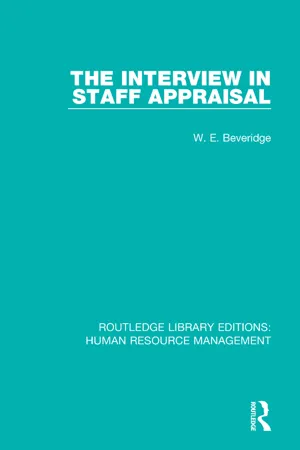
The Interview in Staff Appraisal, first published in 1975, sets out to ensure that the work appraisal is used constructively and within a well-designed system. The book provides personnel and training managers, and others responsible for the introduction of an appraisal system into their work organisation, with a detailed analysis of th
- 128 pages
- English
- ePUB (mobile friendly)
- Available on iOS & Android
eBook - ePub
The Interview in Staff Appraisal
Chapter 1
Problems of Appraisal
From their earliest days people start eyeing each other critically. John is the fastest runner in the class and Mary the best at spelling. This is an appraisal that is simple and relatively easy to make. Heats in running are held and John emerges as the overall winner; Mary spells more words correctly in the test than anyone else. In later life appraisal is likely to be more complex and less easily carried out. Mary can fairly easily be appraised as a better cook than Lucy or Susan but how does John decide whether or not she will make him a better wife? What criterion or criteria does he use? What exactly is meant by a ‘good wife’? Would a ‘good wife’ mean the same for John as it does for Dave or Ian?
In the industrial or business organisation we cannot pit managers against each other to test their efficiency as we do athletes in a race, and again we have the problem of what criteria to use. How do we define an ‘efficient manager’? Is he the man with the capacity to improve profitability? Or to establish a happy work-force with little labour turnover and no strikes? Or to employ the skills of workers in a creative and fulfilling manner? Or all of these? Or only some of them? Or perhaps none of them?
Of course there are some appraisal situations even in adult life which seem at first sight comparatively simple. In the machine shop Tom is the fastest man on the drills and if all we are concerned about is Tom’s rate of production we have sufficiently appraised his utility as a worker. But if Tom’s speed at work has resulted in resentment by other members of the work-force and in consequence has led to a series of arguments and disagreements which have brought about stoppages and hold-ups, then not only his rate of production but the effect of this upon his fellow workers may also have to enter into our assessment of his usefulness to the organisation. Before we can appraise, we have to identify the criteria against which our appraisal takes place, and the more complex the job the more complex the criteria. Tom’s utility as a machine-shop operator seems to be determined not only by his production rate and the quality of his work but also by his relationships with the other people in the shop. The good worker, we may decide, must be high on diligence, skill and co-operation. These are traits; we use them as criteria against which to measure our man.
Managers too can be described in this way. A staff reporting scheme in one organisation listed the following traits, among others, against which their staff should be measured: Intelligence, reliability, accuracy, diligence, tact, flexibility, confidence, penetration, fluency and imagination. Managers responsible for completing the form claimed they found the task very difficult. Not surprisingly, for problems arise as soon as we attempt to interpret such trait words; some of them at least seem likely to mean quite different things to different people.
A manager in one company told me of an incident when his immediate superior was filling in his appraisal form. The subordinate could read the words upside down as his boss marked them off. The boss put a cross against the word ‘forceful’ and, mindful of the fact that the form would eventually be filed at the firm’s head office and the information on it presumably noted, the subordinate protested that he felt this assessment was wrong. ‘Oh, surely not’, replied his manager. ‘I’ve certainly never regarded you as one of those pushing, unpleasant types.’ On that difference in interpretation might have depended the subordinate’s career prospects. The ascription of traits to persons in this way is a subjective process which it is difficult to contradict. I state that Mr Jones is flexible or loyal and if you disagree, it is only your opinion against mine. Whose view will count for more in the long run will probably depend on our relative standing in the organisational hierarchy.
Describing persons in trait terms thus presents difficulties: it is a subjective process and there is no certainty that appraisers are using words with the same meaning. Instead therefore of attempting to describe what kind of man an ‘effective manager’ should be, perhaps we could attempt to describe what a manager does which makes him effective. We could use words or phrases descriptive of behaviour rather than those descriptive of personal qualities or characteristics. Looking back to our examples of John and Mary at the beginning of the chapter, this would mean that instead of describing John as ‘athletic’ or ‘speedy’ and Mary as ‘intelligent’ or ‘bright’, with the confusion arising from all the possible interpretations that might be given to these words, we would simply describe what they had done. ‘John ran faster than anybody else in a series of races’, ‘Mary spelled more words correctly in a test than did any other members of her class’. There is less chance of these descriptive statements of behaviour being misunderstood.
This behavioural approach by no means solves all our problems. Admittedly we can observe and measure behaviour but there remains the question of what behaviour to observe and measure. We shall probably identify certain behaviours as more relevant than others to effectiveness in management but this at once plunges us back into the problem of subjectivity. To say that the manager who increases production output is behaving effectively is to imply that production output is a criterion of effective management, and this is a subjective judgement. Not everyone would agree that in every circumstance it is. The decision to use profitability or labour turnover or sales increases or any combination of these and other factors is inevitably subjective. I decide, or you decide, or we decide—and our decision is determined by subjective judgements about what in our opinion is relevant and important, though our opinion no doubt is an informed and carefully considered one.
A decision of this sort always has to be arbitrary and specific, that is, in one situation we decide that effective management means getting the organisation’s financial position into credit, in a second situation it means increasing productivity, and in a third the recruitment and training of a stable labour force and the achievement of an agreed production level. Ghiselli (1956) has said,
‘one college professor is considered good because he is an excellent teacher, and another because his research is very significant. This is not saying that an individual is to be considered good if he is high on any one criterion variable. Rather the notion is that while certain criterion variables are appropriate in describing the performance of some workers, they just are not pertinent in describing the performance of other workers on exactly the same job.’
Behaviour is observable and measurable but the selection of what criteria are pertinent and appropriate and against which we may therefore measure the observed behaviour is a subjective act.
Appraisal however becomes possible not as the judgement of one man’s personal characteristics by another but as the judgement of whether or not certain tasks are important and the identification of whether or not they were carried out. The man appraised is not measured by what he is (reliable, forceful, flexible, etc.), with all the attendant dangers of misunderstanding and disagreement, but by what he has done (achieved or not achieved a defined behavioural goal), which appears to offer less room for disagreement. Though the appraisee may feel as aggrieved by the latter style of appraisal as by the former if he himself has played what he regards as an inadequate part in helping to decide the relevance and realism of the behavioural goal—the criterion against which his performance is being measured. If the appraiser judges the appraisee as not sufficiently forceful or flexible or loyal, the appraisee may well argue that the appraiser is mistaken and feel aggrieved if the latter refuses to alter his judgement. But equally if the goal to be achieved was determined by the appraiser alone, the man appraised may feel aggrieved on the ground that the goal was irrelevant or impossible, that it failed to take into account such factors as inadequate machine maintenance or delays in obtaining raw materials, factors over which he had no control. Stedery and Kay (1966) found that, with supervisors in a manufacturing company, those perceiving the goal they had been set as ‘challenging’ had a 28 per cent decrease in defective items while those who saw it as ‘impossible’ actually had an increase of 35 per cent in fault units. The obvious way to ensure that a subordinate sees his work goals as realistic and relevant is to allow him a hand in deciding them. This means that the possibility of upward communication is essential if the appraisal is to lead to improved performance. The subordinate under appraisal must have the opportunity to make a constructive contribution towards defining his own work tasks and the standards against which to measure them. Otherwise the result as indicated by Stedery and Kay’s findings is likely to be not improvement but a positive deterioration in performance.
Meyer, Kay and French (1965) conducted an investigation of ninety-two manager-subordinate pairs in an American organisation. The results indicated that a manager’s attempts to assist a subordinate by pointing up improvement needs were likely to be perceived by the subordinate as threatening to his self-esteem and therefore resulted in defensive behaviour. The great majority (seventy-five of the ninety-two subordinates) saw their manager’s evaluation as being less favourable than their own self-estimates and regarded the appraisal as providing a deflating experience. It was found that after a period of ten to twelve weeks the aspects of performance most criticised showed least improvement. Meyer et al. concluded that
‘Comprehensive annual performance appraisals are of questionable value. Certainly a major objective of the manager in traditional appraisal discussions is motivating the subordinate to improve his performance. But the evidence we gathered indicated clearly that praise tended to have no effect, perhaps because it was regarded as the sandwich which surrounded the raw meat of criticism. And criticism itself brought on defensive reactions that were essentially denials of responsibility for a poor performance.’
Traditional forms of appraisal in which the appraisee feels that he himself is under judgement thus seem fraught with danger. Meyer et al. pointed out as one of their most significant findings ‘that far superior results were observed when the manager and the man together set specific goals to be achieved, rather than merely discussed needed improvement’. This is a management-by-objectives style of appraisal which lays emphasis on discussion of performance and in which attention is paid to shared goal planning and problem solving. The manager is seen as a counsellor and resource person rather than as a judge. In a study of 109 staff in three work organisations—a local authority, a hospital, and a food manufacturing and distribution company—it was shown that appraisal was perceived as significantly more useful and encouraging by those appraisees who were able to point to specific actions which had taken place in relation to their job or career as a consequence of appraisal than by those who could point to no such specific actions (Beveridge 1974). This means that the subordinate who, following his appraisal, can indicate that his job was restructured to give him more authority or he was sent on a training course which he and his manager had decided was relevant to his job performance or he was provided with additional needed resources or he was seconded to another department to widen his experience, etc. is likely to be more encouraged by the appraisal procedure and to evaluate its utility more highly than will the subordinate who merely talks things through with his manager but sees no consequences of the appraisal taking effect in relation to him or his job.
People who are not allowed to be constructive will often end up by deploying their energies to destructive behaviour. If their co-operation is not actively sought and given expression and recognition they may tend to express themselves in alternative activities that redound to the disadvantage of the organisation, in ‘go-slows’, sabotage and of course strike action. There is an increasing amount of evidence to show that many strikes which are apparently for more money may have less to do with money than with feelings of frustration about the nature of the work or the lack of possibility to use initiative and receive recognition and status. In the automobile industry the opposition to the introduction of measured day work which provides more secure wages seems to be largely motivated by the desire on the part of workers to retain the small degree of control over the work which is allowed by the piece-work system. If a man feels he is being treated as a thing rather than as a human being, he may express his resentment against the organisation which has put him in this invidious position by blocking the organisation’s activity. His role is negative rather than positive: ‘I will, so far as I can, prevent the organisation treating me like this.’ The organisation is perceived as preventing his interests and well-being rather than furthering them. He protects his dignity, his self-respect, his freedom of expression by hindering what he perceives as the organisation’s attempts to degrade him. David Wilson (1973) records the story of the worker who was convicted for jamming a £200,000 machine in a Midlands automobile plant. ‘He had been drilling holes in flywheels, seventy-four an hour for eight hours a day for ten years; he got deafened by the work, picked up a skin disorder, but above all was bored, monumentally bored. So he jammed the machine.’ More usually the worker simply sets out to make the organisation pay in hard cash for what it does to him. To obtain more money is unlikely to be an objective he can achieve on his own so he bands with others to form a union. ‘The man on the floor of the factory who can never realistically hope to rise in the company hierarchy finds a common fate with his fellows similarly situated. They can only improve their lot by joining forces as an interest group against the more privileged members of the organisation’, states Katz (1964). By ‘the more privileged members’ Katz means those whose views are taken account of, who have a say in the decision-making process of the organisation, who have a stake in what goes on. Beynon (1973) quotes a Ford’s shop steward as saying in reference to the men he represented, ‘I’m only a number in the company, but not with these men.’
Horwitz (1964) has pointed out that hostility to the organisation ‘depends less on how strongly the person feels about the issue than on whether he has received the weight he expects for his point of view’. Horwitz describes a series of experiments in which a number of persons acting as subordinates engaged in a problem solving exercise with others acting as their superiors. Both superiors and subordinates were informed in advance that their views would be given a certain weighting in the joint decision-making process. In two situations subordinates were told that the decision would be made wholly by the superior. In the first of these two situations however the superior was instructed to give the subordinate’s views equal weight with his own. He complied with this instruction; the subordinate was delighted to find his views allocated so much importance and rated the superior as compliant, fair and likeable, and the jointly obtained solution to the problem as good and defensible. In the second situation however the superior was told that the decision was to be entirely his. He carried out the instruction, thus behaving in the way his subordinate had been given to expect. Instead of being upset by the neglect of his views, the subordinate accepted the decision and, although he rated the superior as less compliant than did the subordinate in the first situation, he rated him as even higher on fairness and likeability, and the solution as equally good and defensible.
In a further two situations the subordinates were told to expect an equal share with their superiors in the decision-making process. In the first of these two situations the subordinate was given this equal share and rated his superior as compliant, fair and likeable, and the solution as good and defensible. In the second situation the superior pushed forward his own views, as he had been privately instructed to do, allowing no weight to the subordinate’s views but making the decision unilaterally; thus the subordinate’s expectation that he would have as much say in the decision as the superior went unfulfilled. In this situation the subordinate rated the superior as resistant, arbitrary and hostile and the solution as not good and one which he would not wholly be prepared to defend.
Hostility towards the superior by the subordinate was thus not felt in both the situations in which the subordinate was given no say in the decision but only in that one where he had expected a say but did not get it. Horwitz concludes that
‘What is critical is that his actual weight in decision-making has been reduced below his expectations. He gets the sense that his opinions or desires have not been sufficiently recognised or adequately taken into consideration by his supervisor. Thus hostility is a function, not of the weight a person has in joint decision making, not of the violation of his weight expectations alone but of the reduction of his expected weight in decision making.’
The implications are that those who expect to share in the decision-making process because of their rank or expertise or long service in the organisation but are prevented from so sharing will feel this deprivation more deeply and resent it more intensely than will those whose lower rank in the organisation or whose lack of experience or relative newness to the situation lead them to make no such expectations of participation in decision-making. Thus the manager, the specialist, the union representative seem more likely to react against a denial of the possibility of sharing in decisions concerning the organisation than will the machine operator or clerk or labourer or even the relatively new manager. On this theory, professional people seem likely to expect a high level of participation in decisions affecting their work and status. In a study of 454 teachers employed in two school districts located in western New York State, Alutto and Belasco (1972) demonstrated the relationship between attitudinal militancy and decisional participation:
‘The most militant group of teachers were those experiencing decisional deprivation… . The least militant subjects were those who achieved equilibrium between participation desires and actions… . This provides definite support for the hypothesis that unfulfilled desires for participation in decision making provide the basis for much of the current militancy among professionals.’
In 1973 the present author undertook a study in a work organisation in which complex changes were being carried out and which employed a number of professional staff among whom there seemed a considerable degree of unease. This was expressed both verbally by staff members to each other and officially by the staff union to the organisation’s senior management. One division was selected and professional staff were asked to indicate their feelings on a nine-point scale in response to four questions: (a) How much weight do you think should be given to your views in decisions regarding changes in the organisation? (b) How much weight in fact do you think is given to your views in decisions regarding changes in the organisation? (c) How satisfied are you with the way changes are being carried out in the organisation? (d) How good do you rate the changes which are being carried out in the organisation? Of the fifty-four professional staff in the division, two were unavailable during the fortnight during which the inter...
Table of contents
- Cover
- Half Title
- Title Page
- Copyright Page
- Original Title Page
- Original Copyright Page
- Table of Contents
- Introduction
- 1 Problems of Appraisal
- 2 Our Perception of Other People
- 3 Appraising Work Performance
- 4 Appraisal as Upward Communication
- 5 Planning the Appraisal Interview
- 6 The Skills of the Appraisal Interview
- 7 Appraisal Forms
- 8 Training for Appraisal
- References
- Author Index
- Subject Index
Trusted by 375,005 students
Access to over 1.5 million titles for a fair monthly price.
Study more efficiently using our study tools.
Frequently asked questions
Yes, you can cancel anytime from the Subscription tab in your account settings on the Perlego website. Your subscription will stay active until the end of your current billing period. Learn how to cancel your subscription
No, books cannot be downloaded as external files, such as PDFs, for use outside of Perlego. However, you can download books within the Perlego app for offline reading on mobile or tablet. Learn how to download books offline
Perlego offers two plans: Essential and Complete
- Essential is ideal for learners and professionals who enjoy exploring a wide range of subjects. Access the Essential Library with 800,000+ trusted titles and best-sellers across business, personal growth, and the humanities. Includes unlimited reading time and Standard Read Aloud voice.
- Complete: Perfect for advanced learners and researchers needing full, unrestricted access. Unlock 1.5M+ books across hundreds of subjects, including academic and specialized titles. The Complete Plan also includes advanced features like Premium Read Aloud and Research Assistant.
We are an online textbook subscription service, where you can get access to an entire online library for less than the price of a single book per month. With over 1.5 million books across 990+ topics, we’ve got you covered! Learn about our mission
Look out for the read-aloud symbol on your next book to see if you can listen to it. The read-aloud tool reads text aloud for you, highlighting the text as it is being read. You can pause it, speed it up and slow it down. Learn more about Read Aloud
Yes! You can use the Perlego app on both iOS and Android devices to read anytime, anywhere — even offline. Perfect for commutes or when you’re on the go.
Please note we cannot support devices running on iOS 13 and Android 7 or earlier. Learn more about using the app
Please note we cannot support devices running on iOS 13 and Android 7 or earlier. Learn more about using the app
Yes, you can access The Interview in Staff Appraisal by W. E. Beveridge in PDF and/or ePUB format, as well as other popular books in Business & Business General. We have over 1.5 million books available in our catalogue for you to explore.