- 164 pages
- English
- ePUB (mobile friendly)
- Available on iOS & Android
eBook - ePub
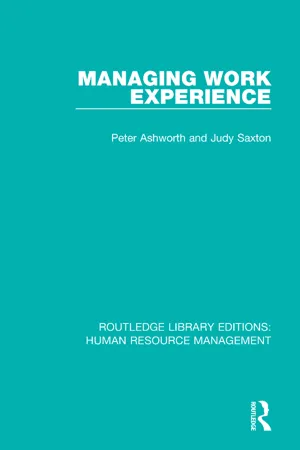
Managing Work Experience
About this book
This book, first published in 1992, sets out the belief that the placement element of courses should be designed from the start as a genuine educational experience. The learner most not merely live through experiences which are supposed to lead to personal and professional development, but must reflect on experiences in a way which is planned to
Information
Chapter 1
Introduction
There is a widespread and longstanding belief that any form of education or training which has the aim of preparing students for work ought to include some element of supervised work experience. Sandwich degrees, Higher National Diploma courses and BTEC National courses all exemplify this principle, but it is also found in other forms such as training programmes for nurses, teachers and social workers. Other firmly established professions also insist on practical experience before full membership is awarded, though the extent to which this is treated as an integral part of the education programme varies.
This book is written on the understanding that the ‘work placement’ element of courses should be designed from the start as a genuine educational experience. The placement should be a situation in which the learner - whether studying HND Chemistry, BA Business Studies, BTEC Social Care, or engaged in post-graduate teacher training - is not merely living through a set of experiences which are supposed to somehow lead to personal and professional development, but is reflecting on experiences in a way which is planned to lead to such development.
In addition, we are concerned here with the placement, meaning that the work experience is intended to be integrated with classroom learning rather than being tacked on, almost as an optional extra, merely to give a flavour of what ‘real work’ is like.
How can such placements be managed so as to give maximum educational benefit to the learner? What is the role of the supervisor at the workplace in this? How can students be encouraged to reflect on the situation and to develop learning opportunities themselves? The college tutor, visiting the student and the workplace supervisor, must have a part to play - but what is it? And how can assessment be designed to bring out the special kinds of learning which placements engender? All these questions are central to the theme of this book.
AN OUTLINE OF THE SHEFFIELD PROJECT
We have mentioned the wide range of kinds of supervised work experience that exists, and this book is intended to have much to say that is of value for each type. In the research project which forms the backdrop of knowledge on which the book is based, however, we focused mainly on the supervised work experience which forms a central of sandwich courses.
The British ‘sandwich degree’ is typically a four year course of study during which a year is devoted to employment relevant to the degree. In the ‘thick sandwich’ model, the student spends an intact year (the third year, generally) outside the walls of the institution of higher education. ‘Thin sandwich’ courses normally split the year of work experience into two separated periods of six months.
Despite the fact that the sandwich degree is well-established and widespread there has been little systematic study of this form of higher education. The major recent impetus for work concerned with supervised work experience in education has been the publication of the RISE Report (1985). The Committee on Research into Sandwich Education (RISE) was set up by the Department of Education and Science to coordinate a programme of research into the costs and benefits of sandwich education. The report concluded that ‘sandwich education provides identifiable and real benefits to the students’. However it was also found that there was a need for evaluation of placements to ensure their suitability, for greater flexibility in educational institutions, for stronger links between academic study and supervised work experience and for an increased willingness on the part of employers to offer placements.
As a result of the RISE Report, considerable work was carried out at various institutions, but this, regrettably, tended to be piecemeal, and to consist of survey-based projects, typically reflecting the current interest in the issue of assessment.
Our own work on the facilitation and assessment of learning on placements is based on a wealth of data from our own institution. Sheffield City Polytechnic currently has the largest number of students (about 4,500) enrolled on sandwich courses of any institution of higher education in the UK. With the commitment to this form of education which this implies, we were concerned to ensure that the quality of learning which takes place is maximised. As one step towards this, a small project team, supported by the Manpower Services Commission, as it was then, undertook a programme of development to enhance the experiential learning of placement students.
As part of this programme we compiled, over a two-year period, case-studies of placements using several methods but primarily involving visits to students at their place of work. We were careful to ensure, in particular, that we accompanied the visiting college tutor on the student’s placement visits. These visits meant that we could see the visiting tutor at work, meet the student’s workplace supervisor and gain some idea of the nature of the placement.
Throughout the project, and in this book, the terms ‘visiting tutors’ and ‘placement tutors’ refer to members of staff from the students’ academic courses who are responsible for the supervision of individual students during the placement period. The student’s ‘workplace supervisor’ is the member of the employing organisation’s staff who is responsible for the supervision of the student during the placement.
In all, a core sample of 78 placements was studied: 40 BA Public Administration (including a full year’s cohort of 32); 25 BA Business Studies (13 in year one of the project and 12 in year two), and 13 Chemistry placements (6 ‘thin sandwich’ BSc placements in year one, and 7 ‘thick sandwich’ Higher National Diploma placements in year two). This sample provided a very strong knowledge base despite being located in only one institution. Presentation of our work at seminars throughout the country and at three national conferences has led us to conclude that we can be satisfied that the picture which our research provides does not differ in any fundamental way from what is generally true of sandwich placements. Furthermore, although we concentrated on placements in higher education programmes we cannot find any way in which the overall picture of placements is different in other contexts. The findings and recommendations of the following chapters are relevant to the supervised work experience elements of courses generally. Indeed, the scheme for managing placements which we advocate here has been adopted by some further education courses.
THE SCOPE OF THIS BOOK
This book is intended to be of interest and practical value to those responsible for supervised work experience at all levels in further and higher education: for those people in industrial organisations taking on the key role of workplace supervisor as well as those in academic institutions.
We have also used much of our material in placement preparation seminars for students just about to go into their period of supervised work experience. We believe that, used selectively, several of the chapters in this book would be found valuable for this purpose.
In short, this book aims to debate some of the issues surrounding placements, and outlines one tried-and-tested procedure for managing them. Central is the idea that placements are to be treated as providing genuine educational experiences, so their management has as its foremost purpose the facilitation of learning in placement settings.
In the following chapter, then, we discuss the educational purpose of placements. Unless the course planning team is fully attuned to the idea that the placement has a clear purpose within the total philosophy of the course, it can hardly be expected that the management of placement work experience will properly encourage reflection and development. Naturally, in the past, reasons have been given for including a placement element in a course, but the reasons have rarely been fully worked out. In particular, the precise ways in which theory and practice are supposed to relate have not been specified, nor have the kinds of personal development which the placement is supposed to encourage been clearly outlined. These issues are opened up for debate in Chapter Two.
The focus of Chapter Three is the student. It is the student who is the central character in placements, of course; and it is his or her workplace learning that the placement is almost entirely about. But it is important to realise that learning does not take place in a vacuum; the position of a student within an organisation needs to be very soundly grasped if learning is to be effectively managed. In fact, the role of the student is an ambiguous one. The student is in a strange situation which has unique difficulties and dilemmas. In this chapter we argue that some of these difficulties are not only inevitable, but sources of valuable experience which ought to be capitalised on. (Naturally, there are also difficulties which can and should be minimised.)
It is part of the job of the visiting tutor to distinguish inevitable and educationally valuable difficulties which the student faces from difficulties which stand in the way of proper learning in the workplace. And it is the role of the visiting tutor from the college which we focus on in Chapter Four. Though this person has an essential part to play in making the placement into a learning experience, very little attention is paid to the tutor: typically, they are simply sent out to ‘see how the student is getting on’. In this chapter, then, we describe some of the tasks which the visiting tutor should ideally perform, and some key attitudes which he or she ought to adopt.
Yet neither the visiting tutor nor any other individual based at the distant college can control the day-to-day experience of students on placement. College staff should welcome the opportunity to regard the workplace supervisor as the real teacher or mentor. He or she is on hand, monitoring the student’s performance and providing feedback; setting up tasks and regulating the workload. In Chapter Five, then, we consider the workplace supervisor as educator. We believe that the necessity of ceding educational responsibility to the workplace supervisor should be welcomed. But it also means that proper attention must be paid to the relationship between student and supervisor – a major theme of the chapter.
Assessment is perhaps the most hotly debated issue in the management of placements. We are adamant that the nature of placements should not be dictated by the requirements of assessment – the central thing must always be the facilitation of genuine learning. Nevertheless, the questions surrounding assessment are certainly important, and we devote both Chapter Six and Chapter Seven to them.
In Chapter Six we are concerned with the human problems of assessing. Whatever is done to make assessment more technically sound (ensuring that assessment is both reliable and valid), one can never get over the fact that, logically quite prior to these technical issues is the human process of assessing. Assessment of placement performance depends essentially on someone correctly perceiving the student’s work and making a judgement of it. This process is fallible and is necessarily fraught with difficulty. Yet it can be organised in a way which makes it worthwhile.
In Chapter Seven we outline a process of placement management and assessment, aimed at minimising the human error in assessment, but more importantly making assessment an integral part of the process of placement management. Thus, we show that a programme of ongoing formative assessment can both assist the student and workplace supervisor to reflect on the placement and the learning opportunities it affords, and also stimulate the student to become conscious of the learning process itself – surely most advantageous in the light of the primary educational purpose of supervised work experience. In this chapter we also show that a viable form of summative (end-of-placement) assessment can grow from the ongoing dialogue between student and workplace supervisor.
The argument of the book is brought together in Chapter Eight. Here we also provide evidence of the effectiveness of the placement management process outlined in the book. All good research has, as an in-built feature, some kind of evaluation. We were concerned to make sure that our claims about managing work experience could be justified, and it is in this final chapter that justification is given.
To make the book as valuable to educators as possible, we provide in the appendices various documents which, appropriately adapted, can form the basis of a system for managing, monitoring and assessing work placements.
Chapter 2
The educational purpose of placements
In the Manifesto of the Education for Capability movement the following paragraph appears:
The great majority of learners — whether pupils at school, students at universities, polytechnics or colleges, or adults still wanting to learn — are destined for a productive life of practical action. They are going to do things, design things, make things, organise things, for the most part in co-operation with other people. They need to improve their Competence, by the practice of skills and the use of knowledge; to Cope better with their own lives and the problems that confront them and society; to develop their Creative abilities; and, above all, to Co-operate with other people.
(RSA, 1980)
It is clear to us that the placement is a most valuable way to make the Education for Capability ideals come true. The objective of providing an opportunity for the emergence of those traits which go under the rubric ‘Capability’ is absolutely central to placements. But what, in det...
Table of contents
- Cover
- Half Title
- Title Page
- Copyright Page
- Original Title Page
- Original Copyright Page
- Table of Contents
- Acknowledgements
- 1 Introduction
- 2 The educational purpose of placements
- 3 The ambiguous role of the student
- 4 The visiting tutor: skills and attitudes
- 5 The workplace supervisor as educator
- 6 Assessment: human problems of assessing
- 7 The process of placement management and assessment
- 8 Managing work experience
- References
- Appendices
- Index
Trusted by 375,005 students
Access to over 1.5 million titles for a fair monthly price.
Study more efficiently using our study tools.
Frequently asked questions
Yes, you can cancel anytime from the Subscription tab in your account settings on the Perlego website. Your subscription will stay active until the end of your current billing period. Learn how to cancel your subscription
No, books cannot be downloaded as external files, such as PDFs, for use outside of Perlego. However, you can download books within the Perlego app for offline reading on mobile or tablet. Learn how to download books offline
Perlego offers two plans: Essential and Complete
- Essential is ideal for learners and professionals who enjoy exploring a wide range of subjects. Access the Essential Library with 800,000+ trusted titles and best-sellers across business, personal growth, and the humanities. Includes unlimited reading time and Standard Read Aloud voice.
- Complete: Perfect for advanced learners and researchers needing full, unrestricted access. Unlock 1.5M+ books across hundreds of subjects, including academic and specialized titles. The Complete Plan also includes advanced features like Premium Read Aloud and Research Assistant.
We are an online textbook subscription service, where you can get access to an entire online library for less than the price of a single book per month. With over 1.5 million books across 990+ topics, we’ve got you covered! Learn about our mission
Look out for the read-aloud symbol on your next book to see if you can listen to it. The read-aloud tool reads text aloud for you, highlighting the text as it is being read. You can pause it, speed it up and slow it down. Learn more about Read Aloud
Yes! You can use the Perlego app on both iOS and Android devices to read anytime, anywhere — even offline. Perfect for commutes or when you’re on the go.
Please note we cannot support devices running on iOS 13 and Android 7 or earlier. Learn more about using the app
Please note we cannot support devices running on iOS 13 and Android 7 or earlier. Learn more about using the app
Yes, you can access Managing Work Experience by Peter Ashworth,Judy Saxton in PDF and/or ePUB format, as well as other popular books in Negocios y empresa & Negocios en general. We have over 1.5 million books available in our catalogue for you to explore.