Originally published in 1994, this book links the distant past with the urgent problems of today, taking the reader on a literary and scientific tour of global pollution from pre-history to the post-industrial age. Ancient problems such as lead poisoning in Rome and water pollution in Mesopotamia provide the background to a discussion of modern catastrophes including the hole in the ozone layer, climate change and the global drinking water crisis. The book chronicles 800 years of pollution in London, charts the growth of environmental activism and spotlights the rise of the consumer society as the driving force behind today's malaise.
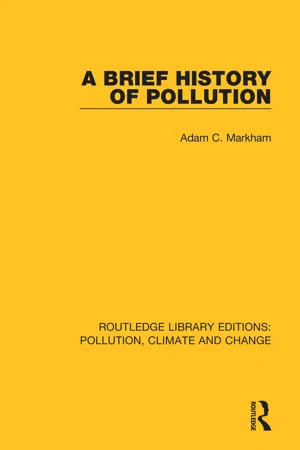
- 174 pages
- English
- ePUB (mobile friendly)
- Available on iOS & Android
eBook - ePub
A Brief History of Pollution
About this book
Information
Chapter One
A BRIEF HISTORY OF POLLUTION
Wherever the Dragon advances, the world darkens.It belches clouds of soot and smoke, engulfing allthat is living in its burning breath.Folke Isaksson
Soiling the Garden of Eden
Older than civilization, pollution has been a problem since the appearance of our earliest ancestors. The adulteration of water, soil and air by the physical and chemical waste products of human activity has accompanied our species since it first walked upon the earth. And from prehistoric times, pollution has been inextricably linked to health and medicine.
Palaeopathologist Paul Janssens1 suggested that:
Medicine precedes religion. The preservation of life whether generally or individually fulfills an inborn need or instinct. It finds expression within the framework of medicine before any notion of religious feeling, since sickness has to exist before it can be looked upon as the punishment of an angry deity.
Much early sickness was undoubtedly caused by what we would today, call pollution. The very earliest form of pollution must have resulted from the act of defecation. The presence of human gut bacteria such as Escherichia coli in drinking water was the first water pollution and must have been a source of illness for prehistoric man, just as it is for millions of people today.
The discovery of fire, at least half a million years ago, created the first significant air pollution source, and smoke remains a major problem in the modern world. Ancient human communities are thought to have suffered from sinusitis and blackening of the lungs (anthracosis) due to regular exposure to smoke.2
Dust pollution also has early origins and Janssens speculated that the Neolithic miners of central Europe, who daily chipped flints from limestone quarries like that of Obourg, suffered from silicosis. Their every breath during the working day would have drawn in air polluted with dust from their labours.3 Simple geography sometimes influenced historical exposure to pollutants. Recent analysis of the 200,000 year old Broken Hill hominid from Zambia has produced evidence that he suffered from lead poisoning due to an ore lode underlying the water supply of the cave dwelling.4
The transition from hunter-gathering to nomadic herding systems and eventually to settled agriculture during the Neolithic period has been described as ‘the most fundamental change in human history.’5 By allowing output of food to increase, the concept of ‘property’ to develop, and surplus food production to grow, the agricultural transition became the basis of a human revolution. Food surpluses enabled the development of non-farmers within society, including the priesthood, the army and craftsmen. The distribution and collection of food was the basis for power and the development of wealth, and the ability to produce more from a smaller area of land laid the basis for population growth.
Out of agriculture, grew the community. Small villages at first, then towns and eventually city-states. Jericho was a walled town of ten acres in 6500 BC, and the Mesopotamian temple city of Uruk had a population of 50,000 people by 3000 BC. For a modern comparison it is noteworthy that the French city of Toulouse had only reached a population of 55,000 nearly 5000 years later in 1789.6 This development of towns and cities ushered in the pollution era.
There hasn’t always been an encompassing word for the filth, grime, miasma, smoke, slime, sludge and generally disagreeable and dangerous substances that contaminate our world. As late as 1783, Dr Johnson defined pollution as ‘the act of defiling’ or ‘the contrary of consecration’. The verb, according to Johnson, meant ‘to make unclean in the religious sense’ or to ‘taint with guilt.’7 The use of the word pollution in its current sense only gained currency in the nineteenth century.
In 1972 the British biologist Kenneth Mellanby defined pollution as the ‘presence of toxic materials introduced into our environment by man’,8 but it can also mean the disruption of natural soil and water regimes by the displacement or mobilization of natural substances. A classic modern example is the pollution of rivers and coastal ecosystems by soil and silt washed off the land due to deforestation or poor agricultural practices. Salinization is another phenomenon in this category, and it was this that destroyed Sumerian civilization.
Over a period of about 1700 years, from 3500 BC to 1800 BC, Sumarian agriculture declined and wheat productivity fell because of salt pollution. When flat land is irrigated, as it was in southern Mesopotamia, lack of proper drainage causes the water to seep into the underlying groundwater and raise the water table. As the soil becomes waterlogged, salts rise and high levels of evaporation from the soil surface leave salt crusted on the fields. Having invented writing, the Sumerians were able to record that the ‘earth turned white’.9
According to the World Health Organization (WHO) and the United Nations Environment Programme (UNEP), even today ‘increasing salinity is one of the most significant and certainly the most widespread forms of groundwater pollution’. Salinity now seriously affects 7 percent of the world’s irrigated crop land, mainly in India (24 percent of the total irrigated area), the USA, Pakistan, Iran, Iraq and Egypt.10 Thus a direct pollution lineage can be traced from ancient Sumer to the modern Middle East.
Unsanitary Conditions
The first sewage system was the Roman Cloaca Maxima, built in the sixth century BC during the Etruscan dynasty of the Tarquins. The initial purpose of this massive structure was to drain the swamp between the Palatine and Capitoline hills, leading eventually to the establishment of the Roman Forum, which became the hub of the Republic and later the Empire. The hydraulic pioneers of the ancient world, the Romans constructed a whole network of cloacae, or sewers, as well as a maze of aqueducts bringing water into the city.
Despite the lead taken by the Romans, public access to sanitation and safe water did not become a priority for most countries until the nineteenth century. The usual motivation behind the removal of organic waste and sewage was the problem of odour, the desire for clean drinking water, and a dislike of wading through streets running with ordure. The direct connection of disease-carrying organisms with water pollution was not proven until the second half of the nineteenth century, when the germ theorists finally proved their case against the miasmists.
The towns and villages of medieval Europe seem not to have been very sweet-smelling places. Pigs were a convenient means of removing waste, and what they didn’t eat would eventually be washed away by the rains. Many towns and cities had rudimentary regulations for the disposal of waste and teams of ‘rakers’ or ‘scavengers’ were often employed to remove garbage from the city. But by and large, the water management advances of the Roman Empire had been long forgotten.
Nevertheless, hard-pressed municipal administrations were already attempting to tackle water pollution problems in the early fourteenth century. An official investigation into the state of the Fleet River in London in 1307 concluded that the main cause of pollution was tanning waste and butchers’ offal from Smithfield market.11 In the same year, the Palace of Westminster installed a pipe connecting the King’s lavatory with another sewage pipe that had been constructed earlier to remove waste from the palace kitchen.12 Needless to say, this was not a privilege available to many commoners, and most people’s sewage continued to flow direct from privies jutting over the river, or into the open gullies and trenches that ran down the streets. Sewers and cesspools were being developed, but their efficacy was doubtful. Sewers were often blocked (and in any case simply emptied into the nearest river or stream), while cesspools stank, overflowed and tended to leak into neighbours’ wells.
Fines for pollution were already being levied in London at this time. A 1306 proclamation on air pollution from coal threatened offenders with ‘grievous ransoms’13 and by 1345 householders could be fined two shillings for not removing filth and refuse from outside their dwelling.14 In the late fifteenth century the secretary to the Venetian ambassador wrote with amazement of the existence of laws banning the killing of ravens and kites, because ‘they keep the streets of the town free from all filth.’15
Pollution and the Plague
By most accounts, the medieval world was more conscious of sanitation than the later renaissance civilization, but it didn’t prevent Europe succumbing to bubonic plague. Philip Ziegler chronicled the impacts of the great pestilence as it swept through Europe, in his classic book The Black Death.16
The plague of 1347 was a disease caused by a bacteria carried by fleas and spread by rats. It came in the wake of widespread death and starvation caused by soil exhaustion and population growth and compounded by extremes of cold weather and high rainfall. The rats themselves had probably arrived in the boats of crusaders returning from the middle east, and they flourished in the overcrowded and unsanitary conditions of medieval Europe. The famine-weakened populace and the virtually uncontrolled flow of sewage through the streets and into the rivers of most European cities provided ideal conditions for the Black Death. Unchecked in its spread, the pandemic probably killed a third of the people in Europe over a period of just two and a half years.
The medical knowledge of the time was unable to explain the plague, but the idea of ‘corruption’ of the air held sway among doctors. Ziegler credits Ibn Khatimah from Granada with the idea that ‘the very nature of the air might be permanently changed by putrefaction’. Alfonso of Cordoba believed someone was waging germ warfare ‘since air can be infected artificially’, and that the evil doer needed only to prepare the dastardly ‘confection’ in a glass flask and then break the container into the wind so that ‘the vapour pours out and is dispersed in the air’. Ziegler himself says ‘almost every fourteenth century savant or doctor took it for granted that the corruption of the atmosphere was a prime cause of the Black Death’. Although completely wrong, like the second century Greek physician Galen before them, these medieval medics were laying the conceptual foundations for the study of invisible air pollution.
The plague also precipitated a pogrom against the Jews. Despite the fact that most people believed the disease to be spread through the air, the Jews were blamed for deliberately poisoning the wells. Through the winter of 1348 and on into the next year, the citizens of town after town in central Europe massacred Jews. In Basle they were penned in wooden buildings and burned alive; 600 Jews were killed in Brussels and similar inhumanities occurred in Stuttgart, Freiburg, Dresden, Erfurt, Barcelona and a host of other cities.
In trying to explain the blame that was so brutally conferred on the Jews, Philip Ziegler suggests:
many wells were polluted by seepage from nearby sewage pits. The Jews, with their greater understanding of elementary hygiene, preferred to draw their drinking water from open streams.... Such a habit, barely noticed in normal times, would seem intensely suspicious in the event of plague.
Dealing with Waste
The problem of management of the disposal of human sewage and organic waste persisted well into the nineteenth century in most colonial nations and still curses much of the Third World. Clive Ponting describes how in 1366, the butchers of Paris were made to dispose of their animal wastes outside the city; how the same citizens, prior to the revolution, used a row of yew trees in the Tuileries as a pissoir and how the method of street cleaning in Madrid at the end of the seventeenth century was merely to empty barrels of water and ‘let the filth run off.’17 The water closet, or WC, was invented by an English poet, Sir John Harrington, in 1589 but because of Elizabethan England’s complete indifference to dirt and its lack of sewage piping, this sanitary innovation was ignored. It was not until 1778, when Joseph Bramah began marketing his own patented closet, that the use of WCs began to be taken seriously.
The unsupportable stench of city pollution was a commonplace throughout Europe for centuries. Travellers to Narbonne in ...
Table of contents
- Cover
- Half Title
- Title Page
- Copyright Page
- Original Title Page
- Original Copyright Page
- Dedication
- Epigraph
- Table of Contents
- Acknowledgements
- Preface
- 1. A Brief History of Pollution
- 2. The City as Source of Pollution
- 3. Why Care? Pollution, Nature and Ethics
- 4. The First Consumer Revolution
- 5. Water Pollution and Chemical Contamination
- 6. The Poisoned Atmosphere
- 7. An all Consuming Passion
- 8. Energy and Survival
- 9. Pollution in the Making: The Example of Asia
- 10. The Politics of Pollution
- Notes and references
- Index
Trusted by 375,005 students
Access to over 1.5 million titles for a fair monthly price.
Study more efficiently using our study tools.
Frequently asked questions
Yes, you can cancel anytime from the Subscription tab in your account settings on the Perlego website. Your subscription will stay active until the end of your current billing period. Learn how to cancel your subscription
No, books cannot be downloaded as external files, such as PDFs, for use outside of Perlego. However, you can download books within the Perlego app for offline reading on mobile or tablet. Learn how to download books offline
Perlego offers two plans: Essential and Complete
- Essential is ideal for learners and professionals who enjoy exploring a wide range of subjects. Access the Essential Library with 800,000+ trusted titles and best-sellers across business, personal growth, and the humanities. Includes unlimited reading time and Standard Read Aloud voice.
- Complete: Perfect for advanced learners and researchers needing full, unrestricted access. Unlock 1.5M+ books across hundreds of subjects, including academic and specialized titles. The Complete Plan also includes advanced features like Premium Read Aloud and Research Assistant.
We are an online textbook subscription service, where you can get access to an entire online library for less than the price of a single book per month. With over 1.5 million books across 990+ topics, we’ve got you covered! Learn about our mission
Look out for the read-aloud symbol on your next book to see if you can listen to it. The read-aloud tool reads text aloud for you, highlighting the text as it is being read. You can pause it, speed it up and slow it down. Learn more about Read Aloud
Yes! You can use the Perlego app on both iOS and Android devices to read anytime, anywhere — even offline. Perfect for commutes or when you’re on the go.
Please note we cannot support devices running on iOS 13 and Android 7 or earlier. Learn more about using the app
Please note we cannot support devices running on iOS 13 and Android 7 or earlier. Learn more about using the app
Yes, you can access A Brief History of Pollution by Adam C. Markham in PDF and/or ePUB format, as well as other popular books in Ciencias biológicas & Negocios en general. We have over 1.5 million books available in our catalogue for you to explore.