First published in 1997, this volume features analysis of one of the fastest growing areas in Asia for gross national product, trade and commerce: the Association of South East Asian Nations (ASEAN). Of its members, Singapore has achieved a GDP exceeding Spain, Ireland and New Zealand, with Brunei Darussalam close to that mark. The other four countries, on their current trajectories, are expected to soon join the Newly Industrialized Economies (NIE) of Asia which already include Hong Kong, Taiwan, South Korea and Singapore. This collaboration consists of six analyses of the six member countries of the ASEAN: Brunei's socio-economic policies, Indonesia's political and economic reforms, the implementation of the New Economic Policy (NEP) in Malaysia, the development policies in the Philippines, the successful role of socio-economic state intervention in Singapore and the double-digit growth conditions in Thailand.
- 130 pages
- English
- ePUB (mobile friendly)
- Available on iOS & Android
eBook - ePub
About this book
Information
1Economie and social policies of Brunei: an empirical analysis
Shamim A. Siddiqui, Abdul A. Hashim
University of Brunei Darussalam
Abu N.M. Wahid
Tennessee State University
Abstract
The discovery of oil in 1929 has been a major political and economic event in the modem history of Brunei Darussalam. After the great oil crunch of the 1973-74 and the subsequent increase in the oil price, the society and economy of Brunei entered into a threshold of transformation process. This paper is an attempt to examine and analyze this transformation process. It argues that in the midst of the transition, the prime policy goal of the government of Brunei is to diversify the economy and reduce its absolute dependence on oil and gas. In order to do that Brunei must be able to encourage the growth and development of the domestic industries without disturbing the market mechanism. At the same time, it should be able to attract direct foreign investment in Brunei by creating appropriate congenial conditions.
Introduction
Brunei is a small Southeast Asian country. It is located on the northwest coast of Borneo facing the South China Sea. The country is enclosed on the landward side by Malaysian province of Sarawak. Brunei is a mere enclave of 2,226 square miles with a population of less than 0.3 million. In 1993, the per capita GDP for Brunei was US $14,360. The history of this ancient trading Sultanate1 dates back to the sixth and seventh centuries AD. During the fourteenth and fifteenth centuries A.D., Brunei was a powerful Muslim Kingdom covering the entire land mass of Borneo stretched deep into the islands of the Philippines. In January 1, 1984, Brunei became a full-fledged independent country after almost 100 years of British protection. Soon after, in quick succession, Brunei became a member of the Association of South East Asian Nations (ASEAN), the Organization of Islamic Conference (OIC), the British Commonwealth and the United Nations Organization (UNO). The country is run under the official ideology of Malay Muslim Monarchy.
The discovery of oil in 1929 has been a major political and economic event in the modern history of Brunei. Since then, the interest of the international community increased suddenly on Brunei. After the great oil crunch of the 1973-74 and the subsequent four-fold increase in the oil price, the society and the economy of Brunei entered into a threshold of rapid transformation process.
This chapter is an attempt to examine and analyze the transition that is underway in the society and economy of Brunei. It will primarily focus on the socioeconomic problems and their implications for public policy in Brunei.
A brief review of literature
The volume of literature on modem Brunei is relatively small. One of the earliest works on Brunei was done by L. W. Jones in 1966. In a section of his book, Population of Borneo, Jones focused on the origin, composition, current growth rate and future projections of the population of Brunei. It also briefly analyzed some rudimentary economic activities in which the people of Brunei were involved .
Nicholas Tarling in his book, Britain, the Brooks and Brunei, addressed the modem history of Brunei in detail. According to Tarling, the British took control of Sarawak— formerly a part of Brunei and gained a formal influence over the Sultan of Brunei in 1847 through James Brook, a Victorian explorer of British origin who came to Brunei in 1838. At that time, Britain developed a trade link with Brunei. Neither Jones nor Tarling examined the socioeconomic dynamics of Brunei. In fact Brunei had been a stagnant society up until oil and gas were discovered in that land in 1929. Thereafter, trade, commerce and economic activities began to grow rapidly.
Since 1973-74, Brunei started sending diplomatic and trade representatives around the world and the society and the people of Brunei began to receive world exposure. Most of the literature available on Brunei today are government documents covering plain description of the history, society, and economy of Brunei.
The U.S. Department of State collects and publishes profile of Brunei as it does for many other countries of the world every year on a regular basis. This is a brief fact sheet about the geography, people, history, politics, economy, and trade which is used as a handy policy guide by the diplomatic decision makers. This profile does not attempt to give an in-depth analysis of the changing socioeconomic structure of Brunei. Gale Research Institute also publishes a chapter on Brunei in its, Countries of the World and Their Leaders series. This is subject to the same criticism as the U.S. State Department’s profile on Brunei. Nigel Holloway contributed a feature to the Far Eastern Economic Review in 1987 on the monarchy of Brunei. This has just been a journalistic description with no depth or rigor about how monarchy works.
A major work on the economy of Brunei came out in 1986. The author-Sritua Arief, in his book, The Brunei Economy gave a general description of the economy of Brunei. It covers almost all sectors of the economy such as agriculture, manufacturing, trade of oil and gas, monetary institutions and the development planning of the country. The basic weakness of Arief’s book is that it does not discuss the role of government and political or social forces of Brunei in shaping the manpower planning determining money supply and framing the public health policies etc.
Resource base of the Brunei economy
Oil and gas
Since the discovery of first oil field in 1929, oil and gas represent the backbone of the Brunei economy. Despite a decline over the years (83.7 percent of GDP in 1980 and 72.2 percent in 1985), its contribution to GDP was nearly 39 percent in 1993. While in the later half of 1980s, oil production was pegged at around 150,000 barrels per day, production of oil in 1993 was 170,000 barrels per day. The Brunei Shell Petroleum (BSP) in which the Brunei government is the equal partner with Royal Dutch Shell Company, has seven offshore and two onshore oil fields. Another active concession holder is Jasra-Elf, which commenced operation actively a few years ago. Almost 90 percent of its oil comes from offshore fields.
Brunei is the world’s fourth largest producer of Liquefied Natural Gas (LNG) which is mainly exported to Japan. A second 20 year contract was signed in 1993 between Cold Gas of Brunei and three Japanese companies. Under this new contract, Brunei Shell will supply 5.54 million tons of LNG per annum to three Japanese power companies-Tokyo Electric Power, Tokyo Gas and Osaka Gas. Brunei’s LNG plant at Lumut which is one of the largest in the world was upgraded and expanded in 1993 at a cost of B$100 million. Revenue from LNG produce is almost as significant as oil in the export and royalty profile of Brunei since the late 1970s.
The pattern of oil and gas reserves is difficult to evaluate because of lack of access to confidential data. According to a new estimate, the life of Brunei’s oil reserve at the current level of production is 70 years.2 Other conservative estimates claim that the known reserves will exhaust in 27 years.3 On the other hand, proven natural gas reserves at the current rate of production is expected to last for another forty years.
The revenue generated by the sale of oil and gas has resulted in budget surplus over the years which has been invested in foreign countries that generates a substantial amount of income. Although, the actual amount of foreign assets is kept confidential, the London-based weekly magazine Economist‘s “Country Profile for 1992-93” estimates the amount at US $35 billion. Furthermore, it is also asserted that the yearly income generated by these assets now surpasses the combined annual income from oil and natural gas.
Agriculture, forestry and fishing
The agro-economy of Brunei contributed just over 2 percent to GDP in 1993. Presently, the country imports 80 percent of its food requirements. Although land, finance and irrigation are all available and the government has established model farms to train potential farmers, the scarcity of manpower has failed to increase agricultural output and achieve even a very modest target for rice production i.e. 18 percent of the total requirement. A large supply of meat is imported from Sultanate’s cattle ranch in Australia4. There is a great potential for the development of orchards as there is a wide variety of fruits available in the country. Large scale less labor intensive, mechanized fruit plantation could be a great success in Brunei.
Forests are considered Brunei’s most permanent assets. About 81 percent of total land area of Brunei is covered with diverse forest types such as mangrove, peat, swamp, heath, mixed dipterocarp and montane. Nearly 58 percent of the country is under primary forest cover. Unlike the other neighboring countries, forests have not been fully exploited for timber and other commercial uses due to the availability of revenue from hydro carbon resources. Forestry exports are prohibited by law. Under strict control of the authorities timber production is limited to 100,000 cubic meter per annum for local consumption.
Although Brunei has one of the highest consumption of sea food, its total annual sea food production is only 1,726 tons which is short of its local needs. Large areas have been identified suitable for shrimp, prawn, and fish culture. In the Sixth Five Year National Development Plan (1990-95), B$28 million has been allocated for the development of this sector.
Human resource
The total population of Brunei Darussalam was 260,000 in 1991 growing at a rate of 3 percent per annum. Out of this, the local population, including permanent residents, was 189,956 about 73 percent of the total. The local population grew at the rate of 2.5 percent during 1981-91. The Muslims, mainly Malays, constituted about 82.2 percent oflocal population in 1991, compared to about 77.1 percent in 1981.5 Although the population of foreigners is about 27 percent, foreign workers constitute 37 percent of the employed labor force. Almost all foreign workers stay in the country with legal documents. The major categories of foreign workers are domestic servants, construction workers and highly qualified teachers and other professionals in the government service.
It is estimated that at present, about 35 percent of the local labor force is women which is significantly higher than many developing countries with Muslim majority. Women in Brunei take all types of jobs and play a very important role in the development of the country. The number of expatriate workers is continuously rising. At the same time, however, the unemployment rate among local population has risen from 4.82 percent in 1981 to about 7 percent in 1991.6 This has been a cause of concern for the authorities in Brunei. It is generally understood that the main reason for this problem is mismatch.
Sectoral contribution to GDP
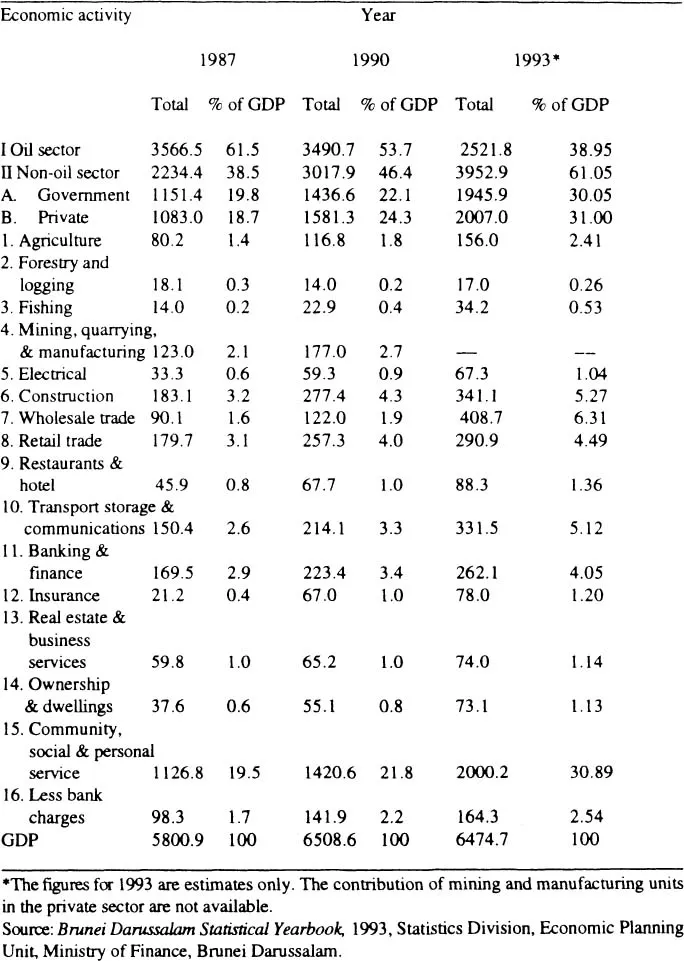
Table 1.1 shows the composition of gross domestic product (GDP) by kind of economic activities. It clearly exposes the role of oil sector in the economy. Although somewhat decreased, its contribution has remained significant at 38.95 percent in 1993. The decline in its share is both due to depressed international price for crude oil and government’s conservation policy to rationalize the output of this exhaustible resource. The major part of the non-oil sector which is estimated to be 61.05 percent of GDP in 1993, is contributed by the government which is about 30 percent of the non-oil sector. Whatever private sector activities are there, they are still highly dependent on government activities.7 The contribution of manufacturing sector is merely 1.7 percent and that of agriculture 1.2 percent. Social services which include education and health, both under the government, remain the most important segment of the non-oil sector.
Table 1.1
GDP by kind of economic activities at current prices (totals are in million B$)
GDP by kind of economic activities at current prices (totals are in million B$)
Over the last two decades, the government has made large investments in foreign countries. A special investment agency looks after these investments but details of financial and non-financial assets and their annual returns are kept confidential. The GNP figures for the country is therefore not published by the government.
Social and welfare policies
Literacy and education
The government of Brunei Darussalam provides free education up to the university level to all its citizens and permanent residents. The country has moved toward universal literacy. This is clearly described by Figure 1.1. The definition of literacy used in 1991 was the ability of a person to read and wri...
Table of contents
- Cover
- Half Title
- Dedication Page
- Title Page
- Copyright Page
- Table of Contents
- Preface
- 1 Economie and social policies of Brunei: an empirical analysis
- 2 Policy reforms in Indonesia: a political economy perspective
- 3 Malaysia in transition
- 4 Economie development in the Philippines: a frustrated take-off?
- 5 A brief assessment of Singapore’s economic miracle
- 6 An enduring lesson from Thailand’s economic performance
Trusted by 375,005 students
Access to over 1.5 million titles for a fair monthly price.
Study more efficiently using our study tools.
Frequently asked questions
Yes, you can cancel anytime from the Subscription tab in your account settings on the Perlego website. Your subscription will stay active until the end of your current billing period. Learn how to cancel your subscription
No, books cannot be downloaded as external files, such as PDFs, for use outside of Perlego. However, you can download books within the Perlego app for offline reading on mobile or tablet. Learn how to download books offline
Perlego offers two plans: Essential and Complete
- Essential is ideal for learners and professionals who enjoy exploring a wide range of subjects. Access the Essential Library with 800,000+ trusted titles and best-sellers across business, personal growth, and the humanities. Includes unlimited reading time and Standard Read Aloud voice.
- Complete: Perfect for advanced learners and researchers needing full, unrestricted access. Unlock 1.5M+ books across hundreds of subjects, including academic and specialized titles. The Complete Plan also includes advanced features like Premium Read Aloud and Research Assistant.
We are an online textbook subscription service, where you can get access to an entire online library for less than the price of a single book per month. With over 1.5 million books across 990+ topics, we’ve got you covered! Learn about our mission
Look out for the read-aloud symbol on your next book to see if you can listen to it. The read-aloud tool reads text aloud for you, highlighting the text as it is being read. You can pause it, speed it up and slow it down. Learn more about Read Aloud
Yes! You can use the Perlego app on both iOS and Android devices to read anytime, anywhere — even offline. Perfect for commutes or when you’re on the go.
Please note we cannot support devices running on iOS 13 and Android 7 or earlier. Learn more about using the app
Please note we cannot support devices running on iOS 13 and Android 7 or earlier. Learn more about using the app
Yes, you can access The ASEAN Region in Transition by Abu N. M. Wahid in PDF and/or ePUB format, as well as other popular books in Social Sciences & Sociology. We have over 1.5 million books available in our catalogue for you to explore.