First published in 1999, this volume is a study of regional and local co-operation across national borders in Denmark, Finland, Norway, Sweden and also of regional co-operation out of the area - across the Baltic Sea, the North Sea and in the Barents region. The focus of the study is on processes of region-building. Co-operation between regions across national borders is seen as a creative process, and as something that has to be nurtured and guided. The authors recognised the need for a work which examined issues crossing Nordic borders and made the information more publicly accessible, emerging within evolving discussions of regional governance, cross-border collaborations and Nordic co-operation. The editors have featured three forms of contributions: a series of regional case studies, collations of data on sub-national governments and relating these sub-national factors to debates on Nordic co-operation and European integration. Authors with specialist regional knowledge examine these processes in detail, through case studies which represent the most important of this type of Nordic area and provide a view of what may constitute 'success' in such ventures. The authors also discuss what such processes may signify for general Nordic co-operation against the backdrop of European integration and seek to indicate what Nordic regions may bring to European regionalism. Such a discussion is of particular interest since the EU acquired a new Nordic dimension when Sweden and Finland joined. Contributors' articles focus on areas including the Kvarken Council, the ARKO co-operation, the internationalisation of Finnish and Norwegian local government and the Øresund region. The collaboration was published in English in order to better contribute to discussions on cross-border interaction more widely, particularly in the case of Europe.
- 177 pages
- English
- ePUB (mobile friendly)
- Available on iOS & Android
eBook - ePub
Nordic Region-Building in a European Perspective
REGION-BUILDING ACROSS NORDIC BORDERS
2
Patterns in Nordic cross-border region-building - an overview
Mårten Johansson
At the time of the admission of Finland and Sweden to the European Union, Nordic transborder co-operation at the regional and local levels had had some twenty years experience of managing cross-border activity. These partnerships are rooted in regional and local administration. They have joint decision making bodies and joint management of their budgets. They operate in many fields of activity. To sum up, they appear to fully meet with the vision of the European Union of how transborder co-operation should work.
Description of Nordic transborder co-operation
Transborder co-operation in the Nordic area initially refers to nine established transborder regions on the internal borders of Denmark, Finland, Iceland, Norway, and Sweden. It also includes the self-governing areas of Greenland, the Faeroe Islands and the Aland Islands. The transborder regions co-operate on a broad range of issues and have a high involvement of local and regional partners.
On the next page is a map of the co-operative arrangements across the borders of the Nordic countries.
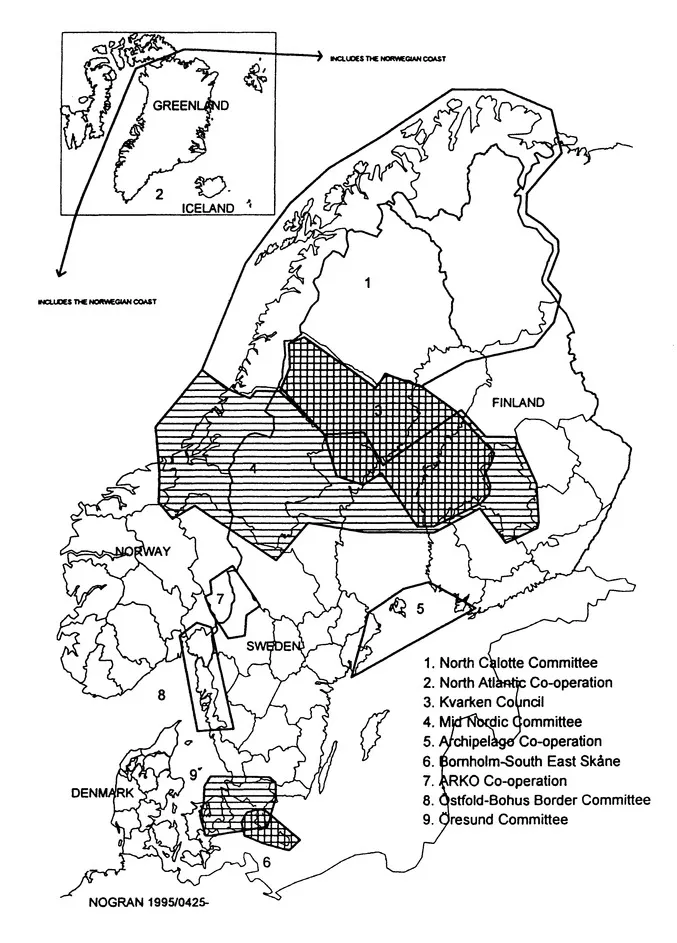
Figure 2.1 Nordic transborder co-operation regions
The nine Nordic transborder co-operation agreements include the following:
Nordkalottkommitten - The North Calotte Committee
Area: Nordland, Troms and Finnmark counties in Norway, Norrbotten county in Sweden, and the province of Lapland in Finland.
Population: 920,000.
Objective: To promote co-operation in the field of regional and labour market policy as well as joint projects with significance for employment and social development in the North Calotte area. Budget 1994: 27.3 million DKK
Main area of expenditure: Joint product development and marketing of tailored tourist products to attract customers from Central Europe to the North Calotte area (Club Nord, Green Initiative), Research and Development activities under extreme climate variations.
INTERREG eligibility: The area is fully eligible for INTERREG and is involved in two programmes, one covering the Nordic co-operation area the other the Barents area. Total budgets for the North Calotte INTERREG for the period 1995-99 is estimated at 40.7 MECU, of which the EU share is 12 MECU.
Secretariat: Rovaniemi (Finland), Lulea (Sweden) and Bodø (Norway).
Nordatlantiska samarbetet (previously Vastnordensamarbetet) - The North Atlantic Co-operation (previously West Nordic Co-operation)
Area: Greenland, the Faeroes (Denmark) and Iceland.
Enlargement 1995: An extension of the co-operation to include the Norwegian coastal regions and project based co-operation with Scottish islands took place in 1995.
Population: 360,000.
Objective: To create favourable development within the region by linking it more closely with other parts of the Nordic countries.
Budget 1994: 10.4 million DKK
Main area of expenditure: Monitoring common fish resources in the North Atlantic area and stimulating new fisheries-based business activities.
INTERREG eligibility: No part of the area is eligible under INTERREG. Secretariat: Torshavn (Faeroe Islands)
Kvarkenradet - The Kvarken Council
Area: The Province of Vaasa (Finland), Vasterbotten County and the municipality of Ornskioldsvik (Sweden).
Population: 800,000.
Objective: To stimulate and improve the conditions for the members of the partnership as well as to initiate, plan and manage joint projects.
Budget 1994: 11.6 million DKK
Main area of expenditure: Business co-operation (Bothnia-project in logistics, energy and subcontracting 5.8 million SEK, procurement of production of Arctic raspberry and sea buckthorn, joint export marketing of wooden products) and joint chamber music-festival orchestra (Vasa-Umeá). INTERREG eligibility: Part of the area (the county of Vasterbotten and the coastal parts of the province of Vaasa) is eligible for INTERREG. The INTERREG programme for 1995-99 also covers the following adjacent areas: the region of Etela-Pohjanmaa (Finland), Órnskióldsvik (Sweden) and the Helgeland part of county of Nordland (Norway). Total budget allocations amount to 16 MECU, of which EU funding is 5.5 MECU.
Secretariat: Vaasa/Vasa (Finland), Umeá (Sweden)
Mittnordenkommittéen - The Mid-Nordic Committee
Area: The counties of Nord-Tr0ndelag and Sør-Trøndelag in Norway, Jámtland and Vasternorrland counties in Sweden and the provinces of Vaasa and Keski-Suomi in Finland. The county of Møre og Romsdal and the provinces of Mikkeli and Kuopio are associate members.
Population: 1,500,000 (excluding associate members).
Objective: To co-ordinate the resources of the region in order to achieve an optimal and balanced development in the Mid-Nordic Region.
Budget 1994: 2.5 million DKK
Main area of expenditure: Partnership, internal round table discussions, studies and monitoring of opportunities and threats of European integration have been high-priority activity during 1994; cross-regional goods transport links (Mittlink) and air connections (Trondheim-Sundsvall) have been another important focus. Since 1994, co-operation with the Karelian Republic of Russia.
INTERREG eligibility: Only the county of Jámtland is eligible for INTERREG with Norway. The INTERREG programme for 1995-99 includes the counties of Jámtland, Nord-Trøndelag and Sør-Trøndelag and has a 25 MECU budget, of which 5.5 is EU funding.
Secretariat: Sundsvall (Sweden).
Skargárdssamarbetet - The Archipelago Co-operation
Area: The Archipelagos of Stockholm, Aland and South-West Finland comprising 40,000 islands.
Population: 16,000 (refers to the settlements on islands in the operational area) of a total of 50,000 inhabitants in the reference area.
Objective: To promote tangible co-operation in the three archipelagos focused on the conditions of the settled population and the demand for recreation from the surrounding conurbations (Stockholm, Uppsala, Äbo).
Budget 1994: 2.9 million DKK
Main area of expenditure: Integration of culture and handicrafts in developing tourism, joint tourist marketing in Central Europe and small scale tele-working.
INTERREG eligibility: The whole area is eligible for INTERREG. The total budget for 1995-99 amounts to 9 MECU, of which EU funding is 4 MECU. Secretariat: Mariehamn (Aland islands, Finland).
Bornholm-Sydöstra Skäne - Bornholm-South East Skäne
Area: Bornholm county in Denmark and South East Skäne Committee of Cooperation which comprises five municipalities in South East Skäne (Sweden).
Population: 135,000.
Objective: Improved transport, fewer administrative frontier obstacles and joint actions to promote a sense of cohesion in the region are important objectives for the Bornholm-South East Skäne region.
Budget 1994: 1.5 million DKK
Main area of expenditure: Joint tourist, cultural, communication and business projects focusing on the potential of the area as the Nordic ‘holiday-corner’. The project activities also include partners in Szczecin county (Poland) and North-East Germany.
INTERREG eligibility: Bornholm is eligible for INTERREG over the maritime borders of Poland, and the South East Skäne is included as an adjacent area in the INTERREG programme of Øresund. The traditional Bornholm-South East Skäne co-operation is however continuing outside the INTERREG.
Secretariat: Rönne (Bornholm/Denmark), Ystad (Sweden). ARKO-samarbetet - ARKO Co-operation.
Area: Nine Municipalities in Arvika-Kongsvinger region on the Norwegian- Swedish border. Population: 100,000.
Objective: To initiate projects to promote cross-border co-operation and improve living conditions for the inhabitants in the area. Budget 1994: 1.7 million DKK.
Main area of expenditure: Product development around the common wilderness ‘Finnskogen’ and joint tourist marketing activities. INTERREG eligibility: The counties of Varmland and Kopparberg (both in Sweden) are eligible. The ARKO co-operation thus constitutes a demarcated smaller part of a significantly bigger INTERREG border co-operation, called Inner Scandinavia. Its total budget amounts to 19 MECU of which EU funding is 9 MECU.
Secretariat: Morokulien on the Swedish-Norwegian borderline.
Granskommitten Østfold-Bohuslan - Østfold-Bohus Border Committee
Area: 17 municipalities along International Highway E6 between Oslo (Norway) and Gothenburg (Goteborg, Sweden). Population: 250,000.
Objective: To monitor the development in the border region and to initiate co-operation in different fields of activity. Budget 1994: 2 million DKK
Main area of expenditure: Culture and tourism. Establishment of the ‘Eco-museum’ programme showing the interaction of man in his cultural environment, and joint tourist marketing of ‘Expedition Skagerak’. INTERREG eligibility: The Swedish counties of Goteborg&Bohus and Alvsborg are eligible. The INTERREG-programme on the Norwegian border includes a somewhat larger area than the traditional Østfold-Bohus border cooperation. The programme budget for 1995-99 amounts to 24 MECU, of which 5.5 MECU is EU funding. Secretariat: Uddevalla (Sweden).
Øresundskommitteen - Øresund Committee
Area: Malmohus and Kristianstad counties in Sweden and the capital region of Denmark. Population: 3,200,000.
Objective: To strengthen and promote co-operation and integration between the areas on both sides of the Sound. Budget 1994: 2.4 million DKK
Main area of expenditure: Creation of a joint identity, business opportunities in the medical and social sciences.
INTERREG eligibility: Most of the region is eligible for INTERREG. The uncovered parts (Kristianstad and Roskilde) are, however, included as adjacent areas in the INTERREG programme. The programme budget for 1995-99 amounts to 28 MECU of which 13 MECU is EU funding. Secretariat: Copenhagen (Denmark).
Other transborder co-operation
In addition to these nine regions on the internal borders of the five Nordic countries, new initiatives to encourage co-operation have been undertaken for the larger islands (Aland, Bornholm, Gotland, Oland, Hiumaa, Saaremaa and Rtigen) in the Baltic Sea, and the regions around the Skagerak (Sweden, Norway, Denmark). Several Nordic regions are involved in transborder co-operation on the external borders with Russia, the Baltic States, Poland, and Germany.
Historic background of Nordic transborder co-operation
Transborder co-operation, as currently defined, has its roots in the 1960s. Co-operation between the Copenhagen region and Malmo and vicinities in the Sound or in the Øresund region (as it more frequently referred to), was formalised in 1964. Co-operation between a number of small municipalities of West-Varmland in Sweden and East Hedmark in Norway - The ARKO-cooperation - also originated in the early 1960s.
The North Calotte co-operation involving the Nordic regions above the Polar Circle was initiated by the governments of Finland, Norway, and Sweden in 1967. It started as an ad hoc-committee, with members from the five Northern counties as well as from the Ministries of Labour in the three countries.
In the 1970s, three transborder co-operations were formed (the Archipelago Co-operation, 1970; the Kvarken Council, 1972; the Mid-Nordic Co-operation, 1977/78).
The Nordic Council of Ministers was established in 1971 and its Nordic Committee of Nordic Senior Officials for Regional Policy (NERP) one year later (December 1972). Nordic funding of transborder organisations commenced with the North Calotte co-operation in 1975. The Kvarken Council received its first Nordic grant in 1979. Initially, funding was restricted to joint funding of administration and contributions based on applications for specific projects.
In 1979, an agreement on co-operation between the municipalities across Nordic national frontiers came into force. This was considered to be an important basis for regional cross-border co-operation in the Nordic countries. Important issues relating to co-operation encompass life, the environment, medical care, transport and tourism. In the same year the Nordic Council of Ministers adopted a programme of co-operation which gave impetus to transborder agreements. Three new transborder organisations were formed in 1980 (The West Nordic Co-operation, the Bornholm South East Skâne Committee and the Østfold-Bohus Border Committee).
In 1986, the Council of Ministers moved from project funding to programme funding. The transborder organisations submitted a one-year programme document together with a financial plan. Instead of assessing the eligibility of each individual project, the Nordic Committee of Regional Officials decided upon an annual lump sum contribution based on the programme documents. The revision of the Nordic funding in 1986 implied that the transborder management committees themselves could take decisions on project funding.
Between 1985 and 1988, Nordic funding was doubled from 11.1 million DKK to 22 million DKK, and has stayed at approximately the same level since.
In May 1990, the Nordic Council of Ministers adopted a programme for Nordic regional policy co-operation during the period 1990-94. The programme confirms that Nordic interregional co-operation should primarily be carried out as transborder co-operation. Other thematic interregional co-operation projects might also receive Nordic funding. Furthermore, the Council of Ministers decided to set out an operational programme for transborder co-operation. The primary aim was a revision of the areas eligible for Nordic funding, more distinct priorities for funding, and a reallocation of budgetary appropriations. The process commenced as a dialogue between the Nordic Committee of Senior Officials and the partnerships of all the transborder organisations involved, and continued during 1991. In most regions the strategy discussions led to fewer priorities/projects and a concentration of activities. A general reallocation of budget appropriations was made, but no organisations were excluded from Nordic funding.
The operational programme adopted by the Council of Ministers in November 1991 laid down new rules of procedure for funding transborder co-operation in the period 1992-94.
Re-organisation of the Ôresund Co-operation was one of the most prominent results of this strategy. The old organisation - Ôresundsrâdet (Ôresund Council) and Óresunds kontakt (Óresund Contact) - had weak political roots in the region and focused its activity mainly on supplying information. The old organisation was abolished and a new organisation called Ôresundskommittéen (Ôresund Committee, cfr. Chapter ...) established in 1992. The new organisation had strong political backing from the Danish Government and from the local and regional authorities on both sides of the Sound. The Danish-Swedish decision to build a bridge between Malmô and Copenhagen was the driving force behind the establishment of the new Ôresund Committee. In 1994 the Danish part of the Ôresund co-operation was approved as eligible under the EU INTERREG-initiative, the Swedish part one year later.
In 1992, the Faeroe Island’s representative proposed to the Nordic Council of Ministers an enlargement of the West Nordic Co-operation to include the coastal region of Norway. This initiative called ‘Nordiskt Atla...
Table of contents
- Cover
- Half Title
- Title Page
- Copyright Page
- Table of Contents
- Preface
- Introduction
- Region-Building Across Nordic Borders
- European Integration and Local Government
- Conclusions
- Contributor
Trusted by 375,005 students
Access to over 1.5 million titles for a fair monthly price.
Study more efficiently using our study tools.
Frequently asked questions
Yes, you can cancel anytime from the Subscription tab in your account settings on the Perlego website. Your subscription will stay active until the end of your current billing period. Learn how to cancel your subscription
No, books cannot be downloaded as external files, such as PDFs, for use outside of Perlego. However, you can download books within the Perlego app for offline reading on mobile or tablet. Learn how to download books offline
Perlego offers two plans: Essential and Complete
- Essential is ideal for learners and professionals who enjoy exploring a wide range of subjects. Access the Essential Library with 800,000+ trusted titles and best-sellers across business, personal growth, and the humanities. Includes unlimited reading time and Standard Read Aloud voice.
- Complete: Perfect for advanced learners and researchers needing full, unrestricted access. Unlock 1.5M+ books across hundreds of subjects, including academic and specialized titles. The Complete Plan also includes advanced features like Premium Read Aloud and Research Assistant.
We are an online textbook subscription service, where you can get access to an entire online library for less than the price of a single book per month. With over 1.5 million books across 990+ topics, we’ve got you covered! Learn about our mission
Look out for the read-aloud symbol on your next book to see if you can listen to it. The read-aloud tool reads text aloud for you, highlighting the text as it is being read. You can pause it, speed it up and slow it down. Learn more about Read Aloud
Yes! You can use the Perlego app on both iOS and Android devices to read anytime, anywhere — even offline. Perfect for commutes or when you’re on the go.
Please note we cannot support devices running on iOS 13 and Android 7 or earlier. Learn more about using the app
Please note we cannot support devices running on iOS 13 and Android 7 or earlier. Learn more about using the app
Yes, you can access Nordic Region-Building in a European Perspective by Harald Baldersheim,Krister Ståhlberg in PDF and/or ePUB format, as well as other popular books in Physical Sciences & Geography. We have over 1.5 million books available in our catalogue for you to explore.