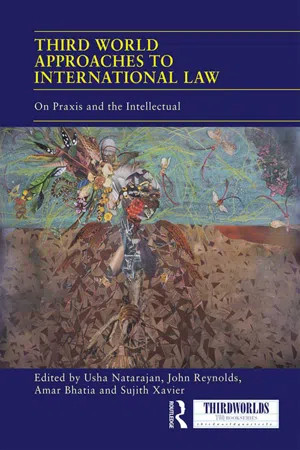
This book addresses the themes of praxis and the role of international lawyers as intellectuals and political actors engaging with questions of justice for Third World peoples. The book brings together 12 contributions from a total of 15 scholars working in the TWAIL (Third World Approaches to International Law) network or tradition. It includes chapters from some of the pioneering Third World jurists who have led this field since the time of decolonization, as well as prominent emerging scholars in the field. Broadly, the TWAIL orientation understands praxis as the relationship between what we say as scholars and what we do – as the inextricability of theory from lived experience. Understood in this way, praxis is central to TWAIL, as TWAIL scholars strive to reconcile international law's promise of justice with the proliferation of injustice in the world it purports to govern. Reconciliation occurs in the realm of praxis and TWAIL scholars engage in a variety of struggles, including those for greater self-awareness, disciplinary upheaval, and institutional resistance and transformation. The rich diversity of contributions in the book engage these themes and questions through the various prisms of international institutional engagement, world trade and investment law, critical comparative law, Palestine solidarity and decolonization, judicial education, revolutionary struggle against imperial sovereignty, Muslim Marxism, Third World intellectual traditions, Global South constitutionalism, and migration. This book was originally published as a special issue of Third World Quarterly.
eBook - ePub
Third World Approaches to International Law
On Praxis and the Intellectual
- 204 pages
- English
- ePUB (mobile friendly)
- Available on iOS & Android
eBook - ePub
Third World Approaches to International Law
On Praxis and the Intellectual
Foreword: Third World Approaches to International Law (TWAIL)
Richard Falk
This Special Issue of Third World Quarterly consists of a selection of papers initially presented at a 2015 conference under the auspices of TWAIL (Third World Approaches to International Law) at the American University in Cairo, and later revised for publication. TWAIL has been in existence for over 20 years, holding periodic conferences since 1995 and spearheading a self-conscious effort by international jurists from Asia, Africa, and Latin America to rethink international law from the perspective of the Global South. The Cairo gathering has added significance as the first TWAIL conference to be held in a Third World academic environment. Egypt also offered a geographical setting that called dramatic attention to a pattern of regional turbulence that cannot begin to be understood without a keen appreciation of both colonial legacies and post-colonial struggles that together constitute the unfinished agenda of decolonisation.
Contrary to the widespread impression that colonialism ends when national flags fly from governmental buildings, it is a premise of TWAIL that after political independence, the most difficult of challenges arise, above all decolonising the mind of both colonisers and colonised. In this sense, international legal studies and praxis is a crucial site of struggle as, by the persistence of Western-oriented international legal regimes, much of the Global South has remained trapped within structures evolved during the colonial era.
In this respect, it is notable that the sub-title given to the TWAIL Cairo Conference was ‘On Praxis and the Intellectual’. And the explicit call was to awaken the intellectual (and not just as ‘legal scholar”) to her or his role as ‘political actor’ and ‘animator of praxis’, specified to involve ‘reflection, agitation, and transformative action’.1 It would be unimaginable for a Western professional association of lawyers to articulate its goals in such language. The prevailing international law claim in the West remains linked to the false consciousness of universalism, as if there is no hegemony or hierarchy in international life that needs to be taken into account when establishing the norms of substance and procedure that comprise international law. Further, the idea that international law scholars and experts should dare to advocate and agitate goes sharply against the grain of Western pretensions of ‘professionalism’, ‘detachment’, and ‘objectivity’. Even the idea that an international law expert should self-identify as an ‘intellectual’ is completely alien to the identity claims of professionalism, which projects primarily the role of a law person to be either one of technician of the law or more characteristically to serve the state as apologist and ardent supporter of governmental and private sector elites. It is thus not surprising that the excellent articles published in this issue are notable for their responsiveness to those social forces that are actively resisting Western hegemony, and are doing their best to reframe international law in light of emancipatory and transformative goals whose undisguised primary motive is not to interpret the world but to change it (pace Marx).
As someone who has lived and worked in the West as a dissident scholar and political activist, my outlook has become progressively more closely aligned with that of TWAIL, and thus more separated from my mainly conservative academic and governmental colleagues here in the Global North. For me, venturing into the realms of praxis became a moral imperative in the course of my opposition to the Vietnam War during the 1960s and early 1970s. It was not enough to analyse the juridical issues to oppose American interventionism, it was at least as important to speak at rallies and to exhibit solidarity with the Vietnamese struggle against the remnants of French colonialism. So long as my views were confined to academic circles, I was tolerated as a misguided critic; but when I went further, and started acting as an engaged citizen, I crossed a red line that placed me in a domain cordoned off from the mainstream, a condition best called ‘political quarantine’. While so quarantined I found myself excluded from realms of ‘responsible’ debate, and therefore no longer welcome in influential media domains nor invited to testify as an expert before congressional committees.
My exclusion intensified later when I was seen as supportive of the Iranian Revolution and, much more so, when playing a public role as Israeli critic and supporter of the Palestinian struggle for a just and sustainable peace. Such praxis was deemed to have crossed a substantive red line that tightened the already restrictive quarantine, adding unpleasant defamatory campaigns, which presented me to the world as a notorious anti-Semite and self-hating Jew. This kind of personal abuse reached its climax during the six years (2008–2014) that I served as United Nations Special Rapporteur for Palestine Human Rights on behalf of the UN Human Rights Council. To bear witness before the world to the ugly truths of the oppressive Israeli occupation of Palestine, and to the resulting Palestinian suffering, was to operate in forbidden territory and suffer adverse consequences. I found, however, that exposing injustice and standing behind my witnessing role was intellectually and personally fulfilling, and so the pressures mounted against me actually deepened my commitments, rather than fulfilling their purpose of intimidation and silence.
I owe this sense of engagement to my friendship and collaborative closeness with a series of extraordinary Third World intellectuals, both among such formative and stalwart TWAIL figures as Mohammed Bedjaoui, Upendra Baxi, B. S. Chimni, Georges Abi-Saab, Christopher Weeramantry, and many others; as well as kindred non-TWAIL intellectual warriors from the Global South including Edward Said, Eqbal Ahmed, Ashis Nandy, Rajni Kothari, and Walden Bello. It is such communities of engaged intellectuals that must forge not only activist networks of solidarity but also give shape to an empowering radical epistemology that liberates international law from its colonial and elitist shackles and validates the transformative and liberationist potential of international law. The essays making up this Special Issue deserve a close reading by all who would embark on this journey, beset as it is by obstacles, yet enlivened by an inspiring alignment with ongoing struggles against injustice and exploitation, and emboldened by its visions of a just, ecologically sustainable, and spiritually enhancing human future that benefits the entire species.
Disclosure statement
No potential conflict of interest was reported by the author.
Note
1.TWAIL Cairo Conference, ‘On Praxis and the Intellectual’, Call for Papers: http://www.uwindsor.ca/
Introduction: TWAIL – on praxis and the intellectual
Usha Natarajan, John Reynolds, Amar Bhatia and Sujith Xavier
ABSTRACT
This Special Issue emerges from the Third World Approaches to International Law (TWAIL) Cairo Conference in 2015 and addresses the conference theme, ‘On Praxis and the Intellectual’, by focusing on different aspects of the intellectual as a political actor. In introducing this Issue, we provide some background to the TWAIL network, movement, event, and publications; and delineate our own understandings of scholarly praxis as editors and conference organisers. Broadly, we understand praxis as the relationship between what we say as scholars and what we do – as the inextricability of theory from lived experience. Understood in this way, praxis is central to TWAIL, as TWAIL scholars strive to reconcile international law’s promise of justice with the proliferation of injustice in the world it purports to govern. Reconciliation occurs in the realm of praxis and TWAIL scholars engage in a variety of struggles, including those for greater self-awareness, disciplinary upheaval, and institutional resistance and transformation.
This Special Issue emerges from the Third World Approaches to International Law (TWAIL) Cairo Conference in 2015 and addresses the conference theme, ‘On Praxis and the Intellectual’, by focusing on different aspects of the intellectual as a political actor. In introducing this Issue, we provide some background to the TWAIL network, movement, event, and publications; and delineate our own understandings of scholarly praxis as editors and conference organisers. Broadly, we understand praxis as the relationship between what we say as scholars and what we do – as the inextricability of theory from lived experience. Understood in this way, praxis is central to TWAIL, as TWAIL scholars strive to reconcile international law’s promise of justice with the proliferation of injustice in the world it purports to govern. Reconciliation occurs in the realm of praxis and TWAIL scholars engage in a variety of struggles, including those for greater self-awareness, disciplinary upheaval, and institutional resistance and transformation.
I. Conspiring in Cairo
Third World Approaches to International Law (TWAIL) is a movement encompassing scholars and practitioners of international law and policy who are concerned with issues related to the Global South. The scholarly agendas associated with TWAIL are diverse, but the general theme of its interventions is to unpack and deconstruct the colonial legacies of international law and engage in efforts to decolonise the lived realities of the peoples of the Global South. The movement coalesced in the 1990s through an alliance of scholars committed to critically investigating the mutually constitutive relationship between international law and the Third World/Global South.1 For legal projects operating at the margins of the mainstream discipline, the TWAIL network enables solidarity and mutual support through a shared political commitment to advocating for the interests of the Global South. It endeavours to give voice to viewpoints systemically underrepresented or silenced. The group first met at Harvard Law School in 1997 and has grown rapidly since then, with conferences at Osgoode Hall Law School in 2001, Albany Law School in 2007, University of British Colombia in 2008, Université Paris 1 Panthéon-Sorbonne in 2010, and Oregon Law School in 2011. This Special Issue stems from the TWAIL Conference held in Cairo on 21–24 February 2015.2 The Cairo conference marked a significant, albeit belated, milestone as the first time TWAIL scholars have formally convened in the Global South. The Cairo conference was also the largest gathering of TWAIL scholars to date, with 85 speakers from five continents uniting to reflect on the conference theme, ‘On Praxis and the Intellectual’.
Against a backdrop of the ongoing revolutionary struggles, conflicts, and contestations across the Middle East and North Africa, we wanted to focus on the intellectual as a political actor: the animation of praxis, broadly conceived as reflection, agitation, and transformative action. What is the role of the intellectual in political life? What is the relationship between our scholarly endeavours and societal structures; whether preserving the status quo, shaping reform, or advocating for radical change? The theme necessitated self-reflection, as TWAIL has sought to distinguish itself from other critical legal approaches through its political and transformative commitments. Building upon past TWAIL meetings,3 and with praxis in mind, this conference provided the space for scholars and practitioners to continue to collaborate and conspire on multiple registers.
We were overwhelmed by the quality and volume of submissions received in response to our call for papers. Over four days, 19 panels brought together eminent and emerging scholars from all over the world to address diverse themes including the politics of writing history, subalternity, Indigenous movements, the legacies of the Bandung Conference, the environment, Palestine, international institutions, Islamic law, national and international criminal law, local and global constitutional law, transitional justice, migration and asylum law, pedagogy and legal education, economic governance, and private ordering. The conference led to two follow-up publication workshops and produced four publications4 beginning with this Special Issue, which commences with Professor Georges Abi-Saab’s closing keynote address and Professor Muthucumaraswamy Sornarajah’s plenary address, followed by nine articles that built on presentations made at the conference.5
In addition to reflecting on the conference theme, the Cairo conference – as with previous TWAIL conferences – was an opportunity for the network to take stock and look to the future. It provided a forum for the TWAIL community to both reconnect and grow. Seeking to deepen and reimagine engagement with underexplored alliances, we wanted to engage with Indigenous movements, environmental issues, and transnational intellectual and political actors in the Middle East and North Africa. We also pursued relationships with potential interdisciplinary allies in cognate fields, focusing on interdisciplinary approaches to population movement. TWAIL conferences have attempted to be opportunities for building useful links between like-minded networks and resources in the global North with those in Africa, Asia, and Latin America in mutually beneficial ways. In reviewing the preparation and correspondence for the conference and workshops, it remains clear that our aspirations for wide inclusion and a sharp focus on praxis were not without their challenges, which included limited funding, visa barriers, political instability and insecurity, long-distance travel, unilingual proceedings, translation costs, and editorial and political differences, among other things. While the final programme and publications reveal some progress along desired lines, they also show that much more remains to be done, reflecting only a partial achievement of our goals as well as the limits of our roles as momentary organisers within an organically evolving scholarly movement. Nonetheless, each successive TWAIL gathering has sought, and will continue to grow, alliances and solidarity between international lawyers and scholars committed to protecting the interests and amplifying the voices of the peoples and movements systematically excluded from, and by, international law. This form of scholarly relationship building serves as the main register for our praxis as conference organisers and editors, though it forms only a small part of the wide spectrum of institutional and social movement praxis that conference participants engage with in their scholarly work and wider lives.
II. Diversities of praxis
The wider theme of praxis was present throughout the four days of the conference. The influence of many formative theorists and exponents of praxis loomed large, from Marx and Gramsci to Arendt and Fanon, but perhaps none more so than Paulo Freire. ‘Reflection and action’ is a mantra of Pedagogy of the Oppressed, where praxis is described as ‘reflection and action directed at the structures to be transformed’.6 The oppressed, writes Freire, ‘whose task it is to struggle for their liberation together with those who show true solidarity, must acquire a critical awareness of oppression through the praxis of this struggle’.7 For international legal scholars, activists, and practitioners whose work is animated by solidarity with oppressed peoples, a critical awareness of international law’s role in such oppression is vital if the law is to be a terrain of transformative struggle. Over the course of the conference, we heard varied articulations of this critical awareness, including the idea that ‘if you don’t do international law, international law will do you’, evoking the central TWAIL themes of counter-hegemony and resistance. Also resurfacing was the question of how TWAIL understands its relationship with Critical Legal Studies, a ...
Table of contents
- Cover
- Half Title
- Series
- Title
- Copyright
- Contents
- Citation Information
- Notes on Contributors
- 1. Foreword: Third World Approaches to International Law (TWAIL)
- 2. Introduction: TWAIL – on praxis and the intellectual
- 3. The Third World intellectual in praxis: confrontation, participation, or operation behind enemy lines?
- 4. On fighting for global justice: the role of a Third World international lawyer
- 5. Regulation of armed conflict: critical comparativism
- 6. Decolonisation, dignity and development aid: a judicial education experience in Palestine
- 7. The conjunctural in international law: the revolutionary struggle against semi-peripheral sovereignty in Iraq
- 8. Mir-Said Sultan-Galiev and the idea of Muslim Marxism: empire, Third World(s) and praxis
- 9. International lawyers in the aftermath of disasters: inheriting from Radhabinod Pal and Upendra Baxi
- 10. The South of Western constitutionalism: a map ahead of a journey
- 11. Disrupting civility: amateur intellectuals, international lawyers and TWAIL as praxis
- 12. Migration, development and security within racialised global capitalism: refusing the balance game
- Index
Trusted by 375,005 students
Access to over 1.5 million titles for a fair monthly price.
Study more efficiently using our study tools.
Frequently asked questions
Yes, you can cancel anytime from the Subscription tab in your account settings on the Perlego website. Your subscription will stay active until the end of your current billing period. Learn how to cancel your subscription
No, books cannot be downloaded as external files, such as PDFs, for use outside of Perlego. However, you can download books within the Perlego app for offline reading on mobile or tablet. Learn how to download books offline
Perlego offers two plans: Essential and Complete
- Essential is ideal for learners and professionals who enjoy exploring a wide range of subjects. Access the Essential Library with 800,000+ trusted titles and best-sellers across business, personal growth, and the humanities. Includes unlimited reading time and Standard Read Aloud voice.
- Complete: Perfect for advanced learners and researchers needing full, unrestricted access. Unlock 1.5M+ books across hundreds of subjects, including academic and specialized titles. The Complete Plan also includes advanced features like Premium Read Aloud and Research Assistant.
We are an online textbook subscription service, where you can get access to an entire online library for less than the price of a single book per month. With over 1.5 million books across 990+ topics, we’ve got you covered! Learn about our mission
Look out for the read-aloud symbol on your next book to see if you can listen to it. The read-aloud tool reads text aloud for you, highlighting the text as it is being read. You can pause it, speed it up and slow it down. Learn more about Read Aloud
Yes! You can use the Perlego app on both iOS and Android devices to read anytime, anywhere — even offline. Perfect for commutes or when you’re on the go.
Please note we cannot support devices running on iOS 13 and Android 7 or earlier. Learn more about using the app
Please note we cannot support devices running on iOS 13 and Android 7 or earlier. Learn more about using the app
Yes, you can access Third World Approaches to International Law by Usha Natarajan, John Reynolds, Amar Bhatia, Sujith Xavier, Usha Natarajan,John Reynolds,Amar Bhatia,Sujith Xavier in PDF and/or ePUB format, as well as other popular books in Law & International Law. We have over 1.5 million books available in our catalogue for you to explore.