1.1 Introduction to Staircases
A stair is constructed with steps rising without a break from floor to floor, or with steps rising to a landing between floors, with a series of steps rising further from the landing to the floor above. There are three basic ways in which stairs are planned:
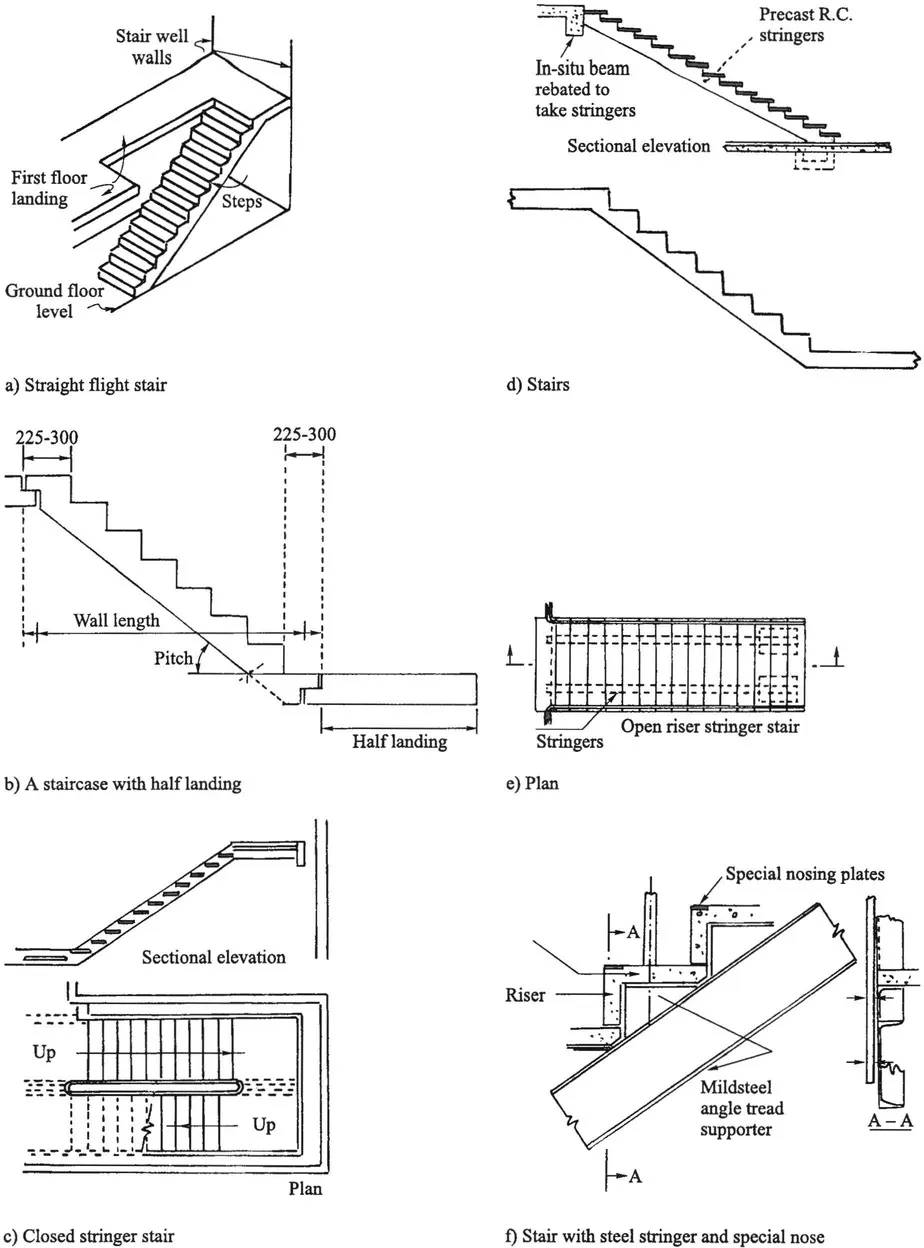
A straight flight stair (Fig. 1.1), which rises from floor to floor in one direction with or without landing.
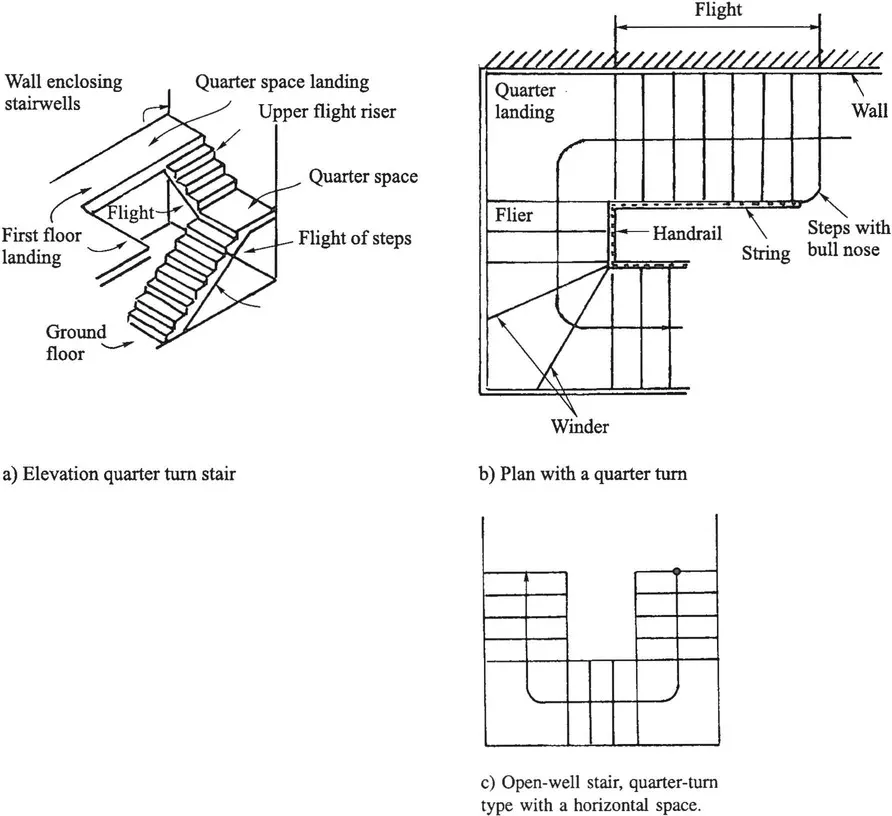
A quarter turn stair (Fig. 1.2), which rises to a landing between floors, turns through 90°, then to the floor above.
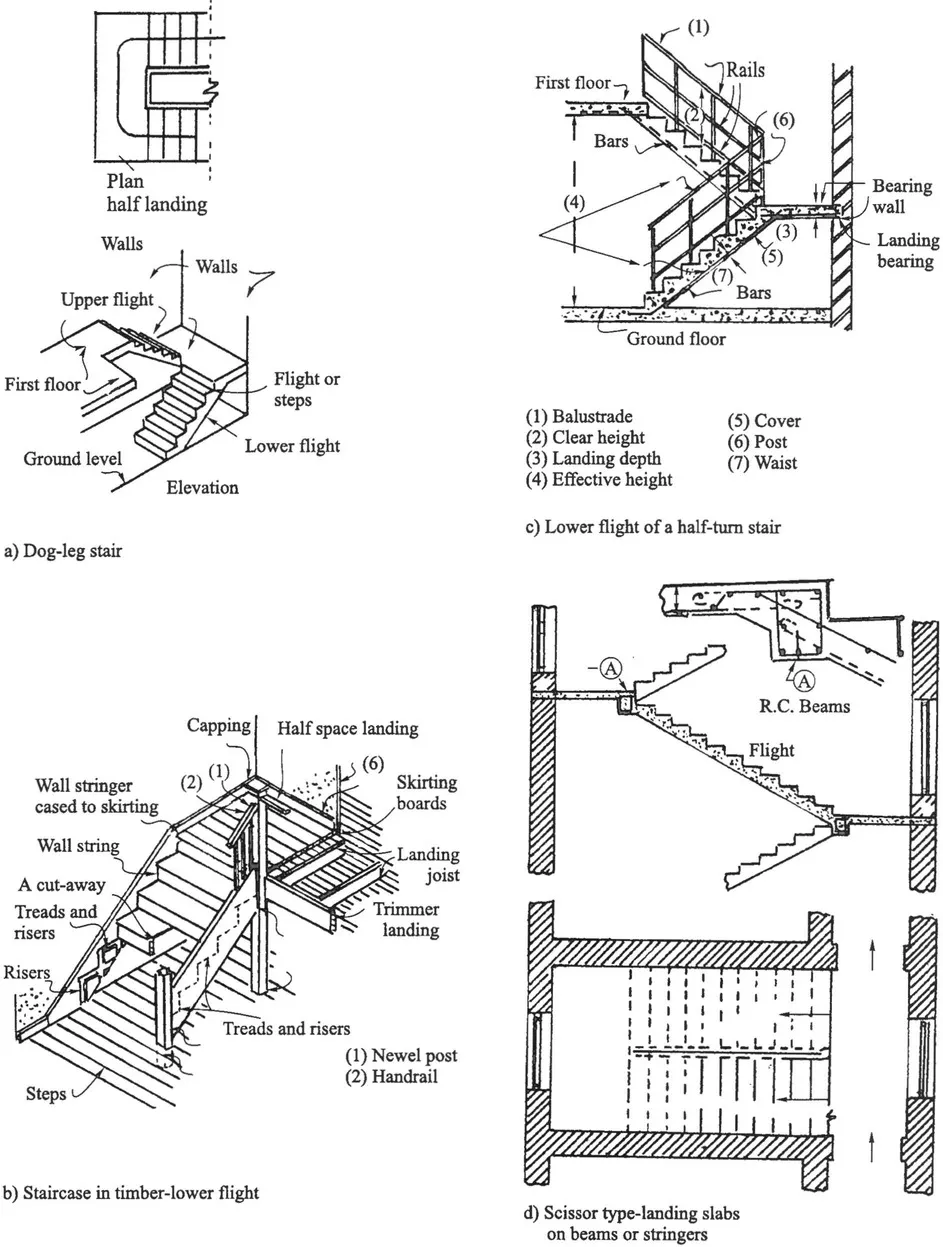
A half turn stair (Fig. 1.3), which rises to a landing between floors, turns through 180°, then rises, parallel to the lower flight, to the floor above. This type of stair is sometimes called ‘dog-leg’ or ‘scissor-type stair’.
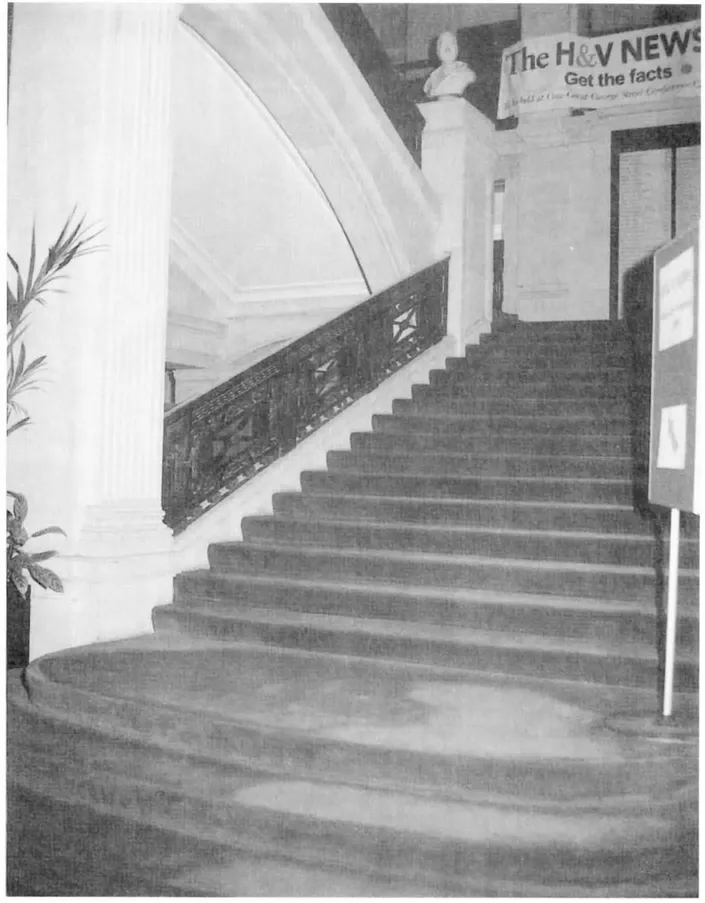
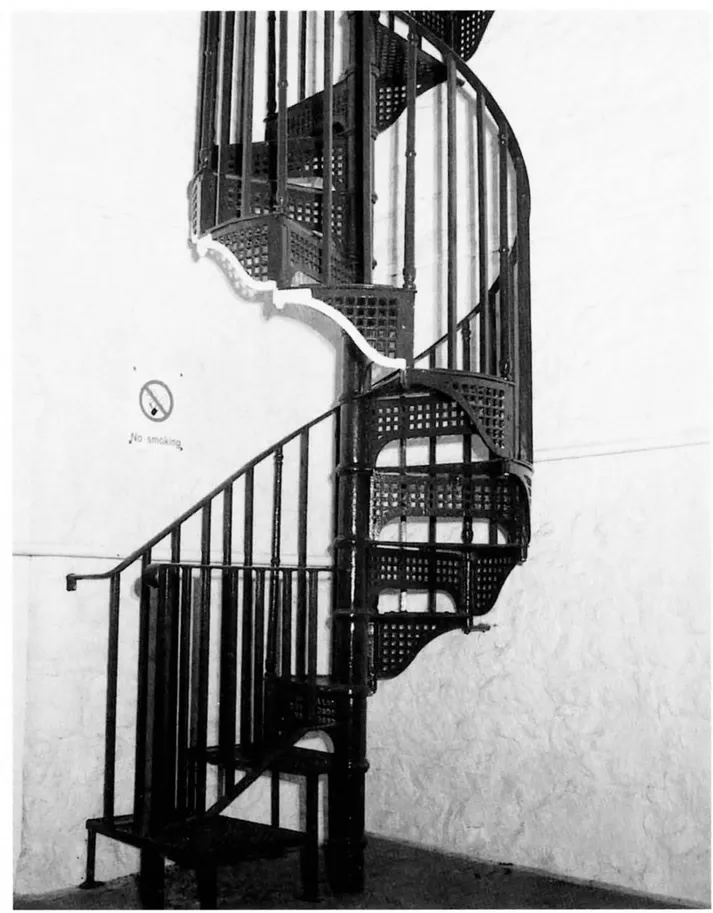
Geometric stairways. The stairs mentioned above are generally freestanding ones. In addition to these, stairs known as geometrical stairs can be designed into spiral, helical, circular, elliptical (Fig. 1.4) and other shapes. They can all be in concrete, steel, timber or combination. The stairs are sometimes described as open well stairs where a space or well exists between flights (Fig. 1.2(c)).
Again in free-standing stairs the main types are:
– Type 1 : Those supported transversely or across the flight. Stringer beams are needed (Fig. 1.1) on one or both sides.
– Type 2: Those spanning longitudinally along the flight of steps (Fig. 1.2) either on walls or on landing beams or on wall beams.
– Type 3: Cantilever type projecting from walls or wall beams (Fig. 1.5) with each step acting as a cantilever.
– Type 4: Combination of Type 2 and Type 3. Every 4th or 5 th step is cantilevered with sloped soffit with a slab continuous between two steps.
The structural details of some of the stairs are given in Appendix 2.
Figure 1.1. Straight flight stairs.
Figure 1.2. Quarter turn stairs.
1.2 Stairway Layouts
Stairway layouts depend on several factors including building type and its layout, choices, material etc. Comfortable stairways should be designed in relation to the dimensions of the human figure. A summary of the American practice for staircases is given in Tables 1.1 and 1.2. The British Standard on stairs BS5395 (1977) defines some of these dimensions in Figure 1.6. The British and the European practices use the following criteria for width, length and headroom etc.:
a) Flats - two storey to four storey wF = 900 mm; more than four storey wF = 1000 mm.
b) Public buildings using each floor - under 200 persons wF = 1 m; 200 to 400 persons wF = 1.5 m; in excess of 400 persons 150 mm to wF > 3 m. Where the width is 1.8 m or over, the width should be divided by a handrail.
c) The length and rise a minimum of 3 steps and a maximum of 16 steps. There must not be more than 36 rises in consecutive flights without a change in the direction of travel of 30° or more. The total rise must not exceed 6 m.
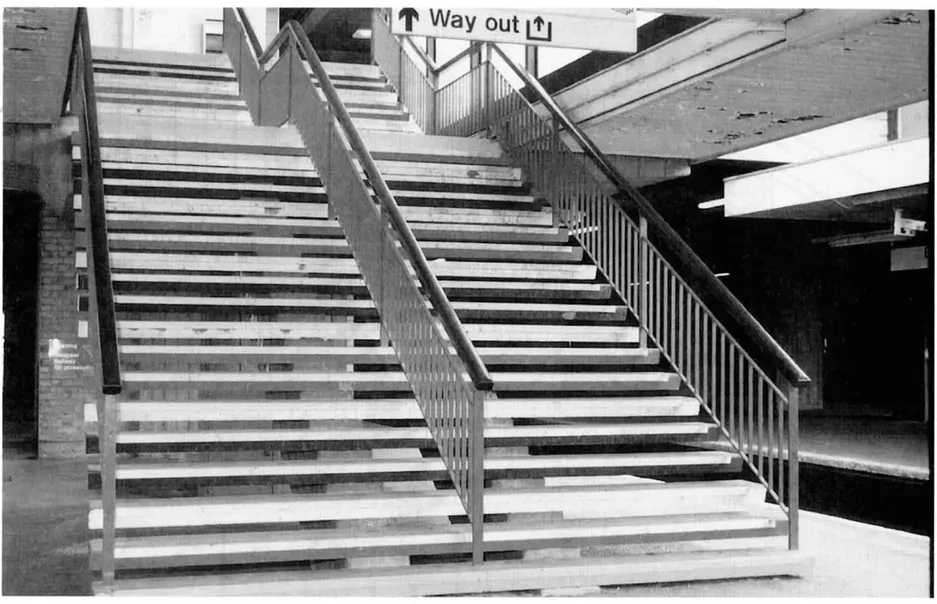
Plate 1.1. Open riser stringer stair straight flight.
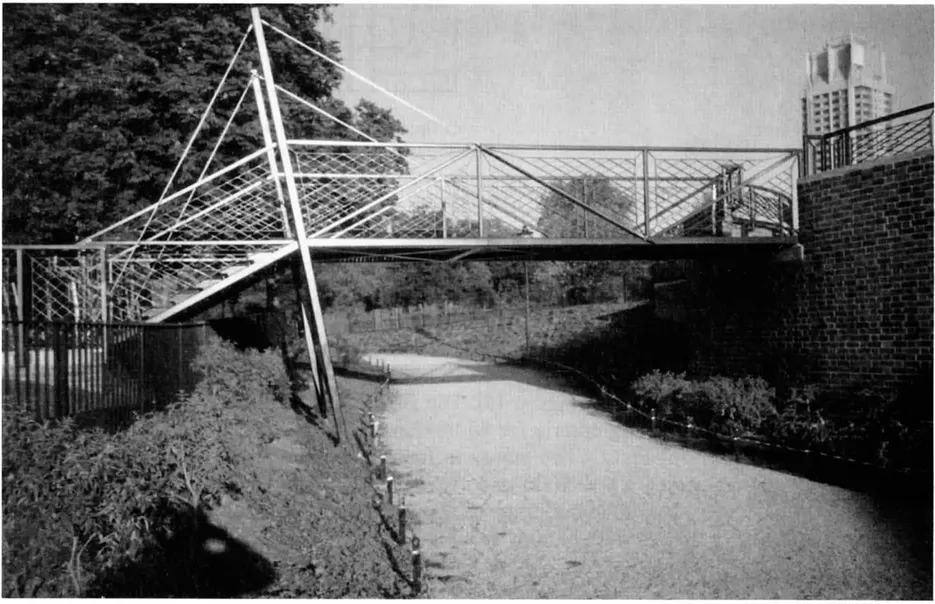
Plate 1.2. Straight stairs and long landing using cable stays.
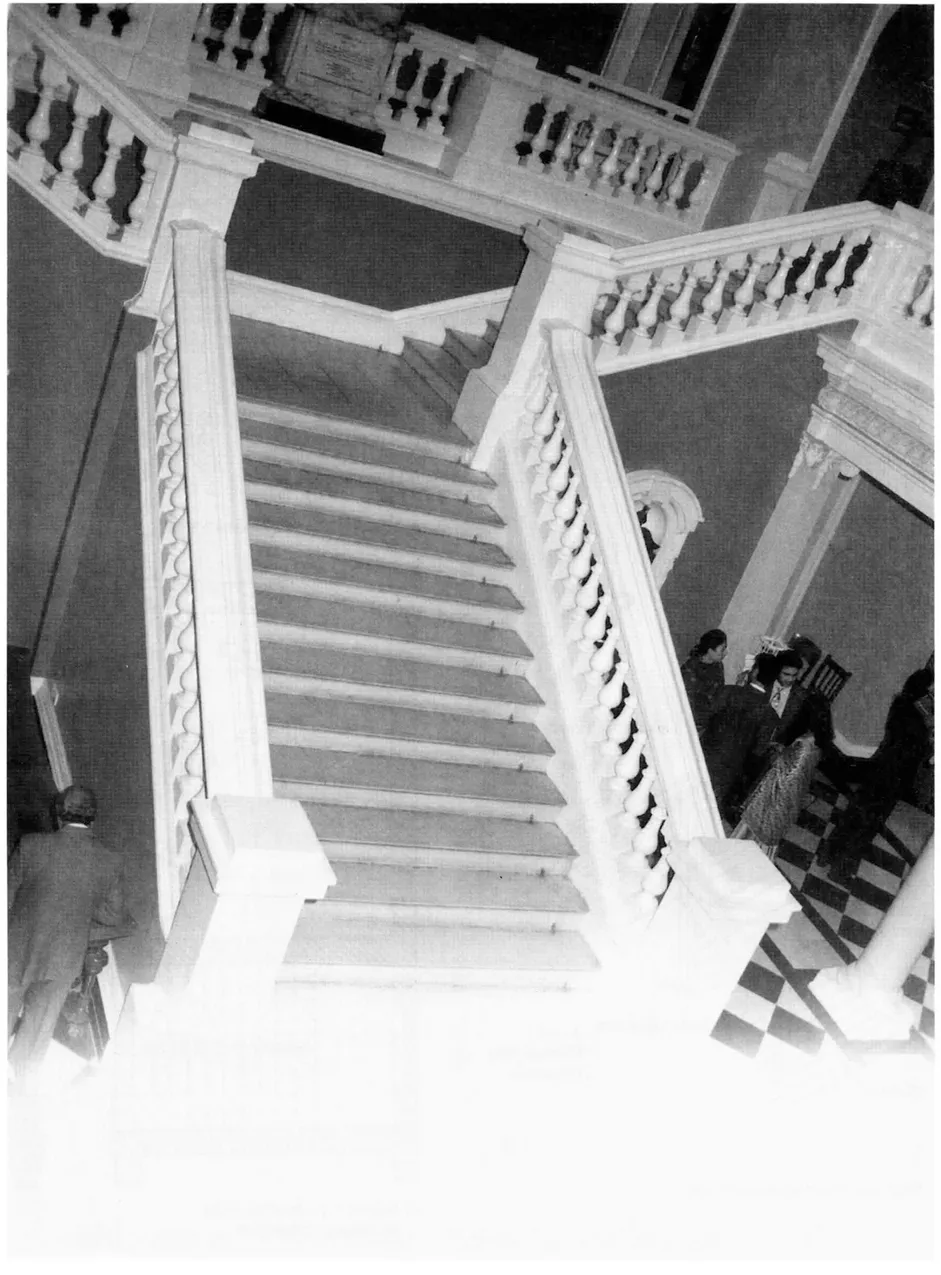
Plate 1.3. Close stringer stairs (quarter turn). (With compliments from the Institution of Civil Engineers, London.)
Figure 1.3. Half turn stairs.
Plate 1.4. Scissor type stairs.
1.2.1 Landings, landing beams and flights
A quarter space landing in wood is generally supported by a newel post carried down to the floor below. In small houses quarter or half turn stairs are sometimes constructed with winders (Fig. 1.2(b)) instead of quarter or half space landings. Winders are triangular shaped steps constructed at the turn from one flight to the next. The landing beams (Fig. 1.9) are designed as rectangular or flanged beams, for the reactions from the two flights or steps on one side and the landing on the other.
Plate 1.5. Helical stair case in steel.
1.2.2 Strings or stringers
These are available in steel, concrete, timber and composite. There are two types of wood string, namely, the open (cut) and the close (closed) strings. The string enclo...