From Mediterranean Europe to Chile and from China to Australia, chestnut cultivation surface has greatly increased globally over the last several decades. The crop provides solid revenue to growers, is resilient to climate change and the fruits are a calorie-dense, carbohydrate-rich nut, the production of which improves soil and sequesters carbon. However, there is a great lack and a great need for technical information on management of old and new chestnut plantations.
The Chestnut Handbook shares achievements in chestnut development and cultivation including information on sustainable planning and management of chestnut production from nursery to plantation, entomology, pathology, and ecosystem services. Cultivation techniques of Chinese, Japanese, and European chestnut species including hybrids are described containing information on over 550 local and commercial cultivars. Beautiful original handmade drawings and technical sheets facilitate accessibility and comprehension of information.
FEATURES:
• Offers practical, easy-to-follow, technical solutions for chestnut farming and forestry, provides ideas for present and future plantations and management
• Contains more than 300 figures published in full color featuring original handmade drawings
• Provides information about cultural practices, nursery techniques and ecosystem services
• Includes a reference list of over 550 local and commercial cultivars of Chinese, Japanese, and European chestnut species and their hybrids
• Presents important information on both major and minor pests and diseases as well as pest diseases and physiological disorders.
With the collaboration of more than 30 researchers from internationally renowned institutes, professionals and nurserymen this book serves as a technical reference and valuable resource for agronomists, forest experts, farmers, researchers and students of agricultural and forestry sciences.
Growing and Using the Chestnut in the World from Past to Present
Giancarlo Bounous and Gabriele Beccaro
Geographically distributed in three main areas throughout the Northern Hemisphere (Asia, Europe, North America), the chestnut (Castanea spp.) has an invaluable historical and cultural heritage, a glorious past, but also a promising future, continuing to play an important economical and environmental role in many agroforestry systems. For centuries the nuts provided in rural areas a dietary staple and, when dried, a stored food for the whole year; the wood was used as firewood or building timber.
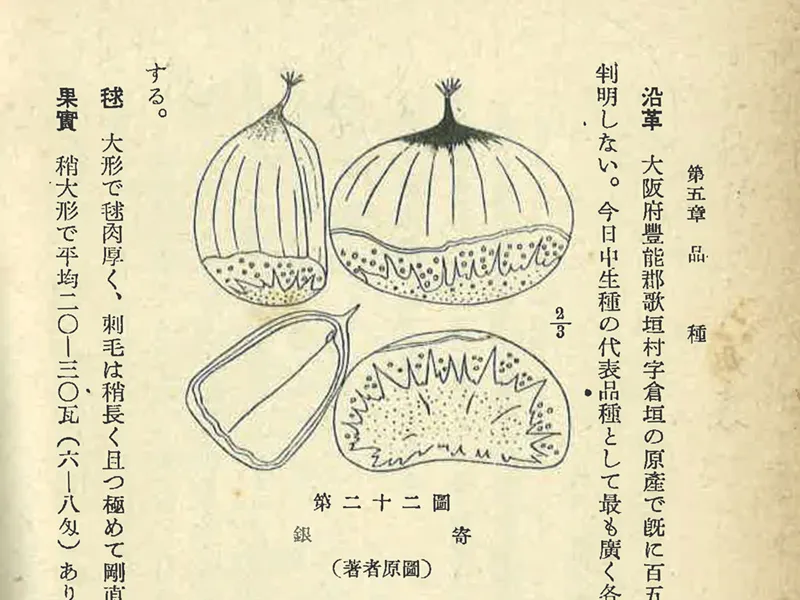
In Asia, mainly in China, the Chinese chestnuts (C. mollissima, C. henryi, and C. seguinii) are found in wild and cultivated stands and the history of Chinese chestnut cultivation could be traced back to many centuries B.C. Japan, the Korean peninsula and the temperate regions of East Asia are the natural range of the Japanese chestnut (C. crenata). The Chronicles of Japan (about 700 A.D.) state that in the era of the empress Jito Tenno (645–703 A.D.) the cultivation of chestnuts was promoted in order to fight hunger, and from the Nara to Heian Period (710–1180), the utilization of wild and cultivated chestnuts flourished (Figure 1.1).
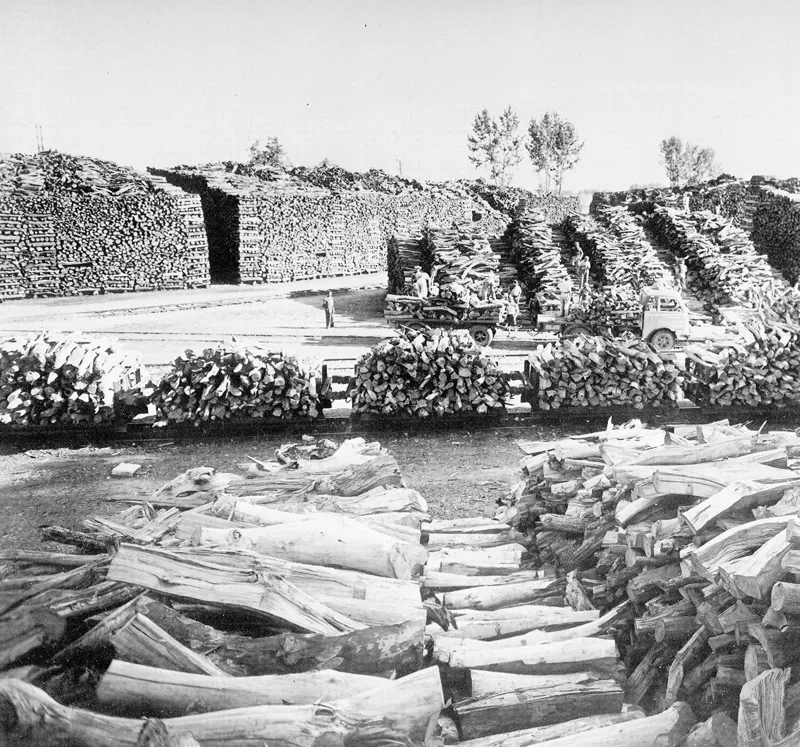
Asia Minor, and more specifically the Transcaucasia region, is considered to be the centre for the domestication, cultivation, and dissemination of C. sativa (European chestnut or sweet chestnut). During the Roman Empire, thanks to the Roman Legions, the sweet chestnut spread beyond the Italian peninsula into the rest of Europe from East (Romania, Hungary) to West (Spain, Portugal), and to Southern England in the north. From the Middle Ages the chestnut replaced the oak in the European forests, and chestnuts become a staple food. Nowadays the chestnut still dominates forests, and plantations are found in 25 countries and cover a surface of more than 2 million hectares. After a period of abandonment until the end of the twentieth century, parts of old chestnut forests have been restored and new plantations established. In Turkey C. sativa is distributed over a broad range both in natural forests and in plantations (Figure 1.2).
In North America, C. dentata, a forest giant, was a dominant species in the broadleaf forests along the Appalachian range. The chestnut timber industry vanished about a century ago as the canker blight and ink disease decimated the American chestnut. Before being destroyed it furnished small nuts, fuel wood, building timber, and wood products. Nowadays in North America few chestnut plantations of economic importance, based mainly on Asiatic chestnut species or hybrids, have been established.
FIGURE 1.1 An extract from Y. Tanaka’s volume, cultivation of chestnut, Meibundou, Tokyo, 1933.
FIGURE 1.2 Wood piles of chestnut timber used to extract tannin, early twentieth century, Italy.
Into the Southern Hemisphere, mainly in Australia, New Zealand, Chile, and Argentina, C. sativa was introduced from Europe during the nineteenth century by the first settlers who brought with them seeds of food plants from their own countries. In Australia the gold rush of the 1850s and 1860s led to the first plantations of chestnut trees. Although the first plantations date back to that period, in Chile and Australia a true chestnut industry was established starting in the middle of the twentieth century and is rapidly growing following new technical interpretations of chestnut cultivation.
Today, the world’s leading chestnut producer is China, followed by Korea, Turkey, Italy, Japan, Spain, Portugal, France, and Greece, in decreasing order, but many other countries produce valuable nuts and timber. The market potential appears to be prosperous for the plantations established in suitable environments and the demand continues to outstrip the supply.
Chestnuts are a prized food for an increasingly large market and differ from other nuts in their low fat content, which makes them ideally suited for high complex carbohydrate and low fat diets. The nuts are used to prepare food products of a very healthy quality, often appearing in recipes for balanced dietary schemes. The beneficial effects of the nuts could be the driving force to increase consumption.
Nowadays consumers have a great concern for health, and this unique crop has an outstanding potential for different food products such as vegetables, pastry, dessert, and snacks. The largest part of the production is intended to the fresh market for roasting or boiling which covers a timeframe of six months, with an high demand at the beginning of the harvesting season. Roasted chestnuts in the street are a popular autumn and winter sight in cities all over the world. The best chestnuts, after peeling, are candied or sent to confectioneries to prepare marrons glacés, chestnuts in syrup or in alcohol. Whole peeled chestnuts can become water-packed in tins, dry-packed in glass jars, or vacuum packed. The purée is the base for creams and dairy desserts containing chestnut cream. Peeled and frozen nuts, flakes, beer, or liquor are other processed products high in demand. Dried chestnuts and flour are packed and sold throughout the year.
The increase in demand for environmentally friendly products is a driving force having a positive influence on the market. Technological and aesthetic quality, good resistance to meteoric agents and alterations, and durability make the timber of the species fit for high value products. Timber is used in flooring, building, furniture, and joinery. With coppice small diameter logs, panels, turnery, walking sticks, baskets, charcoal and firewood, garden furniture, traditional fences, vineyard stakes, poles climbing frames, and poles for slope consolidation works are produced. The market offers new products such as finger jointed beams and laminated veneer boards. Tannin is still used for skin tanning, and the wood, after tannin extraction, is reused for the realization of high density fiber panels. The tree is also reported to be a good contributor to carbon sequestration and other ecosystem services.
In addition, this species represents an invaluable bridge between culture and historical heritage: from the “bread tree” of the past, which provided food for generations of farmers, to the present resource, which enables us to satisfy the inborn need to recreate our spirit in a landscape where life can be spent on a human scale. Due to these positive traits, the chestnut landscape and ecosystem must be protected and improved for the great benefits it offers in terms of social welfare. It is a landmark of the history of the people who lived in the areas where the chestnut occurs; the chestnut forests are an unique witness of the liaison among cultivation, memory, and heritage. In old plantations the trees are natural monuments, and these ecosystems contain a large biodiversity and a high cultural heritage created by centuries of human activity. These signs are symbols of a civilization where the elements (dry-stone walls, roads, driers, rural buildings, mills), everyday use objects (furniture, handcrafts), traditions, and ethnic gastronomy should be preserved for leisure and recreation and to improve the quality of life.
2
Botany, Anatomy, and Nut Composition
Gabriele Beccaro, Giancarlo Bounous, Marta De Biaggi, Dario Donno, Daniela Torello Marinoni, Feng Zou, and Maria Gabriella Mellano
CONTENTS
2.1 Taxonomy and Species Distribution
2.1.1 European Species
2.1.2 Asian Species
2.1.3 North American Species
2.2 Morphology
2.2.1 Root Systems and Mycorrhiza
2.2.2 Trunk and Branches
2.2.3 Leaves
2.2.4 Flowers
2.2.5 Nut
2.3 Phenological Phases
2.4 Nut Composition
2.4.1 Chemical Composition
2.4.1.1 Carbohydrates
2.4.1.2 Fibre
2.4.1.3 Protein
2.4.1.4 Lipids
2.4.1.5 Organic Acids
2.4.1.6 Mineral Elements
2.4.1.7 Polyphenolic Compounds
2.4.1.8 Vitamins
2.4.2 Allergens
2.4.3 Nutritional Value and Health Properties
References
2.1 TAXONOMY AND SPECIES DISTRIBUTION
Fagaceae (Cupuliferae) includes six genera (Castanea, Castanopsis, Fagus, Lithocarpus, Nothofagus, Quercus) and approximately 1000 species. The genus Castanea (x = 12, 2n = 24),1 chestnuts and chinkapins, is supported as a monophyletic clade closely related to the genus Castanopsis.2
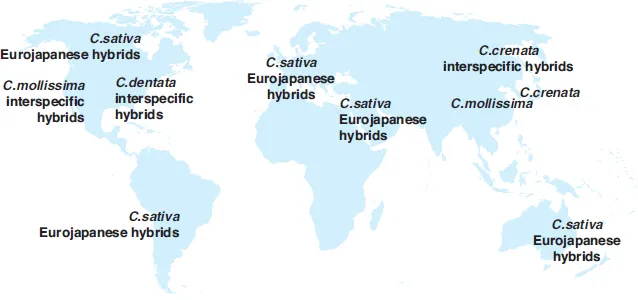
It is widespread in the boreal hemisphere (Figure 2.1) and includes 12 or 13 species depending on the classification (Table 2.1). The natural distribution of the European chestnut (C. sativa) covers Europe and all Mediterranean countries. In Asia (China, Korea, Japan, Vietnam) C. crenata, C. mollissima, C. seguinii, and C. henryi occur. In North America, C. dentata is now rarely present in its native range along the Appalachian Mountains due to the devastating impact of the chestnut blight, and C. pumila is found in the southeastern states.
The genus Castanea is classified into three sections: Eucastanon, Balanocastanon, and Hypocastanon, but further revisions are expected due to genetic studies in contrast to the validity of this classification.3
Castanea species show high levels of diversity (morphological and ecological traits, vegetative and reproductive habits, nut size, wood characteristics, adaptability and resistance to biotic and abiotic stresses), reflecting the adaptation of the genus to different environmental conditions (Figure 2.2).
FIGURE 2.1 Main areas of chestnut (Castanea spp.) cultivatio...
Table of contents
Cover
Half Title
Title Page
Copyright Page
Table of Contents
Preface
Editors
Contributors
Chapter 1 History: Growing and Using the Chestnut in the World from Past to Present
Chapter 2 Botany, Anatomy, and Nut Composition
Chapter 3 Distribution, Marketing, and Trade
Chapter 4 Cultivars List and Breeding
Chapter 5 Nursery Techniques
Chapter 6 Orchard Management
Chapter 7 Chestnut Farming with Chinese, Japanese, and Eurojapanese Hybrid Cultivars
Chapter 8 European Chestnut Traditional and High-Density Orchards
Chapter 9 Postharvest Handling
Chapter 10 Coppice Woodlands and Chestnut Wood Technology
Chapter 11 Diseases
Chapter 12 Pests
Chapter 13 Pests, Diseases, and Physiological Disorders Vademecum
Index
Trusted by 375,005 students
Access to over 1.5 million titles for a fair monthly price.
Study more efficiently using our study tools.
Frequently asked questions
Yes, you can cancel anytime from the Subscription tab in your account settings on the Perlego website. Your subscription will stay active until the end of your current billing period. Learn how to cancel your subscription
No, books cannot be downloaded as external files, such as PDFs, for use outside of Perlego. However, you can download books within the Perlego app for offline reading on mobile or tablet. Learn how to download books offline
Perlego offers two plans: Essential and Complete
Essential is ideal for learners and professionals who enjoy exploring a wide range of subjects. Access the Essential Library with 800,000+ trusted titles and best-sellers across business, personal growth, and the humanities. Includes unlimited reading time and Standard Read Aloud voice.
Complete: Perfect for advanced learners and researchers needing full, unrestricted access. Unlock 1.5M+ books across hundreds of subjects, including academic and specialized titles. The Complete Plan also includes advanced features like Premium Read Aloud and Research Assistant.
Both plans are available with monthly, semester, or annual billing cycles.
We are an online textbook subscription service, where you can get access to an entire online library for less than the price of a single book per month. With over 1.5 million books across 990+ topics, we’ve got you covered! Learn about our mission
Look out for the read-aloud symbol on your next book to see if you can listen to it. The read-aloud tool reads text aloud for you, highlighting the text as it is being read. You can pause it, speed it up and slow it down. Learn more about Read Aloud
Yes! You can use the Perlego app on both iOS and Android devices to read anytime, anywhere — even offline. Perfect for commutes or when you’re on the go. Please note we cannot support devices running on iOS 13 and Android 7 or earlier. Learn more about using the app
Yes, you can access The Chestnut Handbook by Gabriele Beccaro, Alberto Alma, Giancarlo Bounous, Jose Gomes-Laranjo, Gabriele Beccaro,Alberto Alma,Giancarlo Bounous,Jose Gomes-Laranjo in PDF and/or ePUB format, as well as other popular books in Technology & Engineering & Biology. We have over 1.5 million books available in our catalogue for you to explore.