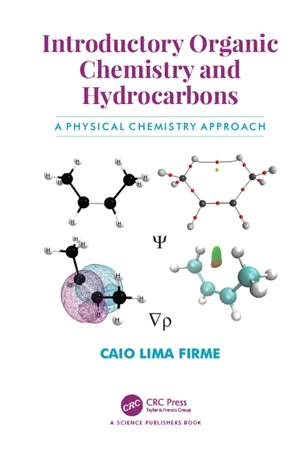
A novel proposal for teaching organic chemistry based on a broader and simplified use of quantum chemistry theories and notions of some statistical thermodynamic concepts aiming to enrich the learning process of the organic molecular properties and organic reactions. A detailed physical chemistry approach to teach organic chemistry for undergraduate students is the main aim of this book. A secondary objective is to familiarize undergraduate students with computational chemistry since most of illustrations of optimized geometries (plus some topological graphs) and information is from quantum chemistry outputs which will also enable students to obtain a deeper understanding of organic chemistry.
eBook - ePub
Introductory Organic Chemistry and Hydrocarbons
A Physical Chemistry Approach
- 438 pages
- English
- ePUB (mobile friendly)
- Available on iOS & Android
eBook - ePub
About this book
Information
Chapter One
Notions of Quantum Mechanics and Wave Function
NOTIONS OF OLD QUANTUM MECHANICS
Black-body radiation—an ideal material that absorbs all light and radiates electromagnetic energy according to its temperature — originated from Kirchhoff’s law of thermal radiation in 1860. Quantum mechanics began in very early twentieth century when Max Planck found the expression for black body thermal radiation in which the emitted light was not a continuum as postulated by classical physics. He developed Planck’s constant, h, to ensure that his expression matched experimental values. Planck’s theory was based on statistical mechanics and postulated the blackbody as a collection of isotropic oscillators with specific vibrational frequency for each oscillator. Later, Albert Einstein proved Planck’s quantization theory by means of theory of the photoelectric effect (Pilar 1990).
Henceforth, Niels Bohr succeeded in interpreting mathematically the hydrogen spectral lines (a type of bar code for each element) obtained from a gas tube discharge (Bohr 1925). The Bohr model established the circular orbit movement of electrons with definite energies, discrete (orbital) angular momentum, L, of the electron in orbit, and the electron energy jump between two discrete energy levels due to absorption or emission radiation.
Where ν is the frequency of electromagnetic radiation.
In classical physics, angular momentum is given by the product of moment of inertia, I, (needed torque to yield angular acceleration) and angular velocity, ω:
Bohr also stated that the angular momentum of an electron in an atom is constrained to discrete values according to the quantum number, n.
For one electron, e, in a circular orbit around one nucleus with Z charge, the centripetal force equals the electrostatic force.
Where aB is Bohr radius. The total energy is given by:
Which gives the expression:
Where E0 is the ground-state energy (n = 1) of hydrogen atom which is 13.6 eV.
Another important experiment to prove the space quantization was realized by Pieter Zeeman. Curiously, his experiment was carried out before the birth of quantum physics. Initially, it confirmed that negatively charged particles (later discovered as electrons by Thomson) were the source of light from a determined substance, and that the emitted light was polarized under a magnetic field (Zeeman 1897). Zeeman’s experiment was an important chapter in the history of spectroscopy initiated by Kirchhoff and Bunsen in 1860 (Kirchhoff and Bunsen 1860). However, the Zeeman effect was also important to prove the quantization of particles because of the splitting of the spectral lines under the magnetic field, B. The splitting occurs by the torque of B on magnetic dipole, μorbital, which is associated with an orbital angular momentum, L.
Where me is the electron mass.
When considering singlet substances, the normal Zeeman effect occurs, providing the discrete values of the orbital ang...
Table of contents
- Cover
- Title Page
- Copyright Page
- Dedication
- Preface
- Advice for Students
- Note about the wB97X-D Functional used in this Book
- Table of Contents
- 1. Notions of Quantum Mechanics and Wave Function
- 2. Molecular Orbital, Valence Bond, Atoms in Molecules Theories, and Non-Covalent Interaction Theories and Their Applications in Organic Chemistry
- 3. Quantum Mechanics and Electrostatic Force in Molecules
- 4. Notions of Thermodynamics, Molecular Energy, and use of Theoretical Thermodynamic Data
- 5. Quantum Mechanics and Periodic Table
- 6. Quantum Mechanical Resonance, Chemical Bond, and Hybridization
- 7. Electron Delocalization, Resonance Types, and Resonance Theory
- 8. Quantum Chemistry of Potential Energy Surface (Geometric Parameters, Energy Derivatives, Optimized Geometries, and Transition State)
- 9. Representations of Organic Molecules, Atomic Charge, and Formal Charge
- 10. Kinetics And Mechanism: Notions and the Quantum Statistical Influence
- 11. Intermolecular Interactions
- 12. Carbocations
- 13. Isomerism
- 14. Alkanes (nomenclature, properties, and reactions)
- 15. Cycloalkanes, Bicyclic, And Caged Hydrocarbons
- 16. Alkenes (nomenclature and properties)
- 17. Alkenes (reactions)
- 18. Alkynes (properties and reaction)
- 19. Aromaticity and Aromatic Compounds
- 20. Substituent Groups And Electrophilic Aromatic Substitution
- Appendices
- Index
- Color Plate Section
Trusted by 375,005 students
Access to over 1.5 million titles for a fair monthly price.
Study more efficiently using our study tools.
Frequently asked questions
Yes, you can cancel anytime from the Subscription tab in your account settings on the Perlego website. Your subscription will stay active until the end of your current billing period. Learn how to cancel your subscription
No, books cannot be downloaded as external files, such as PDFs, for use outside of Perlego. However, you can download books within the Perlego app for offline reading on mobile or tablet. Learn how to download books offline
Perlego offers two plans: Essential and Complete
- Essential is ideal for learners and professionals who enjoy exploring a wide range of subjects. Access the Essential Library with 800,000+ trusted titles and best-sellers across business, personal growth, and the humanities. Includes unlimited reading time and Standard Read Aloud voice.
- Complete: Perfect for advanced learners and researchers needing full, unrestricted access. Unlock 1.5M+ books across hundreds of subjects, including academic and specialized titles. The Complete Plan also includes advanced features like Premium Read Aloud and Research Assistant.
We are an online textbook subscription service, where you can get access to an entire online library for less than the price of a single book per month. With over 1.5 million books across 990+ topics, we’ve got you covered! Learn about our mission
Look out for the read-aloud symbol on your next book to see if you can listen to it. The read-aloud tool reads text aloud for you, highlighting the text as it is being read. You can pause it, speed it up and slow it down. Learn more about Read Aloud
Yes! You can use the Perlego app on both iOS and Android devices to read anytime, anywhere — even offline. Perfect for commutes or when you’re on the go.
Please note we cannot support devices running on iOS 13 and Android 7 or earlier. Learn more about using the app
Please note we cannot support devices running on iOS 13 and Android 7 or earlier. Learn more about using the app
Yes, you can access Introductory Organic Chemistry and Hydrocarbons by Caio Lima Firme in PDF and/or ePUB format, as well as other popular books in Physical Sciences & Biology. We have over 1.5 million books available in our catalogue for you to explore.