Microbes are the most abundant organisms in the biosphere and regulate many critical elemental and biogeochemical phenomena. Because microbes are the key players in the carbon cycle and in related biological reactions, microbial ecology is a vital research area for understanding the contribution of the biosphere in global warming and the response of the natural environment to climate variations. The beneficial uses of microbes have enabled constructive and cost-effective responses that have not been possible through physical or chemical methods. This new volume reviews the multifaceted interactions among microbes, ecosystems, and their pivotal role in maintaining a more balanced environment, in order to help facilitate living organisms coexisting with the natural environment.
With extensive references, tables, and illustrations, this book provides valuable information on microbial utilization for environmental sustainability and provides fascinating insights into microbial diversity.
Key features include:
Looks at enhancing plant production through growth-promoting arbuscular mycorrhizae, endophytic bacteria, and microbiome networks
Considers microbial degradation and environmental management of e-wastes and azo dyes
Explores soil-plant microbe interactions in metal-contaminated soils
Examines radiation-resistant thermophiles for engineered bioremediation
Describes potential indigenous/effective microbes for wastewater treatment processes
Presents research on earthworms and microbes for organic farming
MYCORRHIZA: A POTENTIAL BIO-ENHANCER IN THE AGRICULTURE PRODUCTION SYSTEM
BAKULRANJAN JANA
ICAR-RCER, Research Center on Makhana, Darbhanga, Bihar–846005, India
1.1 INTRODUCTION
The agriculture industry is confronted today with the pressure of bourgeoning population, depleting, and degrading natural resources of soil and water, climate change, and shortage manpower and the non-availability of optimal technology. Due to rapid urbanization, we are losing the fertile soil for agriculture, and on the other hand, infertile and degraded soils have been taken for cultivation with a view to area expansion. In such a scenario, research on abiotic stresses is gaining momentums in India. This has been termed as a gray revolution, which may play a vital role for future agriculture in tropical and subtropical areas. In abiotic stress conditions, mycorrhizae are economically important symbionts to plant in arable conditions (Table 1.1). Mycorrhizae are simply a symbiotic association between numerous fungi and roots of higher plants/vascular host plants (Kirk et al., 2001). The term mycorrhizae mean fungus root, and it was derived from the Greek words ‘mykós’ means fungus, and ‘rhiza’ means root’ (Frank, 1885). This type of plant and fungus association was first observed in certain forest plant species, now is widespread and to affect most of the agricultural plant species, including many agronomic or field crops (Brady, 1995). From an economic point of view, the mycorrhizal associations have great importance because it significantly increases the availability of water and nutrients to the plants. It has been found that several essential nutrients especially from arable degraded soil to plant, resulted in better crop stand and thereby minimizing the irrigation facility and increasing productivity of several horticultural and agronomic crops in the agriculture production system. In a broad sense, fungal plant symbiotic association makes available the fungi with current photosynthates, i.e., sugar and other organic metabolites in the form of plant root exudates to use as food for VAM fungi. On the other hand, the fungi help in enhanced availability of water and other essential micronutrients, including phosphorous, which are essential for plant growth and development. The most common type of mycorrhizal association in the plant is VAM fungi, which are recently known as arbuscular mycorrhizal (AM) fungi, and its distribution in the plant kingdom is substantial covering 2/3 of land plants (Hodge, 2000).
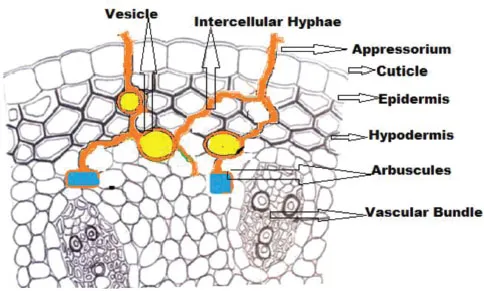
Although several kinds of mycorrhizae present in the entire plant kingdom, with regard to practical importance in agriculture, there are mainly two types of mycorrhiza, like Ectomycorrhiza and Endomycorrhiza, which are actively engaged with host plants in a natural ecosystem. The former group includes hundreds of different fungal associations, primarily with tree species of horticulture and forestry systems, such as pine-oak, fir, and hemlock. These fungi are actively involved in colony formation with fungal mantle forming common mycelia network (CMN) on the root surface and stimulated by the root exudates of the plant. The fungal hyphae do not penetrate the cell wall. They only penetrate the feeder root and develop around the cells of the cortex. On the other hand, the economically most important group of fungi are endomycorrhizae, which penetrate the root cells and forms two types of hyphal masses within the root cells, which are known as vesicles and arbuscules (Figure 1.1). The cell walls of the root cortex of the host plant are accessed by fungal hyphae of the vesicular-arbuscular mycorrhizae (VAM), which are presently known as AM fungi (AMF). Inside the root cells, highly branched small structures are formed sporadically, which are known as arbuscules formed by fungi and act as a medium that transfers the mineral nutrients from fungi to the host plant species. Vesicles are another structure, which is served as a storage organ for plant nutrients and other organic metabolites. A vast range of agronomical crops like wheat, maize, bajra, cotton, potatoes, sugarcane, cassava, and dry land rice have the AMF association with their root systems. Many horticultural crops, including apple, grapes, citrus, cocoa, coffee, and rubber, also have AMF associations. Many economically important trees like maple, yellow poplar, and redwood have been found to exist with AMF associations for mutual benefits.
TABLE 1.1 Different Groups of Economically Important Mycorrhizae
Types of Fungi
Scientific Names/Groups
Host Plant Species
Media pH and Rhizosphere
References
Endomycorrhiza
Glomus spp.
Cultivable crops, cereals, pulses, fiber crops, and horticultural crops
Alternative dry and moist friable, acid and alkaline, pH 5.5–7.5
Redecker et al., 2000; Fitter, 2005; Santos-González et al., 2006
Ericoid mycorrhizal fungi
Rhizoscyphus ericae
Mediterranean climate zones in chaparral vegetation systems
Muck and sandy pH >5.8, rocky, nutrient poor
Selosse et al., 2007
Orchid fungi
Myco-heterotrophic
Orchids
Deep sand sandy loam clay loam, Dry and friable
Bidartondo et al., 2002; Leake, 2004, 2005
Achlorophyllous
Monotropoid mycorrhiza
Achlorophyllous monotropoid plants
Forest soil, leaf mould, pH 4.3–8.0
Leake, 2004; Bidartondo, 2005
Arbutoid mycorrhizae
Arctostaphylos virgata and Arbutus spp.
This type of mycorrhizae involves plants of the Ericaceae subfamily Arbutoideae. It is, however, different from ericoid mycorrhizae and resembles ectomycorrhizae. Hyphae of the arbutoid do actually penetrate the outer cortical cells and fill them in coils.
Peat and loam/sand-peat Moist and dry forest soil, pH > 7.2
Leake, 2004
Ectomycorrhiza
Basidiomycota and Ascomycota
Trees or shrubs from cool, temperate boreal or montane abundantly found in forests, arctic-alpine, and dwarf shrub communities
Dry and friable, acid, and alkaline pH 4.5–8.5
Wallander et al., 2001; Taylor and Alexander, 2005
FIGURE 1.1 Mycorrhizae association with host plant at the cellular level.
1.2 ROLE OF MYCORRHIZAE
Due to rapid urbanization and increasing population, people are searching for underexploited areas to grow more food. Even to mitigate the climate change scenario and to maintain soil fertility, symbiotic microorganisms played a significant role in the agricultural production system. An interest in soil microbes and their active role and use in agriculture flared a few decades ago. Despite of that, most of the commercial products quickly flickered out, and laboratory successes had not translated to the field application to revive the microbial contribution to agricultural development. One of the few agricultural microbes that did catch hold was AMF for crop growth in almost all agricultural crops and the bacterium Rhizobium, which helps in nitrogen fixation through legumes in soils.
The major challenges of the new millennia are to grow food and other economic crops at adverse weather conditions to feed the billions of rural poor and to sustain food security. Under the climate change scenario, agricultural crops are exposed to the extent of biotic or abiotic stresses such as drought, flood attenuation, freezing stress, and salt loading that influence plant growth and development and thereby productivity. Water stress (WS) is one of the major abiotic stresses that directly influence plant productivity. Agriculture production also affected by drought and salinity at a major part of the world (Gueta-Dahan et al., 1997) as well as in India. Wang et al. (2003) stated that WS alone is responsible for crop loss worldwide, decimating average yields by 50%. Water deficit in plant tissue resulted in inhibition of photosynthesis, thus leading to a negative effect on yield. Some plants are drought tolerance, i.e., the ability to maintain the photosynthetic activity under WS. Cornic (1994) explained that plants response to water deficit through affecting transpiration and rapid closure of stomata. Apart from photosynthesis, respiration, metabolism, and translocation of growth promoters and nutrient ions, the colony of AMF prevent to develop other fungi related to plant diseases in the rhizosphere (Alam, 1999; Jaleel et al., 2008). Smith and Read (2008) observed that the hyphae of the AMF not only uptake the water but also absorb nutrients like phosphorus (P), nitrogen (N), potassium (K), zinc (Zn) or copper (Cu). In another study, Brachmann and Parniske (2006) also reported that the symbiotic association between plant roots and AMF was known to be one of the beautiful and widespread plant strategies to increase nutrient and water uptake to cope with adverse weather condition for mutual benefit. The soil fungi which had intra-radical mycelium (IRM), which elongated in the root cortex, absorb the nutrient for the host plant. Extra-radical mycelium (ERM) of AMF spread in the soil around the root and provide the surface area by which the AM fungus absorbs nutritional elements such as for transport and transfer to the host. Zaidi et al. (2003) reported that the presence of mycorrhizal fungi in the roots of chickpea or Bengal gram, which improves the growth and yield, especially in phosphorus-deficient soils. Even AMF imparts a positive role in various leguminous crops, particularly the enhancement of phosphate uptake and growth through their symbiotic association (Atimanav and Adholeya, 2002). In abiotic stress condition, drought reduces both nutrient and water uptake by the roots and decrease the transport of metabolites and ions from the roots to the shoots due to restriction of transpiration rates and impaired membrane permeability and thereby active transport. Mycorrhizal fungi generally increase fertilizer use efficiency. The research studies about mycorrhizal fungi in a wide range of conditions, plants, and soils were studied since 1981 to find out a viable symbiotic association for crop growth and soil health. The studies were also performed in diverse climatic conditions from field to greenhouse and even in nurseries of horticultural importance. The vesicular-arbuscular mycorrhizal fungi (AMF), i.e., Glomus deserticola, G. intraradices, G. fasciculatum, G. mosseae, and G. etunicatum have been identified as promising in arable agriculture world till now. Aguilera-Gomez et al. (1999) tried to demonstrate the importance of mycorrhizae for phosphate solubilization and more efficient utilization of P in a sustainable agricultural production system, particularly in the paper industry. The useful effect of mycorrhizal colonization increased leaf number, large leaf area, and greater shoot: root ratio and fruit mass as compared to non-VAM plants through higher water absorption and nutrient uptake. At high P levels, the increment of reproductive growth was 4.5 folds in mycorrhizal plants. Due to greater uptake of P from the soil and greater extra radical hyphae of fungi, enable the plants to become more vigorous and...
Table of contents
Cover
Half Title
Title Page
Copyright Page
Series Page
About the Editors
Table of Contents
Contributors
Abbreviations
Preface
1. Mycorrhiza: A Potential Bio-Enhancer in the Agriculture Production System
2. Plant Growth-Promoting Microbiome Network
3. Plant Growth-Promoting Endophytic Bacteria and Their Potential Benefits in Asian Countries
4. Eccentricity in the Behavior of Penicillium spp. as Phytopathogen and Phytoaugmentor
5. Environmental Management of E-Waste by Biological Process
6. Microbial Degradation of Wastes for Environmental Protection
7. Soil Microbial Biofilm Communities and Their Interactions
8. Bacteriological Removal of Azo Dyes: An Eco-Friendly Approach
9. Impact of Soil, Plant-Microbe Interaction in Metal Contaminated Soils
10. Radiation-Resistant Thermophiles: From High Temperature and Radiation to Engineered Bioremediation
11. Dynamic Potential of Indigenous and Effective Microbes in Wastewater Treatment Processes
12. Earthworms and Microbes in Environmental Management Through Vermitechnology-Mediated Organic Farming
Index
Trusted by 375,005 students
Access to over 1.5 million titles for a fair monthly price.
Study more efficiently using our study tools.
Frequently asked questions
Yes, you can cancel anytime from the Subscription tab in your account settings on the Perlego website. Your subscription will stay active until the end of your current billing period. Learn how to cancel your subscription
No, books cannot be downloaded as external files, such as PDFs, for use outside of Perlego. However, you can download books within the Perlego app for offline reading on mobile or tablet. Learn how to download books offline
Perlego offers two plans: Essential and Complete
Essential is ideal for learners and professionals who enjoy exploring a wide range of subjects. Access the Essential Library with 800,000+ trusted titles and best-sellers across business, personal growth, and the humanities. Includes unlimited reading time and Standard Read Aloud voice.
Complete: Perfect for advanced learners and researchers needing full, unrestricted access. Unlock 1.5M+ books across hundreds of subjects, including academic and specialized titles. The Complete Plan also includes advanced features like Premium Read Aloud and Research Assistant.
Both plans are available with monthly, semester, or annual billing cycles.
We are an online textbook subscription service, where you can get access to an entire online library for less than the price of a single book per month. With over 1.5 million books across 990+ topics, we’ve got you covered! Learn about our mission
Look out for the read-aloud symbol on your next book to see if you can listen to it. The read-aloud tool reads text aloud for you, highlighting the text as it is being read. You can pause it, speed it up and slow it down. Learn more about Read Aloud
Yes! You can use the Perlego app on both iOS and Android devices to read anytime, anywhere — even offline. Perfect for commutes or when you’re on the go. Please note we cannot support devices running on iOS 13 and Android 7 or earlier. Learn more about using the app
Yes, you can access Beneficial Microbes for Sustainable Agriculture and Environmental Management by Jeyabalan Sangeetha, Devarajan Thangadurai, Saher Islam, Jeyabalan Sangeetha,Devarajan Thangadurai,Saher Islam in PDF and/or ePUB format, as well as other popular books in Sciences biologiques & Science environnementale. We have over 1.5 million books available in our catalogue for you to explore.