This title was first published in 2001. New technologies and the liberalization of the broadcasting and telecommunications market, together with the digitalization and globalization of new services, have challenged irrevocably not only the traditional markets and instructional structures but also the legal systems of broadcasting and telecommunication sectors in the 21st century. This text takes into account changes in digital broadcasting and telecommunication by pointing out that convergence is the process through which broadcasting, telecommunication, press and information sectors are transformed into new sectors (info-com arteries, info-com products, info-com services and info-com content) in order to be fully compatible with the emerging new info-communication industry in the digital transformation and info-communication era.
eBook - ePub
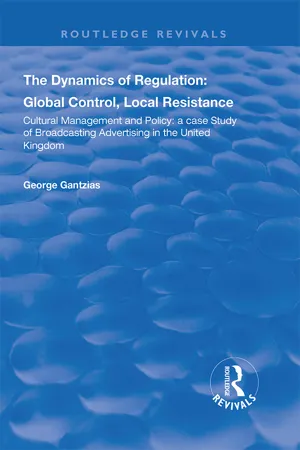
The Dynamics of Regulation: Global Control, Local Resistance
Cultural Management and Policy: a case study of broadcasting advertising in the United Kingdom
- 388 pages
- English
- ePUB (mobile friendly)
- Available on iOS & Android
eBook - ePub
The Dynamics of Regulation: Global Control, Local Resistance
Cultural Management and Policy: a case study of broadcasting advertising in the United Kingdom
About this book
Trusted by 375,005 students
Access to over 1.5 million titles for a fair monthly price.
Study more efficiently using our study tools.
Information
Subtopic
SociologyIndex
Social Sciences1 Theories of Regulation, the Public Interest and Info-com Policy: the Twenty-first Century Convergence Vision for Info-com Policy
Introduction: New Pressures on Policy and Regulation from Convergence in the Twenty-first Century
In the digital transformation and info-communication era the convergence of telecommunications, broadcasting, publishing and information sectors is blurring the traditional boundaries between different policy and regulatory systems in communication sectors at local/national level. Regulation has been developed along different pathways in broadcasting, telecommunications and the computing industry in the twentieth century. Pressures of convergence1 will increase as telecom, cable and dot.com companies gradually start to provide services previously offered by others (e.g. television channels or webcasting and narrowcasting, etc.), as Internet video quality and capability has recently improved. Digital television has allowed for substantial expansion of traditional television services and television advertising, not only to broadcasting but also to Internet territory in the twenty-first century.2
In the twentieth century broadcasting regulation with regard to television advertising was shaped and developed in a very specific way from its inception in the United Kingdom. Some of the issues in regulating broadcasting connect to larger political, economic and social concerns: state control versus free enterprise; monopoly versus competition; the public interest in broadcasting or in communication; freedom of expression, accountability and access; regulation – what form and how much or how little; methods of finance – licence fee, government assistance or advertising? New technologies in broadcasting and telecommunication have introduced new means of communication – fax, e-mail, interactive television, mobile telephone and the Internet – which have revolutionised the way we communicate in our society. The developments in digital technology pay very little attention to state frontiers and create new rules and regulations in which state sovereignty loses part of its meaning. Globalisation of information and communication sectors transcends state frontiers and makes regulation a much more complicated process at local/national level.3 This chapter examines and analyses the theories of regulation, the definition of public interest in communication and introduces the methodological distinction – process and product regulation – as an analytical tool to identify and evaluate the regulation of British broadcasting and television advertising in the deregulation/reregulation and liberalisation era. It also introduces the twenty-first century convergence vision of info-com policy, info-com public interest principles and definition, the regulatory model product and process regulation, the infocom sectors and the info-com industry which are likely to contribute to the emergence of the new 'info-communication society'.
Theories of Regulation: Government Regulation and the Public Interest
There is a very extensive literature on regulation from numerous perspectives, and a number of general studies which bring all these perspectives together for comparative purposes. Differences in terminology and different ways of defining regulation sometimes cause confusion. I have followed John. G. Francis's inclusive definition of regulation as a 'state intervention in private sphere of activity to realise public purposes'.4 Francis extends the traditional view of regulation as restriction on choice to include the notion of regulation as actually strengthening choice by protecting people from undesired choices, particularly in the area of social regulation. This interpretation is especially relevant to broadcasting regulation, the primary purpose of which has always been social rather than economic. For example the initial regulatory decision to exclude advertising as an undesired choice was crucial to the future direction of the broadcasting system in the United Kingdom.5 It strongly influenced the way in which the advertising option was presented once policy-makers had come to the conclusion that audiences no longer needed protection from having to decide whether they wished to be exposed to broadcast advertising or not. All those issues are becoming more complicated in the digital broadcasting and telecommunications sectors. In the digital transformation and info-communication era the above definition of 'regulation', together with the public interest in broadcasting, needs to be reconsidered by taking into consideration the new role of the state in the digital and global markets.6
Regulation has always been a very complex issue in communications policy. In the deregulation/regulation and liberalisation era much attention has been paid to regulation of national cross-media ownership,7 television advertising and the domination of national media and telecommunication sectors. In the broadcasting sector regulation of television advertising has always been one of the main concerns of government broadcasting policy, broadcasters and the advertising industry. As a theoretical framework for analysing television advertising regulation in the UK, including the 'negative' period when regulation policy ruled that advertising and broadcasting were a socially unacceptable mix, I have used Robert Horwitz's classification. The concrete exercise of television advertising regulation is best examined against the theoretical background of regulation in general. Control of television advertising, particularly in the UK, is, for the most part, an aspect of broadcasting regulation, although independent domestic and EC consumer protection and competition legislation also play a significant role. Broadcasting regulation, in turn, is framed with reference to wider policy issues, political, economic and social, and is just one of various ways in which the state seeks to control industry in the deregulation/re-regulation and liberalisation era.
No single theory or approach wholly explains every event in the history of broadcasting regulation in Britain, which has evolved over time, but all have at least something to say about the most salient features of British regulatory structures and operations over the years. A useful classification of theories of regulation has been made by Robert Horwitz in his book The Irony of Regulation Reform. He groups them into 'five general, ideal typical categories: public interest theory, regulatory failure or "perverted" public interest theory, conspiracy theory, organisational behaviour theory, and capitalist state theory'.8 These categories are not mutually exclusive and overlap to some extent.
Government Regulation: The Public Interest Theory
Public interest theory, oldest of the theoretical perspectives on government regulation of private business, holds that 'regulation is established in response to the conflict between private corporations and the general public. The creation of regulatory agencies is viewed as the concrete expression of democratic reform'.9 According to this view, the state intervenes in the economy to protect the community from the undesirable effects of either outright monopoly, or of the concentration of economic power in too few hands. This happens because free markets are inherently unstable. Left to their own devices they fail to provide a mechanism for ensuring that their benefits are distributed equitably among all sections of society. The theory's earliest formulation, dating from the nineteenth century, equated the public interest with the interests of the individual small producer struggling to survive in competition with increasingly dominant national corporations. With the twentieth century came the mass market, the concept of the mass consumer and the accompanying realisation of the importance of advertising. As the public utilities such as gas, electricity and telecommunications reached more and more homes, the number of consumers of the services they provided increased. Regulation was then designed to curb the power of private interests in the management of these 'natural monopolies' and to safeguard the citizen's right to benefit from the development of a national infrastructure.
This later 'progressive' version of public interest theory shifts the emphasis from producers to consumers. Based on the notion of market failure, progressive public interest theory maintains that it is necessary for the state to intervene in the economy, not just to look after the interests of those who are vulnerable to exploitation in specific areas, but to introduce rationality and fairness into the system generally. Regulatory agencies are able to do this because they represent 'impersonal, non-partisan, scientific expertise vested in a body which is continually in session'.10 As independent administrative apparatuses they act as counterbalances to the partisan interests of private business.
According to public interest theory, regulation combines an economic response – promoting efficiency and consumer welfare by anti-monopoly and fair competition measures – with the political goal of promoting democraticrights. This view is based on a pluralist theory of power which conceives of political power as a coalition of numerous competing interests. The political system functions best when it is able to balance these different interests and cater for a wide range of social needs. And as markets cannot adequately respond to many legitimate social needs, regulation is necessary to ensure that the needs of society, as a group of consumers, are served.
According to Horwitz, the weakness of public interest theory is that it does not sufficiently recognise the importance, in practice, of economic power and, as a result, it cannot account for many of the features of regulation as it is actually carried out. It also confuses two distinctly different aspects of regulation: genetic and operational. Horwitz believes that 'the origin of an institution is different from the set of reasons and structures by which that institution operates or is maintained over time'.11 So, although some regulatory agencies may originally be set up by the state to serve the public interest, commercial realities dictate that a great deal of regulation ultimately benefits industry not the consumer. Regulatory agencies may even be established in the first place as a response to industry pressure, and as a means of protecting the regulated parties' commercial activities rather than the interests of the buying public.
Public interest theory, therefore, is only a partial explanation of the genesis of regulatory institutions and does not have enough to say about the operation of an agency once it has been established. It also suffers from the fact that it is not always easy to identify the public interest in any given set of circumstances. The term is often loosely used and only vaguely defined. The International Encyclopaedia of Social Sciences says that the notion is 'elastic and relative ... [and] has no a priori content waiting to be revealed ... [It] serves to remind parties concerned that there are considerations extending beyond their goals'.12 While noting its centrality to discussions of public policy, political action and social value, Virginia Held, writing in 1970, admitted that 'there is at present no agreement as to what we mean when we use the term'.13
Given the difficulty of defining the public interest objectively, it is hardly surprising that vested interests often simultaneously propose completely opposite solutions to policy problems, each one claiming to be acting in the wider public interest. In fact, it would be difficult to find anyone who claimed otherwise. Traditional public interest theory relies on the somewhat simplistic assumption that a clear-cut judgement can easily be made between policies which are in the interests of the community and those which are not. Such a judgement can only be made in a relatively simple situation, with a limited number of factors to be taken into consideration – a rare occurrence in the context of regulatory decision-making. But in spite of the problems surrounding its interpretation the concept has nevertheless been widely used in the sphere of public policy and is the cornerstone of much theory of regulation.14
‘Perverted’ Public Interest Theory: Instrumental, Structural and Capture Models of Influence
By the 1960s it was becoming quite clear that public interest theory was unable to account for many of the dynamic aspects of regulation and its frequent failure, despite an enormous increase in its scope during the post-war decades, to achieve what it set out to do. This led to the development of various forms of regulatory failure, or 'perverted' public interest theory.15 These are attempts to explain the behaviour of agencies once they have been established which offer critiques of the empirical facts of regulatory operation. They are highly critical approaches because their proponents feel that the public interest has in reality been betrayed and not advanced by government regulation. Richard Posner, for e...
Table of contents
- Cover
- Half Title
- Dedication
- Title
- Copyright
- Contents
- List of Figures
- List of Tables
- Acknowledgments
- Introduction
- 1 Theories of Regulation, the Public Interest and Info-com Policy: the Twenty-first Century Convergence Vision for Info-com Policy
- PART I: REGULATION, REGULATORY AUTHORITIES AND THE PUBLIC INTEREST: BRITISH BROADCASTING AND ADVERTISING REGULATION POLICY
- PART II: THE DYNAMICS OF REGULATION AND THE PUBLIC INTEREST IN THE DEREGULATION/RE-REGULATION AND LIBERALISATION ERA
- PART III: GLOBAL/REGIONAL CONTROL AND RESISTANCE
- Appendices
- Index
Frequently asked questions
Yes, you can cancel anytime from the Subscription tab in your account settings on the Perlego website. Your subscription will stay active until the end of your current billing period. Learn how to cancel your subscription
No, books cannot be downloaded as external files, such as PDFs, for use outside of Perlego. However, you can download books within the Perlego app for offline reading on mobile or tablet. Learn how to download books offline
Perlego offers two plans: Essential and Complete
- Essential is ideal for learners and professionals who enjoy exploring a wide range of subjects. Access the Essential Library with 800,000+ trusted titles and best-sellers across business, personal growth, and the humanities. Includes unlimited reading time and Standard Read Aloud voice.
- Complete: Perfect for advanced learners and researchers needing full, unrestricted access. Unlock 1.5M+ books across hundreds of subjects, including academic and specialized titles. The Complete Plan also includes advanced features like Premium Read Aloud and Research Assistant.
We are an online textbook subscription service, where you can get access to an entire online library for less than the price of a single book per month. With over 1.5 million books across 990+ topics, we’ve got you covered! Learn about our mission
Look out for the read-aloud symbol on your next book to see if you can listen to it. The read-aloud tool reads text aloud for you, highlighting the text as it is being read. You can pause it, speed it up and slow it down. Learn more about Read Aloud
Yes! You can use the Perlego app on both iOS and Android devices to read anytime, anywhere — even offline. Perfect for commutes or when you’re on the go.
Please note we cannot support devices running on iOS 13 and Android 7 or earlier. Learn more about using the app
Please note we cannot support devices running on iOS 13 and Android 7 or earlier. Learn more about using the app
Yes, you can access The Dynamics of Regulation: Global Control, Local Resistance by George Gantzias in PDF and/or ePUB format, as well as other popular books in Social Sciences & Sociology. We have over 1.5 million books available in our catalogue for you to explore.