- 204 pages
- English
- ePUB (mobile friendly)
- Available on iOS & Android
eBook - ePub
Master Of Rock
About this book
Celebrated as the father of modern bouldering, John Gill is an awe-inspiring climber with immense talent. This book provides an insight into the life of Gill as he developed into a world leading and climbing pioneer and an inspirational climber. He is a pioneer in his approach to bouldering with his impressive accomplishments, such as the one-arm f
Trusted by 375,005 students
Access to over 1.5 million titles for a fair monthly price.
Study more efficiently using our study tools.
Information
Subtopic
SociologyIndex
Social SciencesA Chat with John Gill
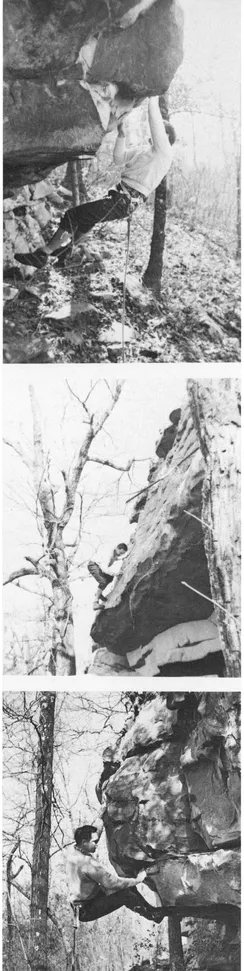
Shades Mountain, Alabama, mid '60's
January 1976
After a spaghetti dinner and some wine, John Gill and I sat at the kitchen table in his large, two-story house in Pueblo, Colorado. We talked climbing for a couple of hours with a cassette tape recorder running, then retired to the living room and continued the discussion until the recorder shut off. It was not so much an interview as just talk. After awhile, the language became uninhibited, we forgot about grammar, and we laughed. Some of our comments later seemed downright spaghetti-bloated!
It felt good to hear Gill tell the stories — many of which had reached the climbing world in one or another distorted form. John's words were important and will be instructive and applicable to mountaineers, big-wall climbers, and boulderers alike. He spoke slowly and methodically, radiating endurance and sensitivity.
For Gill, the view from the top is not awesome. His sketches contain just the right amount of humility —not too little, not too much. Although there exists a very mild, protective, individualistic arrogance, there are cool, complete memories, if not an interior lifting or dismissal of the legends. Gill takes us on a journey which is only a step from being perceptible by touch:
Ament: When did you start climbing? How did you get an interest in it?
Gill: In 1953, I had a girl friend in high school who had some experience climbing in Colorado and Wyoming. I believe she had even taken a trip to Europe.
Ament: She took you up?
Gill: Yes, a group of several of us visited north Georgia on a number of occasions during 1953, and the mountains of northern Georgia are low hills, really, compared to the peaks out here. But, there were some nice limestone and sandstone outcrops, and we did some easy climbing. That's the way I got introduced to it. We just had a lot of fun. We didn't push ourselves. I wore floppy basketball shoes.
Tuscaloosa, Alabama, early '60's
Ament: Were you already into gymnastics at this time?
Gill: Not yet.
Ament: Did you get interested in gymnastics and rope climbing through rock climbing?
Gill: Yes, I definitely did.
Ament: Rumor was that you were a rope climber and gymnast and that you just happened to notice climbing and got on the rock and were good.
Gill: It's actually the reverse. I did not engage in any form of organized athletics in high school. But, we started going up to north Georgia and doing some easy rock climbing at places such as Stone Mountain, right outside of Atlanta. I was living in Atlanta at the time. During the summer of 1954, a friend, Dick Wimer, and I drove out in his old car to Colorado and did a number of climbs. We spent most of the month of August in Colorado. I recall climbing the regular route on the Maiden, having a lot of fun on that. We did some mountain hiking, more of that than actual rock climbing. We did Longs Peak. I soloed a route on the East Face of Longs — a fairly easy route.
Ament: How old were you?
Gill: Sixteen. But, it was an easy route. The lower portion of it was on the buttress below which the glacier is situated. I recall crossing the glacier at one point and getting onto Broadway (the ledge system which runs across the East Face of Longs at mid-height). There I was joined by a guide — can't recall his name right now —who was working for . . . whatever the guide service was at that time. A1 . . . Hays, I believe. In any event, he had seen me scrambling around up there and, I guess, thought I was a tourist idiot and came wandering up to see what I was doing. We had a little discussion on Mills Glacier, and he became convinced that I wasn't a complete idiot. So, we decided to go on to the top. He had come up that day actually to replace the summit register, and I had stumbled over a route that he had anticipated doing himself. I had a short length of rope with me, a little piece of nylon about fifty feet long. We roped together and did the upper portion of the face, on through the little notch.
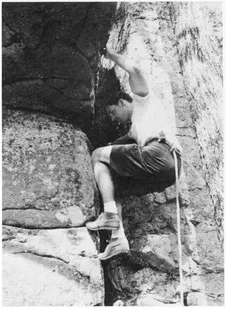
Fort Collins, late '60's
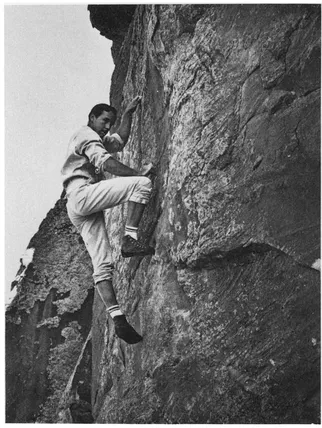
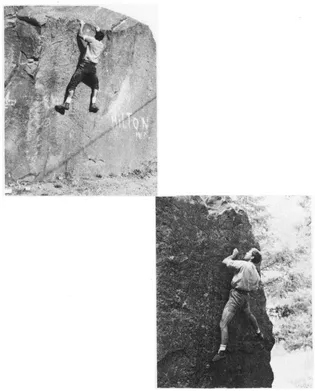
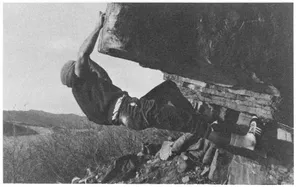
Eldorado Canyon, late and mid '60's
It was a lot of fun. I do recall that he had a very painful journey coming back, because he had a trick knee, and it went out ... I don't believe on the summit, but . . . down in the boulder field. He hobbled all the way back, with a couple of ice axes.
Ament: You were just visiting Colorado that trip and went back to Georgia?
Gill: Right. Then I enrolled in Georgia Tech that fall, and they had a good gymnastics program. But, actually, that wasn't what got me started in gymnastics so much as the fact that every freshman had to take three physical education activity courses, one each quarter. And one of these was gymnastics. Another was swimming. The third was track and field. I think I took the track and field first and was unhappy with that. But, when I got into gymnastics, I discovered that I had really found an athletic home that I hadn't anticipated. I had a good time in the course. Later, I worked out with the Georgia Tech gym team for about a year.
Ament: What was your apparatus?
Gill: I started on rope climbing, which was a legitimate event at the time. I could climb rope quite well the first day I walked into the gymnasium, although I'd really never done any of that sort of thing before, apart from the kind of arm exercise you get doing fairly simple rock climbing. I surprised myself. I discovered that I could zip right up there. That was my primary apparatus. Then I did some work on my own on the parallel bars, a little bit on the high bar. The rings always fascinated me. I was too weak then to do anything hard on rings but started working on preliminary moves. I left Georgia Tech after two years and transferred to the University of Georgia, and there was no gymnastics team, so from that point on I worked out on my own. I started working the still rings more, I suppose, than any other apparatus. I climbed the rope fairly frequently but just didn't have the enthusiasm for it that I'd had at Tech. However, the rings continued to fascinate me, and I built up a fair amount of strength. When I entered Georgia Tech, I weighed about 140 pounds. By the time I graduated from college, I was up to about 185, maybe 190. There wasn't much fat on that.
Ament: Was the build-up from rope climbing mostly or from rings?
Gill: The rope didn't actually develop much muscle. I could climb rope fairly well when I first started. Of course, I didn't develop refined rope climbing technique until I had practiced for several months. I climbed rope on and off with the team for awhile, and that's really the only competitive event I engaged in.
Ament: How far did you go with the competition?
Gill: Just local. I dropped off the team after a short time. I was never really all that good at gymnastics. Although I was fairly good at rope climbing, my body was just a little too long, and I was too inflexible to be really good on other apparatus.
Ament: Were you continuing rock climbing right along with gymnastics?
Gill: Yes. I suppose I really started bouldering — and, by that, I mean climbing short difficult things — in 1955 or 1956. Difficult in those days meant 5.7. I was enthusiastic about gymnastics — not so much from the standpoint of it being an excellent sport as from the fact that it contributed to climbing. And I was pretty interested in climbing at the time.
Ament: Then you graduated from the University of Georgia?
Gill: Yes. I went into the Air Force. I had been in the R.O.T.C. program at the University of Georgia and so got a commission. I went in as a meteorology officer. The following year, 1959, the Air Force sent me to the University of Chicago to study meteorology for a year. I was happy to be reasonably close to Devil's Lake, Wisconsin. I had visited the area once before, on a trip with my parents in the early '50's. I climbed there that fall (1959), probably seven or eight times.
Ament: How close was this from where you were stationed?
Gill: Technically, I was stationed at the University of Chicago. But I was completely independent of the Air Force at that point, other than going to classes, you know, doing my work, picking up my paycheck. We didn't have to wear a uniform, and I had my weekends free. The college vacations were time we could take to do what we wished. It was mostly on weekends that I visited Devil's Lake. It was not a long drive. I also enjoyed working out in the gymnasium with the University of Chicago gymnastics team. I met several talented performers there and developed some skills. When I graduated from meteorology training at Chicago, I was assigned to Glasgow Air Force Base in Montana. That's when I moved out west. The base was located in the northeastern corner of Montana, very remote, well away from all the big mountains. It's not one of the prettier spots in Montana.
Ament: Hearsay had it that you worked out alone in some tower while studying the clouds.
Gill: As a weather forecaster, sometimes things would get a little dull, say on an evening shift, and I would go up into the control tower and do chin-ups, things like that, to pass the time. But, there was a good base gymnasium, and I kept up my gymnastics. By this time, I had purchased a rope and also had a set of rings. As soon as I arrived in Montana, I hung these up in the base gymnasium. In some of my spare time, I would go over and work out, usually every other day for one to two hours. Originally I had been assigned to Montana for a period of two years. But, my tour of duty was extended during the Berlin crisis, so I stayed two years, eight months. When I left the base in May, 1962, I packed my Volkswagen full of all sorts of goodies, shipped my major belongings to my parents' house in Alabama, and took off to spend most of the summer traveling, bouldering, hiking, having a good time for a change. I started off by driving all the way down to Zion and doing some hiking and bouldering there. Then I visited various places in Colorado. I remember meeting Dave Rearick. I had met him the first time in the Tetons in 1957 or 3958. I believe, in that summer of 1962, he was a ranger at Longs Peak. I went back to Alabama that fall. I wanted to get a master's degree in math. So, I was in Alabama for two years, from 1962 to 1964, during which time I again did gymnastics on my own. I went bouldering in northern Alabama. There were even some places around Tuscaloosa (where I was born) and Birmingham with sol...
Table of contents
- Cover
- Half Title
- Title
- Copyright
- Contents
- Dedication
- INTRODUCTION
- THE THIMBLE
- A FACE IN A PHOTOGRAPH
- A PROFILED POSITION
- THE POETRY OF MOUNTAINEERING
- THE JUGGERNAUT
- DELIBERATING POSES
- WHISPERS OF A LEGEND
- MISCELLANEOUS INTERCHANGE
- A CHAT WITH JOHN GILL
Frequently asked questions
Yes, you can cancel anytime from the Subscription tab in your account settings on the Perlego website. Your subscription will stay active until the end of your current billing period. Learn how to cancel your subscription
No, books cannot be downloaded as external files, such as PDFs, for use outside of Perlego. However, you can download books within the Perlego app for offline reading on mobile or tablet. Learn how to download books offline
Perlego offers two plans: Essential and Complete
- Essential is ideal for learners and professionals who enjoy exploring a wide range of subjects. Access the Essential Library with 800,000+ trusted titles and best-sellers across business, personal growth, and the humanities. Includes unlimited reading time and Standard Read Aloud voice.
- Complete: Perfect for advanced learners and researchers needing full, unrestricted access. Unlock 1.5M+ books across hundreds of subjects, including academic and specialized titles. The Complete Plan also includes advanced features like Premium Read Aloud and Research Assistant.
We are an online textbook subscription service, where you can get access to an entire online library for less than the price of a single book per month. With over 1.5 million books across 990+ topics, we’ve got you covered! Learn about our mission
Look out for the read-aloud symbol on your next book to see if you can listen to it. The read-aloud tool reads text aloud for you, highlighting the text as it is being read. You can pause it, speed it up and slow it down. Learn more about Read Aloud
Yes! You can use the Perlego app on both iOS and Android devices to read anytime, anywhere — even offline. Perfect for commutes or when you’re on the go.
Please note we cannot support devices running on iOS 13 and Android 7 or earlier. Learn more about using the app
Please note we cannot support devices running on iOS 13 and Android 7 or earlier. Learn more about using the app
Yes, you can access Master Of Rock by Pat Ament in PDF and/or ePUB format, as well as other popular books in Social Sciences & Sociology. We have over 1.5 million books available in our catalogue for you to explore.