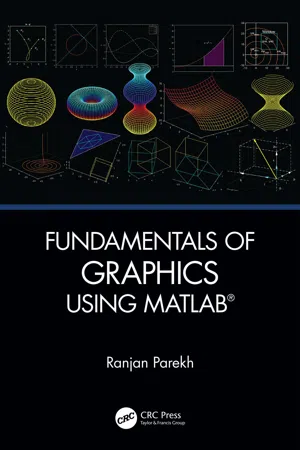
Fundamentals of Graphics Using MATLAB
eBook - ePub

Fundamentals of Graphics Using MATLAB

  1. 410 pages
  2. English
  3. ePUB (mobile friendly)
  4. Available on iOS & Android
eBook - ePub

Fundamentals of Graphics Using MATLAB

About this book

This book introduces fundamental concepts and principles of 2D and 3D graphics and is written for undergraduate and postgraduate students of computer science, graphics, multimedia, and data science. It demonstrates the use of MATLABĀ® programming for solving problems related to graphics and discusses a variety of visualization tools to generate graphs and plots. The book covers important concepts like transformation, projection, surface generation, parametric representation, curve fitting, interpolation, vector representation, and texture mapping, all of which can be used in a wide variety of educational and research fields. Theoretical concepts are illustrated using a large number of practical examples and programming codes, which can be used to visualize and verify the results.

Key Features:

  • Covers fundamental concepts and principles of 2D and 3D graphics
  • Demonstrates the use of MATLABĀ® programming for solving problems on graphics
  • Provides MATLABĀ® codes as answers to specific numerical problems
  • Provides codes in a simple copy and execute format for the novice learner
  • Focuses on learning through visual representation with extensive use of graphs and plots
  • Helps the reader gain in-depth knowledge about the subject matter through practical examples
  • Contains review questions and practice problems with answers for self-evaluation

Frequently asked questions

Yes, you can cancel anytime from the Subscription tab in your account settings on the Perlego website. Your subscription will stay active until the end of your current billing period. Learn how to cancel your subscription.
At the moment all of our mobile-responsive ePub books are available to download via the app. Most of our PDFs are also available to download and we're working on making the final remaining ones downloadable now. Learn more here.
Perlego offers two plans: Essential and Complete
  • Essential is ideal for learners and professionals who enjoy exploring a wide range of subjects. Access the Essential Library with 800,000+ trusted titles and best-sellers across business, personal growth, and the humanities. Includes unlimited reading time and Standard Read Aloud voice.
  • Complete: Perfect for advanced learners and researchers needing full, unrestricted access. Unlock 1.4M+ books across hundreds of subjects, including academic and specialized titles. The Complete Plan also includes advanced features like Premium Read Aloud and Research Assistant.
Both plans are available with monthly, semester, or annual billing cycles.
We are an online textbook subscription service, where you can get access to an entire online library for less than the price of a single book per month. With over 1 million books across 1000+ topics, we’ve got you covered! Learn more here.
Look out for the read-aloud symbol on your next book to see if you can listen to it. The read-aloud tool reads text aloud for you, highlighting the text as it is being read. You can pause it, speed it up and slow it down. Learn more here.
Yes! You can use the Perlego app on both iOS or Android devices to read anytime, anywhere — even offline. Perfect for commutes or when you’re on the go.
Please note we cannot support devices running on iOS 13 and Android 7 or earlier. Learn more about using the app.
Yes, you can access Fundamentals of Graphics Using MATLAB by Ranjan Parekh in PDF and/or ePUB format, as well as other popular books in Computer Science & Computer Graphics. We have over one million books available in our catalogue for you to explore.

Information

CHAPTER 1

Interpolating Splines

1.1 Introduction

Splines are irregular curve segments with known mathematical properties. Splines are frequently encountered in vector graphics when graphic objects are required to have a defined shape in 2D planes (Figure 1.1a) or 3D space (Figure 1.1b) or moved along a specified path (Figure 1.1c). Based on the coordinates of some of the points on the curves, or slopes of lines along the curves, the graphics system needs to calculate a mathematical representation of the curve before storing them onto a disk. This representation usually takes the form of ā€œvectorsā€ or a series of values stored in matrices. The values are calculated using an orthogonal 2D coordinate system consisting of the origin, X-axis, and Y-axis. These coordinate axes are often called the primary or principal axes.
The term ā€œsplineā€ has been derived from the ship building industry where it is used to refer to wooden planks bent between wooden posts for building the curved hull of ships (O’Rourke, 2003). The location of the fixed posts controlled the shape of the plank. In graphics, we use specific points along the spline curve to control the shape of the spline and hence they are aptly referred to as ā€œcontrol points,ā€ shortened as CPs. Depending on the relationship between the CPs and the actual curves, the splines can be...

Table of contents

  1. Cover
  2. Half Title
  3. Title Page
  4. Copyright Page
  5. Table of Contents
  6. Preface
  7. Author
  8. CHAPTER 1 ā–  Interpolating Splines
  9. CHAPTER 2 ā–  Blending Functions and Hybrid Splines
  10. CHAPTER 3 ā–  Approximating Splines
  11. CHAPTER 4 ā–  2D Transformations
  12. CHAPTER 5 ā–  Spline Properties
  13. CHAPTER 6 ā–  Vectors
  14. CHAPTER 7 ā–  3D Transformations
  15. CHAPTER 8 ā–  Surfaces
  16. CHAPTER 9 ā–  Projection
  17. Appendix I: MATLABĀ® Function Summary
  18. Appendix II: Answers to Practice Problems
  19. References
  20. Index