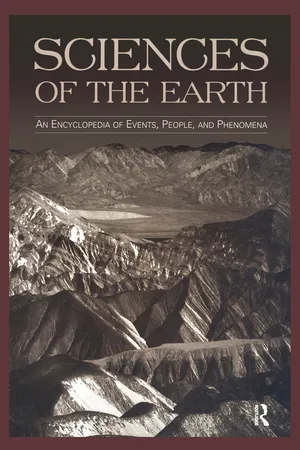
The planet as seen by its inhabitantsIn two millenia, our knowledge of the planet and its natural laws and forces has undergone remarkable changes--from the religious belief of earth as the center of the universe to the modern astronomers' view that it is a mere speck in the cosmos. Now a first-of-its-kind reference work charts this remarkable intellectual progression in our evolving perception of the earth by surveying the history of geology, geography, geophysics, oceanography, meteorology, space science, and many other fields.
Covers human understanding of the Earth in varioustimes and cultures
The Encyclopedia traces our understanding of the earth and its functioning throughout history, summarizing historical explanations of earthly occurrences, including explanations with no scientific basis. It presents the latest facts and theories, explains how our understanding of the earth has evolved, and shows why many outrageous and fanciful earlier ideas were accepted in their time. The coverage explores the physical phenomena that inform our knowledge, starting at the earth's core and extending outward through the mantle, crust, oceans, and atmosphere to the magnetosphere and beyond.
Charts the evolutionof our perceptions
The primary focus of the Encyclopedia is the history of the study of the earth. It also discusses the institutions that advanced and shaped science and probes the interplay between science, practical applications, and social and political forces. The result is a unified historical overview of the earth across a wide canvas of time and place, from antiquity to the space age. Its wide-ranging articles summarize subjects as diverse as geography and imperialism, environmentalism, computers and meteorology, ozone formation theories since 1800, scientific rocketry, the Scopes trial, and much more.
SpecialFeatures
Shows how diverse disciplines, from geology to space science, fit together in a coherent view of the earth * Explains earlier ideas and theories in the context of the beliefs and scientific knowledge of their time * Spotlights important institutions that have shaped the history of science * Explores relationships between science, practical applications, and sociopolitical concerns * Provides a subject index and an index of scientists with birth/death dates
- 901 pages
- English
- ePUB (mobile friendly)
- Available on iOS & Android
eBook - ePub
About this book
A
Actualism, Uniformitarianism, and Catastrophism
A set of ideologically and methodologically distinct positions on the character, rate, and intensity of geological forces, which stem from geological controversies set in the 1830s in Great Britain. The contrasts among these "isms" arose not from necessary philosophical consequences, but rather from the appropriation of these terms as labels to identify adversaries in the ongoing controversies of that specific historical setting.
Actualism is most commonly defined by the aphorism that geologists should try to explain the past by reference to causes now in operation. In most European languages other than English, cognates of the word actual carry the meaning "present," rather than "real" (Gould, p. 120). Hence, the rhetorically powerful term "actualism" was useful to English speaking advocates of a historical geology dependent entirely on ordinary everyday processes, most notably Charles Lyell (1797-1875).
Uniformitarianism is the term that has come to be most closely identified with Lyell's methodology since he published his landmark three-volume text, Principles of Geology (1830-1833). The many specific senses of the root word uniform helped Lyell to sustain an ideologically potent claim in behalf of his own collection of assumptions about how geology ought properly to be done. Uniformitarianism embraces and sometimes confounds some or all of the following: uniformity of law (which is a prerequisite to scientific inquiry); uniformity of process (in other words, actualism); uniformity of rate (that is, a gradualism which, for Lyell, also meant that the shaping of the Earth's features must have taken a very long time); uniformity of scale (so that, for example, the strictly local observable natural disasters like floods, earthquakes, and volcanic eruptions ought not be supposed to ever operate in a global manner); and uniformity of state (that is, the rejection of the popular contemporary idea that the Earth had undergone a purposeful progressive development to its present condition—one designed for human habitation) (Gould, pp. 99-126; Huggett, pp. 4-5). Taken all together or in convenient subsets, these various senses of uniform have enabled uniformitarianism to rule the practice of geology, at least in name, ever since 1832 when William Whewell (1794-1866) coined the term to denominate Lyell's doctrine.
Catastrophism was the name Whewell attached to the doctrine of Lyell's opponents. Both terms were coined in a review by Whewell of Principles, in order to set Lyell's program apart from its contemporary competitors. During the 1820s, England's leading geologist was the Reverend William Buckland (1784-1856). An extremely popular lecturer at Oxford, internationally respected for his interpretation of hyena bones found in caves, Buckland supported a diluvialist theory that attributed universal deposits of gravel and loam, as well as the excavation of some valleys, to the action of a sudden and transient deluge. Evidence of cataclysmic flooding abounded in a world not yet seen as molded by the ice ages. Gigantic boulders perched atop high hills, displaced from their native rock by hundreds of miles, were only the most obvious of a host of phenomena that seemed to testify to the inadequacy of "causes now in operation."
Drawing on the most sensational aspects of diluvialism, Whewell dubbed those who were opposed to Lyell's uniformitarianism "catastrophists." Interestingly enough, in subsequent reiterations of this distinction, Whe well consistently failed to cite Buckland as a representative of catastrophism, mentioning instead the French theorist of mountain-building Léonce Elie de Beaumont (1798-1894) and even Scottish-born Roderick Murchison (1792-1871), who harbored ideas about an ancient time of "paroxysmal turbulence" in the Earth's history (Rupke, p. 199).
Nineteenth-century intellectual historians saw catastrophism primarily in negative terms from the start. In the black-and-white heroic tradition of scientific biography, such as Founders of Geology (1897) by Archibald Geikie (1835-1924), any theory or explanatory mechanism that could be accused of not adhering to some sense of uniformity was potentially catastrophist. Thus, from a historical perspective, it becomes clear that the label "catastrophism" has served more an ideological than a logical categorical function.
As a case in point, uniformitarians branded all flood theorists as old catastrophists by lumping together any diluvialist with the so-called Scriptural geologists, who saw Moses' account of the Deluge as unimpeachable scientific evidence. In this way Buckland was accused of defending an outmoded cosmogony. For well over a century, this portrayal of Lyell's contemporaries as biblical literalists, uninformed by the real world of observable processes and phenomena, was faithfully reproduced by historians of geology.
The characterization is particularly unfair to Buckland, who had done such important work in establishing an actualist basis and evidence to corroborate fossil-based stratigraphic technique and who had consistently argued against a literal reading of the Genesis account (Rupke, pp. 33—41, pp. 60-61). The automatic identification of actualism with uniformitarianism (again, translation to non-English European languages often freely interchanges these two) bears the unfounded implication that catastrophists were not actualistic. Typically, as a matter of fact, catastrophists relied upon present-day processes to explain most of their observations, insisting only that some phenomena may fall outside the explanatory power of cumulative effects of gradual everyday processes.
In other words, catastrophists were good empiricists who preferred to keep an open mind about explanatory mechanisms when faced with extraordinary evidence. Ironically, given Lyell's success in portraying the catastrophists as unscientific fantasists, it was really the uniformitarians who were metaphysically attached to an a priori belief—that is, the sufficiency of causes now in operation, at presently observable rates, to explain all past changes in the Earth's surface (Hooykaas, "Catastrophism," pp. 336-338).
It is interesting to note how some now-standard elements of the uniformitarian understanding of the Earth's history had their roots in theories originally branded as catastrophist. For example, the promulgation by Alpine geologist Jean Louis Rodolphe Agassiz (1807-1873), in 1837, of sudden and universal glacial action (an ice age) to explain rock displacement and striation throughout Europe was initially ridiculed by English geologists as a catastrophist scenario. The plausibility of the agency of mile-thick ice was not widely accepted until after 1858, when expeditions reported a massive sheet of slowly moving ice in the interior of Greenland.
True to his uniformitarian creed, Lyell, though initially receptive to Buckland's 1840 presentation of Agassiz's ideas, quickly reverted to a theory that he and Murchison had developed to explain the rock striation by the motion of water-borne icebergs across formerly submerged land (Rupke, pp. 98-103). At that point, iceberg transportation of boulders was preferable (in an actualist sense) to universal glaciation, even though climate change was otherwise one of Lyell's favorite mechanisms to explain geographically surprising fossil discoveries.
Recent historians of geology have noted the misleading dichotomy of uniformitarianism and catastrophism, and have attempted to offer a conscientious analysis of the points of contrast between the two along the lines of the discussion above. First among these must be counted Reijer Hooykaas, whose work beginning in the 1950s has made possible a more contextually sensitive reading of Lyell's emergence as the "father of modern scientific geology" than the idea that all who preceded or opposed him were captives to speculation about supernatural causes and extraordinary events. In his writings about the principle of uniformity, Hooykaas delineates the philosophical typology of catastrophisms, actualisms, and uniformitarianisms to which all subsequent students of this subject have referred (Hooykaas, Natural Law; Hooykaas, Principle of Uniformity).
Beyond this important first task of setting straight these terms and their possible interactions, other historians have sought to disaggregate or substitute for one or the other elements of the problematic catastrophist-uniformitarian dichotomy. Needless to say, this effort entails the introduction of yet more "isms." For example, Martin Rudwick proposes to substitute the name "directionalism" for "catastrophism" as a better representative of the synthesis Lyell sought to displace (Rudwick, pp. 213-218).
Nicolaas Rupke, Buckland's biographer, offers a more direct challenge to Whewell's dichotomy, so well preserved by historians of English geology, when he charges that no catastrophist synthesis ever existed. Instead, according to Rupke, the school of geology to which Buckland belonged was that of historical geology, a school that produced progressivism as its synthesis. Progress in this case had much more to do with continuity and long periods of gradual change than with the catastrophic interruptions which, after all, are embedded in the very periodization of historical geology. The boundaries separating Primary, Secondary, Tertiary, and Quaternary epochs are universally abrupt and recognizable (Rupke, pp. 194-195).
In his most recent and succinct deliberations on catastrophism in geology, Hooykaas reiterates his typology of catastrophisms while providing representative proponents of the various combinations. Actualist catastrophists include the eighteenth-century French cosmologist G.L. LeClerc (Comte de) Buffon (1707-1788), the aforementioned Elie de Beaumont, and their late-nineteenth-century countryman Charles Saint-Claire Deville (1814—1881). Nonactualist catastrophists include the following: the Russian neptunist (that is, Wernerian) geologist Count Gregor Razumovsky (1759-1837); the French theorist impatient with gradualistic arguments about mountain-building Deodat de Dolomieu (1750-1801); and Lyell's self-designated nemesis, Baron George Cuvier (1769-1832), who, like Murchison, argued that long periods of tranquillity, such as the present, must in the past have been interrupted by brief periods of great convulsion in order to produce the dramatically overturned rock masses observable in the Alps (Hooykaas, "Catastrophism," pp. 316-331).
A brief reflection upon this list raises two significant historical questions. First, to what degree were catastrophist ideas characteristic of Continental European, as opposed to insular English, geology (and, if so, for what reasons)? And second, to what degree were mountain-building theories especially problematic for dogmatic uniformitarians? Historian Mott Greene suggests in his book on nineteenth-century geology that the story to be told revolves around these two questions rather than upon the ultimate "triumph" of Lyellian uniformitarianism (Greene, p. 76).
Noting that me study of global tectonics by Europeans has proceeded primarily in the hands of French- and German-speaking geologists—for example, Elie de Beaumont, Horace Benedict de Saussure (1740—1799), and Eduard Suess (1831-1914)—Greene tacitly illustrates the inability of British geology and of the Lyellian paradigm to answer questions about processes that were necessarily monumentally dynamic. England's strength lay, rather, in its rich record of secondary strata. These bore both the wondrous variety of fossilized life forms that sustained the reputation of British science, and the concomitant stores of iron ore, coal, and limestone that fueled the ascent of British industry. For these reasons, perhaps, the preeminence of Britain in discussions of the history of nineteenth-century geology can be understood. But that does not mean that terms and categories peculiar to the English geological context are universally applicable.
Greene's purpose in calling attention to Great Britain's post-Lyellian shortcomings is not to make a strictly linguistic or cultural discrimination. Indeed, he credits English-speaking North American geologists—such as James Hall (1811-1898), the Rogers brothers (Henry Darwin [1808—1866] and William Barton [1804—1882]), and James Dwight Dana (1813-1895)—with the original development of the geosynclinal view of orogenesis, an approach to the theory of mountain-building that was subsequently adopted by geologists worldwide (Greene, pp. 122-143). The key difference, therefore, had to do with access to salient phenomena. Geologists were more or less likely to accept the plausibility of catastrophic processes, depending on the suggestiveness presented by their native landscapes. Americans were confronted with the wavelike ripples of the Appalachian Mountains, and so were led to speculate about dynamic causes for such a structure.
On the other hand, Lyell's acquaintance and collaboration with Italian geologists was what ultimately set him apart from his English (Buckland, et al.) contemporaries (Rupke, p. 181). In Italy, Lyell transcended the experience of his own quiescent landscape. There he learned about earthquakes and volcanoes, and gained the insight that gave uniformitarianism such an advantage over catastrophism. Lyell interpreted local cataclysms as cumulatively tremendous in their effects. Thus, ac tualism combined with an expanded timescale made extraordinary causes, forces, and scales less compelling. Paradoxically, natural disasters only added to the repertoire of gradualism. Evidence of a past gigantic, catastrophic event could even become fodder for uniformitarianism if some pattern, even an irregular one, of recurrence could be shown.
Lyell's escape from nationalistic limitations in nineteenth-century geological theory and speculation only reinforces the general validity of the rule. Further research might explore some other sources of ideological predisposition highlighted by this review of the controversy typically cast as one between catastrophists and uniformitarians. For example, vernacular language and its connotations did enter that century's controversies. It played a role that can be illustrated both by contrasting it to the preceding (Enlightenment) era, when Latin tended to be the universal language of science, and by attending to persistent efforts by scientists and mathematicians in the late nineteenth century to construct international standards of measurement, nomenclature, and even hybrid languages (for example, Esperanto).
Another valuable exercise would be to devote more attention to the periphery of the English-speaking geological community. So much is known and published about the English geologists themselves that the nonspecialist historian of science might conclude that geological controversies were confined to the British Isles. Clearly, however, these controversies had active partisans, as well as vociferous, historically interesting analogues, overseas, such as in North America and Australia. Correspondence among English-speaking geologists operating hemispheres apart has yet to receive central attention in the literature. The imperial model of knowledge acquisition has amplified the myopic concerns for local central concerns at the expense of global geological practices. In other words, the English speaking scientific community comprised more than its London and Oxbridge circles.
Finally, taking the cues offered by Hooykaas, Rudwick, and Rupke, alternate formulations of what Lyell's geology triumphed over deserve the kind of critical and thoughtful elaboration that has been foisted upon the dead horse of catastrophism. What is interesting, after all, is that a creed named uniformitarianism established hegemony over 150 years of geological discourse. That catastrophism was the name chosen for the enemy goes far to explain some geologists' resistance to provocative ideas in that time span, but other questions remain unaddressed. What effect did uniformitarian suppr...
Table of contents
- Cover Page
- Volume 1
- Volume 2
- Name Index
- Subject Index
Trusted by 375,005 students
Access to over 1.5 million titles for a fair monthly price.
Study more efficiently using our study tools.
Frequently asked questions
Yes, you can cancel anytime from the Subscription tab in your account settings on the Perlego website. Your subscription will stay active until the end of your current billing period. Learn how to cancel your subscription
No, books cannot be downloaded as external files, such as PDFs, for use outside of Perlego. However, you can download books within the Perlego app for offline reading on mobile or tablet. Learn how to download books offline
Perlego offers two plans: Essential and Complete
- Essential is ideal for learners and professionals who enjoy exploring a wide range of subjects. Access the Essential Library with 800,000+ trusted titles and best-sellers across business, personal growth, and the humanities. Includes unlimited reading time and Standard Read Aloud voice.
- Complete: Perfect for advanced learners and researchers needing full, unrestricted access. Unlock 1.5M+ books across hundreds of subjects, including academic and specialized titles. The Complete Plan also includes advanced features like Premium Read Aloud and Research Assistant.
We are an online textbook subscription service, where you can get access to an entire online library for less than the price of a single book per month. With over 1.5 million books across 990+ topics, we’ve got you covered! Learn about our mission
Look out for the read-aloud symbol on your next book to see if you can listen to it. The read-aloud tool reads text aloud for you, highlighting the text as it is being read. You can pause it, speed it up and slow it down. Learn more about Read Aloud
Yes! You can use the Perlego app on both iOS and Android devices to read anytime, anywhere — even offline. Perfect for commutes or when you’re on the go.
Please note we cannot support devices running on iOS 13 and Android 7 or earlier. Learn more about using the app
Please note we cannot support devices running on iOS 13 and Android 7 or earlier. Learn more about using the app
Yes, you can access Sciences of the Earth by Gregory A. Good in PDF and/or ePUB format, as well as other popular books in History & World History. We have over 1.5 million books available in our catalogue for you to explore.