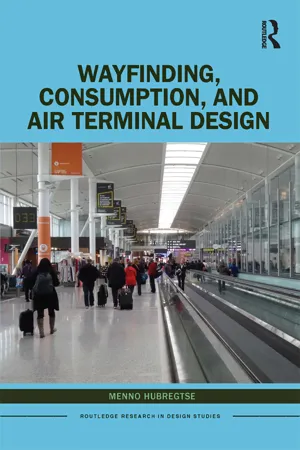
This book investigates how international air terminals organize passenger movement and generate spending. It offers a new understanding of how their architecture and artworks operate visually to guide people through the space and affect their behaviour.
Menno Hubregtse's research draws upon numerous airport visits and interviews with architects and planners, as well as documents and articles that address these terminals' development, construction, and renovations. The book establishes the main concerns of architects with respect to wayfinding strategies and analyzes how air terminal architecture, artworks, and interior design contribute to the airport's operations.
The book will be of interest to art historians, architectural historians, practising architects, urban planners, airport specialists, and geographers.
1Wayfinding and Facilitating Passenger Circulation
This chapter examines contemporary international air terminals that include ‘intuitive’ designs to facilitate wayfinding. While I address these buildings’ structural supports, elevations, and footprints, I concentrate on how architects design their interiors with material cues intended to aid with passenger orientation. For instance, they often design the concourse with high ceilings such that travellers can see where they are in the building. Sometimes planners design these ceilings with skylights or other materials that give the sense of the required directional flow. Carpets, colour schemes, and artificial lighting are also used for wayfinding purposes. I begin my analysis by outlining some of the central aspects of air terminal design before examining three airports in greater detail. Schiphol, Heathrow, and Hong Kong International Airport (HKIA) are three of the busiest airports in the world with respect to international air travel. Their terminals illustrate three different models of development to account for increasing passenger traffic. Schiphol’s terminal has been renovated and expanded repeatedly since it first opened in 1967. Rather than creating one large terminal building, Heathrow’s planners have built an agglomeration of free-standing structures since the airport started its operations in 1946. I focus on Richard Rogers Partnership’s Terminal 5, an architectural design subjected to numerous revisions before it finally opened in 2008. It illustrates how architects have to adjust their designs to account for existing airport buildings and infrastructure. At HKIA, on the other hand, architects designed the terminal on an entirely new site. The airport opened in 1998 on reclaimed land in the water west of the city’s downtown and replaced Kai Tak, the city’s former airport in Kowloon, Hong Kong. I briefly discuss each of these airports’ histories before examining their current terminal designs. Although I address the ground transportation networks that connect these airports with surrounding cities and regions, I omit a description of the rail transportation buildings and parking garages. Instead, I account for how the terminals are linked to these transfer points such that the passenger can move from the automobile or train to the check-in counter as efficiently as possible. My aim for this overview of Schiphol, Heathrow, and HKIA is to provide the reader with an understanding of air terminal design and wayfinding, how this differs from site to site, and some of the reasons behind the design choices.
While architects aim to create terminals that facilitate smooth circulation, they also try to design these structures as consumer spaces that generate passenger spending. The latter half of this chapter considers how architects incorporate retail and food services into their plans and how this sometimes hampers their ability to provide transparent designs with regard to wayfinding and navigation. Typically, the main routes travelled by departing and arriving passengers are lined with shops and restaurants in order to maximize financial return.1 Some interior designs require travellers to walk past retail areas, while others, particularly walkthrough duty-free stores, force passengers to transit through a commercial space before reaching their gate. Moments of immobility, or dwell-time, are seen as a potential commercial boon for airport authorities. In most airports, the majority of retail stores and restaurants are located on the post-security airside; people are encouraged to loiter in or around shops and restaurants and spend their money as they spend their time waiting. Terminals often include a few shops and restaurants on the landside for people awaiting arriving friends and family members. In my analysis, I focus on walkthrough duty-free stores since these designs exemplify how planners use materials to organize passengers’ movement and encourage them to spend.
In short, this chapter concentrates on air terminal interiors with regard to circulation, and it aims to provide the reader with an overview of various types of air terminal layouts. This summary of the material aspects of these complex structures sets the stage, so to speak, for the more detailed critical analyses of air terminal architecture, artworks, and design in this book.
Air Terminals as Spaces of Circulation
airport terminals are the cathedrals of our age—a huge public space where people gather, wait, eat, sometimes sleep, and usually shop. These are truly twenty-firstcentury buildings—fluid space for fluid functions using high technology architecture for spatial containment and cultural expression.
(Edwards 2005, x)
The twenty-first-century air terminal, Brian Edwards argues, is akin to a cathedral architecturally in relation to its structure and manipulation of light. This comparison between a transportation building and an ecclesiastical structure is not entirely unusual. G.K. Chesterton made a comparable pronouncement with respect to railway stations (Richards and MacKenzie 1986). While air terminals and cathedrals share some material similarities, these buildings differ markedly in terms of symbolic and spiritual value. Air terminals and railway stations, on the other hand, are very alike in structure and in purpose. Edwards notes that in both of these buildings the paths people follow in their interiors “are processional and linear” (2005, x). They are planned as transit hubs that move passengers through the space as efficiently as possible as well as marketplaces where travellers are encouraged to dwell and spend their money at air terminal retailers. Not only do airport architects need to design a space that functions as a passenger-processing machine and a consumption centre, they need to account for technological requirements that support aviation and security. While function is a major determinant of the design, architects also need to consider the passenger’s experience within these structures. Architectural historian Koos Bosma (1996, 2004) argues that the ideal airport is not simply a transfer point that moves people efficiently through the space but is also a place where travellers are kept calm while they wait and move through the terminal.
In his essay “In Search of the Perfect Airport,” Bosma concedes that planners and architects have been unable to achieve “typological or architectural purity” in their designs since their plans need to account for a vast number of functions integral to an airport’s smooth operation (2004, 64).2 The strategies used in airports to circulate people, cargo, and aircraft constantly change due to new logistical and security demands, technological developments, and shifts in socio-political conditions. This constant push for upgrades to improve the speed, efficiency, and security of how passengers and freight are processed necessitates renovations, reconstruction, and expansions.
Foster + Partners’ design for London’s Stansted anticipated future expansions (Powell 1992). It is a large single terminal using a modular construction that allows new modules to be added without dramatically disrupting the appearance of the whole (Figure 1.1).
Figure 1.1 Foster + Partners, London Stansted Airport, United Kingdom, 1991. Source: Menno Hubregtse (2018).
Its open-spaced design contrasted with the majority of airports in use when it was built in 1991. Many airports, notably Heathrow, had undergone numerous reconstructions and renovations and were experienced as a maze of confusing corridors (Gottdiener 2001). Airports built during the 1950s and 1960s needed to be restructured to handle increased passenger loads due to the mass popularization of air travel, cheaper airfares, and the introduction of the jumbo jet in 1970 (Gordon 2008; Pearman 2004). Air terminal interiors were also redesigned in response to the dramatic increase in hijackings and terrorist attacks during the late 1960s and early 1970s. New airports constructed during the 1970s, such as Paul Andreu’s Charles de Gaulle in Paris, accounted for these increased risks and were designed as heavy and solid structures that funnelled passengers through tightly regulated and artificially lit corridors.3 Stansted is one of many air terminals built after 1990 that are designed as large unified structures with lightweight roofs and floor-to-ceiling glass walls that allow the passenger to see the terminal from end to end. From the outside, these glassy buildings often appear “to float in the air or to be poised to take wing” (Gottdiener 2001, 70). These spectacular air terminals have been constructed for new airports such as Foster + Partners’ Terminal 1 at Chek Lap Kok in Hong Kong or for existing airports such as Richard Rogers Partnership’s Terminal 5 at Heathrow (Figure I.2, 1.2).
Figure 1.2 Foster + Partners, Terminal 1, Hong Kong International Airport, Hong Kong, 1998. Source: Menno Hubregtse (2014).
Whether it is one large open space or a solidly built structure with a maze of corridors, passengers predominantly experience the air terminal by walking and navigating themselves through the building’s interior. Signage and other visual cues help lead them through the space. At Schiphol, Paul Mijksenaar has carefully designed a signage system consisting of nested categories that directs people to their destination (Cresswell 2006; Mijksenaar 2012). Mijksenaar colour-coded and sized Schiphol’s signage according to three categories: signs directing flows, which indicate where travellers need to go in the process; signs referring to fixed locations such as toilets, lounges, and chapels; and signs identifying specific shops and restaurants. His design has become an “international aesthetic of air mobility” since numerous other airports have adopted Schiphol’s signage system (Cresswell 2006, 246).
Planners are trying to design airports where passengers rely less on signage and navigate the terminal primarily on an intuitive level (Gordon 2008). This is intended to reduce the stress experienced by travellers and mitigate the increasing number of ‘air rage’ incidents. Architects incorporate specific visual cues into their terminal designs that are intended to help push passengers into specific directions (Edwards 2005). For example, columns used to support a roof are often aligned parallel to major routes as are other structural elements like beams. Daylight is manipulated and is sometimes projected onto passageways to help guide travellers. The size of a space is determined by its relative importance as a route; major transit points and thoroughfares like departures halls are often built as large concourses while minor routes like emergency exits and pathways to private areas are designed as smaller corridors.
While wayfinding is a significant aspect of air terminal design, the main determinant of the building’s overall form is the airport’s runways. These vast expanses of tarmac occupy most of the airport’s landmass, and they are relatively fixed once they have been developed. Airport planning firms such as NACO (Netherlands Airport Consultants) determine the ground plan based on the area between the runways and how aircraft can best access the terminal’s gates (Hein Baijer, Piet Ringersma, and Toon Stallaart, pers. comm., April 10, 2018). NACO designed Beijing Capital International Airport’s Terminal 3 with a Y-shaped footprint since this configuration works well for long, narrow segments of land between two parallel runways. Hong Kong International Airport’s Terminal 1 has a comparable shape since it is also placed between two parallel runways. Amsterdam Airport Schiphol’s terminal is situated in an area enclosed by three runways and a highway.4 It consists of seven piers, each with a different footprint, radiating out from the main terminal structure. Unlike HKIA Terminal 1 and Beijing Terminal 3, Schiphol’s terminal does not have a symmetrical footprint—largely because it has been substantially reconstructed and expanded since it opened in 1967. Beijing Terminal 3 and HKIA Terminal 1, on the other hand, have undergone few renovations since they were opened in 2008 and 1996 respectively.5 HKIA has added separate sate...
Table of contents
Cover
Half Title
Series Page
Title Page
Copyright Page
Contents
List of Figures
List of Plates
Acknowledgements
Introduction
1 Wayfinding and Facilitating Passenger Circulation
2 Air Terminal Design: Agency and a Functional Aesthetic
3 Installing Artworks for Wayfinding and Commerce
4 Movement-Themed Artworks: Affect, Kinaesthesia, and Control
5 Place-Themed Designs and Mobility
Conclusion
Index
Trusted by 375,005 students
Access to over 1.5 million titles for a fair monthly price.
Study more efficiently using our study tools.
Frequently asked questions
Yes, you can cancel anytime from the Subscription tab in your account settings on the Perlego website. Your subscription will stay active until the end of your current billing period. Learn how to cancel your subscription
No, books cannot be downloaded as external files, such as PDFs, for use outside of Perlego. However, you can download books within the Perlego app for offline reading on mobile or tablet. Learn how to download books offline
Perlego offers two plans: Essential and Complete
Essential is ideal for learners and professionals who enjoy exploring a wide range of subjects. Access the Essential Library with 800,000+ trusted titles and best-sellers across business, personal growth, and the humanities. Includes unlimited reading time and Standard Read Aloud voice.
Complete: Perfect for advanced learners and researchers needing full, unrestricted access. Unlock 1.5M+ books across hundreds of subjects, including academic and specialized titles. The Complete Plan also includes advanced features like Premium Read Aloud and Research Assistant.
Both plans are available with monthly, semester, or annual billing cycles.
We are an online textbook subscription service, where you can get access to an entire online library for less than the price of a single book per month. With over 1.5 million books across 990+ topics, we’ve got you covered! Learn about our mission
Look out for the read-aloud symbol on your next book to see if you can listen to it. The read-aloud tool reads text aloud for you, highlighting the text as it is being read. You can pause it, speed it up and slow it down. Learn more about Read Aloud
Yes! You can use the Perlego app on both iOS and Android devices to read anytime, anywhere — even offline. Perfect for commutes or when you’re on the go. Please note we cannot support devices running on iOS 13 and Android 7 or earlier. Learn more about using the app
Yes, you can access Wayfinding, Consumption, and Air Terminal Design by Menno Hubregtse in PDF and/or ePUB format, as well as other popular books in Art & History of Art. We have over 1.5 million books available in our catalogue for you to explore.