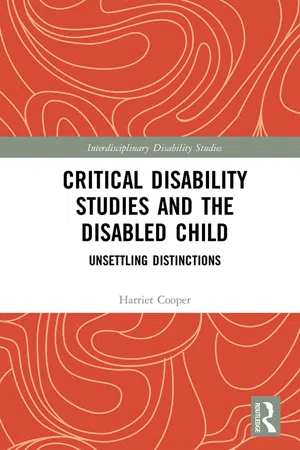
Critical Disability Studies and the Disabled Child
eBook - ePub

Critical Disability Studies and the Disabled Child

Unsettling Distinctions

  1. 176 pages
  2. English
  3. ePUB (mobile friendly)
  4. Available on iOS & Android
eBook - ePub

Critical Disability Studies and the Disabled Child

Unsettling Distinctions

About this book

This book examines the relationship between contemporary cultural representations of disabled children on the one hand, and disability as a personal experience of internalised oppression on the other. In focalising this debate through an exploration of the politically and emotionally charged figure of the disabled child, Harriet Cooper raises questions both about what it means to 'speak for' the other and about what resistance means when one is unknowingly invested in one's own abjection.

Drawing on both the author's personal experience of growing up with a physical impairment and on a range of critical theories and cultural objects – from Frances Hodgson Burnett's novel The Secret Garden to Judith Butler's work on injurious speech – the book theorises the making of disabled and 'rehabilitated' subjectivities. With a conceptual framework informed by both psychoanalysis and critical disability studies, it investigates the ways in which cultural anxieties about disability come to be embodied and lived by the disabled child.

Posing new questions for disability studies and for identity politics about the relationships between lived experiences, cultural representations and dominant discourses – and demonstrating a new approach to the concept of 'internalised oppression' – this book will be of interest to scholars and students of disability studies, medical humanities, sociology and psychosocial studies, as well as to those with an interest in identity politics more generally.

Frequently asked questions

Yes, you can cancel anytime from the Subscription tab in your account settings on the Perlego website. Your subscription will stay active until the end of your current billing period. Learn how to cancel your subscription.
No, books cannot be downloaded as external files, such as PDFs, for use outside of Perlego. However, you can download books within the Perlego app for offline reading on mobile or tablet. Learn more here.
Perlego offers two plans: Essential and Complete
  • Essential is ideal for learners and professionals who enjoy exploring a wide range of subjects. Access the Essential Library with 800,000+ trusted titles and best-sellers across business, personal growth, and the humanities. Includes unlimited reading time and Standard Read Aloud voice.
  • Complete: Perfect for advanced learners and researchers needing full, unrestricted access. Unlock 1.4M+ books across hundreds of subjects, including academic and specialized titles. The Complete Plan also includes advanced features like Premium Read Aloud and Research Assistant.
Both plans are available with monthly, semester, or annual billing cycles.
We are an online textbook subscription service, where you can get access to an entire online library for less than the price of a single book per month. With over 1 million books across 1000+ topics, we’ve got you covered! Learn more here.
Look out for the read-aloud symbol on your next book to see if you can listen to it. The read-aloud tool reads text aloud for you, highlighting the text as it is being read. You can pause it, speed it up and slow it down. Learn more here.
Yes! You can use the Perlego app on both iOS or Android devices to read anytime, anywhere — even offline. Perfect for commutes or when you’re on the go.
Please note we cannot support devices running on iOS 13 and Android 7 or earlier. Learn more about using the app.
Yes, you can access Critical Disability Studies and the Disabled Child by Harriet Cooper in PDF and/or ePUB format, as well as other popular books in Sozialwissenschaften & Sozialarbeit. We have over one million books available in our catalogue for you to explore.

Information

Year
2020
Print ISBN
9780367183066
eBook ISBN
9780429593970

Table of contents

  1. Cover
  2. Half Title
  3. Series Page
  4. Title Page
  5. Copyright Page
  6. Table of Contents
  7. Acknowledgements
  8. Abbreviations
  9. Introduction
  10. 1. The look that made me: The early gazing relationship and the construction of disabled subjectivity
  11. 2. Making her better? Denaturalising the notion of the ‘developing child’
  12. 3. (Un)making the child, making the future: On gifts, commodities and diagnostic speech acts
  13. 4. Making, unmaking, remaking? Finding a position from which to resist
  14. Conclusion
  15. References
  16. Index