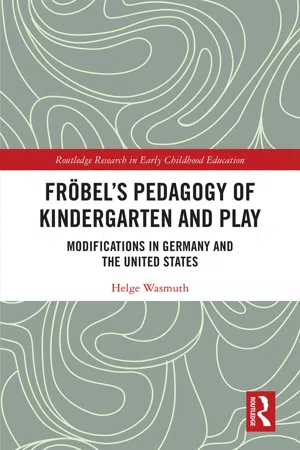
Fröbel's Pedagogy of Kindergarten and Play
eBook - ePub

Fröbel's Pedagogy of Kindergarten and Play

Modifications in Germany and the United States

  1. 214 pages
  2. English
  3. ePUB (mobile friendly)
  4. Available on iOS & Android
eBook - ePub

Fröbel's Pedagogy of Kindergarten and Play

Modifications in Germany and the United States

About this book

This text provides a comprehensive analysis of historical archives, letters, and primary sources to offer unique insight into how Fröbel's pedagogy of kindergarten and play has been understood, interpreted, and modified throughout history and in particular, as a consequence of it's adoption in the US.

Tracing the development, modification, and global spread of the kindergarten movement, this volume demonstrates the far-reaching impacts of Fröbel's work, and asks how far contemporary understandings of the kindergarten pedagogy reflect the educationalist's original intentions. Recognizing that Fröbel's pedagogy has at times been simplified or misunderstood, the book tackles issues caused by translation, or transfer to non-German speaking countries such as the US, and so demonstrates how and why contemporary research and Froebelian practice is in the danger of diverging from the original ideas expressed in Fröbel's work. By returning to original documents produced by Fröbel, Wasmuth traces various interpretations, and explains how and why some of these understandings established themselves in the context of US Early Childhood Education, whilst others did not.

This insightful text will be of great interest to graduate and postgraduate students, researchers, academics, professionals and policy makers in the fields of early childhood education, history of education, Philosophy of Education and Teacher Education.

Frequently asked questions

Yes, you can cancel anytime from the Subscription tab in your account settings on the Perlego website. Your subscription will stay active until the end of your current billing period. Learn how to cancel your subscription.
No, books cannot be downloaded as external files, such as PDFs, for use outside of Perlego. However, you can download books within the Perlego app for offline reading on mobile or tablet. Learn more here.
Perlego offers two plans: Essential and Complete
  • Essential is ideal for learners and professionals who enjoy exploring a wide range of subjects. Access the Essential Library with 800,000+ trusted titles and best-sellers across business, personal growth, and the humanities. Includes unlimited reading time and Standard Read Aloud voice.
  • Complete: Perfect for advanced learners and researchers needing full, unrestricted access. Unlock 1.4M+ books across hundreds of subjects, including academic and specialized titles. The Complete Plan also includes advanced features like Premium Read Aloud and Research Assistant.
Both plans are available with monthly, semester, or annual billing cycles.
We are an online textbook subscription service, where you can get access to an entire online library for less than the price of a single book per month. With over 1 million books across 1000+ topics, we’ve got you covered! Learn more here.
Look out for the read-aloud symbol on your next book to see if you can listen to it. The read-aloud tool reads text aloud for you, highlighting the text as it is being read. You can pause it, speed it up and slow it down. Learn more here.
Yes! You can use the Perlego app on both iOS or Android devices to read anytime, anywhere — even offline. Perfect for commutes or when you’re on the go.
Please note we cannot support devices running on iOS 13 and Android 7 or earlier. Learn more about using the app.
Yes, you can access Fröbel's Pedagogy of Kindergarten and Play by Helge Wasmuth in PDF and/or ePUB format, as well as other popular books in Education & Education General. We have over one million books available in our catalogue for you to explore.

Information

Year
2020
Print ISBN
9781032238555
eBook ISBN
9780429602320
Edition
1

Part I
Friedrich Fröbel and His Pedagogy of Kindergarten and Play

1 Friedrich Fröbel on His Way of Becoming an Educator of Young Children

Why start with biographical remarks? As Martin Heidegger once famously remarked regarding Aristotle’s life: he was born, he worked, and he died—so why does Friedrich Fröbel’s life matter?
There are reasons, though, for a closer look. Fröbel’s work and life were interwoven; the events that shaped his life and time help to understand his pedagogy. Moreover, Fröbel’s life itself is of interest, not because it was such an extraordinary one, but because much of it is hidden behind the often-repeated myths until today.
The latter may come as a surprise. One would expect Fröbel, the so-called “father of kindergarten,” whom Weston, in his short biography, describes as “probably the most influential educationalist of the nineteenth century” (1998, p. 1), to be a well-known and well-researched figure. Surprisingly, that is only partially true. As Oelkers (1998) has pointed out, Fröbel continues to be a rather unknown character hidden behind the cult around him. Despite the numerous works on him, he is only a “roughly drawn figure” (Krone, 2016, p. 18), at least if one expects credible, well-documented, and critically reviewed data.1Current research (Krone, 2016; Sauerbrey, 2015; Sauerbrey, Winkler, & Zipf, 2015) has increased the knowledge about Fröbel’s life; however, those insights are only accessible in German. In the English-speaking context, a critical, well-researched biography is still lacking, here, Fröbel is an even more unknown figure.2
Who was Fröbel, though? Historical works often describe him as a sensitive pedagogue of Romanticism and, of course, as the father of kindergarten, a great pedagogue who is unfortunately not easy to understand due to his complicated writing style but still a real pedagogical “genius.” It is an attractive perspective, but one that Fröbel’s contemporaries, except for his early followers, would not have shared—at least the part of him being a genius. Fröbel may be famous today, but he was not during his lifetime. Instead, his economic and pedagogical work was often judged negatively.3 Founders of institutions and publicists such as Fröbel were “a dime a dozen” (Oelkers, 1998, p. 9) in the 19th century. The kindergarten, as well as his written work, none of it was very well received. The rise in fame only began after his death.
1 Until today, Halfter’s biography from 1931 is still the most comprehensive one and, despite the contemporary national tone and being source-uncritical, still worth reading. Other biographies are Heiland (1982, 2002), Krone (2016), Kuntze (1952), Sauerbrey & Winkler (2018).
2 For English biographies, see Brosterman (1997/2014), Downs (1978), Hanschmann (1897), Liebschner (1992), Michaelis and Moore (1889), Snider (1900). Most of the biographies are outdated and often inaccurate. The best look at Fröbel’s life, at least this is my opinion, offers Liebschner (1992).
This fact is important for any study on Fröbel, not to demean him, but because his unknownness impacts what is known about him today. His life was not of interest to his contemporaries, and thus, not much was documented or archived. Fröbel was not a Pestalozzi, let alone a Goethe, Schiller, or Schelling. Fröbel himself, however, was convinced of his importance and thus became his own archivist. Many of his notes and letters have survived, at least as drafts or copies. Fröbel wrote these letters with the intent to reflect on, but also to present his life.4 He drafted them for a specific reason, to convince people, justify his actions and life, and also attract investors. Thus, they cannot be fully trusted. Instead, the later myths and glorification already started with these letters.
While it is beyond the scope of this book to give an adequate biographical account, Chapters 1 and 2 aim at presenting a more sober picture of Fröbel’s life. The goal is to go beyond the too often prevailing glorifications. The focus in the following two chapters will be on historical-biographical conditions, specific moments, as well as relevant caesura that help to understand why Fröbel became a pedagogue. The years of founding kindergarten are described in the next chapter. Both chapters are, of course, not compensation for the necessary newer English biography of Fröbel.

Birth and Death of the Mother

Friedrich Wilhelm August Fröbel was born on April 21, 1782, in Oberweißbach in the principality Schwarzburg-Rudolfstadt as the sixth child of Johann Jacob Fröbel and Jacobine Eleonore Friederike Fröbel (née Hoffman). Oberweißbach was a small city, but the connection to a trade route allowed some prosperity, even if famines were not unknown. Due to the trade route, news from all over Europe came to Oberweißbach (Sauerbrey & Winkler, 2018).
Oberweißbach today belongs to Thuringia, one of the German States. However, it is misleading to speak of Germany for Fröbel’s time. Germany, as a unified state, did not exist nor would until 1871 (Smith, 2011). Fröbel was born into the Holy Roman Empire of the German Nation, a heterogeneous entity consisting of 300 territories, which was separated by countless political, cultural, economic, and especially religious dividing lines. There was neither the effective sovereignty of a single ruler nor the authority of a single church as the German states were divided between Catholic and Protestant rulers. The vast territory encompassed numerous individual states, many rulers were petty, but the majority of people nevertheless lived in large territorial states such as Prussia, Bavaria, or Austria. Some sovereigns were thrifty, others were wasteful, and many oppressed their subjects. The political conditions were highly volatile, and the policies of a state often changed entirely after the death of a monarch.
3 See Krone (2016, pp. 71ff). Dr. Reinhard, the director of a grammar school and an academically educated pedagogue, had to evaluate Keilhau. His judgment was negative; he even ridiculed Fröbel and his behavior (Krone, 2016, p. 73).
4 Especially four of his letters are important: The draft to the Duke of Meiningen (1827), the letter to Krause (1828), and the two letters to the women and the confirmands in Keilhau (1831), respectively.
The catastrophic defeat of 1806 led to reforms and modern Germany: “In the beginning was Napoleon,” as Thomas Nipperdey has famously phrased it (2014, p. 1). After secularization and mediatization, and the Congress of Vienna, German territory consisted of “only” 40 states and four free cities. It was not a unified state, though, but the German Confederation, a loose confederation of sovereign states with Austria as an essential part. Its citizens thought similarly and mainly showed loyalty to the state in which they lived, but not to a nebulous entity such as “Germany.” Thus, it is not very meaningful to speak of “Germany” during Fröbel’s lifetime. If it is done, then it is for reasons of simplification.
Fröbel was born into a time of uproar. Wide-ranging changes were happening; new currents such as liberalism, conservatism, nationalism, and romanticism surfaced, and not all of it meant progress. Initially, however, it was the personal situation that impacted Fröbel tremendously. Biographers of Fröbel usually emphasize the traumatic early years as one, if not the reason for his later passion for the education of young children and the training of women as their first teachers. There lies some truth in it. Friedrich’s mother died nine months after his birth, and even 50 years later, his mother’s death was still on his mind. From an early age and until this day, so Fröbel wrote in his letter to the confirmands in Keilhau, this tragedy had been the “center of his personal fates” which had assigned him the biggest task, to unite “life and death, union and separation, invisible and visible; my special profession became thereby to dissolve the largest of the contrasts (Gegensätze), of the oppositions (Entgegensetzungen) in one’s own life and by one’s own life into its consistency” (Fröbel, 1832, as cited in Heiland, 2010, p. 375). A, one might say, typical Fröbel statement. The traumatic experience certainly had a profound impact on Fröbel, and he never became tired of emphasizing it. The loss of the mother was the condition for his “external life” or “external appearance and development” (Fröbel, 1827, p. 32). However, such later self-analysis should be taken with a grain of salt. Many lost their mothers in childbed, but not everyone with such a fate turned into an educator. There were other reasons and also coincidences.
Without his mother, Friedrich grew up in his father’s care. Johann Jacob Fröbel was a pastor and a respected personality. However, he must have been an authoritative, obstinate, and irascible man (Kuntze, 1952). Neither did he have the time nor the talent for the education of the slow-developing and idiosyncratic child who must have been a disappointment for his father. His brothers were much older and of not much help during childhood; thus, Fröbel grew up largely unattended and was often on his own (Heiland, 1982).
The father’s profession and personality had a huge impact not only on Fröbel’s later life but also on his pedagogical thinking. Johan Jacob Fröbel was a Protestant pastor with a strict dogmatic faith, hardworking with no time or inclination to consider the Holy Bible in any other way than its literal interpretation (Halfter, 1931). The daily morning and evening devotions, as well as the Sunday services which Friedrich had to attend in the sacristy alone, left a profound impact on Fröbel’s understanding of faith and religiosity (Heiland, 2002). Catechism and torments of hell were a given; the Christian self-understanding was determined by sin and punishment. Fröbel later lively described the fear he experienced in his childhood (Sauerbrey & Winkler, 2018, p. 79). Despite, Fröbel took the churchly piety for granted and the dualistic idea of a sinful world and godly afterlife, of the gap between God and men, as ubiquitous. Although Fröbel later developed a very different religiosity, he was always a deeply religious person, not able, but probably also not interested in freeing himself from his religious upbringing. Throughout his life, he used religious language to express non-clerical ideas (Kuntze, 1952) and based his educational thinking on his religious enculturation. One can only fully understand Fröbel against this background.
Such upbringing and religious enculturation, though, were not a rarity. While Christianity increasingly faced criticism and rejection, including radical atheism and the demands of modernity, Christianity was able to renew itself and even gain in power and authority (Nipperdey, 2014). The 19th century was an age marked by Christianity and the church. The century witnessed, especially after 1815, a resurgence of religious practices (Smith, 2011). Christianity shaped people’s lives, thoughts, and behavior, and the churches continued to be of crucial importance for state, society, and culture. Religion was a fundamental part of the nation’s psyche, with a significant influence on the way people looked at their world, life, and society. Both churches continued to be pillars of authority, highly conservative and anti-revolutionary. It is called the alliance of “throne and altar” for a reason. Religiosity continued to be a given for most—this was definitely true for Fröbel.

An Unfortunate Childhood

Without the mother and with a father who neither had time nor sympathy for the child, Friedrich must have felt lost. Thus, he probably was excited when his father remarried in 1785, hoping for the mother he had never had. His stepmother, Friederike Sophie, née Otto, met Friedrich with heartfelt affection and for a short time, he probably felt happy for the first time. However, after the birth of her children, Karl Poppo (born 1786) and Johanna Sophie (born 1792), his stepmother became increasingly distant until she even denied him the informal “you” (Halfter, 1931; Heiland, 1982). However, she was not the “cruel stepmother” (Downs, 1978, p. 12) as she has sometimes been described, especially in the English literature. She showed affection for Fröbel, for example, by convincing his father to pay his debts to free him from the campus prison. Fröbel further reconciled with her later in life and also had a close relationship with his stepsiblings (Kuntze, 1952).
Notwithstanding, Fröbel’s childhood continued to be miserable. He was again left to himself often, and in his solitude in the parsonage garden, he developed his lasting relationship with nature (Halfter, 1931). In retrospective, Fröbel portrayed his solitude in nature as a prerequisite for his deep connection to, and understanding of nature, which enabled him to develop a premonition (Ahnung) of the law of the sphere. His early attachment to nature, as Fröbel wrote in his letter to the Duke of Meiningen, as well as the “unexpressed self-observation, self-reflection and self-education” (Fröbel, 1827, p. 38), was the basis of his life from an early age. To what extent such statements were mainly justifications of his life and the concept of the law of the sphere is speculative.
Friedrich continued to suffer, especially from his father, who humiliated Friedrich constantly. The situation deteriorated increasingly because the father interpreted Friedrich’s self-centered, self-sacrificing behavior as defiance or malice. “I was considered evil early on,” Fröbel stated (as cited in Heiland, 1982, p. 11). Halfter (1931) describes Friedrich’s upbringing in detail, and even if today’s judgment is not justified, it seems to have been emotional and physical abuse. It was not a happy time for young Friedrich.
Especially humiliating was the fact that the father disregarded Friedrich as little intelligent (Halfter, 1931; Sauerbrey & Winkler, 2018). Thus, unlike his older brothers, Friedrich was only allowed to attend the village school, but not grammar school. There, he was taught by the organist, the girls’ teacher, together with the older girls. That was uncommon, as the cantor usually taught the boys (Halfter, 1931, p. 23) and for a pastor’s son, such as decision is telling.5 It was not unjustified, though. Fröbel was never a good student, nor did he enjoy school learning. Later in his life, he called learning to read a “torment” and admitted that he had often been accused of “stupidity” (Beschränktheit) (Fröbel, 1808, p. 1R).
Fröbel’s lack of education is crucial for the understanding of his life and work. Throughout all of his life, Fröbel lacked a well-rounded general education. Compared to many contemporary (educational) thinkers, he did not have the basic knowledge and familiarit...

Table of contents

  1. Cover
  2. Half Title
  3. Series Page
  4. Title Page
  5. Copyright Page
  6. Table of Contents
  7. Acknowledgments
  8. Introduction
  9. Part I Friedrich Fröbel and His Pedagogy of Kindergarten and Play
  10. Part II The Fröbelianer and Their Modification of Fröbel’s Pedagogy of Kindergarten and Play
  11. Part III How Kindergarten Came to the United States
  12. Bibliography
  13. Index