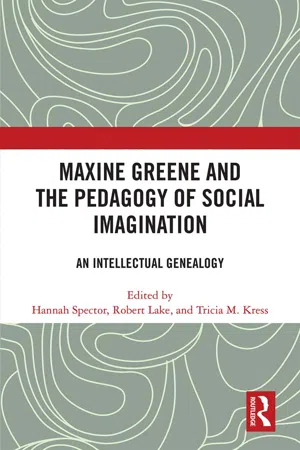
Devoted to and inspired by the late Maxine Greene, a champion of education and advocator of the arts, this book recognizes the importance of Greene's scholarship by revisiting her oeuvre in the context of the intellectual historicity that shaped its formation. As a scholar, Greene dialogued with philosophers, social theorists, writers, musicians, and artists. These conversations reveal the ways in which the arts, just like philosophy and science, allow for the facilitation of "wide-awakeness," a term that is central to Greene's pedagogy. Amidst contemporary trends of neoliberal, one-size-fits-all curriculum reforms in which the arts are typically squeezed out or pushed aside, Greene's work reminds us that the social imagination is stunted without the arts. Artistic ways of knowing allow for people to see beyond their own worlds and beyond "what is" into other worlds of "what was" and "what might" be some day. This volume demonstrates Maxine Greene's profound ability to illuminate the importance of the artistic world and the imaginary for development of the self in the world and for encouraging a "wide-awakeness" reflective of an emerging political awareness and a longing for a democratic world that "is not yet." This book was originally published as a Special Issue of The Review of Education, Pedagogy and Cultural Studies.
eBook - ePub
Maxine Greene and the Pedagogy of Social Imagination
An Intellectual Genealogy
- 128 pages
- English
- ePUB (mobile friendly)
- Available on iOS & Android
eBook - ePub
Maxine Greene and the Pedagogy of Social Imagination
An Intellectual Genealogy
About this book
Information
The social world, the creative self, and the ongoing achievement of freedom
As an educator, Maxine Greene returned repeatedly to the dynamic transaction that John Dewey had theorized between a vital social world and individual creativity. With Dewey, she viewed mutually transformative relations with others as the wellspring of all personal growth and social progress and as key to achieving a form of freedom that both scholars viewed in intellectual and moral terms. Greene strove continually to promote and realize this form of freedom within her own life and the lives of those around her and in contrast to most philosophers, including Dewey, chronicled aspects of her personal journey in hopes of inspiring and informing the efforts of others.
Here, I consider three of Greene’s principal sets of commitments in this light: her work in teacher education, her use of autobiography, and her studied investigations of the arts. These commitments can, in emphasis, be seen to correspond loosely to the three notions joined in this paper’s title: The social world, the creative self, and the ongoing achievement of freedom. Yet the three also merged throughout Greene’s (1995) adult life, creating contexts from within which she might cultivate affecting transactions “as woman, as teacher, as mother, as citizen, as New Yorker, as art-lover, as activist, as philosopher, [and] as white middle-class American” (1).
Dewey had drawn on Darwin in order to position the idea of healthy growth as a guiding vision for all efforts to imagine and work toward a better world. Gone were the inherited metaphysical assumptions of prior ages and a reflexive deference to traditional religious authority. Moral deliberation, Dewey argued, must now be based upon an expanded vision of what it means for all people to be given opportunities to grow. In encouraging all children to realize their unique selves through their thoughtful interactions with others, democratic societies could gradually acculturate them to the complex demands and satisfactions of democratic relations—thereby creating the conditions for continued growth (Dewey 1916/1944; Popp 2007; Mayer 2015).
Dewey developed the pedagogical implications of this radical reorientation toward growth as a moral imperative throughout his life. Greene, too, based the whole of her work upon this same organizing construct and frequently cited Dewey in this regard. As a result, both scholars focused on the need to nurture students’ imaginations, which they identified as the essential engine of all new thinking. As Greene (1995) put it: “There is always a gap between what we are living through in our present and what survives from our past” (20–21). As she often did, Greene then turns to Dewey to finish her thought, “Because of this gap, all conscious perception involves a risk; it is a venture into the unknown, for as it assimilates the present to the past it also brings about some reconstruction of that past” (Dewey 1934, 272; as cited in Greene 1995, 20–21). In fostering students’ active reconstructions of their currently held understandings, Dewey and Greene believed that teachers could help to develop curious and sensitive minds, minds that would remain open and active throughout a child’s life.
Yet for all his attention to the role of personal growth in the creation of satisfying social realities, Dewey remained in many ways the traditional Western philosopher, speaking in abstract and generalized terms about human affairs and grappling primarily with the inherited texts of his field (as well as those of the emerging social sciences). Although he spoke of truths as multiple and as taking form in response to local mores, needs, and resources, Dewey never seemed to experience the Western philosopher’s traditional lack of engagement with the personally situated as professionally constraining.
Greene, in contrast, transcended this inherited divide between the thoughts and the lives of philosophers to pursue possibilities for sparking and sustaining dynamic intellectual relations within her personal and professional worlds. The sense of urgency that propelled this project can be heard in most of what Greene wrote, but nowhere more so than in her 1995 essay collection, Releasing the Imagination: Essays on Education, the Arts, and Social Change, published in her late seventies. These essays, which I draw upon here, likely provide Greene’s most comprehensive treatment of the practical means and strategies she developed for living a life predicated on an embrace of the disruptive and on realizing the potential growth on offer in all forms of provocation and struggle.
The social world
How are we to comprehend the kind of community that offers the opportunity to be otherwise? Democracy, we realize, means a community that is always in the making. Marked by an emerging solidarity, a sharing of certain beliefs, and a dialogue about others, it must remain open to newcomers, those too long thrust aside. (Greene 1995, 39)
Greene’s reflections on the social world commonly drew upon the concerns and people she encountered in her role as a teacher educator. Her use of pragmatism, existentialism, and later traditions within continental philosophy to illuminate the struggles of those who teach in schools can be seen as representing a principled activism given Greene’s desire to be taken seriously as a philosopher. Students of education prepare in their programs to undertake what in the United States continues to be seen by many as intellectually unchallenging work. As a practical field concerned with the care and acculturation of the young, the discipline has been historically relegated to the lower tiers of intellectual prestige within the academy (Lagemann 2000).
Yet Greene eschewed the professional remove and relative academic stature provided by her philosophical training, which would have permitted—and surely also encouraged—her to distance herself from the daily concerns of classroom teachers. Instead, Greene looked to classrooms as a most promising personal and professional context, one within which human realization becomes both possible and, as she believed, necessary. As an educator of educators, Greene not only invited the feelings of connection that result from awakening students to new questions and perspectives, she also strove to nurture those rarer forms that can emerge when one genuinely interests oneself in students’ divergent beliefs and understandings.
As Greene (1995) put it, “the classroom situation most provocative of thoughtfulness and critical consciousness is the one in which teachers and learners find themselves conducting a kind of collaborative search, each from her or his lived situation” (23). Throughout her work, Greene challenged democratic educators to care about the lived experiences and worldviews of others and so to move beyond the boundaries of their familiar ways of perceiving and understanding the world. Greene saw such openings as creating opportunities, not just for growing as an individual, but also for collaboratively constructing new social realities within schools and beyond. “Once we can see our givens as contingencies,” Greene (1995) continues, “then we may have an opportunity to posit alternative ways of living and valuing and to make choices.”
Throughout Releasing the Imagination, Greene also frequently draws upon the feminist and postmodern works that have inspired her to interrogate her established identity as a Western intellectual, as well as her enduring sense of marginality within that world.1 As a woman born early in the 20th century, who struggled alongside others to dislodge the monolithically male worldview of the educational institutions of her youth, Greene extrapolates, in the way of philosophers, to the sense of powerlessness now so commonly felt among young teachers, who are pressured to view the work of raising test scores as their central professional challenge, rather than being charged with the work of imagining new ways of being and of learning in schools.
As a woman whose own vision was often undermined, Greene also extrapolates to the irreducible human worth of the concerns and perspectives that are brought into the classrooms of her life-long home, New York City, every day by the diverse others who people the educational institutions there. Greene’s attention, in particular, to the enduring repercussions of racial subjugation adds a crucial layer of analysis to Dewey’s construction of the relationship between the individual and society within the U. S. context, where African-Americans have historically been positioned as lesser than and so may feel alienated from, or even at odds with, their local school culture. The project of “imagin[ing] a democratic community accessible to the young” (Greene 1995, 33) in such circumstances may require that educators actively engage oppositional and even angry readings of the world.
So when Greene references Dewey’s call in The Public and its Problems, for the rebirth of the local community (Dewey 1927/2012), she does so as one who has taken on the work of igniting transformative interpersonal interactions as an organizing practice within her professional life. Greene therefore championed the interpretive and critical pedagogical approaches that progressive educators have developed over the past century, generally with an eye on overcoming the very forms of barriers that troubled Greene: those created by social and cultural exclusions and by chauvinisms of every kind.2 She believed such barriers could be breached through the dedicated efforts of teachers to locate and pursue significant questions and issues and to work collaboratively toward shared understandings as possible: “Community cannot be produced simply through rational formulation or through edict. Like freedom, it has to be achieved by persons offered the space in which to discover what they recognize together and appreciate in common: they have to find ways of making intersubjective sense” (Greene 1995, 39).
Well beyond Dewey, then, Greene called on American educators, particularly Euro-American educators, to attend to the ways in which their accrued cultural power as educated Westerners can threaten and thereby marginalize the worldviews of their students.3 In contrast to Dewey, who spoke in terms of an ever-expanding democratic sensibility willing to embrace and absorb new discoveries and diverse traditions of thought, Greene (1995) sought to confront the irremediably partial and parochial aspects of her Euro-American worldview, advising that we hope for no more than “a sharing of certain beliefs, and a dialogue about others” (39).
The creative self
It is, I am suggesting, incompleteness—the open question, perhaps—that summons us to the tasks of knowledge and action … What seems crucial is the noticing, the active insertion of one’s perception into the lived world. (Greene 1995, 74)
Greene (1995) generously shared her own experiences with autobiographical narrative as a route to being, as she put it, “truly present to ourselves” in a manner that allows us “to partake in an authentic relationship with the young” (75). This concern with true presence caused Greene to call on educators to reflect upon and reconstruct their own life stories, which she believed have the power to carry us all back toward our “enmeshed and open-ended selves,” toward what she cites Merleau-Ponty as calling “the true conditions of objectivity itself” (1995, 73).4 Greene believed that to create the kind of democratic pedagogical community that she had in mind, everyone would need to interest themselves in the ways in which their own life experiences had influenced who they had become and how they viewed the world.
In working to recall the circumstances and interactions that have led us to know and to believe in certain ideas and to conceptualize our lived experience in particular ways, we may “become aware of rifts, gaps in what we think of as reality” (Greene 1995, 111). This awareness of disjunctions or lacunas can, in turn, inspire us to reflect critically upon influential experiences and our current relation to them. In Greene’s case, she came to realize that certain aspects of her own perspective had been skewed by dominant biases she had not previously recognized and now chose not to perpetuate. In an essay called “Teaching for Openings,” Greene (1995) recounts some of the history of her subsequent resistance in order to illustrate the ways in which any of us may be called on to identify and grapple with unnamed forces if we are to “widen the spaces in which we hope to choose ourselves” (112).
It is important for me, for example, to summon up the ways in which I was demeaned in my early days of college teaching by being told I was too “literary” to do philosophy … Only now, trying to understand the contexts of the dominant preoccupations and their connections with issues of gender, trying to name the relationship between academic norms and the demands of an advanced technological society, trying to grasp the real meaning of instrumental rationality in a universe of suffering children and desperate mothers and thousands of sickening poor, can I begin to identify what stopped me from the kind of analysis that was expected of me earlier. (Greene 1995, 113)
For Greene, such awakenings serve as resources for the formulation of fresh intentions and the guiding aims that she sees, with Dewey, as essential to any shared or individual journey of discovery and, indeed, for grounding the very notion of meaningful action in the world. In an essay entitled “Seeking Contexts,” Greene (1995) cites Dewey’s call for educators to articulate pedagogical aims as a way, as she says, “to avoid feeling like a chess piece or a cog or even an accomplice of some kind” (11). While overarching aims are likely to come up against entrenched barriers and involve questions that can never be entirely resolved, such aims can nonetheless provide an enduring sense of purpose for a life. On a smaller scale, valued aims serve as a necessary frame of reference for any attempt to compose meaningful personal narratives from the experiential jumble of our daily lives.
Consonant with this focus on achieving a meaningful sense of purpose in one’s professional life, Greene also sought to reorient the common understanding of freedom as “freedom from” restraint and interference toward Dewey’s more difficult and nuanced construct of “freedom for,” defined in relation to “the power to act and the power to choose” (Dewey 1938/1997, 61–65; as cited in Greene 1995, 196).5 This notion of “freedom for” embeds progressive values and commitments, including the idea that society can and should be made more responsive to both the needs and desires of individuals and the demands of a democratic social order, and that each of these projects needs to be seen as informing and enabling the other. Greene looked for teachers and students to experience this positively oriented notion of “freedom for” within their lives together and to understand, as well, how this form of freedom connects to the idea of democratic life as many have imagined it.
In returning to the social context within which such a personal freedom becomes possible, Greene draws first on the social psychology of Dewey’s close colleague George Herbert Mead to remind us that we only ever become free, in this sense, as members of the social worlds in which we live and to which we choose to dedicate ourselves. Greene (1995) then continues
This thought is … also being made present to us today by the work being done on women’s ways of knowing (Belenky, Clinchy, Goldberger, and Tarule 1986), so long repressed in literature. Our very realization that the individual does not precede community may summon up images of relations, of the networks of concern in which we teachers still do our work and, as we do so, create and recreate ourselves. (197)
Again, then, Greene situates her claims within t...
Table of contents
- Cover Page
- Half Title
- Title Page
- Copyright Page
- Table of Contents
- Citation Information
- Notes on Contributors
- Introduction: Maxine Greene and the pedagogy of social imagination: An intellectual genealogy
- 1 The social world, the creative self, and the ongoing achievement of freedom
- 2 Freedom, aesthetics, and the agôn of living in Maxine Greene’s philosophy
- 3 Cultivating the ethical imagination in education: Perspectives from three public intellectuals
- 4 Mamma don’t put that blue guitar in a museum: Greene and Freire’s duet of radical hope in hopeless times
- 5 The slow fuse of the gradual instant reprised
- 6 The dialectic of racial justice: Maxine Greene’s contributions to morally engaged and racially just education spaces
- 7 On innervisions and becoming in urban education: Pentecostal hip-hop pedagogies in the key of life
- Index
Trusted by 375,005 students
Access to over 1.5 million titles for a fair monthly price.
Study more efficiently using our study tools.
Frequently asked questions
Yes, you can cancel anytime from the Subscription tab in your account settings on the Perlego website. Your subscription will stay active until the end of your current billing period. Learn how to cancel your subscription
No, books cannot be downloaded as external files, such as PDFs, for use outside of Perlego. However, you can download books within the Perlego app for offline reading on mobile or tablet. Learn how to download books offline
Perlego offers two plans: Essential and Complete
- Essential is ideal for learners and professionals who enjoy exploring a wide range of subjects. Access the Essential Library with 800,000+ trusted titles and best-sellers across business, personal growth, and the humanities. Includes unlimited reading time and Standard Read Aloud voice.
- Complete: Perfect for advanced learners and researchers needing full, unrestricted access. Unlock 1.5M+ books across hundreds of subjects, including academic and specialized titles. The Complete Plan also includes advanced features like Premium Read Aloud and Research Assistant.
We are an online textbook subscription service, where you can get access to an entire online library for less than the price of a single book per month. With over 1.5 million books across 990+ topics, we’ve got you covered! Learn about our mission
Look out for the read-aloud symbol on your next book to see if you can listen to it. The read-aloud tool reads text aloud for you, highlighting the text as it is being read. You can pause it, speed it up and slow it down. Learn more about Read Aloud
Yes! You can use the Perlego app on both iOS and Android devices to read anytime, anywhere — even offline. Perfect for commutes or when you’re on the go.
Please note we cannot support devices running on iOS 13 and Android 7 or earlier. Learn more about using the app
Please note we cannot support devices running on iOS 13 and Android 7 or earlier. Learn more about using the app
Yes, you can access Maxine Greene and the Pedagogy of Social Imagination by Hannah Spector, Robert Lake, Tricia M. Kress, Hannah Spector,Robert Lake,Tricia M. Kress in PDF and/or ePUB format, as well as other popular books in Education & Education General. We have over 1.5 million books available in our catalogue for you to explore.