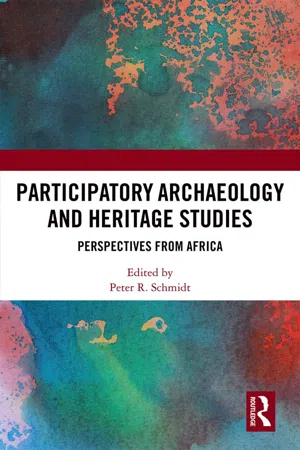
Participatory Archaeology and Heritage Studies: Perspectives from Africa provides new ways to look at and think about the practice of community archaeology and heritage studies across the globe. Long hidden from view, African experiences and experiments with participatory archaeology and heritage studies have poignant lessons to convey about local initiatives, local needs, and local perspectives among communities as diverse as an Islamic community on the edge of an ancient city in Sudan to multi-ethnic rural villages near rock art sites in South Africa. Straddling both heritage studies and archaeological practice, this volume incorporates a range of settings, from practical experiments with sustainable pottery kilns in Kenya, to an elite palace and its hidden traditional heritage in Northwestern Tanzania, to ancestral knowledge about heritage landscapes in rural Ethiopia. The genesis of participatory practices in Africa are traced back to the 1950s, with examples of how this legacy has played out over six decades—setting the scene for a deeply rooted practice now gaining widespread acceptance. The chapters in this book were originally published in the Journal of Community Archaeology and Heritage.
- 136 pages
- English
- ePUB (mobile friendly)
- Available on iOS & Android
eBook - ePub
About this book
Information
Rediscovering Community Archaeology in Africa and Reframing its Practice
Community archaeology and heritage work have a long history in Africa, a history embedded in the practice of ethnoarchaeology, studies of indigenous knowledge systems, and the collaborative study of oral traditions and other intangible heritage. This paper reviews some of the intellectual legacies that foreground community approaches today in Africa. Whilst top-down approaches have tended to characterize many projects in recent history, the requirements of outside development agencies often force archaeologists into collaborative compliance that communities are not ready to embrace or where histories of land alienation complicate best efforts to engage communities. An alternative community approach arising from a grassroots initiative in Northwest Tanzania is discussed to illustrate how collaboration may lead to mutual research and heritage development that contribute new knowledge to African history and archaeology and improve community well-being.
Reflection and rediscovery
Thirty years ago I shared with a mostly American audience some common practices in African archaeology that privileged local needs and sensibilities — one of the first explicit recognitions of a collaborative approach in the practice of archaeology in Africa, namely:
One of the most critical issues facing archaeology in Africa (and North America) today is the need to perform research on problems that are significant to the historical self-identity of living peoples, particularly those descended from the prehistoric and historic populations we study. As anthropologists we cannot continue to perpetuate Western paradigms that militate against local historical sensibilities. This is particularly true of the practice of archaeology in the colonized world; it is even more poignantly relevant in Africa because of the colonial history of the West on that continent. (Schmidt 1983, 63)
My point in citing this passage is to refocus attention on research that emphasizes local historical identity as a key benefit to emerge from collaborative research amongst archaeologists, heritage workers, and communities in Africa. This perspective has been an integral part of African archaeology for decades, although it was not named or consciously recognized as community archaeology. Rather, it was a holistic anthropological inquiry using archives, archaeology, and oral testimonies — the latter depending on the participation if not the initiative of African peoples who engage heritage studies and archaeology. Following a full review of the ethnohistorical and ethnoarchaeological research carried out in Africa up to 1983, I concluded in the same American Antiquity essay that,
[...] ethnoarchaeology and historical archaeology in Africa have pioneered perspectives that are sensitive to history, symbolic systems, and the historical sensibilities of local peoples. This further suggests that when cultures in Africa participate in the interpretation of their own past, we can begin to build a self-enriching tradition of archaeology free from the domination of Western paradigms and appropriate to the African setting. (emphasis mine; Schmidt 1983, 75)
This insight into archaeological practice in Africa was not self-consciously intended to complement what we would now call community archaeology, but it certainly anticipated by several decades the importance of integrating local historical knowledge, namely: ‘Bringing this knowledge to the foreground and acknowledging ethnohistoric data as central for including Indigenous views in interpretations are both aspects of a decolonizing archaeology practice’ (Atalay 2006a, 275). Long an unrecognized if not a subaltern practice in African settings, we may now openly acknowledge its place in the lineage of thought related to what has become known as community practices. There are a variety of ways in which these perspectives are represented in the literature, including public and participatory archaeology rubrics. Here I consider both archaeology and heritage together as community actions in Africa, because in my research in Northwest Tanzania (Kagera Region) heritage sites are the focus of collaborative research that often have archaeological components, with their archaeological dimension seen by some people as an integral part of their heritage.
My very first step as a young archaeologist was to collect oral traditions and oral histories about the Haya people in Northwest Tanzania for a full year before I put a spade or trowel in the ground, building a collaborative approach that privileged the way that the Haya thought about and related their histories. I was a neophyte in the midst of a sophisticated system of oral record keeping that depended on rigorous transmission of oral accounts and sacred places that acted as mnemonics — parts of the sacred and political landscape such as shrines, burial places, and royal palace locations (Schmidt 1978, 2006).
Forty-four years ago, this participatory community approach fit well with local cultural sensibilities and was in keeping with my apprenticeship to the most knowledgeable keepers of oral accounts, allowing me to reach a deeper understanding of Haya history (Schmidt 1978). These relationships led, organically, to more detailed collaborations and dynamic planning and strategizing over potential sites where archaeological investigations were considered as a possible form of joint inquiry. More than five decades later, such approaches are appropriately being heralded in settings around the globe as the future of archaeology — a collaborative or public archaeology that incorporates the participation and initiative of communities for their benefit. This trend, specifically called Community Archaeology and Community Heritage, are much needed perspectives that balance the scientific objectives of archaeology driven by professionals and brings a new, local perspective to bear on what constitutes heritage at a local level. The most positive attributes out of this increasingly popular agenda is a focus that continues the goals followed more than five decades ago in Africa — a privileging of local needs, foremost of which is to overcome representations of local history that arose out of colonialism.
Decolonization
Decolonization of archaeological practice looms very large in community archaeology and heritage work because it addresses issues of power and control of archaeology — who initiates archaeological research or heritage work, who sets the research and interpretative agendas, and who controls the dissemination of results (see Atalay 2006a, 2006b; Schmidt and Patterson 1995; Smith and Wobst 2005). The last issue may be one of the most difficult to address. It was the focus of our introduction to Making Alternative Histories (Schmidt and Patterson 1995), where we argued that specialized esoteric language of archaeological reports alienated people whose history was being studied, and that it drove a significant wedge between archaeologists and the communities in which they worked — a theme reiterated recently by Chirikure and Pwiti (2008) in their review of African community experiments. Participatory approaches have grown in popularity over the last two decades around the globe and in Africa (e.g. Abu-Khafajah 2010; Atalay 2012; Colwell-Chanthaphonh and Ferguson 2008; Cooke 2010; Dowdall and Parrish 2001; Marshall 2009; McDavid 2002; Murimbika and Moyo 2008; Silliman 2008), but archaeological practice that unites rather than separates archaeologists and local people in the field has been much slower to follow the academic rhetoric underwriting such views. In spite of the multiple resolutions and codes of ethics, such as those implemented by the World Archaeological Congress insisting that communities must be brought into the process of archaeological planning, execution, and writing, we have far to travel to deliver the goods.
Sonya Atalay (2006b, 2012), one of the most effective advocates amongst the community of Native American archaeologists, writes compellingly about the need for archaeology to develop new methodologies and new theoretical approaches based on community initiatives in archaeology and heritage work (see Kuwansisiwma 2008). This perspective resonates with initiatives taken by communities in Kagera, Tanzania — engagements that are a relatively infrequent genre of community participation, yet that hold great promise in the valourization and revitalization of histories shredded through colonialism, globalization, and trauma. When archaeologists try to implement ideas, Atalay is quick to note that it is a slippery slope when archaeologists try to implement their ideas of fulsome community engagement based on reciprocity and mutual benefits. She strongly believes, as do I, that community engagement is the way of the future in archaeology and that archaeologist-driven projects not accounting for the needs of the community are practices that retain colonial legacies of non-consultation and separation of ‘subject peoples’ to the directives and desires of a science often practiced in the interest of imperial interests, whether the early twentieth-century colonial state or the postcolonial state. Lest we forget, Bruce Trigger (1980) made similar points in his seminar article on science and history in Native American settings.
A slippery slope enters the picture when archaeologists, well-intended and earnest to apply such a philosophy, try to put it into practice and find that some communities have no interest in the archaeology of their past nor in heritage work in their midst. Or, they may find that the communities where they would like to establish collaborative programmes mistrust archaeologists, manipulate them to their economic advantage, or provide only token forms of collaboration. Each of these scenarios — only a small sampling of what one might expect — present soulsearching challenges and sometime impossible difficulties. Basically they speak to the issue of what happens when outside agendas for participatory approaches are presented to a community, rather than what happens when a community comes to life with its own agenda. The direction from which the initiative flows will often influence success and engagement.
Atalay’s (2012) recent review of her attempts to engage very different genres of communities provides some useful insights into some of the difficulties and successes that emerge in community-oriented research. Her review provides a device through which insights into top-down and bottom-up collaborations can be applied to Africa and other world regions. She starts with how she tried to interest communities around Catalhoyiik, Turkey, in archaeological research. She admits that her initiative — and her refreshing honesty in describing it as her initiative rather than the communities’ initiative — did not elicit positive reactions. No one in these five communities initially saw any benefit in archaeological research. It was only after an extensive and complex educational campaign that local people slowly began to see ways that they could participate.
Despite its best intentions, the Catalhoyiik experiment started with top-down practice whilst it espoused participatory engagement. This is not an anomaly. In fact it is the common template for projects that want community engagement. It was not the community that came to Hodder, Atalay, or other archaeologists engaged in research. People in the villages from which labourers were drawn did not seek ways to engage archaeology. It was archaeologists affiliated with the project after it had been up and running for years who took initiatives to the villagers, engaging in extensive efforts at education about archaeology. Some of these top-down initiatives led to positive results. This is a powerful case study because it illustrates how much hard work is in store for archaeologists who recognize the importance of participatory archaeology benefiting descendants and local people but where such communities display little or no interest in archaeological inquiry. Most archaeologists working in rural areas of Africa, Asia, or the Americas can expect similar disinterest on the part of local people unfamiliar with archaeology, unless we modify our approach to work with communities in developing training and other educational perspectives before projects are launched. To engage with communities in this manner before launching projects presents some stiff challenges of the sort that Atalay shares.
Her study sets out a stark prescription for extensive preparatory work. It also causes us to ask — how might the (Çatalhoyiik project have avoided the disengagement of nearby communities over the long term? One answer, I believe, lies in capacity building before a project begins or at least from the very beginning of projects; that is, training local people how and why archaeology is conducted and what kinds of questions are appropriate. It also means working together with those associated with the project in whatever role they play — labourer, technician, manager — about how they interpret the research results — be they archaeological finds or heritage management plans. This should be a prelude to more complex interactions and on-site training that privilege the intelligence and potential contributions of the labour force.
An important part of any collaborative project is the exercise of a reflexivity that questions privileging scientific goals over local participation, and examines the degree to which we are willing to accept that intelligent people will respond enthusiastically to skilled training if they are invested with trust. I find that local farmers are much more skilled in many archaeological tasks than advanced archaeology students. They quickly recognize changes in soil colour and texture, recognizing odd features such as micro-inclusions of clay, and practice an archaeology that has much finer motorcontrol of tools than most university students and even some professional archaeologists. I sometimes pair university students with locally trained archaeologists, with the latter acting as trainers. We must also ask if mental restraints in our thinking — no matter how reasonably justified — are a form of denial, a way of exclusion that seeks comfort in expeditious research results over the more demanding but ultimately more satisfying task of inclusion and full training, not just in sieving, flotation, sorting — all tasks that require lower levels of training. Given that most rural folk are better equipped to deal with the basics of archaeology than are university students, then why are they not included from the beginning and invested with trust to increase their confidence and sense of ownership?
Investing trust in local collaborators — an African legacy
A recent initiative taken in Kagera Region during 2008 by the leadership of Katuruka village (Schmidt 2010) to restore, preserve, and reclaim their heritage cannot be explained by formal training in archaeology at university level or the presence and active involvement of a developed infrastructure, such as an active NonGovernmental Organization (NGO) dedicated to cultural heritage and preservation. Rather, such spirited awareness may be traced back to the extensive participation of Katuruka residents in the archaeology of heritage sites within their community between 1969 and 1984 and their clear awareness that archaeological goals were linked to the oral traditions told about sites. The original research programme effected several decades earlier was guided and jointly designed by elders, building on and complementing local values and needs — now part of the legacy of local engagement. Through this period, several of those who were talented in archaeological inquiry went on to lead excavations and supervise major regional surveys, clearly understanding the goals and helping to design the day-to-day methods that were appropriate to the local circumstances as well as finding sites of major importance (Schmidt and Childs 1985). Memories of these engagements and the significance of the archaeology previously conducted in the community by community members lived on through time to create informed knowledge ready for additional development.
The methods that were developed with Haya collaborators and communities during the 1969—84 period were later taken into the university classroom, laboratory, and field schools when the formal teaching of archaeology was launched in Tanzania in 1985 (Schmidt 2005). Amongst the innovations introduced into the instructional programme at the University of Dar es Salaam (UDSM) was the idea, soon formalized as a requirement, that students design their field school research project. The faculty felt that it was critical that students, as the most important stakeholders, take ownership of the research programme in which training occurred. Initially the intake of students was so small that all could participate as a group, but soon students were required to present individual proposals, the best designed of which would be chosen for collective treatment leading to field school research.
There were detractors who said, ‘How can you expect naive students without any significant prior experience to design research projects?’ Our response was simple: that we were not looking for precise and theoretically informed projects — those would come through instruction and growing confidence through time. Rather, we were looking for innovative ideas that drew on local histories and ideas about the past where archaeology could contribute. We encouraged our students to think out of the box, asking them to move beyond established, colonial, and normative research ideas that could be challenged by research in new regions and sites. Once a basic research idea was accepted and discussed at length, then students were asked to design a research strategy that would be used to obtain information that they needed to test their ideas. The next step was implementation, close guidance, and modifications as the research strategies were applied in the field. Constant discussion about the adequacy or inadequacy of strategies and tactics built a sense of empowerment and ownership in students, who by their second year were eager to test their ideas in a new setting. This approach stands in stark contrast to most western field schools, where students are plugged into faculty-determined agendas to perform rote tasks that often help advanced academics achieve their goals.
Within the Tanzanian setting, then, capacity building unfolded in two dimensions: 1) with local people in the field, stakeholders and collaborators who assimilated and engaged archaeological resea...
Table of contents
- Cover
- Half Title
- Title Page
- Copyright Page
- Table of Contents
- Citation Information
- Notes on Contributors
- Preface: Participatory Archaeology and Heritage Studies: Perspectives from Africa
- Introduction: Intersectionality at work in participatory approaches in African archaeology and heritage studies
- 1 Rediscovering community archaeology in Africa and reframing its practice
- 2 Archaeology and the local community in Africa: A retrospective
- 3 Seniority through ancestral landscapes: Community archaeology in the highlands of southern Ethiopia
- 4 Community archaeology and heritage in coastal and Western Kenya
- 5 Contests between heritage and history in Tanganyika/Tanzania: Insights arising from community-based heritage research
- 6 Community involvement and heritage management in rural South Africa
- 7 Understanding ‘the community’ before community archaeology: A case study from Sudan
- 8 Community cultural identity in nature-tourism gateway areas: Maun Village, Okavango Delta World Heritage Site, Botswana
- Index
Trusted by 375,005 students
Access to over 1.5 million titles for a fair monthly price.
Study more efficiently using our study tools.
Frequently asked questions
Yes, you can cancel anytime from the Subscription tab in your account settings on the Perlego website. Your subscription will stay active until the end of your current billing period. Learn how to cancel your subscription
No, books cannot be downloaded as external files, such as PDFs, for use outside of Perlego. However, you can download books within the Perlego app for offline reading on mobile or tablet. Learn how to download books offline
Perlego offers two plans: Essential and Complete
- Essential is ideal for learners and professionals who enjoy exploring a wide range of subjects. Access the Essential Library with 800,000+ trusted titles and best-sellers across business, personal growth, and the humanities. Includes unlimited reading time and Standard Read Aloud voice.
- Complete: Perfect for advanced learners and researchers needing full, unrestricted access. Unlock 1.5M+ books across hundreds of subjects, including academic and specialized titles. The Complete Plan also includes advanced features like Premium Read Aloud and Research Assistant.
We are an online textbook subscription service, where you can get access to an entire online library for less than the price of a single book per month. With over 1.5 million books across 990+ topics, we’ve got you covered! Learn about our mission
Look out for the read-aloud symbol on your next book to see if you can listen to it. The read-aloud tool reads text aloud for you, highlighting the text as it is being read. You can pause it, speed it up and slow it down. Learn more about Read Aloud
Yes! You can use the Perlego app on both iOS and Android devices to read anytime, anywhere — even offline. Perfect for commutes or when you’re on the go.
Please note we cannot support devices running on iOS 13 and Android 7 or earlier. Learn more about using the app
Please note we cannot support devices running on iOS 13 and Android 7 or earlier. Learn more about using the app
Yes, you can access Participatory Archaeology and Heritage Studies by Peter R. Schmidt in PDF and/or ePUB format, as well as other popular books in Social Sciences & Archaeology. We have over 1.5 million books available in our catalogue for you to explore.