Abiotic stresses such as drought, flooding, high or low temperatures, metal toxicity and salinity can hamper plant growth and development. Improving Abiotic Stress Tolerance in Plants explains the physiological and molecular mechanisms plants naturally exhibit to withstand abiotic stresses and outlines the potential approaches to enhance plant abiotic stress tolerance to extreme conditions. Synthesising developments in plant stress biology, the book offers strategies that can be used in breeding, genomic, molecular, physiological and biotechnological approaches that hold the potential to develop resilient plants and improve crop productivity worldwide.
Features
· Comprehensively explains molecular and physiological mechanism of multiple abiotic stress tolerance in plants
· Discusses recent advancements in crop abiotic stress tolerance mechanism and highlights strategies to develop abiotic stress tolerant genotypes for sustainability
· Stimulates synthesis of information for plant stress biology for biotechnological applications
· Presents essential information for large scale breeding and agricultural biotechnological programs for crop improvement
Written by a team of expert scientists, this book benefits researchers in the field of plant stress biology and is essential reading for graduate students and researchers generating stress tolerant crops through genetic engineering and plant breeding. It appeals to individuals developing sustainable agriculture through physiological and biotechnological applications.
1 Spectrum of Physiological and Molecular Responses in Plant Salinity Stress Tolerance
Insha Amin, Aditya Banerjee, Abbu Zaid, Mudasir A. Mir, Shabir H. Wani, Nazeer Ahmed, Aryadeep Roychoudhury, and Khalid Z. Masoodi
CONTENTS
1.1 Introduction
1.2 Mechanisms Adopted for Salt Adaptations
1.3 Effect of Salinity on Plant Growth and Development
1.4 Salinity and the Antioxidant System
1.5 Salinity and Osmotic Balance
1.6 Cell Membrane Lipid Modification
1.7 Salinity and Transporters
1.8 Salinity and Phytohormone Synthesis
1.9 Future Perspectives
Acknowledgments
References
1.1 Introduction
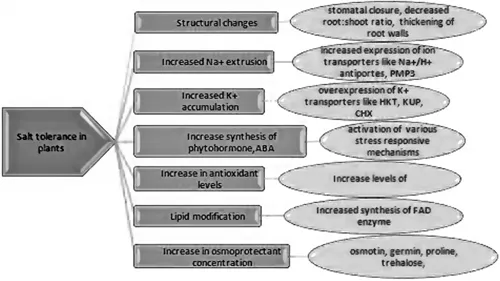
Salinity stress is regarded as one of the principal environment stresses that retard growth and productivity of crop plants, especially in arid and semi-arid regions of the world (Rozema and Flowers, 2008). According to Munns and Tester (2008), globally more than 800 million hectares of arable lands are severely affected by salinity stress, which corresponds to 50% of all irrigated lands (Sairam and Tyagi, 2004). Salt stress is a physiological condition characterized by increased concentrations of soluble salts inside the cells leading to an imbalance in the cell steady state (Joshi et al., 2016; Khan et al., 2017). Salt stress induces ion toxicity due to increased levels of ions like sodium (Na+), chloride (Cl–) and sulfate (SO42–). Sodium chloride (NaCl) is the most widely present and most soluble salt, and therefore Na+ accounts for the majority of the salt stress-related symptoms in the plants. There can be approximately 40 mM NaCl concentration and electrical conductivity (EC) of 4dS/m in the soils affected by salinity (Acosta-Motos et al., 2017). There is an increased concentration of Na+ ions in the salt-rich soils with a concomitant increase in carbonate/bicarbonate levels making these soils highly alkaline (pH greater than 7). Salinity stress results in an imbalance of ion homeostasis due to an increase in the concentration of Na+ ions as well as the simultaneous decrease in potassium (K+) concentration (Liu et al., 2018). Many plants show a reduced growth, deteriorated quality and a significant decrease in productivity under such salt levels because salinity stress triggers complex signaling pathways to inhibit growth, development and plant physiological processes (Naeem et al., 2012). Salinity stress limits photosynthetic potential as a result of disorganized chloroplast thylakoids (Khan et al., 2014; Fatma et al., 2016) and impairment in the diffusion rate of carbon dioxide (CO2) via decreasing conductance of stomata and mesophyll cells (Flexas et al., 2004). Rasool et al. (2013) conducted an experiment to evaluate the effect of salt stress on growth and some key antioxidants in eight chickpea genotypes which were grown in a hydroponic environment. Their results indicate that salt stress-induced oxidative stress by hampering the growth and physiology of the cells. Salinity stress results in oxidative damage through orchestrating the production of reactive oxygen species (ROS), which can cause cell death by damaging proteins, lipids, RNA and DNA (Gill and Tuteja, 2010; Anjum et al., 2015; Ahmad et al., 2016). Plants possess intricate mechanisms undergoing complex crosstalks for sensing of environmental stresses (Wani et al., 2013). To survive under such sub-optimal conditions, salt-tolerant plants like halophytes have evolved a well-integrated adaptive response at the molecular, cellular and physiological levels to ensure survival, distribution and productivity (Flowers and Muscolo, 2015). Various salt tolerance mechanisms have been comprehensively depicted in Figure 1.1. These adaptation mechanisms can be associated with detoxification, protein degradation, synthesis of osmoprotectant and antioxidants, overexpression of water and ion channels and accumulation of stress-responsive transcription factors (TFs) like WRKY, NAC, bZIP, MYB, MYC, etc. (Hiz et al., 2014; Banerjee and Roychoudhury, 2017). The TFs upregulate osmotic responsive (OR) genes encoding late embryogenesis abundant (LEA) proteins, heat shock proteins (HSPs) and antioxidant enzymes (Banerjee and Roychoudhury, 2016). The salt-tolerant genotypes accommodate the stress-mediated low water potential by maintaining a high relative water content (RWC) (Joshi and Karan, 2013). Salinity initiates multi-level regulation of gene expression through complex transcriptional networks (Singh and Laxmi, 2015). At the molecular level, the identification and characterization of candidate genes for the accumulation of ions and movement of water molecules are of paramount importance in dissecting underlying mechanisms of plants’ salt stress tolerance. The salt overly sensitive (SOS1) gene, which encodes an antiporter Na+/H+ in plasma membrane, can play a significant role in deciphering mechanisms related to how Na+ ions are excluded out of a salt-stressed cell and controlled via their long-distance transport from the roots to shoots in Arabidopsis thaliana (Shi et al., 2002). In plants, salt stress is known to increase the expression level of SOS1, which might confer salt stress tolerance (Gao et al., 2016). In a recent study, Liu et al. (2018) studied the growth, ionic response and gene expression analysis in ryegrass under salt stress conditions and observed that salinity tolerance is related to the decreased expressions of SOS1, NHX1 and TIP1 in the shoots, and increased expressions of NHX1 and PIP1 in the roots. These reports suggest that the coordination of genes for regulating the homeostasis of ions might prove beneficial for enhancing plant salinity stress tolerance. Nevertheless, the characterization and incorporation of selected salt-responsive genes like DREB, SOS, HKT, NHX, PMP3, etc., using transgenic technology can help to design salt-tolerant lines and promote agricultural expansion.
FIGURE 1.1 Various salt-tolerance mechanisms in plants.
1.2 Mechanisms Adopted for Salt Adaptations
Ion toxicity and the hyperosmolar interior are the two important factors affecting the plants reared on soils with high salt concentrations. Adaptation to soil salinity is definitely one of the most complicated biological phenomena carried out by plants in order to maintain a steady state inside the cells. Plants adapt to many abiotic stresses at molecular, cellular, biochemical and physiological levels (Adem et al., 2014). Various adaptations include the regulation of ion transport and maintenance of water balance, vacuolar sequestration of Na+ ions, retention of K+ ions, accumulation of compatible solutes for osmotic adjustments and reactive oxygen species (ROS) scavenging at the gene and transcriptional levels.
1.3 Effect of Salinity on Plant Growth and Development
Ionic stress is predominant among the various abiotic stresses which act as limiting factors for plant growth and survival (Adem et al., 2014). There is a detrimental effect of salt excess on almost all the developmental parameters like seedling, flowering, chlorophyll content, internodal growth, etc. During salinity stress, there is a change in the concentration of ions in the soil around the root tip causing an imbalance in water potential leading to osmotic stress first and ending in ionic toxicity. This leads to shortening and swelling of the roots due to reduced cell division and proliferation in the root meristematic zone (Li et al., 2014b). It limits leaf extension, photosynthesis and biomass accumulation in plants (Rahnama et al., 2010). A significant reduction occurs in leaf elongation due to loosening of epidermal wall rigidity (Zörb et al., 2015). NaCl changes stem morphology by decreasing the number, diameter and length of internodes leading to stunted plant height (Nja et al., 2018). In olives, high salt levels cause significant reductions in the number and length of roots and an increased root turnover leading to restricted lifespan and development (Soda et al., 2017). Salt stress induces leaf discoloration, wilting, leaf bronzing and necrosis, thus derailing the aesthetic quality of plants (Valdez-Aguilar et al., 2011). Salt stress negatively affects flowering which can lead to drawbacks in the reproductiv...
Table of contents
Cover
Half-Title
Title
Copyright
Contents
Editors
Contributors
Chapter 1 Spectrum of Physiological and Molecular Responses in Plant Salinity Stress Tolerance
Chapter 2 Root Plasticity under Low Phosphate Availability: A Physiological and Molecular Approach to Plant Adaptation under Limited Phosphate Availability
Chapter 3 The Role of Sugars in Improving Plant Abiotic Stress Tolerance
Chapter 4 Glutathione Is a Key Component in Abiotic Stress Responses
Chapter 5 Improving Heavy Metal Tolerance through Plant Growth Regulators and Osmoprotectants in Plants
Chapter 6 Role of Osmolytes in Regulation of Growth and Photosynthesis under Environmental Stresses
Chapter 7 Role of Exogenous Salicylic Acid in Drought-Stress Adaptability in a Changing Environment
Chapter 8 Role of Nitric Oxide in Plant Abiotic Stress Tolerance
Chapter 9 Role of Jasmonates in Plant Abiotic Stress Tolerance
Chapter 10 Emerging Trends of Proline Metabolism in Abiotic Stress Management
Chapter 11 Networking by Small Molecule Hormones during Drought Stress in Plants
Chapter 12 Aquaporins: A Promising Gene Family for Tackling Stresses for Crop Improvement
Chapter 13 The Role of Extracellular ATP in Plant Abiotic Stress Signaling
Chapter 14 Phospholipase C in Abiotic Stress-Triggered Lipid Signaling in Plants
Chapter 15 Role of Silicon in Abiotic Stress Tolerance of Plants
Chapter 16 Genomics Approaches in Plant Stress Research
Chapter 17 High-Throughput Genomics: Application in Plant Breeding under Abiotic Stress Conditions
Index
Trusted by 375,005 students
Access to over 1.5 million titles for a fair monthly price.
Study more efficiently using our study tools.
Frequently asked questions
Yes, you can cancel anytime from the Subscription tab in your account settings on the Perlego website. Your subscription will stay active until the end of your current billing period. Learn how to cancel your subscription
No, books cannot be downloaded as external files, such as PDFs, for use outside of Perlego. However, you can download books within the Perlego app for offline reading on mobile or tablet. Learn how to download books offline
Perlego offers two plans: Essential and Complete
Essential is ideal for learners and professionals who enjoy exploring a wide range of subjects. Access the Essential Library with 800,000+ trusted titles and best-sellers across business, personal growth, and the humanities. Includes unlimited reading time and Standard Read Aloud voice.
Complete: Perfect for advanced learners and researchers needing full, unrestricted access. Unlock 1.5M+ books across hundreds of subjects, including academic and specialized titles. The Complete Plan also includes advanced features like Premium Read Aloud and Research Assistant.
Both plans are available with monthly, semester, or annual billing cycles.
We are an online textbook subscription service, where you can get access to an entire online library for less than the price of a single book per month. With over 1.5 million books across 990+ topics, we’ve got you covered! Learn about our mission
Look out for the read-aloud symbol on your next book to see if you can listen to it. The read-aloud tool reads text aloud for you, highlighting the text as it is being read. You can pause it, speed it up and slow it down. Learn more about Read Aloud
Yes! You can use the Perlego app on both iOS and Android devices to read anytime, anywhere — even offline. Perfect for commutes or when you’re on the go. Please note we cannot support devices running on iOS 13 and Android 7 or earlier. Learn more about using the app
Yes, you can access Improving Abiotic Stress Tolerance in Plants by M. Iqbal R. Khan, Amarjeet Singh, Péter Poór, M. Iqbal R. Khan,Amarjeet Singh,Péter Poór in PDF and/or ePUB format, as well as other popular books in Biological Sciences & Biology. We have over 1.5 million books available in our catalogue for you to explore.