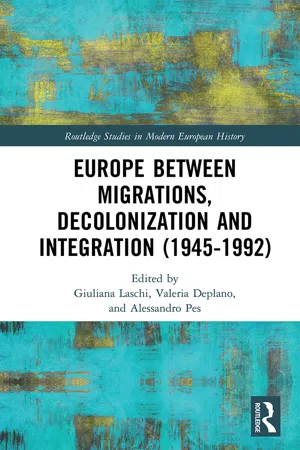
This monograph addresses mobility and migrations as contributing phenomena in shaping contemporary Europe after 1945, in connection with decolonisation and the creation of the European Community. The disappearing of the colonial empires caused a large movement of people (former colonizers as well as formerly colonized people) from the extra-European countries to the "Old continent"; while the European integration project encouraged the movement of the citizens within the Community. The book retraces how, in both cases, migrations and mobility impacted the way national communities, as well as the European one, have been defining themselves and their real and imaginary boundaries.
eBook - ePub
Europe between Migrations, Decolonization and Integration (1945-1992)
- 192 pages
- English
- ePUB (mobile friendly)
- Available on iOS & Android
eBook - ePub
Europe between Migrations, Decolonization and Integration (1945-1992)
Part I
Workers or citizens
European community faces mobility
1 Movement but with limitations – mobility in the process of European integration
Freedom, identity, citizenship and exclusion
Mobility in the process of European integration
During the process of European integration, mobility has taken on different meanings, roles and relevance, oscillating between positive and fully satisfactory characteristics and elements and negative opinions and judgements, all aspects that this chapter intends to consider and bring into focus. The main negative and positive aspects have often crossed or at times even overlapped; it is, therefore, necessary to re-establish dates and characteristics that will allow us to grasp in depth these issues and problems. The mobility of Europeans within the Community has experienced successful periods that have shaped identity processes. On the other hand, when faced with mobility from third countries, the EEC and then the EU increasingly strived to stem arrivals, conflicted between the need for labour and the cost of integration. In all European countries, even in those where solidarity prevailed for a long time, ever more restrictive rules were adopted in the 1980s, both at the national and European level. The inability of Member States and the EU to handle increasingly larger flows of people, especially during the war in Syria and the Arab Spring, fostered a general intolerance towards migrants, fomented by many political parties and movements and even by a growing number of European governments.
My thesis is that, as with many other Community policies, mobility developed in a complex but advantageous way for a few decades, namely until it was confined to Europeans of the Western bloc; however, it later became an increasingly divisive issue among Member States, which became ever more rigid toward third countries. Mobility rose mainly from the economic and demographic needs of the Member State affected by serious and persistent unemployment, i.e. Italy, but it later became a positive identifying element, especially following its full development thanks to Schengen and its inclusion in the treaties. At the same time, however, migration from third countries has overshadowed the positive aspects of mobility and a system of rules has been created that has substantially delegated some states (especially in the Mediterranean) to bear the burden of migration flows. Furthermore, mobility has become very divisive because it has created a first, rigid opposition between Europeans, following the great enlargement to Central and Eastern Europe, which has favoured a massive migration to Western Europe. The Member States and the European institutions have shown not only a serious inability to manage the phenomenon, but also deep divisions, leading to the emergence of differences that had seemed to be assimilated within the process of European integration. Mobility has been called into question and migration has been transformed from one of the fundamental freedoms of the EEC into a central element of the centrifugal thrust of the integration process, which marks the height of the political crisis of the continent, at national and European level.
The double objective of this chapter is to analyse the main stages and themes of mobility in the framework of the integration process and its centrality to the issues of European identity and citizenship up to the early 1990s, while also investigating the role played by Italy, often forgotten in European and international historiography, mainly due to linguistic reasons rather than for its lacking an important role in the definition of some policies, including mobility.
A diachronic reading of the development of mobility during the process of European integration makes it possible to analyse the junctions and the main changes that have taken place since 1957. In the 20 years following the Second World War, Europeans were still the main actors in internal migration within the continent. It involved people with a history of mobility, who for centuries emigrated to every part of the world and who, after the Second World War, limited their movements to within mainly European borders. Significant migration flows started primarily from the poorest countries in Europe, those with structural redundancies, but migrants often found an uncertain situation awaiting them, marked by legislation that did not pay much attention to the rights of migrant workers.
During the European upheaval of the 1950s, which gave rise to the continent’s first process of political integration, mobility issues were given a prominent place, so much so that they were included in the 1957 Treaties of Rome as one of the four great freedoms of the European Economic Community. Indeed, the free movement of persons was necessary for the other freedoms and for the creation of a customs union that would move in the direction of ever greater economic and political integration, as provided for in the treaties. The freedom of movement was mainly designed for European workers but, from the very beginning of the integration process, it also extended to refugees: the Member States of the EU were also members of the Council of Europe and, as such, had signed the 1951 Refugee Convention. However, access to these rights was limited by a narrow definition of refugee, described in the Convention as the consequence of “events occurring before 1 January 1951.” From the outset, then, such a definition wilfully restricted the origin of possible refugees to Central and Eastern Europe; they were generally European, white and anti-communist, all traits that contributed to fashion a friendly human image for the refugee. Moreover, in the 1950s, three quarters of all refugees were welcomed in Germany alone, removing any concerns by other Member States about the actual acceptance of the refugees.
In the 1970s and 1980s, the composition of migration waves to Europe slowly but gradually changed, from a very large majority of intra-European flows to an increasingly high immigration from non-European countries. The numbers were still low, but a structural change in migration flows was taking shape, due also to family reunification, which led to a progressive feminisation of emigration and a marked decline in the average age. In this same twenty-year period, concurrent with these profound changes, most migration policies of the Western countries were increasingly converging toward strict controls on primary immigration from non-EEC countries. Even those countries that were experiencing a large emigration up to that moment, like Italy, introduced a regulation to contain immigration; this was partially due to a decrease in emigration and an increase in the definitive returns of Italians from abroad. Indeed, the oil crises of the 1970s caused a rapid deterioration in the European labour market and the Member States, concerned about rising unemployment, tried to prevent and stem further immigration. Nonetheless, many immigrant workers decided to settle permanently and applied for family reunification. Thus, what in the 1960s seemed to be a temporary, cheap and easily manageable labour force transformed in those years into ethnic communities of permanent residents. Migration gradually took hold in all Member States except Ireland.
The main developments in terms of migration policies took place in the mid-1980s with the ratification of the Single European Act and, more importantly, with the 1985 Schengen Agreement, which, in establishing the creation of an area without borders, also entailed controls on immigration from third countries. The new treaty provided for the establishment of the internal market by 31 December 1992, with an area in which people could move freely, i.e. without internal frontiers. New legislation was therefore needed to strengthen the external borders of the Community, through joint action that could also ensure its security. The Schengen Treaty and the Single European Act are therefore the two pillars underpinning the convergence of the Member States’ migration policies and they mark a clear boundary between before and after in terms of EEC/EU action.
Freedom of movement at the heart of the European Community
Immediately after the Second World War and throughout the first decade of integration, the need to organise migration flows within the EEC was strongly debated and took up much of the work carried out for both the treaties and the Community’s internal or bilateral organisation. For some Member States, the need to ensure freedom of movement of labour within the Community was one of the most important issues in the whole process of European integration. Italy, in particular, worked to persuade the other future members of the European Community to include the free movement of persons in the Treaties of Rome, targeting workers in particular. Much of the intense diplomatic work that Italy carried out within the process of European integration was in fact devoted to safeguarding and supporting the development of the free movement of Italian labour, especially agricultural labour, within the Community. As other Member States did for other issues and sectors, Italians tried to transfer the issue of unemployment from Italy to the Community,1 Europeanising the problem, or at least trying to do so. Growing globalisation, the creation of many important international organisations as well as the beginning of greater cooperation in Europe meant that Italian governments began to look for markets for their surplus labour, through bilateral and then multilateral treaties. It was an effort to make Italian unemployment central to the need of organising migration flows, especially in Europe. On the other hand, while large intercontinental flows resumed immediately after the war, they decreased in the following ten years, as intra-European flows began to grow. Not only did Italy and the European governments consider emigration to be the most suitable instrument for resolving the very serious unemployment that afflicted post-war Europe, but the major international organisations, such as the International Labour Organisation (ILO) and the Organisation for European Economic Co-operation (OEEC), also pushed in the same direction. So, despite the scepticism and worries of the other members of the future Community, Italy managed to put emigration at the centre of the negotiations, transforming it into a European theme.
The Treaties of Rome and the principle contained therein of the free movement of persons, though still facing challenges and complications, produced a slow but inexorable opening of the Community’s borders. Coinciding with the economic miracle period, such an opening generated large migratory flows, especially to Germany, which involved significant numbers of workers, who were more specialised than in the past.
The free movement of workers also created important problems, especially for the receiving countries, making its regulation a necessity. Thus, on 9 December 1957, a European Convention on Social Security for Migrant Workers was signed in Rome by the six ECSC2 countries, which came into force in January 1958. The agreement was drawn up by a group of experts from various Member States’ governments, on the initiative of the ECSC and in collaboration with the Bureau International du Travail. The Convention implemented important principles relating to citizenship, even if it considered only the working aspect of the citizen, since it established that migrant workers and their families could benefit from social security benefits regardless of the Member State of residence.3 In March 1958, the European Commission suggested to the Council that the Convention be transformed, by applying Article 51 of the Treaties of Rome,4 into a genuine regulation, according to which: “The Council, acting unanimously on a proposal from the Commission, shall, in the field of social security, adopt the measures necessary for the establishment of the freedom of movement for workers.” After establishing one of the fundamental freedoms of the Treaties, it was, thus, necessary to specify and normalise it further for its effective implementation.
In the twenty years following the signing of the Treaties of Rome, several regulations and directives were adopted to implement the articles concerning free movement, equal treatment, freedom of establishment and mutual recognition of qualifications. In the very first year of the Community’s existence, the Treaties’ general principle was already turned into regulations that established equal rights for European workers, as was the case with the complex regulation on social security for migrant workers, which was established by the Council in August 1958. Many challenges and discordant visions soon emerged, primarily resulting from the fact that Member States included both countries that represented the preferred destinations for emigrants and countries from which, instead, large flows of unemployed people left in search of jobs. One of the unruliest countries was France, which wanted seasonal and cross-border5 workers to be excluded from the regulation, because it was interested in taking advantage, at limited cost and with little effort, of the considerable availability of seasonal workers, especially Italians, who were essential for agricultural harvesting. However, the Council managed to win the day by including this group of workers in the regulation6 and by rejecting the French attempt to keep the whole issue of mobility7 on an intergovernmental footing. Thus, on 25 September 1958, the regulation “for the social security of migrant workers”8 was approved. The main clashes regarding the regulation involved France and Italy and not surprisingly so, since the Italian government had continued, after the signing of the Treaties of Rome, to insist on migration issues, countering the wilful delay, if not outright opposition, of the French.9
The first discrepancies immediately highlighted one of the main contradictions of mobility: while seeking out economic migrants, wealthier Member States also wanted to maintain their unstable working conditions, in order to obtain the greatest economic benefit, without paying the social costs of their inclusion.
The Community’s action on emigration issues at large was undertaken in its early years, with the approval of the 1961 Community Regulation during the Consultative Conference on Social Aspects of the Common Agricultural Policy, advocated by the European Commission. Indeed, without minimising the importance of the other fundamental freedoms of the Treaties of Rome...
Table of contents
- Cover
- Half Title
- Series Page
- Title Page
- Copyright Page
- Table of Contents
- Illustrations
- Notes on contributors
- Introduction
- Part I: Workers or citizens: European community faces mobility
- Part II: Postcolonial returns
- Part III: Refugees and displaced persons
- Part IV: Migrants and citizens: policies in comparison
- Index
Trusted by 375,005 students
Access to over 1.5 million titles for a fair monthly price.
Study more efficiently using our study tools.
Frequently asked questions
Yes, you can cancel anytime from the Subscription tab in your account settings on the Perlego website. Your subscription will stay active until the end of your current billing period. Learn how to cancel your subscription
No, books cannot be downloaded as external files, such as PDFs, for use outside of Perlego. However, you can download books within the Perlego app for offline reading on mobile or tablet. Learn how to download books offline
Perlego offers two plans: Essential and Complete
- Essential is ideal for learners and professionals who enjoy exploring a wide range of subjects. Access the Essential Library with 800,000+ trusted titles and best-sellers across business, personal growth, and the humanities. Includes unlimited reading time and Standard Read Aloud voice.
- Complete: Perfect for advanced learners and researchers needing full, unrestricted access. Unlock 1.5M+ books across hundreds of subjects, including academic and specialized titles. The Complete Plan also includes advanced features like Premium Read Aloud and Research Assistant.
We are an online textbook subscription service, where you can get access to an entire online library for less than the price of a single book per month. With over 1.5 million books across 990+ topics, we’ve got you covered! Learn about our mission
Look out for the read-aloud symbol on your next book to see if you can listen to it. The read-aloud tool reads text aloud for you, highlighting the text as it is being read. You can pause it, speed it up and slow it down. Learn more about Read Aloud
Yes! You can use the Perlego app on both iOS and Android devices to read anytime, anywhere — even offline. Perfect for commutes or when you’re on the go.
Please note we cannot support devices running on iOS 13 and Android 7 or earlier. Learn more about using the app
Please note we cannot support devices running on iOS 13 and Android 7 or earlier. Learn more about using the app
Yes, you can access Europe between Migrations, Decolonization and Integration (1945-1992) by Giuliana Laschi, Valeria Deplano, Alessandro Pes, Giuliana Laschi,Valeria Deplano,Alessandro Pes in PDF and/or ePUB format, as well as other popular books in History & 20th Century History. We have over 1.5 million books available in our catalogue for you to explore.