This book, first published in 1985, conveys the flavours of geomorphology and the bases of its ideas. It portrays the positive features of pluralism in geomorphology, and focuses on processes operative and their associated landforms; the distinctive geological settings of karst, volcanicity and tectonic activity; and technological advances.
A knowledge of the processes which fashion landforms is necessary for understanding landscapes. Therefore, studies of the incorporation, transport and deposition of materials by glaciers should combine direct observation of the processes which operate beneath glaciers with sound glaciological theory. As opportunities for observation are limited, many discussions of sub-glacial conditions have been based on simple assumptions, involving two-dimensional models, beds of solid rock and pure, isotropic ice. In recent years, the development of hydroelectric power schemes taking water from beneath glaciers has increased opportunities for subglacial studies, and some glaciological theories are now more realistically based.
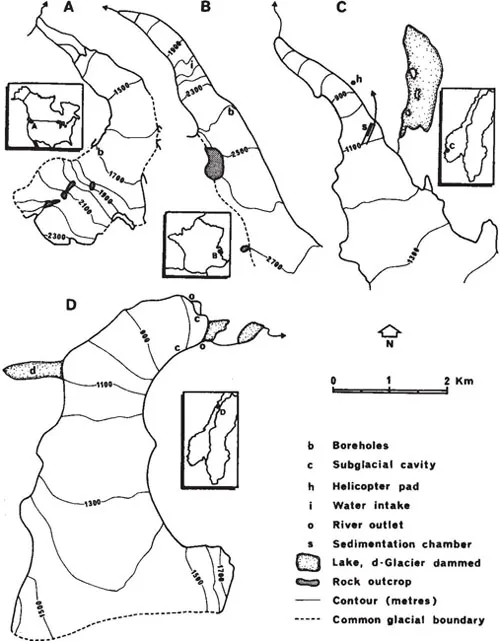
If a glacier has been moving over an area for a very long time, erosion will probably have removed much of the sediment and weathered debris which may have been present in the past. Areas of bare rock are common around the margins of retreating glaciers, and most observations beneath existing glaciers have been made at sites where the bed is solid. However, when the bottoms of bore-holes made between 1969 and 1976 through the Blue Glacier, Washington, USA (Figure 1.1. A) were examined with the aid of small television cameras, the bed invariably was found to consist of rock debris. The glaciologists, having noted the abundance of abraded and striated rock at the glacier margin, were surprised at their failure to observe any solid rock at the bottom; the basal conditions did not correspond closely to those assumed in existing theories of glacier sliding.
Advancing glacier fronts generally move over areas with a sometimes substantial, cover of soil, sediment or weathered rock. Sub-glacial deformation of this material may account for much of the total basal movement of a glacier. Theories of glacier sliding involving such deformable bed material are much less common than are theories relating to a solid bed.
Figure 1.1: Four glaciers at which sub-glacial and glacio-hydrological studies have been made. A. Blue Glacier, Washington, USA. B. Glacier d’Argentière, Mont Blanc, France. C. Bondhusbreen, Folgefonni, Norway. D. Austre Okstindbreen, Okstinden, Norway. The glacier beds have been investigated in natural cavities beneath the ice, in tunnels made to collect water and remove sediment for hydroelectric power schemes, and through boreholes drilled from the glacier surface. Note that two rivers issue from Austre Okstindbreen, the northern one flowing back under the glacier after a short subaerial course.
The nature and behaviour of ice at the bottom of glaciers
The bottom of a glacier may be thermally complex; even if the basal ice generally is temperate (i.e. at the melting-point), patches of cold ice with below-melting-point temperatures may occur. The basal ice may include both true glacier ice (metamorphosed snow) and refrozen meltwater; some may be bubble-free; elsewhere, many bubbles may be present. At the bottom of the Norwegian glaciers Østerdalsisen and Austre Okstindbreen, cavities form down-glacier of steeply inclined parts of the bed, and some basal ice is trapped between the rock floor and ice which is moving more rapidly over it. This forms thin zones, characterised by numerous air bubbles and low bulk density. The bubble-rich ice deforms rapidly (Theakstone, 1979).
The debris content of ice adjacent to a glacier bed may be as much as 30 per cent by volume. However, the proportions of relatively clean and dirty ice in contact with the bed must vary from one part of a glacier to another. Most basal ice is markedly anisotropic and frequently displays well-developed banding or foliation. Crystal sizes differ: the high shear induced by irregularities of the bed may result in the development of zones of very fine-grained ice. Crystal orientation patterns (ice fabrics) are likely to be non-random because of the large total strain to which the ice has been subjected in its long history. If sufficient stress is applied to a sample of ice, the rate at which it deforms (the strain rate) becomes constant. Laboratory studies have shown that the relation between the deformation of samples of polycrystalline ice and the stress producing the deformation has the form:
where
is the strain rate, τ is the applied stress, n is a constant and A is a function of the pressure, temperature, texture (shape and size of individual crystals) and fabric. Although this relationship, the Glen flow law, is much used in theories of glacier sliding, comparison of the behaviour of the glaciers and of samples of ice strained in laboratory investigations indicates that unmodified application of the law to glaciers is not justified (Hooke, 1981). Since ice strain is affected by its temperature, grain size and structural anisotropy, and by the sediment particles and other inclusions within it, the behaviour of ice close to the bed of a glacier should not be expected to conform to a simple flow law. As ice deforms, the textural and structural changes which occur may influence its subsequent behaviour significantly. The flow law at any part of a glacier therefore must be a function of location, defined by the local crystallographic fabric and stress situation. The flow law derived from laboratory studies of isotropic ice is so modified by local factors that it may underestimate actual strain rates by a factor of more than 10.
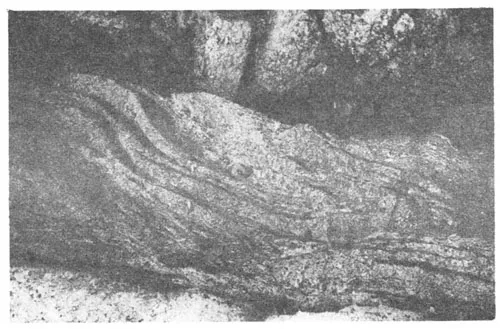
Figure 1.2: Folded basal ice at the Norwegian glacier Corneliussens Bre. This sediment-rich basal layer contrasts with the overlying, relatively clean ice. Boulders within the cavity beneath the glacier are mud-coated. The tape holder in the centre is 5 cm across.
The deformation of dirty ice is affected by the concentration of the debris particles. Although low concentrations of sediment within the ice may increase the strain (creep) rate, concentrations in excess of about 10 per cent by volume apparently stiffen ice, with the particles impeding creep. Very dirty ice, like ice-rich soils, has a creep rate much lower than that of clean polycrystalline ice. Clearly, the mechanical properties of ice at the bottom of a glacier cannot be characterised without specifying such other properties as impurity or inclusion content, texture and fabric. Ice passing round the sides of upstanding parts of a glacier bed, or round other obstacles such as boulders, is subject to transverse compression and longitudinal extension. Upstream of the obstacle, longitudinal compression occurs, whilst longitudinal extension is characteristic of ice moving over the top of the obstacle. Such deformation patterns may lead to folding of basal ice and may cause sediment to move towards cavities and low pressure zones in the lee of obstacles. Strong basal folding of basal ice can cause a single debris-rich layer to appear several times in vertical section, thereby increasing the overall concentration of sediment in ice close to the bed (Figure 1.2).
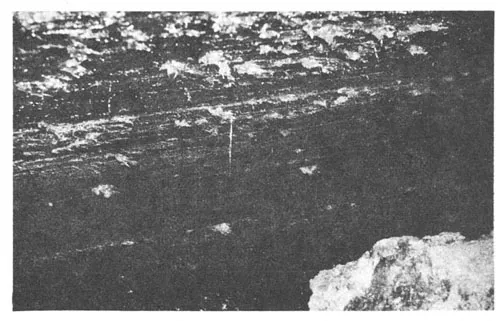
Pressure fluctuations at glacier beds change ice melting-point, and water may be squeezed out of the ice by high pressure. The water tends to flow towards zones of lower pressure, such as cavities at the bed. Some refreezes there, forming a basal layer of bubble-poor ice with dirty layers containing dispersed sediment particles and rock fragments. The chemical composition of such regelation ice frequently differs significantly from that of glacier ice; and the impurities within it may impede sliding. Formation of a patch of cold basal ice, as water produced by pressure melting within the ice is squeezed out, may eliminate a thin film of water which otherwise would be present (Robin, 1976). Such cold patches at the bed must influence glacier sliding. The ceilings of natural sub-glacial cavities may be below melting-point at atmospheric pressure, reflecting the lower melting-point of ice under stress up-glacier of the cavity. Some water expelled from the glacier refreezes at the cavity ceiling when the pressure is released, forming ice stalactites and excrescences (Figure 1.3) or rows of small bumps. These may be related to variations of sliding of the ice up-glacier of the cavity (Andreasen, 1983).
Glacier sliding
Theories
Glacier flow is commonly described in terms of two components — plastic deformation within the glacier, and sliding of the glacier over its bed; the latter usually occurs only where the basal ice is temperate. The relationship between the sliding velocity of a glacier, the characteristics of its bed and the basal shear stress may be expressed in terms of a sliding law. However, the nature of glacier sliding remains relatively poorly understood; it may involve intense deformation of a layer of ice close to the bed, rather than simply discrete motion of the body of ice over the underlying surface.
Figure 1.3: Ice accretions on the wall of a natural cavity beneath the Norwegian glacier Austre Okstindbreen. Ice flow is from right to left The near-parallel flow lines along the wall result from moulding of the ice as it flows past bedrock irregularities up-glacier of the cavity. Platy ice structures, projecting from the wall, probably develop as water which has been extruded from the glacier by ambient hydrostatic pressure refreezes. The thin ice stalactite in the centre is about 15cm long.
As glacier beds are not smooth, explanations of glacier sliding have to account for the movement of ice past irregularities of the bed. In 1957, Weertman suggested two possible mechanisms: enhanced plastic deformation, and regelation. Although all the ice of a glacier is likely to be deforming plastically, the higher stress against the up-glacier side of obstacles at the bed causes above-average deformation. Regelation involves melting of temperate ice as a result of the higher pressure present at the up-glacier side of obstacles; the meltwater refreezes at the down-glacier side, where the pressure is lower. The resistance to sliding offered by the irregularities of the bed (i.e. its roughness) varies with their size. Enhanced plastic deformation permits ice to overcome the resistance of large obstacles, whilst regelation allows ice to flow easily round small ones. Weertman suggested that there was a controlling obstacle size at which overall resistance to the two mechanisms was greatest and that this critical size largely determined a glacier’s sliding velocity. Some recent experimental work has indicated that sliding may be controlled more by ice deformation than by regelation and that the regelation phenomenon itself may be the result of deformation.
Weertman’s early theory of glacier sliding has been modified to take account of several additional factors. These include the separation of parts of the glacier bottom from the bed, with the formation of cavities on the down-glacier side of obstacles; these reduce the friction between ice and rock. Short-term variations of glacier surface velocity, assumed to result from changes of sliding velocity, have also been considered. An increase of thickness of the water layer present at the glacier bed may result in the submergence of some of the smaller obstacles which previously resisted sliding, thereby reducing the effective roughness of the bed.
Although the behaviour of water at the bed is an integral part of the process of glacier sliding, it has not yet been incorporated successfully into sliding theories. Some water must be present at any point at which temperate ice is sliding over a rock bed. Additional water is formed by frictional heating and by geothermal heat flow from the bed to the basal ice. Water formed by melting at the glacier’s upper surface is more abundant, and much reaches parts of the bed. If the glacier bed is impermeable, as in most theoretical sliding models, the water must flow along it, thereby affecting both the effective roughness and the sliding velocity. However, if the bed is permeable, water may move through it to the glacier bottom, or water may move from the glacier into the bed. Many observations have shown that glacier surface flow rates and, by implication, glacier sliding velocities, vary with the availability of water: glaciers generally move more rapidly in the summer melt season than in winter. However the relationship between velocity and water availability is not simple: the pressure of the sub-glacial water is a significant factor.
Observations
Direct observations of sliding have been made in tunnels excavated to glacier beds and in natural sub-glacial cavities accessible from the glacier margins. Indirect determination of sliding rates utilizes boreholes drilled from the glacier surface to the bed (Figure 1.1 A).Movement of the top of the borehole and the inclination and bearing (azimuth) of the borehole axis at different depths are measured at different times, commonly about one year apart. Most glacier boreholes have been made with drills which melt their way down through the glacier. Such thermal drills may fail to penetrate englacial debris and, more generally, basal layers of dirty ice. Photography from the bottoms of boreholes which had been extended with the aid of electromechanical drills and removal of rock debris indicated that sliding of Blue Glacier was much less than that calculated indirectly from changes of borehole position and inclination. Previous assessments of glacier sliding made in this way were called seriously into question (Engelhardt et al., 1978).
Frequently, borehole inclination data, showing the variation of velocity with depth below the glacier surface, have been plotted two-dimensionally, with the implication that the direction of flow is uniform. However, measurements of an array of boreholes at Athabasca Glacier, Canada indicated that the flow direction varied with depth, and the photographic studies from the Blue Glacier boreholes revealed marked differences of direction of surface and basal flow. Although variability of flow direction within a glacier has been given relatively little attention in theoretical studies and in glacier flow modelling, both direct observations and the evidence provided by striations on bedrock indicate that it is an important characteristic of movement of ice at the bed. Folding of ice which is subjected to compression as it comes into contact with the bed at the downstream limits of subglacial cavities is common (Theakstone, 1966). The strong lateral flow component of the deforming ice reflects the sometimes complex relationship of glacier flow direction and the three-dimensional geometry of the bed.
At many glaciers, debris is present in the lowermost few centimetres of ice. Some particles partly within the ice make contact with the bed where they are retarded relative to the moving ice, because of the frictional drag, and particles entirely surrounded by ice may tend to form folds over them. When debris concentrations are high and drag is large, the basal debris determines the sliding velocity. Frequent particle collisions result in accumulations forming, and ice is forced to move round such mobile obstructions as well as round the fixed obstacles of the rock bed (Boulton et al., 1979). As seen below the Glacier d’Argentière in the French Alps (Figure 1.1. B), the resultant transverse component of flow of basal ice causes debris-rich ice and particle con centrations to move through furrows alongside the obstructions. Water at the bed is often diverted into such furrows, so that more ice melts there than above the adjacent hump, increasing still further the differential concentration of debris at the bed and its effect on glacier sliding and erosion.
Direct measurements...
Table of contents
Cover
Half Title
Title Page
Copyright Page
Table of Contents
Introduction
1. Aspects of Glaciers and their Beds
2. Glacial Geomorphology: Terminological Legacy and Dynamic Future
3. Active and Fossil Periglacial Landforms
4. Geomorphological Development of Modern Coastlines: A Review
5. Geomorphological Processes, Soil Structure and Ecology
6. Themes in Australian Fluvial Geomorphology
7. Tropical Fluvial Geomorphology
8. Themes in Desert Geomorphology
9. Arid Zone Slopes and their Archaeological Materials
10. Karst Forms and Processes
11. Volcanoes
12. Landform Development by Tectonics and Denudation
13. Geomorphic Measurements from Ground-based Photographs
14. Cities and Geomorphology
15. Relief Form on Planets
Notes on Contributors
Index
Trusted by 375,005 students
Access to over 1.5 million titles for a fair monthly price.
Study more efficiently using our study tools.
Frequently asked questions
Yes, you can cancel anytime from the Subscription tab in your account settings on the Perlego website. Your subscription will stay active until the end of your current billing period. Learn how to cancel your subscription
No, books cannot be downloaded as external files, such as PDFs, for use outside of Perlego. However, you can download books within the Perlego app for offline reading on mobile or tablet. Learn how to download books offline
Perlego offers two plans: Essential and Complete
Essential is ideal for learners and professionals who enjoy exploring a wide range of subjects. Access the Essential Library with 800,000+ trusted titles and best-sellers across business, personal growth, and the humanities. Includes unlimited reading time and Standard Read Aloud voice.
Complete: Perfect for advanced learners and researchers needing full, unrestricted access. Unlock 1.5M+ books across hundreds of subjects, including academic and specialized titles. The Complete Plan also includes advanced features like Premium Read Aloud and Research Assistant.
Both plans are available with monthly, semester, or annual billing cycles.
We are an online textbook subscription service, where you can get access to an entire online library for less than the price of a single book per month. With over 1.5 million books across 990+ topics, we’ve got you covered! Learn about our mission
Look out for the read-aloud symbol on your next book to see if you can listen to it. The read-aloud tool reads text aloud for you, highlighting the text as it is being read. You can pause it, speed it up and slow it down. Learn more about Read Aloud
Yes! You can use the Perlego app on both iOS and Android devices to read anytime, anywhere — even offline. Perfect for commutes or when you’re on the go. Please note we cannot support devices running on iOS 13 and Android 7 or earlier. Learn more about using the app
Yes, you can access Themes in Geomorphology by Alistair Pitty in PDF and/or ePUB format, as well as other popular books in Scienze fisiche & Geografia. We have over 1.5 million books available in our catalogue for you to explore.