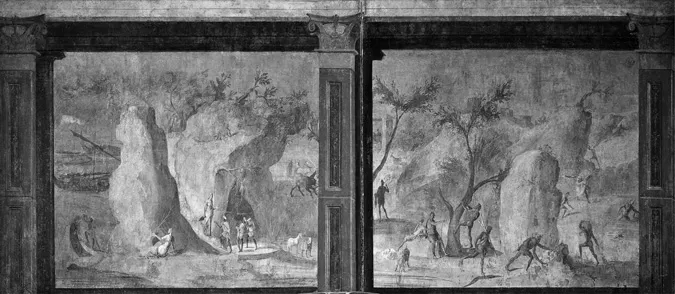
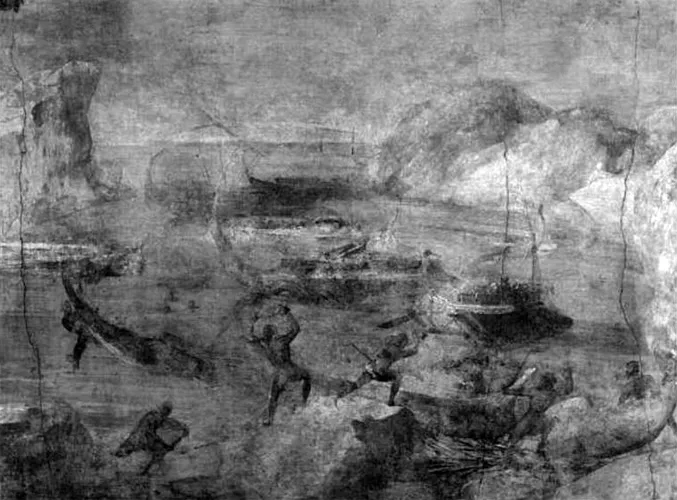
Sing to me, Muse, of the man of twists and turns, who was tossed off course time and again, after he had sacked the holy citadel of Troy; he saw the cities of many men, and came to know their minds, and countless sufferings at sea his heart endured, as he struggled for his life [psyche] and the homecoming [nostos] of his companions. But he did not save his companions, although he really wanted to; for they perished out of their own recklessness, the fools, who ate the oxen of Helios Hyperion. And he deprived them of the day of their return home.
As C. P. Segal observes,9 “[t]he Odyssey begins with the hero’s strong sense of responsibility for his men”; lines i.4–6 inform us that Odysseus went to great lengths in order to remain alive and to bring his companions to Ithaca. As D. N. Maronitis has shown,10 the temporal-causal participle ἀρνύμενος (i.5), a hapax in the Odyssey,11 performs a pivotal thematic function in both the proem and the poem: it ranks Odysseus’ life [psyche] and the companions’ nostos as equally important in the hero’s ascending scale of affection,12 affirms his intent to safeguard them both, but does not reveal if he actually did. This question is answered by the adversative participle ἱέμενός περ (i.6), which, with its connotations of yearning, signals both Odysseus’ dedication to the cause of the group’s collective nostos and his failure to secure it. Odysseus, the brains of the Achaean army, the sacker of cities, cannot manage to bring his crew home from Troy. And yet, he is not alone among his fellow Achaeans to suffer such a fate: as the tradition of the nostoi reminds us, divine persecution can easily turn any homecoming into a tragedy. As G. Danek convincingly argues, the same storm, caused by Athena, is responsible for the calamitous nostoi of the Lesser Aias, Menelaos, and Odysseus.13 Moreover, as J. Strauss Clay has demonstrated,14 the wrath of Athena, though artfully suppressed, can be unmistakably detected in the Odyssey. The poem also highlights Odysseus’ relationship with his patron goddess Athena, whose support, though decisive, does not commence until after Odysseus has spent seven years in Ogygia.15 By that point, Odysseus has already failed as a captain: deprived of his fleet and sailors, he travels alone, subject to Poseidon’s continuing anger, which he singlehandedly provoked. Helios’ anger, on the other hand, seems to have befallen his comrades on account of their foolishness, which, as we will see, Odysseus could have prevented.
As T. R. Walsh has shown, lines i.6–9 indicate the starting point of the poem’s narrative;16 after invoking the Muse and stating the general topic of the song, the proem reveals the moment in the plot that initiates the narrative. In the Odyssey, this key moment is the Thrinakia episode: not only does it demarcate the narrative boundaries of the song treating the hero’s homecoming, but it also reconciles the three variants of his nostos, the version that Odysseus narrates to the Phaeacians,17 and the two versions that he recounts to Penelope, one with18 and one without19 a reference to Kalypso. The slaughter of the oxen of Helios redefines Odysseus’ nostos, as the captain sheds his remaining “luggage,” namely his ship and crew, completing a process that started shortly after they left Troy. But let us follow the captain from the beginning of his homeward journey.
A step-by-step failure or release
As we hear in II.637, Odysseus led a contingent of twelve ships to Troy, manned with Cephallenians from Ithaca, Zacynthus, and Samos. The poet introduces him as “equal to Zeus in cunning intelligence [mētis]” (Διὶ μῆτιν ἀτάλαντος, II.636).20 We see the twelve ships again in ix.159, anchored by a small island near the land of the Cyclopes, after two stops in Odysseus’ journey from Troy. The context is the Apologoi,21 Odysseus’ narrative of his adventures to king Alkinoos and his guests in Phaeacia. As bard-protagonist, Odysseus begins his linear account of events with the fall of another Troy; soon after the sack of Ismaros, the city of the Kikonians, which he presents as his personal accomplishment (“there I sacked the city and killed them [the Kikonians],” ix.40), his companions jeopardize their safety by lingering over roasted meat and wine. Odysseus urges them to leave, “but they, in their great foolishness,” do not listen to him (τοὶ δὲ μέγα νήπιοι οὐκ ἐπίθοντο, 44). Defeated by Kikonian reinforcements, the group suffers the loss of seventy-two men and makes a hasty retreat.22 Not only does the Kikonian episode indicate that the companions can get their mind off nostos rather easily, it also identifies a pattern of dysfunction within the group: Odysseus urges caution but the crew fails to comply. As J. Shay demonstrates,23 Odysseus’ failure as a commander hinges on his poor judgment and lack of control over his men: both are present here. Nevertheless, at this early stage of the trip, captain and crew are still travelling through a world that seems to offer them considerable hope of sailing home safely, as Odysseus himself recollects:
καί νύ κεν ἀσκηθὴς ἱκόμην ἐς πατρίδα γαῖαν,
ἀλλά με κῦμα ῥόος τε περιγνάμπτοντα Μάλειαν
καὶ βορέης ἀπέωσε, παρέπλαγξεν δὲ Κυθήρων.
ix.79–81
And I would have reached my homeland unscathed, but a tide-rip and the North wind drove me off course and threw me near Kythera, as I was sailing past Cape Malea.
By his choice of the singular (ἀσκηθής, ἱκόμην, με), Odysseus portrays this near-success as a personal accomplishment, distancing himself from his men, all of whom have perished...