A Southern Criminology of Violence, Youth and Policing examinespublic experiences of insecurity and the social impacts of security programmes that aim to address violence in Brazil. This book contributes to the emerging field of southern criminology by engaging with the perils faced by people living in 'favelas' in Brazil and critically investigating the discourse of state actors. It combines original ethnographic data with critical analysis to expand understandings of violence and control in urban and postcolonial contexts.
This study challenges dominant practices and notions of security and control. Its objective is to decolonise knowledge and shed light on issues relating to policing, coercion, and the great socioeconomic, historical and spatial inequalities that shape the lives of millions of people in the Global South. The findings of this book expose the exacerbation of social problems by the expansion of the penal and crime industry, unsettling the applicability and universalism of mainstream managerial criminology.
The evidence reveals that new modes of securitisation have not addressed long-standing issues of sexism, racism, classism and brutalisation in the police. Moreover, through the increasing use of methods of control and incarceration, security programmes have failed to prevent diverse forms of violence and challenge the expansion of organised crime. Instead they have exacerbated the inequalities that affect the most marginalised populations.
Written in a clear and direct style, this book will appeal to students and scholars in criminology, sociology, cultural studies, social theory and those interested in learning about the social injustices that exists in the Global South.
On 27 January 2016, I obtained permission to attend yet another security meeting at the Secretariat for Planning and Management of the State of Pernambuco (aka SEPLAG – Secretaria de Planejamento e Gestão) in the northeast of Brazil. Initially, through personal and academic networks, and later though snowballing methods, I gained access to some of the meetings of the local security apparatus. My status as a Brazilian student living abroad and conducting research at a London university seemed to indicate that I posed little threat in terms of local politics. Academic networks, my own background – as local (nordestina) turned British – and my understanding of local cultural norms allowed me to access those meetings. Moreover, the gatekeepers associated with me were trusted and well liked in SEPLAG, introducing me as someone who wanted to understand the “success” of a local homicide reduction programme entitled Pact for Life (Pacto pela vida in Portuguese, or PPV), all of which facilitated my entry into the security apparatus as a researcher.
At PPV meetings I could observe first-hand the complexity of counting the dead. A delegado (chief of civil police) approached the head of statistics sitting next to me to informally request the change of classification for a case. Bones had been found in his jurisdiction and classified as a homicide, affecting his targets. The delegado argued that often these deaths occurred in neighbouring states, but these dead bodies were buried in his jurisdiction. He also contended that the death may have been manslaughter (homicidio culposo) instead of homicide (homicidio doloso), in which case, the delegado reminded the statistician that the death would not affect his targets. This concern with targets, classifications and counting are part of a new securitising agenda in Brazil, the product of new forms of governance – new approaches to urban social control. The dialogues among government officials, planners, statisticians and high-ranking members of the military and civil police during closed public security government meetings reveal the ways in which crime data is used and misused for personal and political ends. There is no question that statistics released by the public security apparatus are “adjusted, manipulated, subcategorized, or poorly represented to convey rosier images of public security” (Denyer Willis 2015, 51).
Only 4 days prior to the security apparatus meeting in question, a large-scale prison escape had shaken any remaining public confidence in the security system. In Recife, the capital city of the state of Pernambuco, prisoners used explosives to blast a hole in one of the walls of the Complexo do Curado prison, leading to the escape of forty prisoners on 23 January 2016. One of the largest prisons in Latin America, the Complexo do Curado housed at the time approximately 7,000 inmates (four times its capacity). A few days before the explosion, on 20 January 2016, over 50 prisoners had escaped from another prison in the state of Pernambuco. The police recaptured many escapees and killed others, raising concerns about the routine disrespect for human rights in overcrowded prisons and in Brazilian society more widely. The prison breaks increased public fear, feelings of insecurity and doubts about the sustainability of the existing public security system. During the government meeting on 27 January 2016, one of the delegados present expressed his concern with the level of prisoner organisation and the failures of the system:
We have tightened security inside and outside the prison. We discovered sixteen tunnels connecting the prison to the outside and we closed those. The problem used to be people throwing parcels over the walls, so as we increased surveillance around the walls, prisoners started to build tunnels. Now, as we found the tunnels, they started to blow the walls up.
As a solution, he argued that the way to solve the situation would be to build more prisons, as long as they were smaller and more manageable: “we need smaller prisons but it is going to take years to build enough prisons for all the inmates we already have”. From a critical criminological perspective, this seemed to be a catch 22 situation: whatever the police tried to do, the police-criminals pursuit would be unending. Incarcerating suspects and increasing surveillance did not seem sustainable or efficient methods for creating or maintaining public safety, especially when deeper structural, institutional and societal problems are inadequately addressed.
Anecdotes about homicide data, prison escapes and the manipulation of quantitative data illustrate and epitomise some of the limits of managerialism in crime control, the flaws of attempts at “modernizing” policing and incarceration in Brazil’s context. They are bare illustrations of the salient symptoms of multiple failures to generate and implement meaningful and transformative public policies. Such accounts shed light on powerful state actors’ perceptions of threats associated with, and proposed solutions for, high-crime areas, prison escapes and popular insecurity. Contradictions inherent in such perceptions, dialogues and discourses can be compared with perceptions of low-income communities perceived as peripheral, informal and dangerous. Such communities are often described as favelas; they are feared spaces, seen as no-go areas that need to be avoided by middle and upper class citizens.
In what follows, first-hand ethnographic data from these communities is explored, revealing the diverse ways of perceiving such places, as humane, populated by people living in hardship and yet culturally rich, financially impoverished but deeply interconnected in multiple ways, through politics and work, to the rest of the city. This chapter provides a brief overview of the book’s content and situates the work in the developing field of southern criminology (Carrington, Hogg, and Sozzo 2016).
Favelas: life on the edge?
At nearly 2:00 p.m., in July 2013 I got off a bus, which could barely squeeze through the narrow roads and alleys leading to the community. As I walked into the unpaved roads of the community I noticed cheerful people sitting outdoors on plastic chairs chatting. There were occasional stretches of pavement to walk on, open sewage running down the street, uncollected piles of rubbish scattered around and obnoxious smells hung in the air. There was no breeze and heat reflected off brick and concrete walls. Some of the decaying small brick houses that formed the community and the apartment blocks had been built in the 1970s near the prison, but the community had a longer history, dating back to the early part of the 20th century. Despite the appearance of deterioration, I learned that rents were surprisingly high so the research funding I had naively set aside for accommodation would hardly cover the monthly cost (R$350, approximately £116 at the time) of renting a single room in a home in the community of Tourinho.1
Outward appearances told me little about the people who live in these poor communities. Many of the people encountered during the fieldwork were active members of social movements, active in local politics, innovative people capable of reinventing themselves and being creative and organised. In a meeting with Lourdes in the small building from which she ran a non-governmental organisation (NGO) in Tourinho providing leisure and cultural activities, sports and arts training to young people in the peripheries of the city, she explained there is a high demand for housing in the area as many of the prisoners’ family members want to live near the prison, as well as traffickers who kept business ties with inmates, pushing the price of rents upwards. Lourdes was quick to deflect attention away from negative connotations about the community and was keen to present positive and innovative images of its people. She explained her work in the community:
The group [NGO] started in the porch of my house. Some of the guys used to tag walls with spray paint during the night … we didn’t have the financial means but we decided to get together and put what little we had together to form a group that would do something for the community … using drawing, tagging, graffiti. We have been together 10 years […] and have won prizes due to our community work taking kids off the street.
Lourdes became one of the co-researchers on this project and enabled access to a larger sample of residents and young participants; she also became a key informant. Deeply aware of the social inequalities in the city, she was well read and talked freely about feminism, the afro-movement, hip-hop and art. She epitomises the context of hardship and cultural richness, experiencing financial impoverishment but maintaining deep political and economic interconnections to the rest of the city.
Outsiders view favelas as undesirable spaces. They are working-class barrios where workers such as labourers, service-sector employees and domestic workers live. They are spaces replete with community associations, organisers and leaders, places in which family, hard work and social mobility are highly valued. Still, they have been constructed in the global gaze as violent spaces, known for high levels of violence and cinematographic representations ingrained in public consciousness through films such as City of God. Indeed, favelas are often socially and spatially marginalised in the city, in the sense that they are segregated spaces, sometimes being separated from wealthier communities by walls, distance, disparities in access to services or other socio-economic disadvantages.
Brazilian favelas and informal communities can be traced back to colonial times, sometimes formed by escapee slaves or, after the abolition of slavery at the end of the 19th century, when a large population of former slaves, peasants and indigenous people were left destitute and with no land rights (Zaluar and Alvito 2006; Garmany and Pereira 2019). Although often perceived as “problems”, favelas have endured because they serve key roles to the city and capitalist development. Brazilian political scientist Lúcio Kowarick developed the concept of espoliação urbana or urban spoliation (Kowarick 1979) to explain how urban informality is not an abnormal characteristic of capitalist development. Instead, he argued, urban informality is produced by capitalist development because it enables a workforce to live and socially reproduce with little cost for private capital or the State. Favelas provide not only a reserve army of labour, but also housing for subaltern and marginalised working people, so that income and wealth remain unequally distributed and concentrated, and urban growth can continue despite the “spoliation” or dilapidation of the urban landscape dotted by informal communities. Kowarick’s work and concept expands our understanding of urban growth and development around the world.
Just as in other parts of the world, informal settlements built on state, private or public land have become established with the explicit or implicit connivance of government and politicians trying to expand their support base through often clientelist offers of financial support or infrastructure (Arias 2006; Lasslett 2018). This has not enabled residents to secure housing titles or avoided threats of forced evictions. Yet, residents are entangled in the city, and in politics. They work outside their communities, often in minimum wage jobs, which do not permit access to private housing. Residents vote, protest, make music, dance and claim the right to the city by self-building their own communities.
In contrast to other large Brazilian metropolises, where poor communities are concentrated in peripheral areas, in Recife a large number of slums are scattered across the city. Its periferias do nonetheless tend to have higher concentrations of poverty. The region was a hub for the sugar cane industry in the 16th century, but although sugar cane remains the most important crop in the area, its economic importance has declined. There are large industrial plants in the city’s suburbs, but most of the economy relies on the service sector. It is estimated that 60% of the population works in the private service sector (Koster 2009).
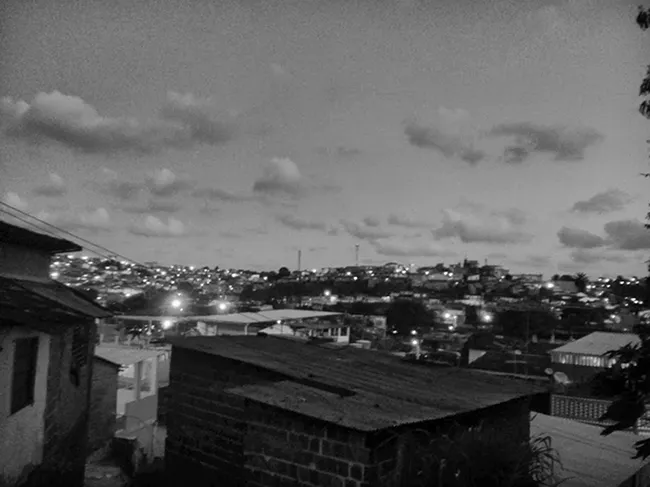
The first case study community, Tourinho (Figure 1.1), comprises two adjacent neighbourhoods located in the peripheries of the metropolitan region of Recife, with over 40,000 inhabitants. In the 19th century, the territory belonged to an engenho (sugar mill) and early in the 20th century the population began to settle in the area. Today the community is constituted of a combination of small gated terraced houses, some two- and three-storey buildings, some irregular settlements and some small local businesses. Most residents have metal bars around their houses’ windows and doors, gates and sometimes guard dogs. The average monthly household income in 2013 was R$1,296 (the equivalent of £298) to supply for at least three people – a far cry from rental prices or the minimum required for a dignified living.
Figure 1.1 Tourinho, Pernambuco 2013.
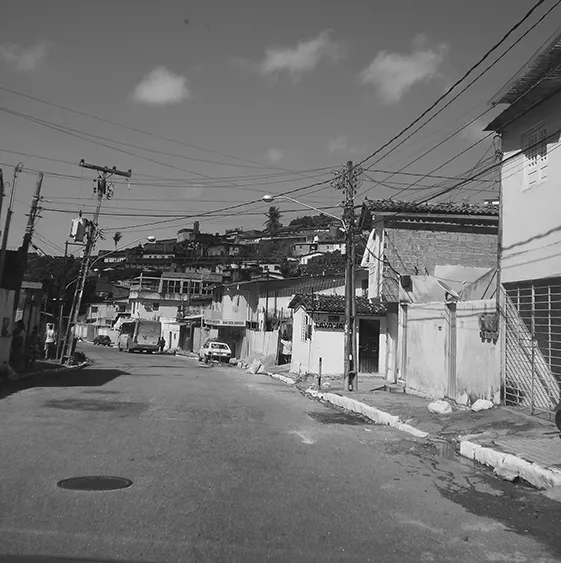
According to State definitions most households in the communities are “abnormal agglomerates”, or in other words, “abnormal housing”, slums or irregular settlements. Half of the population is ethnically mixed (54%), 35% white, 9% black and a minority self-classify as indigenous (Prefeitura do Recife 2013). The second case study community, Vitoria (Figure 1.2), is similarly diverse in terms of ethnicity, situated in the north part of Recife, adjacent to a middle-class neighbourhood and constituted of several smaller low-income communities. The average monthly household income in 2013 was R$ 1,166 (the equivalent of £268). Socioeconomic conditions in both studied communities were similar. The Human Development Index (HDI) in Tourinho was 0.751 and in Vitoria, it was 0.731 in 2000, respectively equivalent to the HDI of Kazakhstan and Ecuador (Bitoun 2005). As a point of comparison between countries, the HDI includes data about income, life expectancy and education. In the upper-class neighbourhood of Boa Viagem in Recife, the HDI was 0.964 in 2000; this was equivalent to Norway’s HDI. Such demographic data illustrate the extent of social inequalities within the city.
Figure 1.2 Main Street in Vitoria, 2013.
Violence
A significant literature has begun to emerge identifying the i...
Table of contents
Cover
Endorsements
Half Title
Series Page
Title Page
Copyright Page
Table of Contents
List of figures and tables
Acknowledgements
Prologue
1. Over, under and through the walls
2. Unpacking security, context and research design
3. Southern criminologies of violence and control
4. Policing the poor
5. Reforming the system
6. Life, crack and violence in the favelas
7. Policy and practice: What is to be done?
8. Conclusion
Index
Trusted by 375,005 students
Access to over 1.5 million titles for a fair monthly price.
Study more efficiently using our study tools.
Frequently asked questions
Yes, you can cancel anytime from the Subscription tab in your account settings on the Perlego website. Your subscription will stay active until the end of your current billing period. Learn how to cancel your subscription
No, books cannot be downloaded as external files, such as PDFs, for use outside of Perlego. However, you can download books within the Perlego app for offline reading on mobile or tablet. Learn how to download books offline
Perlego offers two plans: Essential and Complete
Essential is ideal for learners and professionals who enjoy exploring a wide range of subjects. Access the Essential Library with 800,000+ trusted titles and best-sellers across business, personal growth, and the humanities. Includes unlimited reading time and Standard Read Aloud voice.
Complete: Perfect for advanced learners and researchers needing full, unrestricted access. Unlock 1.5M+ books across hundreds of subjects, including academic and specialized titles. The Complete Plan also includes advanced features like Premium Read Aloud and Research Assistant.
Both plans are available with monthly, semester, or annual billing cycles.
We are an online textbook subscription service, where you can get access to an entire online library for less than the price of a single book per month. With over 1.5 million books across 990+ topics, we’ve got you covered! Learn about our mission
Look out for the read-aloud symbol on your next book to see if you can listen to it. The read-aloud tool reads text aloud for you, highlighting the text as it is being read. You can pause it, speed it up and slow it down. Learn more about Read Aloud
Yes! You can use the Perlego app on both iOS and Android devices to read anytime, anywhere — even offline. Perfect for commutes or when you’re on the go. Please note we cannot support devices running on iOS 13 and Android 7 or earlier. Learn more about using the app
Yes, you can access A Southern Criminology of Violence, Youth and Policing by Roxana Pessoa Cavalcanti in PDF and/or ePUB format, as well as other popular books in Law & Criminal Law. We have over 1.5 million books available in our catalogue for you to explore.