Today, fermentation products profit from industrial microbial strains which are established by targeted genetic engineering techniques. For many years, the process of fermentation of foods was done for the production of alcoholic beverages through barley and grapes (Campbell-Platt 1994). The environmental conditions and microbial strain are employed in the development of by-product or end products. Due to their catalytic activities, enzymes have been used in the industry for many years, and their actions are dependent on substrate, pH, inhibitors and temperature. Each process should be optimized. In the fabrication of over 500 profitable products, enzymes are used (William and Akiko 2004). They have an extensive variety of applications in diverse industrial fields.
Many commercial products are produced by a process in which enzymes are used. There are 500 products in this category (Johannes and Zhao 2006). For thousands of years, enzymes have been used to produce cheese, yoghurt, beer and wine (food and beverages). Production of alcohol (ethanol) and carbon dioxide gas is done by breakdown of sugar by the enzymes in yeast:
The present reaction of fermentation is getting in the anaerobic condition.
The term “biotechnology” is known from the mid-1970s, and it has been described in an incredibly uncomplicated type as applied science to the composite type of industrial arts or scientific learning of the practical. This technology is used in mainly fermenter set up, control, purification as well as improvement of product to characterize processes of chemical engineering by microorganisms and their products (Blieck et al. 2007). In biotechnology, fermentation is the area which is incredibly important and is moreover growing rapidly. It is an increasingly rising process. History of this technology is longer and its future is brighter then biological sciences because of its covering significant areas like the mankind service in medicine and food (Pátková et al. 2000).
On a huge scale, the industries of pharmaceuticals, food and alcoholic beverages have wide use of fermentation technology. The term “fermentation” is from the Latin and its denoting boiling, for the reason that beverages formed by fermentation appear to be boiling. The science of fermentation is “zymology.” The productivity is affected by fermentation modes like types of strains, media and growth conditions.
Development in production of fermented products is possible for producers when they have knowledge about the biochemical changes in fermented foods. The changes in production are possible by manipulation of conditions as well as strains (John and Sons 2014). High productivity can be achieved by selection of modes of fermentation like continuous, batch and fed-batch. Because of cell immobilization in bioreactor, the concentration of biomass increases and therefore the concentration of biocatalyst also increases, so from it higher productivity can be attained. There is need of evaluation and optimization of the recovery method of product from fermentation, and its economic limitation factor also should be optimized. There are some examples of recovery method such as filtration, homogenization and extraction (liquid and solid).
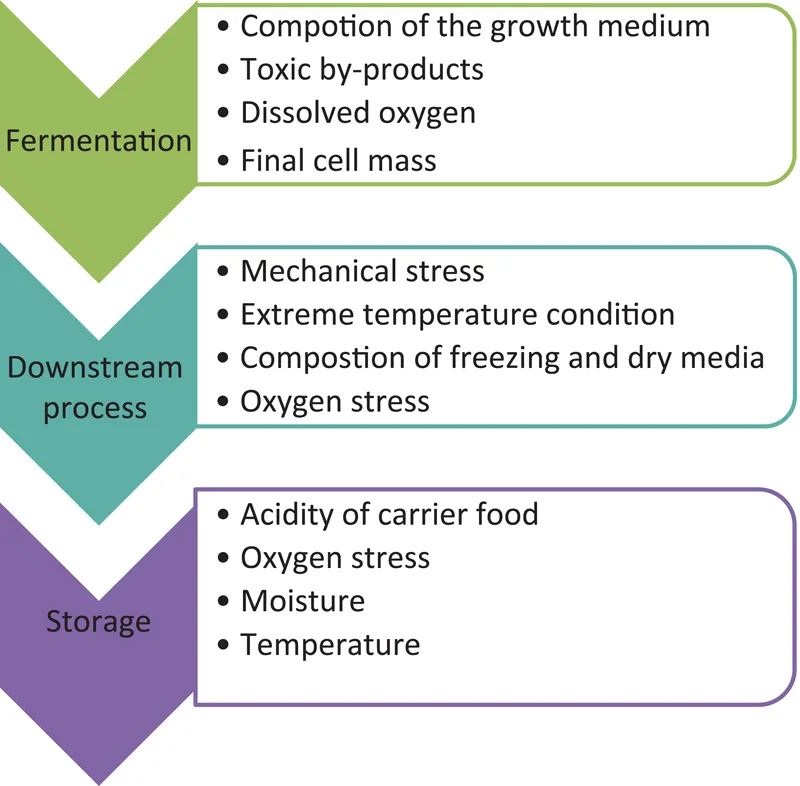
The end-product purification is also a step of this process which has high cost. Extracellular products, biomass itself or intracellular products moreover can be the microbial end products. Due to their catalytic activities, enzymes have been used in the industry for many years, and these are products of living organisms (Kameswara Rao 2009). Figure 1.1 discusses the process of fermentation. Activity of enzymes should be optimized for each process, and it is dependent on pH, temperature, inhibitors, substrate, etc. as recovery of enzyme is difficult, the process cost reduces by application of enzyme immobilization. Microorganisms, plants and mammalian tissues also can be used for isolation of enzymes. However, due to their specificity as well as accessibility, microbial enzymes are preferred. In pharmaceuticals, food, leather, detergents, paper and cosmetics, a variety of enzymes have been used. Commercial enzymes include proteases, lipase, pectin enzymes, milk clotting enzymes (rennet) and amylases.
The phrase “fermentation” is used by various microbiologists to depict the production method of the mass culture by the microorganisms.
1.2 Basic Principle of Fermentation
For the preferred yield it is needed that the environmental conditions should be according to the desired microorganism with the inoculation of a substrate. The crude product is used directly for the further processing to separate definite individual molecules on or after it. Monoseptic fermentations necessitate merely a particular microbial variety in order to achieve the preferred biochemical modification and by the sterilization kill the microorganisms which are redundant, and then a sterilized substrate is used. It is used to generate insulin that is pharmaceutical products. In the treatment of biological waste and in many food fermentations, there are numerous microbial species. The participation of mixed cultures is required. It is based on the microbial compatibility of the medium constituents. For the growth maxima (Log phage), production of primary metabolite is started by microbes as they uptake the medium nutrients; these primary metabolites then promote the production of their secondary metabolites (stationary phase). Therefore, microbial growth kinetics is able to return to the process of fermentation (Allen et al. 1995).
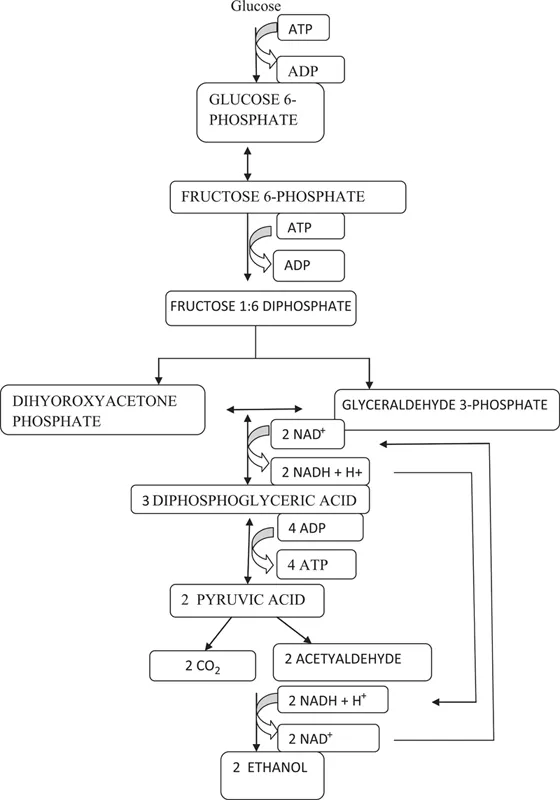
It is a technique of producing pharmaceutical proteins are produced by providing economical systems for production of therapeutic proteins by using transgenic microbes or mammalian cell culture systems. These include vaccines, antibodies, blood proteins, etc. As shown by Figure 1.2, the end products of fermentation are proton sinks such as lactic acid and ethanol, whereby NADH, which permits the cell to carry on the production of energy via glycolysis by substrate-level phosphorylation, is recycled to NAD+. Consequently, microorganisms are helpful in turning out several end products or by-products to retain energy balance.
1.3 Biochemical Process of Fermentation
In diverse species of organisms with different chemical sequences, fermentation is achieved. For glucose, two closely related fermentation pathways are used. Two molecules of three-carbon sugar are formed by partial breakdown of six-carbon glucose molecule; this progression is named lactic acid fermentation. It needs anaerobic condition and it is found in the higher animal’s cells and a number of microorganisms. Glycolysis is enzymes that are used in lactic acid and alcoholic fermentation. In alcoholic fermentation, such as occurs in brewer’s yeast and some bacteria, the production of lactic acid is bypassed, and the glucose molecule is degraded to two molecules of the two-carbon alcohol, ethanol, and to two molecules of carbon dioxide. Interest in the process of fermentation has continued through the ages, and much of modern biochemistry, especially enzyme studies, has emerged directly from early studies on the fermentation process.
Selected fungi and bacteria are used for the production of enzymes and grown under well defined fermentation conditions. At some stage in which microbial growth occurs, the by-products are produced (metabolites).
Still, biochemical changes as shown by Figure 1.3 (cocoaphilippinesblog.blogspot.com/2016/10/cacao-beans-fermentation-process.html) and the environmental conditions such as pH, occurrence of oxygen, and nutrients also affect the by-product formation (Shuler and Kargi 2008).
“Microbial fermentation has been used for such purposes for many commercial products and enables novel techniques to support sustainable manufacturing and screening for microorganisms which produce novel enzymes, monitoring enzyme production in fermenters...