How can local experiences and the social transformation generated by modernity help to enrich our understanding of the international? What might a version of the much-discussed "non-Western International Relations (IR)" look like? What continuities and discontinuities from the Philippine experience in particular can be useful for understanding other post-colonial polities?
The Philippines makes a fascinating case study of a medium-sized, developing, post-colonial, multi-ethnic and multi-cultural state in Southeast Asia. Cruz, Adiong and their contributors map horizons of non-Western approaches in Philippine experiences of IR, rooted in the Global South, and in local customs and practice. Examining both theory and praxis, they explore issues as diverse as pre-colonial history, diplomacy, religion, agrarian reform and the Philippines' relationship with key regions in the Global South.
The book will appeal to researchers interested in Southeast Asian Studies and alternative perspectives on IR.
1 Butuan in the pre-colonial Southeast Asian international system
Reconstructing international history from text, memory, and artifacts
John Harvey D. Gamas
The problem in IR historiography
The historiography of mainstream international relations (IR) is framed along the lines of nation-state system development. Standard IR genealogy traces itself back to the Greek poleis, the Italian city-states, the 1648 Treaty of Westphalia, the Concert of Europe, the 20th-century World Wars, and the Cold War. This orthodoxy has anachronistically privileged the state as the prime actor in the international political system and the West as the center of global turning points. As a consequence, Western history is deeply entrenched in IR theorizing (Buzan, 2016, p. 156). Non-Western ‘voices, experiences, knowledge-claims, and contributions’ are thus neglected or peripheralized in the discipline (Acharya, 2014, p. 647).
Southeast Asia is one of the world’s regions left on the sidelines of IR. To make IR more inclusive of non-Western regions and particularly of Southeast Asia, Alan Chong (2007, pp. 417–420) advised, among others, to utilize historians’ insights in developing an ‘indigenous model’ of international relations. Consequently, Chong (2012) attempted to engage in non-Western theorizing through an analysis of the Sejarah Melayu – the annals of the Sultanate of Malacca. Other places in Southeast Asia could also provide sources for non-Western IR theorizing. In the Philippines, a potential source could come from an exploration of the enigmatic pre-Hispanic polity of Butuan. However, one must be wary of the pervasive nationalist historiography in Southeast Asia that seeks to legitimize and naturalize nation-states.
Nationalist historiography being a by-product of Western experience situates ancient polities along a teleological trajectory of national development. The narratives and material vestige of old kingdoms have been the locus of nationalist myth-making (Reynolds, 1995, pp. 420–421). In the hope of establishing a long historical pedigree modeled upon the Western ontology of progress, modern nation-states in Southeast Asia have appropriated ancient political units as predecessor sovereign entities contextualized in a Westphalian anarchic system. The primordialism, essentialism, and exceptionalism of this narrative have disconnected ancient polities from their historical context. Furthermore, the pervading West-centrism in the academe has reified this narrative while eschewing other alternative paradigms and overemphasizing the validity of written texts as sources of history. The dominant nationalist paradigm of history in the region thus hampers the call for non-Western theorizing from Southeast Asia as an antidote to the Eurocentrism and state-centrism of IR. The pitfall of nationalist historiography is the re-nationalization of IR, even as they try to uncover non-Western voices (Hellmann & Valbjørn, 2017, p. 281).
To a certain extent, pre-colonial Butuan has been understood through the lens of nationalism. Greg Hontiveros (2004), in Butuan of a Thousand Years, regarded Butuan’s pre-colonial past as a source of “tremendous pride” (p. xiv). He argued that local history should stretch far back in time, even before the First Philippine Revolution, and focus on other locales in order ‘to understand, in a much more comprehensive manner, our history, and … ourselves as a people’ (Hontiveros, 2004, pp. xiv–xv). Similarly, despite the efforts of the editors and contributors of Philippines Ancestral Gold (Capistrano-Baker, 2011) to avoid nationalist primordialism and exceptionalism even as they dedicate a particular chapter on Butuan, the book title nevertheless hints at the nationalistic purpose of those who commissioned the book. In the foreword, Jaime Zobel de Ayala, the chair of the Ayala Foundation, appropriates ancient gold craft as the ‘apt metaphors for where we have been and what we can achieve as a people, and a nation’ (Capistrano-Baker, 2011, p. 12).
This problem necessitates a new approach by which to understand history. If we are to make better use of Southeast Asian pre-colonial history in enriching IR historiography, there is a need for a framework that contextualizes local experience rather than a superimposition of an exogenous and universalized interpretation of historical development. I, therefore, propose O. W. Wolters’s mandala polity as an analytic framework to better understand pre-colonial regional poli-ties like that of Butuan. Moreover, there must be a willingness to utilize various sources for reconstructing history. The overreliance on primary textual sources, which has often been the case in IR, disadvantages pre-literate communities and those communities that are literate yet left only a few records or whose purpose of writing was not the mere recording of events. Indigenous evidence of writing discovered in Butuan come from two gold strips which was probably an amulet (Orlina, 2012). Other written accounts on Butuan were from an outsider’s point of view – relying on them would not provide a complete picture of Butuanon agency. Therefore, I also propound the use of non-textual sources in addition to historical sources.
In the following pages, I first discuss the essential elements of Wolters’s mandala polity. Second, with the use of textual and non-textual sources, I then use the mandala to reconstruct pre-colonial Butuan history. Finally, I highlight the methodological and theoretical lessons that international relations could take from the Butuan mandala polity and its historical reconstruction.
I Wolters’s mandala polity: personal hegemony and competition
Alan Chong (2007) first suggested utilizing the insights of O. W. Wolters, one of Southeast Asia’s most prominent historians. In describing the unique characteristics of pre-colonial Southeast Asian states, Wolters (1982, 1999) borrowed the Sanskrit term mandala, or ‘circle of kings’ from the Arthasastra. A mandala was a political unit where one king or overlord claimed ‘divine and “universal” authority’ and ‘personal hegemony over the other rulers in his mandala who in theory were his obedient allies and vassal’ (Wolters, 1999, p. 27). As such, the mandala was non-territorial but personal, being personally identified with its overlord. The overlord in typical ‘big-man’ fashion must demonstrate virtue usually through ritual investiture, possession of sacral objects, or monumental constructions. These visible manifestations of virtue sought to elicit awe at the virtue or prowess of the overlord and consequently attract alliances from chieftains or the loyalty of ordinary people (Wolters, 1999, pp. 18–19). In a sparsely populated Southeast Asia, humans were the most valuable resource. The land was abundant; hence, conquest was made to capture people rather than expand territory. The territorial delimitations of a mandala were at best amorphous, as it was situated in ‘a vaguely definable geographical area without fixed boundaries’ (Wolters, 1999, p. 28).
The mandala was multicentric – with various smaller or less powerful centers dominated by the overlord as the paramount chief. Nevertheless, this was a highly unstable and fluid political setup. Alliances and status of centers could shift expediently; thus, mandalas ‘would expand and contract in concertina like fashion’ (Wolters, 1999, p. 28). If the chance presented itself, tributary chiefs could abrogate their inferior status, compete with other centers, and establish themselves as mandalas. This competitive situation made it necessary for a mandala to have two skills in governance. The first of this was the gathering of updated information on events ‘happening on the fringes’ (Wolters, 1999, p. 28). The second skill was diplomacy. The mandala overlord had to deprive rivals of their claims but also bring them under his influence through accommodation and investiture. Though the overlord had the exclusive right to receive tribute from envoys and send officials to represent his higher status, he “was not an autocrat” but an accessible “mediator” who was able to unite different groups (Wolters, 1999, pp. 28–29). Despite the overlord’s prominence, he was, therefore, not an emperor or a dictator.
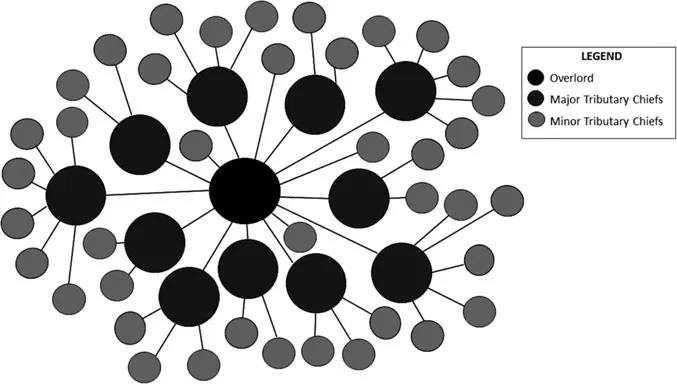
The hierarchy entailed by kingdoms, states, and empires does not come close to the reality of the mandala. In contrast to a European-style kingdom, a mandala does not automatically entail a ruling dynasty with regular and precise succession mechanisms. This characteristic was due to the equal importance of both paternal and maternal ancestry, as well as the status of charismatic or “big-man” leadership in Southeast Asia (Wolters, 1999, p. 18). Unlike a state, a mandala has no fixed boundaries and bureaucracy under a functionally differentiated regime. The titles granted to chieftains through investiture were merely honorary and meant to maintain the loyalty of a tributary chieftain (Wolter, 1999, p. 29). There was no functional differentiation between the overlord and his tributary chiefs. The latter continued to be the unquestioned lord of his immediate subjects and locale. A closer description of a mandala is that of an alliance network of minor and major tributary chiefs around a central node – the overlord. Figure 1.1 provides a conceptual map of the interconnections within a mandala polity.
Figure 1.1 A mandala network of alliances
The personal identification of the mandala with the overlord also makes it incomparable to that of the nation-state. Accordingly, it cannot be taken as a precursor to modern nation-states, given that a mandala cannot be neatly situated in the band-tribe-chiefdom-state continuum. A mandala did not constitute greater socio-political integration. Because of the competition, there was a constant oscillation between coalescence and disintegration. It manifests attributes of the state and tribe but is neither. It was hierarchic but also anarchic in the sense that tributaries remain independent despite recognizing the superior status of the overlord. This state of affairs then makes a mandala hierarchy not as cohesive and durable as that of an empire. As such, the mandala polity challenges mainstream IR’s standard binary of hierarchy and anarchy in describing a system.
II Reconstructing history from textual and non-textual sources
IR theorizing on history has always proceeded from written sources. But bringing non-Western experiences into the discipline would inevitably entail an openness to various data sources, especially since Southeast Asian mandalas did not leave much literature. By weaving both textual and non-textual sources, a clear history of Butuan and its role in the mandalic structure could emerge. Aside from filling the gaps, non-textual sources could also triangulate textual data, given that they come from an outsider’s vantage point. Though the history that we may reconstruct out of them might be incomplete and even speculative, it could still give us valuable insights for IR pre-theorizing.
The relevance of Butuan’s tribute missions to China from text, artifacts, and memory
The primary textual source on pre-Hispanic Butuan comes from the 1345 compilation of Song Dynasty imperial annals, the Song hui-yao ji-gao, or simply Songshi. William Henry Scott (1989) first brought to our attention a portion of Volume 197 of the Songshi, which detailed the series of tribute missions sent by the Butuan rajas to the celestial court in the first part of the 11th century. What happened next to Butuan in subsequent centuries is still shrouded in mystery. Relying solely on these written sources could produce this convenient interpretation: that the trade missions were manifestations of the apex of Butuan’s power while the subsequent years were a decline characterized by subservience to other more powerful entities. But bringing in archaeological findings would make this interpretation simplistic if not erroneous.
Laura Junker (2000, p. 99) pointed out a disjuncture between the abundance of historical reference on Butuan in the 11th century and copious archaeological proof for political expansion in the 12th to 13th centuries. Indeed, the Butuan trade missions recorded in the Songshi were sent during the Northern Song Dynasty (960–1127), while the amount of archaeological evidence on settlement and foreign trade goods mostly came from the period of the Southern Song Dynasty (1127–1279). Junker argued that Butuan succeeded in monopolizing the trade against its rivals, hence rendering it unnecessary to continue sending expensive tribute missions to China. Carrying a mission to China required a significant investment, and unless there were compelling reasons, a polity would not send one. In the light of Wolters’s mandala polity, Butuan’s participation in the Chinese tribute system was a function of the dynamics of mandala competition.
Furthermore, the mandala framework situates Butuan in the greater regional context at the turn of the second millennium CE (Figure 1.2). The Songshi records that Butuan (Pinyin: Puduan) did not have ‘much communication with China’ but that it ‘has had mutual relations with Champa’ and that ‘it was beneath Champa’ (Scott, 1989, p. 27). From here, we can glean that Butuan was a tributary of the Cham mandala. The conduct of trade with China was via this mandala overlord. The disturbance in Champa caused by the southward Vietnamese ex...
Table of contents
Cover
Half Title
Series Page
Title Page
Copyright Page
Contents
Acknowledgements
List of contributors
Preface
Introduction
PART I Mapping concepts
1 Butuan in the pre-colonial Southeast Asian international system: reconstructing international history from text, memory, and artifacts
2 José Rizal attacks imperialism softly: comprehending the depths of psychological conversion and the temptations of violent solutions
3 Constantino revisited: the ‘miseducation’ and diplomacy of the Filipinos
4 Publishing on the ‘international’ in the Philippines: a lexicometric inquiry
5 Internationalizing pagdamay and palakasan: a Philippine perspective on Duterte foreign policy
6 Discursive experiments in vernacularizing international studies in the Philippines
PART II Mapping practices
7 The case of agrarian reforms in Philippine-USA relations: a biopolitical perspective
8 Marginalization of interests: the case of Philippine-Middle East relations
9 Political and economic perspectives on diversification in Philippine-South America relations
10 Religious actors in the international sphere: the case of the National Council of Churches in the Philippines
11 Religious expertise, public theology, and Philippine regime compliance
12 Securitization of the Global War on Terror and counterterrorism cooperation against the Abu Sayyaf Group
13 Sexploitative human trafficking in, out of, and beyond the Philippines: a liquid problem in a cosmopolar international system
Conclusion: small statism and the non-issue of IR in the Philippines
Index
Trusted by 375,005 students
Access to over 1.5 million titles for a fair monthly price.
Study more efficiently using our study tools.
Frequently asked questions
Yes, you can cancel anytime from the Subscription tab in your account settings on the Perlego website. Your subscription will stay active until the end of your current billing period. Learn how to cancel your subscription
No, books cannot be downloaded as external files, such as PDFs, for use outside of Perlego. However, you can download books within the Perlego app for offline reading on mobile or tablet. Learn how to download books offline
Perlego offers two plans: Essential and Complete
Essential is ideal for learners and professionals who enjoy exploring a wide range of subjects. Access the Essential Library with 800,000+ trusted titles and best-sellers across business, personal growth, and the humanities. Includes unlimited reading time and Standard Read Aloud voice.
Complete: Perfect for advanced learners and researchers needing full, unrestricted access. Unlock 1.5M+ books across hundreds of subjects, including academic and specialized titles. The Complete Plan also includes advanced features like Premium Read Aloud and Research Assistant.
Both plans are available with monthly, semester, or annual billing cycles.
We are an online textbook subscription service, where you can get access to an entire online library for less than the price of a single book per month. With over 1.5 million books across 990+ topics, we’ve got you covered! Learn about our mission
Look out for the read-aloud symbol on your next book to see if you can listen to it. The read-aloud tool reads text aloud for you, highlighting the text as it is being read. You can pause it, speed it up and slow it down. Learn more about Read Aloud
Yes! You can use the Perlego app on both iOS and Android devices to read anytime, anywhere — even offline. Perfect for commutes or when you’re on the go. Please note we cannot support devices running on iOS 13 and Android 7 or earlier. Learn more about using the app
Yes, you can access International Studies in the Philippines by Frances Antoinette Cruz,Nassef Manabilang Adiong in PDF and/or ePUB format, as well as other popular books in Politics & International Relations & Colonialism & Post-Colonialism. We have over 1.5 million books available in our catalogue for you to explore.