Economic Development in Ghana and Malaysia investigates why two countries that appeared to be at more or less the same stage of economic development at one point in time have diverged so substantially.
At the time of their independence from the UK in 1957, both Ghana and Malaysia were at roughly the same stage of economic development; in fact, Ghana's real per capita income was slightly ahead of Malaysia's. Since then, Ghana's development has been sluggish, while Malaysia's economy has taken off into sustained growth and today, the real per capita income of Malaysia is about five times that of Ghana. This volume examines the pre-colonial and colonial economies of both countries, and the economic policies pursued after independence. In doing so, it aims to identify policies which might have contributed to Malaysia's development and those which might have slowed Ghana's. The authors ask whether lessons can be learned from the successes of countries such as Malaysia.
This detailed comparative analysis will be useful to students and researchers of development economics as well as public policy makers in developing countries. It is written in language which makes it accessible to the general reader.
The process of economic development is dynamic, not static; as such, an economy’s development over time is not readily observed in real time but only after the process is over or has reached a certain critical point. This is the major reason why, in spite of the fact that many countries have gone through the process of economic development and are now called developed countries, there is as yet no one precise method for prescribing how a developing country can develop.
One way to understand a country’s development is to look back in time, at defining turning points, and determine if some important markers can be isolated to explain them. This, in essence, is what W. W. Rostow (1960) tried to do in his Stages of Economic Growth. According to Rostow’s thesis, countries go through five distinct stages: (1) traditional society; (2) preconditions for takeoff; (3) the takeoff; (4) the drive to maturity; and (5) the age of high mass consumption. Rostow tried to identify the stages by unique markers. Notwithstanding the painstaking efforts to document the necessary and sufficient conditions needed for each stage to usher in the next, the thesis yielded no practical universal laws of application; today, only economic historians refer to it in any meaningful way. Nonetheless, Rostow’s method provides insight into how one might go about extracting useful lessons for what a country should avoid during economic development. Further, the analysis provides an instructive method to better understand the development process; it can be used directly to compare countries that have had similar characteristics and were at the same level of development at one point in time and began the conscious effort of developing their economies at more or less the same time. Such direct comparisons come very close to conducting an experiment – something economists cannot normally do.
Two such countries that readily come to mind for this kind of analysis are Ghana and Malaysia. Ghana became independent from the British on March 6, 1957. At that time, it was economically at about the same level of development (as measured by the real per capita income) as Malaysia, which gained independence (Merdeka, as the Malaysians call it) from the British on August 31 of the same year. In 2007, Joseph Stiglitz, in a speech commemorating the 50th anniversary of Malaysian independence, observed that at independence, Malaysia’s gross domestic product (GDP), in purchasing power parity (PPP) terms, was “some 5% below that of Ghana”. The International Bank for Reconstruction and Development (IBRD, 1957) estimated the per capita income in the Gold Coast at £50 for 1955, which is the equivalent of about US$2,599 today.1 Sixty years later, in 2017, it was US$2,046, less than at independence.2
Data from the Penn World table 9.1 show that in 1957, the Malaysian real GDP of US$18,808.31 million was slightly larger than that of Ghana, which was US$16,025.55 million. Ghana’s real GDP per capita of US$2,640.56, however, exceeded that of Malaysia, which was then US$2,521.89.3 Ghana’s real GDP per capita continued to be higher than Malaysia’s until 1965, when Malaysia’s GDP per capita surpassed it. By then, the real GDP per capita of Malaysia had risen to US$3,164.86 and Ghana’s was US$3,023.02. From 1955 to 1965, the real GDP of Malaysia grew at 5.54% a year; Ghana’s grew at 5.27% – an insignificant difference. During the period, Malaysia’s population grew even faster at 3.07% a year while Ghana’s grew at 3.05%.
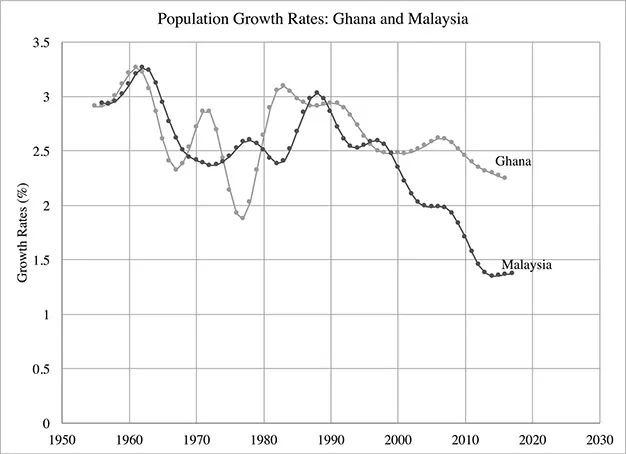
It should be borne in mind that increases in real GDP alone are not sufficient to improve welfare. Real GDP must grow faster than the rate at which population grows to increase the real per capita GDP. In Malaysia, real GDP grew at a faster pace than population; in Ghana, population increased faster than real GDP. Although the differences were not significant, it marked the beginning of a diversion which increased significantly by the 1970s. Both countries have exhibited fluctuations in population growth rates, as can be seen from Figure 1.1. While the correlation between population growth and income is clear, wealthier countries tend to have lower population growth rates, and the causality is less obvious. Is it the case that a lower population growth rate allows a country to become richer faster, or that the increase in income reduces the rate at which the population grows? Whatever the causality, many developing countries have adopted deliberate policies to control the rate at which their population grows. There is no doubt that the high population growth rate has diluted the gains from growth in Ghana, especially in recent times. Malaysia has been able to reduce the rate at which its population has grown, and as a result its GDP per capita has grown faster. Of course that is only a small part of the reason why Malaysia has grown faster than Ghana.
Figure 1.1 Population growth rates: Ghana and Malaysia
Malaysia’s population growth rate reached a high of 3.26% in 1962, fluctuated over the succeeding 26 years, and began a steady decline after 1988 (but not without fluctuations that made it sometimes surpass that of Ghana). For the last 17 years, Malaysia’s population growth rate has been below 2.0%. As of 2017, it stood at 1.37%, having been below 1.5% since 2012. Ghana’s population growth rates have also exhibited the same fluctuations; reaching a high of 3.27% in 1962, the same year Malaysia recorded its highest. The growth rate has been decreasing, but not at the same rate as that of Malaysia. As of 2017, the population growth rate in Ghana was 2.25%, having decreased steadily from 2.61% in 2007. Not coincidentally, the slower population growth rate and the stability in the economy, among other factors, have allowed the Ghanaian economy to grow at an average rate of 4.16% between 2007 and 2017. Indeed, for Ghana, this growth rate represents the highest and the most extended sustained rate of growth of any previous period. At that rate, children born in 2017 should see the per capita real GDP double by the time they reach maturity. Interestingly, between 1957 and 2017, 4% is about the rate at which the Malaysian economy has grown annually, on the average (see Table 1.1 below).
Table 1.1 Real GDP/capita growth rate: 1957–2017
Period
Ghana
Malaysia
1957–1966
.06
2.63
1967–1976
−.98
6.04
1977–1986
−1.00
3.18
1987–1996
1.56
6.07
2007–2006
2.25
2.16
2007–2017
4.16
4.86
Average Growth
1.01
4.16
Source: Calculated from PWT 9.1 and UN population data.
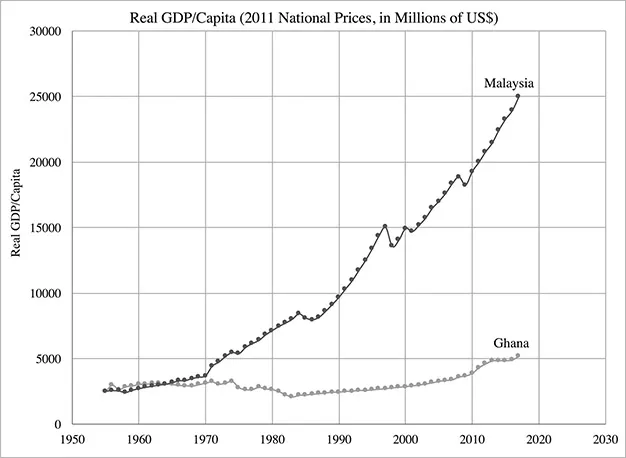
The difference between the economy of Ghana and Malaysia today is dramatic when one considers where they both started. In 2014–2015, the poverty rate in Ghana was 24.2% of the population; it was 0.06% in Malaysia during the same year. In that same year, the gross national income (GNI) per capita (Atlas method) in Ghana was US$1,590; in Malaysia, it was US$11,120 – nearly seven times greater. The life expectancy at birth in Ghana was 65.6 years; it was 75 years in Malaysia.4 By just about any economic or social indicator, Malaysia is an upper-middle-income country; Ghana is a lower-middle-income country. Figure 1.2 shows the disparity in the growth rates of the two economies between 1957 and 2017, 60 years after independence. In 1957, the Malaysian economy – with a real GDP of US$18,808.31 million – was 1.17 times larger than Ghana’s economy, with a real GDP of US$16,025.55. Since Malaysia’s real GDP per capital exceeded that of Ghana in 1965, there was a steady widening gap between the two countries, reaching its highest in 1997 when the ratio of Malaysia’s real GDP to that of Ghana was 6.69 and the real GDP per capita of Malaysia was US$15,010.45 and Ghana’s was US$2,701.73 (a difference of about five and a half times).
Figure 1.2 Real GDP/capita growth rates: Ghana and Malaysia
In the 60 years between 1957 and 2017, Malaysia’s real GDP has grown at an average annual rate of 6.37% while its population has grown at 2.43%. Ghana’s real GDP has grown at 3.99% a year, but its population has grown at 2.66%. The greater real GDP growth rate in Malaysia, coupled with a lower population growth rate over the same period, compared with the lower real GDP growth rate and a faster population growth rate in Ghana meant that Malaysia’s real GDP per capita was getting increasingly larger compared to Ghana, but it also meant that Ghana’s real GDP per capita was declining. The gap between the two countries was widening, not closing. Table 1.2 summarizes the discussion.
Table 1.2 Population and GDP per capita growth rates
Country
Growth Rates
Real GDP/Capita Years to Double
Real GDP
Population
Per Capita
Malaysia
6.37
2.43
3.94
18
Ghana
3.99
2.66
1.33
54
Source: PWT 9.1, UN population estimates, authors’ calculations.
When one looks at the data by decades, there is only one decade (1997–2006) when real GDP per capita grew faster in Ghana than it did in Malaysia (see Table 1.3).
If one places the endpoint of the comparison period at 2007, the picture gets worse. From 1957 to 2007, the real GDP of Ghana grew at a paltry 0.57% while Malaysia’s grew at...
Table of contents
Cover
Halftitle
Series
Title Page
Copyright Page
Dedication Page
Contents
List of figures
List of tables
Preface
Acknowledgments
1 Introduction
2 Ghana and Malaysia: pre- and post-colonial economic planning and policies
3 Economic growth and development theories
4 Determinants of economic growth in Ghana: survey of the literature
5 Determinants of economic growth in Malaysia: survey of the literature
6 Summary, recommendations, and conclusions
Index
Trusted by 375,005 students
Access to over 1.5 million titles for a fair monthly price.
Study more efficiently using our study tools.
Frequently asked questions
Yes, you can cancel anytime from the Subscription tab in your account settings on the Perlego website. Your subscription will stay active until the end of your current billing period. Learn how to cancel your subscription
No, books cannot be downloaded as external files, such as PDFs, for use outside of Perlego. However, you can download books within the Perlego app for offline reading on mobile or tablet. Learn how to download books offline
Perlego offers two plans: Essential and Complete
Essential is ideal for learners and professionals who enjoy exploring a wide range of subjects. Access the Essential Library with 800,000+ trusted titles and best-sellers across business, personal growth, and the humanities. Includes unlimited reading time and Standard Read Aloud voice.
Complete: Perfect for advanced learners and researchers needing full, unrestricted access. Unlock 1.5M+ books across hundreds of subjects, including academic and specialized titles. The Complete Plan also includes advanced features like Premium Read Aloud and Research Assistant.
Both plans are available with monthly, semester, or annual billing cycles.
We are an online textbook subscription service, where you can get access to an entire online library for less than the price of a single book per month. With over 1.5 million books across 990+ topics, we’ve got you covered! Learn about our mission
Look out for the read-aloud symbol on your next book to see if you can listen to it. The read-aloud tool reads text aloud for you, highlighting the text as it is being read. You can pause it, speed it up and slow it down. Learn more about Read Aloud
Yes! You can use the Perlego app on both iOS and Android devices to read anytime, anywhere — even offline. Perfect for commutes or when you’re on the go. Please note we cannot support devices running on iOS 13 and Android 7 or earlier. Learn more about using the app
Yes, you can access Economic Development in Ghana and Malaysia by Samuel K. Andoh,Bernice J. deGannes Scott,Grace Ofori-Abebrese in PDF and/or ePUB format, as well as other popular books in Volkswirtschaftslehre & Vergleichende Wirtschaftswissenschaften. We have over 1.5 million books available in our catalogue for you to explore.