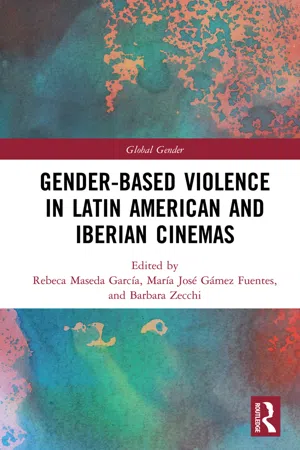
Gender-Based Violence in Latin American and Iberian Cinemas rethinks the intersection between violence and its gendered representation.
This is a groundbreaking contribution to the international debate on the cinematic construction of gender-based violence. With essays from diverse cultural backgrounds and institutions, this collection analyzes a wide range of films across Latin America and the Iberian Peninsula. The volume makes use of varied perspectives including feminist, postcolonial, and queer theory to consider such issues as the visual configuration of power and inequality, the objectification and the invisibilization of women's and LGBTQ subjects' resistance, the role of female film-makers in transforming hegemonic accounts of violence, and the subversion of common tropes of gendered violence.
This will be of significance for students and scholars in Latin American and Iberian studies, as well as in film studies, cultural studies, and gender and queer studies.
Space, embodiment and (dis)possession in Alda e Maria (Pocas Pascoal, 2011)
Katy Stewart
There has been a recent “postcolonial turn” (Liz and Faulkner 5) in Portuguese artistic and literary production, emerging from the silence previously surrounding Portugal’s colonial history and postcolonial encounters. Several of the key artistic and performative contributions within this “turn”, such as Margarida Cardoso’s film A Costa dos Murmúrios (2004)—itself an adaptation of Lídia Jorge’s homonymous novel—and Isabela Figueiredo’s memoir, Caderno de Memórias Coloniais (2009), demonstrate a critical engagement with gender difference, deconstructing and reconstructing colonial history and memory with reference to gendered experiences. There is an interaction between this artistic production and scholarly work within the field of Lusophone postcolonial studies which, Owen and Klobucka argue, is particularly grounded in “political and epistemological legacies and imperatives of feminism, gender analysis, and queer theory” (6). Despite doing much to break the taboo of silence, such reworkings of Portugal’s colonial past still afford the greatest visibility to white Portuguese perspectives. There remains a silence surrounding the “vibrant Portuguese-African subculture” that Vieira (276) identifies as existing from the 1980s onwards: a direct result of Portuguese colonialism in Africa and its violent end in 1975, which plunged its former colonies into civil wars.
Angolan filmmaker Pocas Pascoal is thus a fresh voice within this Lusophone postcolonial context. Her debut feature film, Alda e Maria, Por Aqui Tudo Bem / Alda and Maria: All Is Well (2011), offers a critical remembering and testimony of the just-postcolonial moment of 1980s Portugal from the perspective of two Angolan girls newly arrived in Lisbon (the inverse of narratives such as Cardoso and Figueiredo’s, which deal with Portuguese experiences in Lusophone Africa). This film demonstrates the urgent and ongoing need to explore, give voice to and rework memories that the official narrative in Portugal has done its best to forget and erase, especially from Lusophone African perspectives.1 Within the opening minutes of the film, the desperate situation of the protagonists, 17-year-old Alda (Ciomara Morais) and her sister Maria (Cheila Lima), a year younger, is made clear. It is the early 1980s: Angola has been independent from Portugal for just a few years and has slipped seamlessly from colonial to civil war. The girls’ mother has been detained; their father is presumed dead. With no money, no connections and few possessions, the girls have to find a way to survive in a city that does not want them: it expels them from its monumental centre to its industrial peripheries. They have been thoroughly dispossessed.
Butler and Athanasiou define dispossession in two ways: firstly, in terms of “vulnerability; loss of land and community; […] subjection to military, imperial and economic violence” (2), leading to an existence on the peripheries, based on precarity. They also define it as “a term that marks the limits of self-sufficiency and that establishes us as relational and interdependent beings” (3). Dispossession in both senses is explored in this film. As I will demonstrate, from their precarious position of geographical, economic and community dispossession at the start of the film, the girls test their self-sufficiency and interdependency with each other and with other characters. They perform agency and resistance through their embodied relationships with one another and with the spaces they inhabit during the film, establishing themselves within Lisbon and reworking their sisterly relationship as they do so.
The film, operating at the intersections of gender, race and colonial/postcolonial dynamics, illuminates the “mechanisms of exclusion” (El-Tayeb xxix) that Alda and Maria face in Lisbon. However, rather than allowing them to become passive victims, the film calls instead to account the very societal and political structures which perpetuate violence in former colonial metropoles against formerly colonized people. This draws upon Gordon’s concept of haunting as something systemic and structural, particularly, as El-Tayeb has argued in her theorization of urban minority communities in Europe, the way in which colonialism haunts people of colour in Europe. Present in both Gordon and El-Tayeb’s work is the implication that this haunting is not just a one-way process, because in the attempts to make the most marginalized bodies invisible within the social space, those bodies also take on the power to haunt by creating “cracks in the circular logic of normative European identity” (El-Tayeb xxxv). I will explore this by examining how Alda and Maria haunt postcolonial Lisbon, creating cracks in the dominant narrative of Portuguese identity and of the Lisbon social space. Bearing this in mind, my analysis will be developed from concepts of embodied, multisensory modes of cinema, particularly that which Marks terms “haptic visuality” (22), allowing for an exploration of the interaction between body and space.
Four key spaces will form the focus of the analysis: the dockyard, the apartment, the sewing room and the phone booth. They are liminal; on the edges of public and private, of open and enclosed space, and on the edges of the city. They are haunted by violence and trauma, but the two protagonists are also able to assert agency, to subvert narrative expectations and to inscribe their own desires, imaginaries and memories in those otherwise anonymous, urban sites. The first of these spaces is the city’s industrial dockyard, characterized by creaking, metal shipping containers, oil-slicked beaches and belching factories, where Alda and Maria arrive. The second is the apartment, which the girls try to make into a home. Third is the sewing room, the girls’ workplace, in which they face insidious and unexpected abuse. The final space is the phone booth outside their apartment, which not only provides the link to their mother and motherland, but also inscribes something of Angola into the Portuguese urban landscape. This analysis will thus show how the film introduces some of the highly complex dynamics of gendered violence, which are embedded in the politics and society of postcolonial Portugal and in its highly uneven relationship with Angola.
The dockyard: postcolonial violence and dispossession
Less than ten minutes into the film, Alda and Maria find themselves expelled from the centre of Lisbon—with its quaint, cobbled streets and elegant boutiques—to its undesirable peripheries of informal housing and industrial wastelands. Nail defines expulsion as the “deprivation of social status” as well as physical removal from a particular space (35), and both these markers define Alda and Maria’s wanderings between rusting shipping containers, with little in the way of the resources to survive (see Figure 1.1). At this point they have become multiply dispossessed. Within those first minutes of the film, we learn from snatched conversations and telephone calls that they have been banished from their home country because of the violence of the war—the military violence that swept through Angola so immediately in place of colonial violence. Also, without their mother joining them in Portugal as expected, they do not have the maternal protection and economic support that might otherwise shield them in this new environment, which is so heavily pitted against them because of their race, nationality, gender and age. Thus, they are expelled again, unwanted in Lisbon.
Figure 1.1In the dockyard. Alda e Maria: Por Aqui Tudo Bem, Pocas Pascoal (dir.), Lx Filmes.
In some ways, they have become the sorts of figures that Balibar describes when he reflects on transnational citizenship in Europe: those who “live on the edge of the city, under permanent threat of elimination […] perceived as a threat for civilization” (129). For Balibar, this is no accidental or “unfortunate” situation: it is the result of a systematic process enacted by the state. El-Tayeb proposes that this process is imposed because of the “powerful narrative of Europe as a colorblind continent” (xv). In order to maintain the narrative and the illusion that colonialism is something consigned to the past, “largely benevolent, marginal […] and without negative repercussions for the present” (El-Tayeb xxii), figures such as Alda and Maria—racialized minorities, asylum seekers—must be driven out to the margins. Indeed, their expulsion first leads them to an informal settlement on Lisbon’s periphery, home to a black immigrant community, where the girls try to find a friend of their mother. Their gender deepens their precarious position: the public space of this community—a concrete square and scrubby patch of grass—is dominated by men playing cards and drinking; the women who live here are invisible. After refusing the advances of two Angolan boys, Alda and Maria are further expelled to the dockyard.
It is here among the towering shipping containers and barbed wire fences that Pascoal ratchets up the tension, creating a scene that simultaneously incorporates and subverts horror and thriller narrative conventions. Tracking shots are largely eschewed in favour of static camerawork: the handheld camera regularly takes up a position at the end of a passageway, capturing the girls first as distant figures in a wide shot, and waiting for them to approach the camera until they are in close-up. This has the dual effect of causing the spectator to focus on Alda and Maria’s weary, unrelenting motion and creates the unsettling feeling that they are being watched, leading to a feeling of horror. The spectator sees the girls from behind a metal lattice as they walk through one of the narrow alleys and finds them again as they enter the dark interior of one of the containers, giving rise to the expectation that something or someone might be lurking in there. The only soundtrack is the creaking of metal: a haunting sound. Pascoal sends out all the cinematic signals that this is a place fraught with danger.
The suspense returns when, having found and broken into a small dock worker’s cabin, Alda and Maria are sleeping, intertwined on a narrow camp bed. They are woken suddenly by a security guard’s flashlight. Grabbing their belongings, they flee into the darkness just as a storm breaks, tremendous thunderclaps echoing around the containers. A passing train roars by, adding to the dense auditory confusion. The girls run through the dark alleys, the man in pursuit. Yet any expectations of an act of violence or injury are subverted: there is a cut to a scene where dawn is breaking, and the girls emerge from the dockyard onto a beach, breathing heavily, but with no sign of the man. Somewhere, an alarm blasts, but it seems peripheral, distant. All the sounds, the spectator now realizes, were just the ambient noises of a dockyard at night, and the terror of it fades with the arrival of dawn.
In this way, Pascoal plays with convention and introduces a sense of trauma that, to use the terms employed by Gibbs, is “insidious” rather than “punctual” (15). That is to say, the trauma the girls experience is not the result of a solitary violent event or individual (punctual trauma), but of what Craps has described as “collective, ongoing, everyday forms of traumatizing violence” (4). This almost intangible violence, the aftershocks of colonialism, is what the girls encounter in the dockyard, more than any specific threat. This is the kind of haunting that Gordon theorizes: the way in which the structures and powers of the state make themselves felt within the lives of individuals. It is not a single perpetrator that is really threatening the girls in the dockyard, though that may be more conventional in spectacular cinema, but the haunting remainders of colonialism and imperialism and the violence such structures entailed.
The use of a dockyard as the space in which reminders of colonial violence come to the fore is no accident. Dockyards are imbued with colonialism, tracing lines from imperialist seafaring to the “necropolitics” (Mbembe 11) of modern migration (the system by which sovereign powers decide which lives matter and which are disposable).2 Bodies like Alda and Maria’s are not supposed to emerge from the dockyard once they have been contained there. To give just one real-world example, in February 2017, twenty-seven migrants attempting to cross the Mediterranean were found dead, suffocated, in a shipping container in Libya (Reuters).3 Even when it does not become a site of death, the dockyard acts as a border beyond which such “disposable” people are not permitted to travel. Asylum seekers who manage to survive the journey are routinely rounded up by port security and sent to detention centres.
The apartment: haunting and possessing space
The apartment space also marks a certain loss and lack, corresponding with the first sense of dispossession that has been examined. However, it becomes a space in which the second meaning of dispossession—where intersubjectivity marks the limits of self-sufficiency—is realized, through the sisters’ relationship with one another. It is this interdependency, and the ways in which they test the limits of their own self-sufficiency, which allows them to take possession of the space.
Maria, upon first entering the apartment, is overwhelmed by a sense of suffering and homesickness. She is deeply out of place and, exhausted after their perilous wanderings around Lisbon, seeks more than anything a space of comfort and security, which the empty, unfinished apartment patently does not provide. Kicking some rubbish, she cries: “I don’t want to stay here! I don’t like it!”4 Alda pulls her sister close, wrapping her in a tight embrace. They end up intertwined on the floor, body pressed against body, so close that it is as if they are one, and fall asleep curled up together, without breaking their embrace—a now-familiar composition of their bodies within precarious spaces, echoing the scene in the dockyard cabin. There is an abrupt cut in which the camera shifts by just a few inches to the right, the change in light and the sound of cicadas indicating that some hours have passed. The camera pans back towards the girls, taking in some of the debris littering the room: a large sheet of crumpled packing paper, a paintbrush and a cloth, so close up that the warp and weft of the fibres can be seen. This panning across different, tactile surfaces back towards the sleeping bodies invokes Marks’ “haptic visuality” (22). This multisensory notion of cinema, which proposes that vision cannot be disassociated from the body’s other senses, is particularly potent in the context of Marks’ suggestion that in its haptic aspects, “cinema is able to evoke the particularly hard-to-represent memories of people who move between cultures, by pointing beyond the limits of sight and sound” (129). This too suggests a kind of haunting, of memories not contained within the audiovisual scope of the film, but operating on an affective level, so it offers a starting point for tracing the characters’ agency.
The camera continues to pan across skin touching skin, intertwined limbs, which are animated by the girls’ gradual waking. This sequence gives new resonance to these bodies, inscribed as they are with unvoiced memories and trauma, and establishes the corpor...
Table of contents
Cover
Half Title
Endorsements
Series Information
Title Page
Copyright Page
Dedication
Contents
Figures
Contributors
Preface
Acknowledgements
Screening counter-violence: An introduction to giving account beyond memories of trauma
Part I Memories of gender resistance against violence
Part II Gender violence and agency: Beyond binarisms
Part III The chiaroscuros of witnessing gender violence
Part IV Gender violence across geographical borders: Feminicide as a global issue
Index
Trusted by 375,005 students
Access to over 1.5 million titles for a fair monthly price.
Study more efficiently using our study tools.
Frequently asked questions
Yes, you can cancel anytime from the Subscription tab in your account settings on the Perlego website. Your subscription will stay active until the end of your current billing period. Learn how to cancel your subscription
No, books cannot be downloaded as external files, such as PDFs, for use outside of Perlego. However, you can download books within the Perlego app for offline reading on mobile or tablet. Learn how to download books offline
Perlego offers two plans: Essential and Complete
Essential is ideal for learners and professionals who enjoy exploring a wide range of subjects. Access the Essential Library with 800,000+ trusted titles and best-sellers across business, personal growth, and the humanities. Includes unlimited reading time and Standard Read Aloud voice.
Complete: Perfect for advanced learners and researchers needing full, unrestricted access. Unlock 1.5M+ books across hundreds of subjects, including academic and specialized titles. The Complete Plan also includes advanced features like Premium Read Aloud and Research Assistant.
Both plans are available with monthly, semester, or annual billing cycles.
We are an online textbook subscription service, where you can get access to an entire online library for less than the price of a single book per month. With over 1.5 million books across 990+ topics, we’ve got you covered! Learn about our mission
Look out for the read-aloud symbol on your next book to see if you can listen to it. The read-aloud tool reads text aloud for you, highlighting the text as it is being read. You can pause it, speed it up and slow it down. Learn more about Read Aloud
Yes! You can use the Perlego app on both iOS and Android devices to read anytime, anywhere — even offline. Perfect for commutes or when you’re on the go. Please note we cannot support devices running on iOS 13 and Android 7 or earlier. Learn more about using the app
Yes, you can access Gender-Based Violence in Latin American and Iberian Cinemas by Rebeca Maseda García,María José Gámez Fuentes,Barbara Zecchi in PDF and/or ePUB format, as well as other popular books in Education & Education Counseling. We have over 1.5 million books available in our catalogue for you to explore.