- 312 pages
- English
- ePUB (mobile friendly)
- Available on iOS & Android
eBook - ePub
About this book
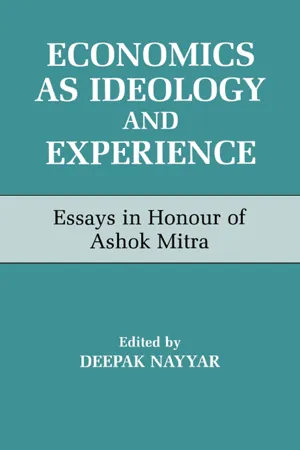
This collection of essays, collected and published in tribute to the economist Ashok Mitra is inevitably diverse, given the wide range of interests of his professional friends and colleagues. There is however one common thread that runs through the articles; a shared belief that ideology and experience, just as much as theory and policy, are inseparable in economics.
EXPERIENCE:
THE INDIAN CONTEXT
8
Terms of Trade and Demand Patterns
N. Krishnaji and T.N. Krishnan
This paper examines the impact of food and non-food prices, in absolute and relative terms, on the changing patterns of consumption in India. Contextually, the reference here is to the observed shift in demand, during the last two decades or so, away from inferior cereals and food grains, and to demand factors that might have played a role in boosting industrial growth during the early 1980s.
The analysis is carried out with the help of a model Ashok Mitra formulated earlier for explaining the deceleration in industrial growth during the late 1960s and early 1970s – a period when the terms of trade moved in favour of agriculture. With changes since then, whether the terms of trade have influenced industrial recovery during the 1980s thus becomes an interesting question.
1. INTRODUCTION
Ashok Mitra (1979) divides the Indian population, for analytical purposes, into four classes based on two dichotomies. In the rural areas the dichotomy is between (1) labourers and small peasants – ‘net buyers’ of food grain and (2) surplus-producing large landowners and traders. In urban India it is between (3) workers in industry and those in professions with fixed incomes, and (4) the bourgeoisie in industry and trade.
When analysing the Indian political economy it is possible to think of other types of division into classes, but what interests us here is the manner in which Ashok Mitra uses this framework to discuss the role of relative prices in the determination of the structure of demand, especially the demand for manufactures. Briefly, Ashok Mitra’s argument set forth in the context runs as follows.
When the price terms of trade (TOT) move in favour of agriculture the rural income distribution worsens because of the concentration of the marketed surplus in the hands of the rural rich. On the other hand, despite the adverse movement in the TOT for them, the industrialists are able to maintain their profits by squeezing the workers, or by ‘marking up’ prices. This ability is derived from a political alliance between the industrial class and the rural rich. In general, wages, both in agriculture and industry, lag behind prices entailing a fall in real wage incomes. The story is similar in respect of the real incomes of small farmers and fixed salary-earners in the urban domain. The most important consequence (for the structure of demand) is that the poorer sections of the population ‘are compelled to make a larger monetary outlay on food grains if they want to maintain their level of intake; simultaneously, they have to pay higher prices for a whole range of industrial goods’. Thus will a shrinkage in the demand for manufactures come about.
The model has been subjected to much critical review, with reference to its ‘ politics’ and its empirical validity on the economic plane (see, for example, Vaidyanathan, 1992, for a discussion of the data). However, it is possible to analyse the changing demand patterns in terms of what has been stated at the end of the last paragraph. This possibility arises from the undeniable fact that, for the poorer classes as well as for some sections of the middle classes, food constitutes a major item of consumption. It seems reasonable to infer that what determines the demand for industrial goods – at least for these classes – is the residual income, that part remaining after food expenses are met.
2. THE NATURE OF THE FOOD GRAIN ECONOMY
Expenditure on food grains constitutes between 40 and 70 per cent of total expenditure in Indian family budgets. Poor families spend two-thirds or more of their incomes on food grains. Still, their daily calorie intake falls below the norm recommended by the Indian Council of Medical Research. The food grain consumption of the bottom 30 per cent in the population is 20 to 30 per cent lower than the mean consumption for the population as a whole which itself has been hovering about the average norm during the last three decades (Krishnan, 1992).
During the period 1960–90, per capita food grain output has shown only a marginal increase. And, per capita availability (which takes into account imports, exports and changes in stocks) for 12 out of the 19 years between 1971 and 1990 was below that of 1971. The per capita availability of food grains has remained more or less steady, largely due to the rise in wheat output. In fact, per capita availability of ‘inferior cereals’ like jowar, bajra, etc., consumed largely by the poor, has steadily declined over this period, from 44 kilograms per annum in 1971 to 30 kilograms in 1989.
Another aspect of the food grain economy is a widening of the regional disparity in production. There has been a continuous increase in the inter-state coefficient of variation in the per capita output of food grains from the mid-1960s; it rose from about 40 per cent in 1966 to 84 per cent in 1988–89. This has happened because the wheat revolution led to a dramatic increase in the per capita output in Punjab, Haryana and Western Uttar Pradesh, while grain production in almost all other states declined in per capita terms irrespective of the gains in yields per hectare (Krishnaji, 1988; Krishnan, 1992).
As regards the consumption of food grains, per capita cereal consumption has more-or-less remained constant during this period. The widening disparity in production does not seem to have affected the levels of consumption in different parts of the country. The coefficient of variation in per capita cereal consumption has even marginally declined in the 1970s and 1980s and the disparity in consumption is only half as much as the disparity in production. There is no doubt that the public distribution system has played an important role in keeping the inter-regional inequalities in consumption within bounds.
The differences in food grain consumption among the regions of India depend not only on the spatial spread in production but also on the amounts of grain transported over long distances. Such transportation involves substantial storage and transport costs and adds to the total cost of distribution of grain. Consumer behaviour in respect of food grains shows three distinct characteristics. Firstly, at the household level, it indicates a high and positive income (and expenditure) elasticity of demand for food grains. Secondly, time series data point to a very low (generally close to zero) income elasticity at the aggregated all-India level. Thirdly, as between states, levels of per capita consumption of food grains do not appear to be positively related to per capita state incomes; for some years, this association is strongly negative (Krishnan, 1992).
An analysis of the determinants of the consumption of food grains at the state level indicates that it is principally determined by the level of per capita production of food grains in each state. Such a relationship was noticed earlier in a study for the year 1961–62 (United Nations, 1975), but analysis of data which have become available since for the later years shows that this relationship has not altered in the least (Krishnan, 1992). This suggests that inter-state transfers are not wholly governed by differentials in demand conditions. Speculatively, we have suggested earlier that this market failure might be associated with the lack of adequate movement of grain into rural areas across state boundaries. (On the other hand, high urban incomes presumably attract grain from everywhere.)
Another critical factor is the change in consumption brought about by the changes in the composition of the grain output. The significant decline in the per capita production and, hence, in the availability of inferior cereals meant that poorer classes had to buy rice or wheat at higher prices to meet their requirements. This meant that, given their low incomes, they could buy only smaller quantities of grain. An analysis of the National Sample Survey (NSS) consumption data for the bottom 30 per cent of the rural population confirms these conjectures. For this class, the quantity of grain consumed has declined between 1960 and 1989 while the expenditure on food grains at constant prices has risen, possibly because of the shift in consumption from the lower-priced to the higher-priced grain (see in this context Radhakrishna and Ravi, 1990).
Another significant finding is that there is a considerable variation in food grain price...
Table of contents
- Cover
- Half Title
- Title Page
- Copyright Page
- Table of Contents
- Contributors
- Preface
- Ashok Mitra: A Biographical Sketch
- Ideology The National Context
- The International Context
- Experience The Indian Context
- The Comparative Dimension
Trusted by 375,005 students
Access to over 1.5 million titles for a fair monthly price.
Study more efficiently using our study tools.
Frequently asked questions
Yes, you can cancel anytime from the Subscription tab in your account settings on the Perlego website. Your subscription will stay active until the end of your current billing period. Learn how to cancel your subscription
No, books cannot be downloaded as external files, such as PDFs, for use outside of Perlego. However, you can download books within the Perlego app for offline reading on mobile or tablet. Learn how to download books offline
Perlego offers two plans: Essential and Complete
- Essential is ideal for learners and professionals who enjoy exploring a wide range of subjects. Access the Essential Library with 800,000+ trusted titles and best-sellers across business, personal growth, and the humanities. Includes unlimited reading time and Standard Read Aloud voice.
- Complete: Perfect for advanced learners and researchers needing full, unrestricted access. Unlock 1.5M+ books across hundreds of subjects, including academic and specialized titles. The Complete Plan also includes advanced features like Premium Read Aloud and Research Assistant.
We are an online textbook subscription service, where you can get access to an entire online library for less than the price of a single book per month. With over 1.5 million books across 990+ topics, we’ve got you covered! Learn about our mission
Look out for the read-aloud symbol on your next book to see if you can listen to it. The read-aloud tool reads text aloud for you, highlighting the text as it is being read. You can pause it, speed it up and slow it down. Learn more about Read Aloud
Yes! You can use the Perlego app on both iOS and Android devices to read anytime, anywhere — even offline. Perfect for commutes or when you’re on the go.
Please note we cannot support devices running on iOS 13 and Android 7 or earlier. Learn more about using the app
Please note we cannot support devices running on iOS 13 and Android 7 or earlier. Learn more about using the app
Yes, you can access Economics as Ideology and Experience by Deepak Nayyar in PDF and/or ePUB format, as well as other popular books in Economics & Economic Theory. We have over 1.5 million books available in our catalogue for you to explore.