- 208 pages
- English
- ePUB (mobile friendly)
- Available on iOS & Android
eBook - ePub
About this book
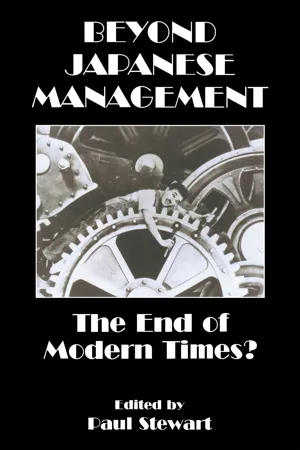
This book brings together original studies of the development of Japanese and - crucially - non-Japanese management in the automotive industry from around the world, including a total of nine country studies in the key production and consumption theatres North and South America, Europe and Japan. It offers new perspectives for all those concerned with the impact of new management arrangements on both employees and management alike.
Information
A Fallen Idol? Japanese Management in the 1990s
COLIN HASLAM and KAREL WILLIAMS with SUKHDEV JOHAL and JOHN WILLIAMS
Colin Haslam and Sukhdev Johal, Royal Holloway University of London School of Management; Karel Williams, University of Manchester; John Williams, University of Aberystwyth
Part of the extraordinary elevation of the status of management in Western social science in the 1970s and 1980s rested on perceptions of the sources of what was seen as Japanese manufacturing superiority. Text after text, popular and academic, traced an apparently permanent Japanese competitive advantage to new productive techniques devised and implemented by innovative Japanese managers. In the eighties there was a spate of books by knowledgeable authors like those by Schonberg, Japanese Manufacturing Techniques: Nine Hidden Lessons in Simplicity (1982) and World Class Manufacturing (1987), which draw attention to these developments and advocated their emulation in the West; throughout the decade and spilling well into the 1990s there were innumerable articles in such influential magazines as Fortune which took as axiomatic both the superiority of Japanese manufacturing and its basis in new and improved management practices; and the culmination was perhaps the publication in 1990 of The Machine That Changed the World, preaching the gospel of lean production and offering the promise of two-for-one improvement for all who followed these Japanese-initiated doctrines. The stress was largely on what could be achieved through the agency of management using such techniques as just-in-time, quality circles, and Kaizen. It is only a relatively mild overstatement to say that the message of much of this literature is that new management techniques have transcendent virtues which can be applied everywhere so that everyone can win if they make the right kind of management effort.
It is no part of the present purpose to question the existence and effect of such skills, nor to deny that Japanese manufacturing in the 1970s and 1980s developed productive methods which were, in some crucial respects, different from those currently practised in the West. The object is rather to shift the balance. The argument is that the evidence – both before and after the serious downturn in the Japanese economy around 1991 – suggests that much more weight needs to be given to the particular structural factors within which Japanese industry operated. Attention is thus drawn to the extent to which Japanese manufacturers operated in a domestic environment where the social settlement was favourable to them (especially in terms of wages, hours worked and managerial control over the labour process), and then their products were sold in export markets where quite different social settlements set prices at levels which generated a great deal of cash for Japanese producers. It is argued that the erosion, if not the disappearance, of these favourable conditions from the mid-1980s onwards has contributed substantially to the recent difficulties of Japanese producers. Further confirmation of the significance of structural factors is contained in the evidence that Japanese manufacturing affiliates abroad (the so-called transplants) have not been able to reproduce the levels of productive efficiency attained by the parent firms in Japan: the suggestion is that when firms – of whatever origin – are working under similar structural conditions the outcome is broadly similar. The object of the essay is thus to shift the balance by placing more weight on such structural factors and less on management success or failure. As so much weight has been given to management agency in accounting for Japanese advantage in 1970s and 1980s, the general force of the argument, it is suggested, is strengthened by using the evidence of Japanese manufacturing performance both domestically and through overseas affiliates.
REVERSAL OF FORTUNE: JAPANESE PARENTS IN THE 1980S AND THE 90s
When the world moves on, it often leaves social scientists trailing in its wake as they reiterate the discursive verities of the old order rather than engage the empirical realities of the new period. Thus, many organization theory and business policy texts continued to teach Chandlerism right through the 1970s and early 1980s and economists continued to test the superiority of ‘M’ form even as American ‘M’ forms were being soundly drubbed by Japanese competitors who were often organised on different lines. It is therefore not surprising to observe that some of the social science literature of the mid 1990s does not register any reversal of fortune and continues to present Japan as an exemplar of success and object of emulation; thus, the 1994 Lorriman and Kenjo book on Japanese management, training and education introduces its themes in cliched language that could have come from any 1980s best seller:
Japan’s continuing success is both inevitable and inexorable unless her competitors can learn the simple lessons explained in this book … what is so extraordinary is that the West has made such little real effort to understand the reasons for Japan’s success (Lorriman and Kenjo, 1994).
But it is equally encouraging to find that some academic social science recognises the 1990s are different and does register a reversal of fortune which has turned the Japanese parents from most feared competitors to peers with problems that sound familiar to most Western manufacturing firms. The most important, forceful and well informed of these reports is provided by Berggren whose summary is well worth quoting because it introduces a new and different Japan:
Suddenly, it is obvious that Japan is not invincible, and that the extrapolation of trends, which supported much of the ‘Japan as number one’ argument has collapsed. Within Japan, long standing issues about creativity – or the lack of it – in the educational system and corporate structures, are resurging. Other aspects of ‘normalisation’ are that growth rates will no longer be exceptional, and that the trade surplus will gradually diminish. At last, the Japanese economic players have started to realize that the surplus is as burden for them because it is driving the yen up, and thus making an increasing number of industries uncompetitive (Mimeo)
However, even this timely work is descriptively focused on the problems manifest since the end of the Hesei boom whose underlying results are presented ambiguously as part of a process of ‘normalization’. The underlying structural mechanisms and their implications for the Japanese trajectory are not addressed; specifically, Berggren does not consider the question of whether and under what condit...
Table of contents
- Cover
- Half Title
- Dedication
- Title Page
- Copyright Page
- Table of Contents
- Introduction: Beyond Japan, Beyond Consensus? From Japanese Management to Lean Production
- A Fallen Idol?: Japanese Management in the 1990s
- The Changing Nature of Japanese Production Systems in the 1990s and Issues for Labour Studies
- Working Conditions under Lean Production: A Worker-Based Benchmarking Study
- A New Model Ford?
- New Manufacturing Strategies and Labour in Latin America
- Volvo – A Force for Fordist Retrenchment or Innovation in the Automobile Industry?
- The Competitivity of the Automobile Industry: The French Way
- Reactions to the Crisis: Job Losses, Shortened Working Week, Income Losses and Business Re-Engineering in the German Auto Industry
- Taylorism, Lean Production and the Automotive Industry
- Index
Trusted by 375,005 students
Access to over 1.5 million titles for a fair monthly price.
Study more efficiently using our study tools.
Frequently asked questions
Yes, you can cancel anytime from the Subscription tab in your account settings on the Perlego website. Your subscription will stay active until the end of your current billing period. Learn how to cancel your subscription
No, books cannot be downloaded as external files, such as PDFs, for use outside of Perlego. However, you can download books within the Perlego app for offline reading on mobile or tablet. Learn how to download books offline
Perlego offers two plans: Essential and Complete
- Essential is ideal for learners and professionals who enjoy exploring a wide range of subjects. Access the Essential Library with 800,000+ trusted titles and best-sellers across business, personal growth, and the humanities. Includes unlimited reading time and Standard Read Aloud voice.
- Complete: Perfect for advanced learners and researchers needing full, unrestricted access. Unlock 1.5M+ books across hundreds of subjects, including academic and specialized titles. The Complete Plan also includes advanced features like Premium Read Aloud and Research Assistant.
We are an online textbook subscription service, where you can get access to an entire online library for less than the price of a single book per month. With over 1.5 million books across 990+ topics, we’ve got you covered! Learn about our mission
Look out for the read-aloud symbol on your next book to see if you can listen to it. The read-aloud tool reads text aloud for you, highlighting the text as it is being read. You can pause it, speed it up and slow it down. Learn more about Read Aloud
Yes! You can use the Perlego app on both iOS and Android devices to read anytime, anywhere — even offline. Perfect for commutes or when you’re on the go.
Please note we cannot support devices running on iOS 13 and Android 7 or earlier. Learn more about using the app
Please note we cannot support devices running on iOS 13 and Android 7 or earlier. Learn more about using the app
Yes, you can access Beyond Japanese Management by Paul Stewart in PDF and/or ePUB format, as well as other popular books in Geschichte & Asiatische Geschichte. We have over 1.5 million books available in our catalogue for you to explore.