In the age of social media, life writing is ubiquitous. But if life writing is now almost universal—engaged with on our phones; reported in our news; the generator of capital, no less—then what are the limits of life writing? Where does it begin and end? Do we live in a culture of life writing that has no limits? Life writing—as both a practice and a scholarly discipline—is itself markedly concerned with limits: the limits of literature, of genres, of history, of social protocols, of personal experience and forms of identity, and of memory.
By attending to limits, border cases, hybridity, generic complexities, formal ambiguities, and extra-literary expressions of life writing, The Limits of Life Writing offers new insights into the nature of auto/biographical writing in contemporary culture. The contributions to this book deal with subjects and forms of life writing that test the limits of identity and the tradition of life writing. The liminal case studies explored include magical-realist fiction, graphic memoir, confessional poetry, and personal blogs. They also explore the ethical limits of representation found in Holocaust life writing, the importance of ficto-critical memoir as a form of resistance for trans writers, and the use of 'postmemoir' to navigate the traumas of diasporic experience. In addition, The Limits of Life Writing goes beyond the conventional limits of life writing scholarship to consider how writers themselves experience limits in the creation of life writing, offering a work of life writing that is itself concerned with charting the limits of auto/biographical expression. This book was originally published as a special issue of Life Writing.
Although Joe Sacco is frequently present in the frame of his comics journalism, as a witness, listener and scribe, he rarely attaches his own autobiographical experience to these representations of self. Recently some more detailed biographical detail about Joe Sacco’s own life story has begun to emerge in the frames of his comics, particularly in his work on refugees and asylum seekers. One of the least significant and little known facts about Joe Sacco’s life, his childhood as a migrant in Australia, becomes relevant here, extending his enduring commitment to ethical spectatorship, and the visibility of human rights violations, by engaging with this most difficult and intimate work of interrogating citizenship, our own and ‘others’.
The limits of autobiography are open to negotiation, and on the move. We see this, for example, in differences between the two editions of the primer for life narrative teaching and research, Julia Watson and Sidonie Smith’s Reading Autobiography: A Guide for Interpreting Life Narratives. In the decade between the first edition of 2001 and the second in 2010 the field expanded exponentially, they remark, identifying burgeoning sites of life writing in digital and visual media, innovative forms of memoir, and a ‘welter’ of new theoretical approaches (xi). Two of these millennial developments that recalibrate the limits of autobiography are relevant to the focus of this article: the self-representations of the graphic memoirist and journalist Joe Sacco. The first of these is autographics:
Autographics: Life narrative fabricated in and through drawing and design using various technologies, modes, signs and materials. A practice of reading the signs, symbols and techniques of visual arts in life narrative. See also autobiography, biography, testimony, comics, self-portrait, avatar. (Whitlock & Poletti i)
The second is the importance of human rights storytelling and issues of trauma, testimony and acts of witnessing in life narrative now. Both of these are instrumental in the craft of Joe Sacco’s comics journalism, and here I want to focus on how Sacco draws himself on the page in his journalism as a ‘cipher’ (Cooke np). Although this cipher is frequently present in the frame of Sacco’s comics journalism, as a witness, listener and a scribe, Sacco rarely attaches his own autobiographical experience to his frequently self-deprecating representations of self. However, recently some new biographical detail about Joe Sacco’s own life story has begun to emerge in the frames of his comics. In this article I want to pursue what seems to be one of the least significant and little known facts about Joe Sacco’s life, his childhood in Australia, and to suggest how this amplifies his graphic art, and deserves more than a passing footnote in Sacco scholarship.
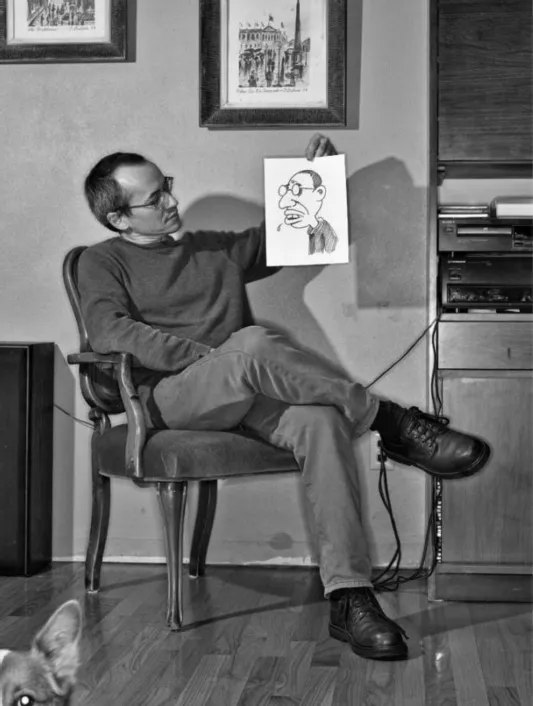
In Figure 1 is Joe Sacco (who we rarely see in ‘real’ life, as he presents himself autobiographically almost exclusively via the cartoony self suspended here) captured in an intimate moment, as the artist looks upon this creation of himself, this ‘cipher’ that is animated as we read across the frames and the gutters of the comics.
Figure 1. ‘Joe Sacco, Cipher and Corgi’.
Source: Stuart Mullenberg, https://www.pdxmonthly.com/articles/2009/11/9/joe-sacco-1209. Permission granted for reproduction.
People tell me that I draw myself in a grotesque way, and I kind of nod my head and agree, but it was very unintentional … The thing is, you can draw yourself the way you look or you can draw yourself the way you feel. I sort of fall into that latter category. I often feel the way I’m drawing myself. There is an accuracy in that drawing (Sacco & Mitchell 54).
Labelling this autographical figure as ‘cartoony’ emphasises how Sacco moves away from realism in his self-depiction, to create a cipher immersed in affect: ‘I often feel the way I’m drawing myself.’ In the frames of his comics, this cipher bends and twists, expands and contracts; sometimes a glimpse of a body part appears in the corner of a frame. Here we see just the head and shoulders. Is this figure looking back at Sacco? Is there a mutual recognition? Is there an element of wonder? Scott McCloud suggests in his book Understanding Comics that cartoon drawing both amplifies and simplifies: ‘When we abstract an image through cartooning we’re not so much eliminating details as we are focussing on specific details. By stripping down an image in cartoon drawing an artist can amplify meaning in a way that realistic art can’t’ (30). McCloud focusses in particular on the force of cartoon drawings of the face. The more cartoonish the face becomes, he argues, the more it becomes an icon that has the capacity to produce recognition and association, to move us and create an empathic attachment. But an empathic attachment to who or to what? And why does this seeing ‘I’ of the comics have eyes that remain hidden?
In all weathers and situations, Sacco’s eyes are masked by the rounded lens of his spectacles. His comics feature graphic depictions of faces that individualise and humanise, with eyes full of emotion. But these are always the eyes of others, those he listens to, never the witnessing ‘I’ of Sacco himself. Theories about Sacco’s spectacles, and what this says about the ethics of spectatorship in his comics, vary. Wendy Kozol speculates that this draws attention this character’s role as a voyeur, and to the media’s myopic and privileged perspective as outside observers, for Sacco is always looking on professionally, he is a journalist, he is working at his craft (167). Hillary Chute reads this blankness amidst so much visual elaboration in his comics as a sign of the political and aesthetic pressure on the act of seeing and witnessing at scenes of trauma and suffering, and as a surface mark of Sacco’s desire to cede the stories he solicits as a journalist to others ‘to highlight, superficially at least, a modesty through formlessness in the face of others’ experiences’ (Chute 337). This suggests Sacco is drawing to create an empathic attachment not on his own account, but for those to whom he bears witness. James Chandler questions whether this blindness represents a kind of Homeric blindness that allows him to see things that others can’t see: ‘Is it the idea that his eyes reflect rather than see the world? Or are these empty spaces peepholes for us ourselves to see the world afresh?’ (Sacco & Mitchell 53). Characteristically Sacco’s own comments on this are more direct and self-effacing, and affirms that desire to remain ‘nondescript’:
It’s deliberate now … But it certainly wasn’t in the beginning … But some people have told me that hiding my eyes makes it easier for them to put themselves in my shoes, so I’ve kind of stuck with it. I’m a nondescript figure; on some level I’m a cipher. The thing is: I don’t want to emote too much when I draw myself. The stories are about other people, not me. I’d rather emphasize their feelings. If I do show mine – let’s say I’m shaking (with fear) more than the people I’m with – it’s only ever to throw their situation into starker relief.’ (Cooke)
Remembering McCloud’s comments that the cartoony face is open to recognition, we see here Sacco’s desire to create a graphic version of self as cipher, a witness who does not emote too much, that works to create an empathic engagement with the stories about other people.
How does this work?
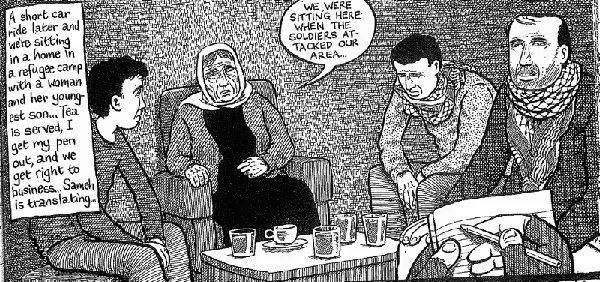
Figure 2. ‘Pilgrimage’ from Joe Sacco, ‘Palestine’.
Source: Joe Sacco, ‘Palestine’ 235. Copyright Fantagraphics. Permission granted for reproduction.
In Palestine, Sacco draws the intersection of ethics and aesthetics and the visualisation of witness into the frame. Palestine was published as a book in 2001, and it gathers a series of nine stories that take place over a two-month period in late 1991 and early 1992, with flashbacks to the expulsion of the Arabs from the West Bank, the Intifada and the Gulf War. Sacco spent much of his time in Palestine in dialogue with Palestinians, narrating their daily struggles and the humiliations of life in the occupied territories, and most particularly, in the refugee camps. These stories were first published serially in comics in 1993.
So, for example, in Chapter 8, ‘Pilgrimage’, Sacco’s fixer, Sameh, has taken him to the home of an elderly Palestinian woman, who has recently lost two sons in violent encounters with Israeli troops. We see Sacco’s hands on the edge of the frame (Figure 2), captured in the act of witness; his hands are magnified, copying the testimony he is hearing: ‘I get my pen out, and we get right to business’ (235). The word ‘business’ is a reminder: Sacco is on the page as a graphic journalist at work.
This explicit depiction of bearing witness to the dispossessed is drawn on the page: as readers/viewers we access their story from their own mouths – or not quite, because Sacco includes the presence of Sameh, his translator and fixer. Although Sacco himself morphs as he enters the frames of the comics in Palestine, the people themselves are always as we see them here: captured in graphic realistic detail. These are historical: they are often named, and are drawn so as to be recognisable as individuals. The accounts we hear are from the Palestinian people themselves, in dialogue with Sacco. In ‘Pilgrimage’, there are six pages of testimony by the woman who is the centre-point here. She has given this testimony many times we know (it’s ‘business’), and here she knowingly and deliberately gives it again to the journalist Sacco. She tells the story in the presence of family. Hospitality is evident: tea on the small table – Sacco is awash with tea during this time on the West Bank. When they are finished, she challenges him: ‘She wants to know,’ Sameh translates, ‘how talking to you is going to help her. We don’t want money, she says, we want our land, our humanity’ (242).
‘Pilgrimage’ begins with a splash page that illustrates Sacco’s journey into this refugee camp. Lacking margins or frames, the entire page is covered with painstaking cross-hatch, shading and stipple. Almost a third of this image is tumultuous sky: huge clouds that buffet the square voice balloons strung across the top of the page to tell the story in Joe’s voice:
There’s been some bad news … Sameh wants to press on regardless … I’m not insistent … We could skip the next item on my agenda … but Sameh is determined to continue … We’ve hitched a lift … a donkey cart … another authentic refugee camp experience … good for the comic, maybe a splash page. (217)
And this is what we see. The work of mediation is evident. Here, too, the captions present an ironic commentary – an irony directed to the business of journalism. The comics journo always has an eye for the potential, for the story and the image. Here is an embedded questioning of the ethics of journalism and the search for authentic story.
Yet, at the same time as the splash page voices this questioning of the ethics of journalism and search for authentic story in the experiences of refugees, the picture tells a story in graphic detail: below the turbulent sky we see drawn with painstaking care the donkey cart, the damaged buildings, a perilously poised tower, the rubble that surround the Palestinians, the thick mud that cakes their boots. The keffiyeh and veils that cover the heads of the people blow in the wind, and it is cold and bleak. And there is Sacco himself, carried into the camp on a wagon along with other commodities: trays of vegetables and provisions. In this cross-hatching and these ink-full pages we see an ethics of care, a scrupulous attention to bearing witness to social suffering.
The Palestinian critic Edward Said wrote a wonderful ‘Homage to Joe Sacco’ that opens Palestine, and here he comments in particular on Sacco’s graphic rendition of Gaza and its refugee camps. You see all of this ‘through Joe’s own eyes as he moves and tarries among them,’ Said comments, ‘attentive, unaggressive, caring, ironic and so his visual testimony becomes himself, so to speak in his own comics, in an act of profoundest solidarity’ (v). Typically, in his self-deprecating and ironic fashion, Sacco draws himself reading Said’s Orientalism and he uses this to question what his seeing ‘I’ can do as it enters the refugee camps on the west bank – but only briefly, because his cipher has little interest in engaging with theory. Said remarks on seeing ‘through Joe’s own eyes’ (my emphasis), but as we have seen Sacco’s presence problematises looking, seeing, spectacle in every cartoon representation of himself on the page.
In his Editor’s Introduction to a fine new collection of essays on Sacco’s work, Daniel Worden identifies two traditions in twentieth-century art and literature that are critical in the pedigree of Sacco’s comics journalism. The first is the underground comics movement in the USA in the 1960s and 70s, which is critical in the development of autographics as Jared Gardener has argued. These underground confessional comics featured the work of Justin Green, Art Spiegelman, R. Crumb and, as the feminist critic Hilary Chute reminds us in Graphic Women, women artists such as Phoebe Gloeckner and Lynda Barry. These comics incessantly return to the artist: their sexuality; obsessions; relationships; and traumatised relations with others. By the late 1980s Sacco was part of this underground comics scene, working for Fantagraphics books, although never in the confessional, highly subjective mode of these early autographics. In fact, Sacco tells us little about his own life history – we know nothing of Sacco’s obsessions and passions, and we know very little of his personal life. As in the photograph of Sacco and his drawn self (Figure 1), he remains at one remove from his masked cipher.
The second influence on Sacco’s graphic journalism is contemporaneous with the underground comics in the USA: new journalism, and its style of literary reportage that combines the historical and the personal, and licenses that subjective reportage that Sacco practises. In Journalism Sacco comments specifically on this art and craft, which he calls an ‘adamant art’ that draws on these earlier literary and artistic movements of the late twentieth century, and puts them to work in disaster zones:
In short, the blessing of an inherently interpretive medium like comics is that it hasn’t allowed me to lock myself within the confines of traditional journalism. By making it difficult to draw myself out of a scene, it hasn’t permitted me to make a virtue of dispassion. For good or ill, the comics medium is adamant, and it has forced me to make choices. In my view, that is part of its message. (Journalism xii)
Hillary Chute gets Sacco’s autographics right in Disaster Drawn, where she identifies this ‘adamant art’ as a visual work of witness, which uses the word and image form of the comics to create a record of the testimony of the dispossessed that is witnessed on and through the page. ‘The medium of the comics,’ remarks Chute, ‘is always already self-conscious as an interpretive, and never purely mimetic, medium. Yet this self-consciousness, crucially, exists together with the medium’s confidence in its ability to traffic in expressing history’ (198). In Journalism, Sacco talks of this as a ‘felt’ presence:
I, for one, embrace the implications of subjective reporting and prefer to highlight them. Since it is difficult (though not impossible) to draw myself out of a story, I usually don’t try. The effect, journal...
Table of contents
Cover
Half Title
Title Page
Copyright Page
Table of Contents
Citation Information
Notes on Contributors
Introduction: The Limits of Life Writing
1 Joe Sacco’s Australian Story
2 Malala Yousafzai, Life Narrative and the Collaborative Archive
3 Remembering Violence in Alice Pung’s Her Father’s Daughter: The Postmemoir and Diasporisation
4 Witnessing Moral Compromise: ‘Privilege’, Judgement and Holocaust Testimony
5 ‘A Thing May Happen and be a Total Lie’: Artifice and Trauma in Tim O’Brien’s Magical Realist Life Writing
6 Forms of Resistance: Uses of Memoir, Theory, and Fiction in Trans Life Writing
7 Confessional Poetry and the Materialisation of an Autobiographical Self
8 Reflection: I Guess What You Say is True
Index
Trusted by 375,005 students
Access to over 1.5 million titles for a fair monthly price.
Study more efficiently using our study tools.
Frequently asked questions
Yes, you can cancel anytime from the Subscription tab in your account settings on the Perlego website. Your subscription will stay active until the end of your current billing period. Learn how to cancel your subscription
No, books cannot be downloaded as external files, such as PDFs, for use outside of Perlego. However, you can download books within the Perlego app for offline reading on mobile or tablet. Learn how to download books offline
Perlego offers two plans: Essential and Complete
Essential is ideal for learners and professionals who enjoy exploring a wide range of subjects. Access the Essential Library with 800,000+ trusted titles and best-sellers across business, personal growth, and the humanities. Includes unlimited reading time and Standard Read Aloud voice.
Complete: Perfect for advanced learners and researchers needing full, unrestricted access. Unlock 1.5M+ books across hundreds of subjects, including academic and specialized titles. The Complete Plan also includes advanced features like Premium Read Aloud and Research Assistant.
Both plans are available with monthly, semester, or annual billing cycles.
We are an online textbook subscription service, where you can get access to an entire online library for less than the price of a single book per month. With over 1.5 million books across 990+ topics, we’ve got you covered! Learn about our mission
Look out for the read-aloud symbol on your next book to see if you can listen to it. The read-aloud tool reads text aloud for you, highlighting the text as it is being read. You can pause it, speed it up and slow it down. Learn more about Read Aloud
Yes! You can use the Perlego app on both iOS and Android devices to read anytime, anywhere — even offline. Perfect for commutes or when you’re on the go. Please note we cannot support devices running on iOS 13 and Android 7 or earlier. Learn more about using the app
Yes, you can access The Limits of Life Writing by David McCooey,Maria Takolander in PDF and/or ePUB format, as well as other popular books in Literature & Literary Criticism. We have over 1.5 million books available in our catalogue for you to explore.