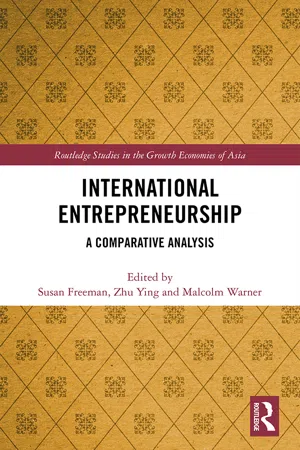
This book explores the importance of entrepreneurs in driving economic growth as the world economy grows and becomes more integrated and more challenging. It examines the situation in both advanced and developing countries and shows how the entrepreneurial orientation of the founders of small and medium sized enterprises has resulted in phenomenal growth, often fuelled by innovation and new technologies. It contrasts the experiences of Chinese family business in China and among the overseas Chinese with the experiences of family businesses in the United States and Europe. One important conclusion is that there has been a noticeable fall in entrepreneurial proclivity in the advanced economies, in contrast to the position in emerging economies.
eBook - ePub
International Entrepreneurship
A Comparative Analysis
- 192 pages
- English
- ePUB (mobile friendly)
- Available on iOS & Android
eBook - ePub
1 Introduction
The origins of entrepreneurship and internationalization
Introduction
In this book, we make a quantum leap from the past to the present in considering entrepreneurship. Doing so is rather an act of faith, since we can never be certain there is a linear connection between two points in time. Entrepreneurship is a rather slippery notion, as it has very many dimensions and has been converted across time and space, and between different cultures. Early achievers may have had some characteristics in common with those of today but the connection is very tenuous. Proto-entrepreneurs acted in an early, simple and straightforward way but their counterparts today in the Silicon Valley or in the Chinese Zhongguancun, Haidian, area in Beijing are a very different creation.
The self-dependent entrepreneur usually is a one-man band or operates in a small company. The survival rate is very poor and even today one in three American small businesses fail within a few years. The emergence of early multinationals, such as the East India Company, are said by some to be a model for the modern Multinational Corporation (MNC). In terms of multinationals, size matters, particularly for international trade. The economies of scale also dominate the economies of entrepreneurship. Today, scale is everything as a new technological innovation needs substantial capital investment. The new unicorn billion dollar firms are the order of the day. The Stone Age entrepreneur was a very different person from the promoter and chief executive of say, Google or Baidu. It is rather remarkable that we had to wait until the end of the eighteenth century to have a precise conceptualization and definition of what is an ‘entrepreneur’. Even today, pinpointing the definition of an entrepreneur, entrepreneurship and an entrepreneurial organization remains problematic. What we include within a Venn diagram clearly rests on so-called family resemblances and, indeed, fuzzy categories.
In order to resolve some of the above issues, we need to have a general contingency theory that can encapsulate these differences in time, space and culture. The extensive literature on the subject today is rather repetitive and unoriginal. Hence, this book offers new research and thoughts on the direction for the all-important aspects of International Entrepreneurship as well as the important characteristics and nature of the immigrant entrepreneur from these markets. By tackling the key questions related to ‘what, who and why’ regarding the causes, patterns/models, and processes of internationalisation of entrepreneurship among different entrepreneurial groups with different cultural and ethnical backgrounds, we expect that there will be new findings that show distinct differences among emerging and advanced markets and between entrepreneurs across selected emerging markets given their socio-political backgrounds and historic pathways.
The origins of entrepreneurship
The origins of entrepreneurship are as diverse as they are as ancient. We continue to know very little about entrepreneurs despite the remarkable interest and numerous publications on the topic (Cunningham & Lischeron, 1991). Some suggest that the first entrepreneurs go far back in time and can be traced back to around 20,000 years ago. The first known trading between humans took place in New Guinea and Australasia around 17000 bc, where people would exchange obsidian (a volcanic glass valuable in hunting weapons) for other goods they needed, such as tools, skins and food. This early proto-entrepreneurship continued for millennia. Hunter-gatherer tribes traded goods from different parts of their regions to offer overall benefits for their tribes. Even in the Bible, there are several passages in which the term ‘Canaanite’ is employed interchangeably with the words for ‘trader’ and ‘merchant,’ suggestive of the idea of entrepreneur (Davies, 1994; Briard, 2001; Demoule, 2007).
A major development in entrepreneurship took place during the Agricultural Revolution, about 12,000 years ago. This was a time where there were no borders for traders and trade brought the possibility of great material wealth and new knowledge. A number of script systems emerged, such as ‘foreign’ languages (e.g. such as names of exotic artefacts), and expertise in technologies was also developed by traders, bringing with them many new ideas. Concepts, ideas and languages travelled as ballast embodied in traded items, or “in the minds of envoys, merchants, and craftsmen – as an intellectual stowaway” (Wedde, 1997: 45). While raw materials began to travel through Europe during the Upper Palaeolithic period (35000–10000 bc), the first known evidence for trade and barter appeared later in the Neolithic period (8000–2200 bc) and onwards (Davies, 1994; Briard, 2001; Demoule, 2007).
The birth of agriculture during the Neolithic period drove bartering practices. Initially, people exchanged mainly livestock, grain and pottery. The use of money as a common practice was to develop later. In Europe, the Neolithic period saw the introduction of tools that were designed essentially for exchange, such as the Grand Pressigny flint blades in France, some of which were found as far as 800 km away from their place of origin. A similar phenomenon was observed in the thousands of polished-axes made in Plussulien (France) and traded hundreds of kilometres away, some reaching England (Demoule, 2007). In China, cowrie shells were used as an early form of currency in the equivalent Neolithic area. The rarity of the shells ensured their value, with imitations found in many archaeological sites made from jade, stone, bone, earthenware, gold, tin and bronze. Interestingly, this type of shell was also used in Oceania, Africa and in the Middle and Far East. Its value varied depending on the distance travelled to find it. Extraordinarily, it is still used today as a currency in Ethiopia and other remote regions in Africa (Davies, 1994).
The importance of the ‘entrepreneur’ in early economic discourse
Remarkably, the word ‘entrepreneur’ was not part of the English language until it drifted from its French origins into various writings, treatises and letters within the English and American communities of economics scholars in the mid-1770s to 1870s. The word was entirely silent during the first century of the classical era until The Wealth of Nations by Adam Smith in 1776 but has had considerable impact on economic concepts that have been formulated since. This silence suggests that the factors of production, namely, the inputs used to produce goods and services, were seen as limited to three important elements – land, labour and capital, which Mankiw (1997) eloquently describes in his Principles of Economics. The term ‘entrepreneur’ is also not included or mentioned in the first edition of Samuelson’s Economics published in 1948. While no doubt, both authors would have considered the importance of entrepreneurial activities, that role was simply not mentioned in the discourse on economic theory at the time. It was not until the 1930s that the word was used by Schumpeter (1934). Today it is in common usage and linked to the idea of innovation. Is it not curious, that the notion of an entrepreneur, the very factor that organizes a business and is responsible for its success or otherwise, lacks a common term in the English language to encapsulate this important risk-taking function in which an individual makes a living by making a profit through the running of a business? (Kates, 2015).
In conducting our own initial analysis, we look first at the occurrence of terms relating to ‘entrepreneur’ in a number of search engines [in March 2018], such as Google and Google Scholar. We then study the frequency of the term’s appearance in Google Books. The methodology used in this analysis of the role of entrepreneurs in Google Books is highly novel, we would argue, at least as applied to Economic Ideas. We look at how often key terms relating to entrepreneurs appear in books in English and are graphically depicted in Google Books regarding these terms being used over the last three centuries, which we discuss and present as comparative charts below. We also suggest that Google Books may achieve wider diffusion through translations into many languages but this is rarer for journal articles.
Google Search and Google Scholar
In Table 1.1, we set out the respective scores in Google Search and Google Scholar for the words entrepreneur, entrepreneurial and entrepreneurship. We can see these occur in English in very large numbers.
Table 1.1 Google Search analysis of key terms, entrepreneur, entrepreneurship and entrepreneurial, number of entries [16 March 2018]
| Google Search | Google Scholar | |
|---|---|---|
| Entrepreneur | 70,000,000 | 890,000 |
| Entrepreneurship | 68,500,000 | 1,430,000 |
| Entrepreneurial | 42,900,000 | 1,330,000 |
Table 1.2 Google Search analysis of key terms, entrepreneur, inventor and innovator, number of entries [16 March 2018]
| Google Search | Google Scholar | |
|---|---|---|
| Entrepreneur | 70,000,000 | 890,000 |
| Inventor | 22,000,000 | 2,860,000 |
| Innovator | 11,600,000 | 192,000 |
Table 1.3 Google Search analysis of key terms, entrepreneur, international business and multinationals, number of entries [16 March 2018]
| Google Search | Google Scholar | |
|---|---|---|
| Entrepreneur | 70,000,000 | 890,000 |
| Intl Business | 15,000,000 | 3,040,000 |
| Multinationals | 42,800,000 | 256,000 |
In Table 1.2, we set out the scores in Google Search and Google Scholar for the terms, entrepreneur, inventor and innovator, to show their relative numbers.
In Table 1.3, we look at the respective scores in Google Search and Google Scholar for the terms entrepreneur, international business and multinationals.
Google Books
The Google Books results are derived from the field of Computational Linguistics and are based on the Google Books N-gram Corpus of terms in its initial phase of over five million books, apparently involving around 6 per cent of all those ever published from 1500-onwards; as presented here, these range from 1700 to 2000 only. The original pioneering paper by J. B. Michel et al. (2011) was to launch this new field, which researchers dubbed Culturomics (see Michel et al., 2011).
Google initially digitalized the contents of this set of published books employing optical character-recognition (OCR) technology. The contents was then compiled into a dataset that could be searched at the level of single words/characters, with the search results plotted on a chart, year by year, a technique we apply later. When a search enters key examples of these topics into the free online search engine, namely, the Google Books N-gram Viewer, which is a text-visualization tool, a graph is shown presenting how frequently those terms or N-grams have occurred over a timeline in a given corpus of books (for example, from English, British–English, American–English and so on) over the selected years.
To use the Viewer, the researcher picks (1) a time period (the study presented here chose 1700–2000); (2) a language (we selected English as a catch-all; (3) a smoothing curve (we used factor-10 because this presented the curve more vividly than a lower one); and, then (4) enters one or more terms sought (we selected entrepreneur, for example). The vertical y-axis on the graph produced shows the relative frequency in percentage, of the terms being researched, over the time-period examined, which is indicated on the horizontal x-axis in terms of years. As a result of this mapping, one can find the percentage of all published works in the corpus of books digitalized in which the phrase sought appears for the period concerned.
Using the data from the Google project, we have concentrated on data derived from influential Google Books as the focus of the study, since these may be seen as the main iconic vehicles for the spread of new ideas, from the Enlightenment onwards, with a higher symbolic status than others. Google Books on economic, management and sociological ideas may be said to have played an especially privileged role in the creation of global intellectual reputations in this particular field of study for the authors we studied, as opposed to articles. The search encompassed the entire corpus of books digitalized by Google Books and was not just restricted to books on entrepreneurs.
In Figure 1.1 below, we create the N-gram graphic for the terms entrepreneur, entrepreneurial and entrepreneurship, as they have occurred in books over the last three centuries. The first term starts to take off in the late nineteenth century and continues rising in the twentieth century. The second starts to rise very rapidly after 1920 and the third ascends at the same time but more slowly, both reaching their peak in the year 2000.
In Figure 1.2...
Table of contents
- Cover
- Half Title
- Series Page
- Title Page
- Copyright Page
- Dedication
- Table of Contents
- 1 Introduction: the origins of entrepreneurship and internationalization
- 2 International entrepreneurship and schools of thought
- 3 International entrepreneurship: its emergence from international business and entrepreneurship
- 4 International entrepreneurship in emerging and Western markets: the rising influence of China
- 5 Ethnicity and entrepreneurship
- 6 Australia and its history of immigration and entrepreneurship
- 7 Internationalization of Chinese entrepreneurship
- 8 Ethnic entrepreneurs in the West vis à vis those in the East: Jewish entrepreneurs’ experience
- 9 Conclusion: comparative analysis of internationalization of entrepreneurship
- Index
Trusted by 375,005 students
Access to over 1.5 million titles for a fair monthly price.
Study more efficiently using our study tools.
Frequently asked questions
Yes, you can cancel anytime from the Subscription tab in your account settings on the Perlego website. Your subscription will stay active until the end of your current billing period. Learn how to cancel your subscription
No, books cannot be downloaded as external files, such as PDFs, for use outside of Perlego. However, you can download books within the Perlego app for offline reading on mobile or tablet. Learn how to download books offline
We are an online textbook subscription service, where you can get access to an entire online library for less than the price of a single book per month. With over 1.5 million books across 990+ topics, we’ve got you covered! Learn about our mission
Look out for the read-aloud symbol on your next book to see if you can listen to it. The read-aloud tool reads text aloud for you, highlighting the text as it is being read. You can pause it, speed it up and slow it down. Learn more about Read Aloud
Yes! You can use the Perlego app on both iOS and Android devices to read anytime, anywhere — even offline. Perfect for commutes or when you’re on the go.
Please note we cannot support devices running on iOS 13 and Android 7 or earlier. Learn more about using the app
Please note we cannot support devices running on iOS 13 and Android 7 or earlier. Learn more about using the app
Yes, you can access International Entrepreneurship by Susan Freeman,Ying Zhu,Malcolm Warner in PDF and/or ePUB format, as well as other popular books in Business & Business General. We have over 1.5 million books available in our catalogue for you to explore.