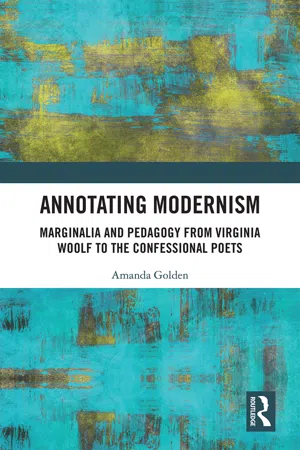
Making extensive use of archival materials by Sylvia Plath, John Berryman, and Anne Sexton, Amanda Golden reframes the relationship between modernism and midcentury poetry. While Golden situates her book among other materialist histories of modernism, she moves beyond the examination of published works to address poets' annotations in their personal copies of modernist texts. A consideration of the dynamics of literary influence, Annotating Modernism analyzes the teaching strategies of midcentury poets and the ways they read modernists like T. S. Eliot, James Joyce, Ezra Pound, Virginia Woolf, and W. B. Yeats. Situated within a larger rethinking of modernism, Golden's study illustrates the role of midcentury poets in shaping modernist discourse.
eBook - ePub
Annotating Modernism
Marginalia and Pedagogy from Virginia Woolf to the Confessional Poets
- 242 pages
- English
- ePUB (mobile friendly)
- Available on iOS & Android
eBook - ePub
Annotating Modernism
Marginalia and Pedagogy from Virginia Woolf to the Confessional Poets
About this book
Information
1 Reading modernist texts
Sylvia Plath’s library and teaching notes
By annotating her reading and preparing notes to teach, Sylvia Plath preserved her encounters with modernism at a particular moment. As a result, the books in Plath’s personal library and the teaching notes that she composed become vital resources for understanding the extent to which her reading of modernism was inseparable from the critical terminology with which she learned to interpret it.1 This chapter argues that Plath revised the modernist critical discourse she engaged as a student and teacher as she turned her attention to the post-World War II milieu in her fiction and poetry.2
In the spring of 1958, as Plath’s year teaching freshman English at Smith College drew to a close, she prepared the following advice for her students: “[T. S.] Eliot said: ‘IN MY END IS MY BEGINNING’: Begin at this level of work next year.”3 As she did so, Plath was at the end of a year in which she had returned to Smith to teach many of the texts that she once had studied there. Since The Bell Jar’s publication under Plath’s name in 1966, readers have had a sense of her diligence as a student.4 Biographies have chronicled Plath’s student years alongside those of her fictional likeness, Esther Greenwood.5 But readers remain less familiar with the more complex ways in which Plath repurposed what she had learned as a student.
This chapter demonstrates the extent to which Plath’s reading strategies were integral to her process of self-fashioning as a student and poet.6 In her marginalia, student notebooks, teaching notes, and other materials, Plath documented sources that informed her study of modernism.7 Drafting her teaching materials, Plath worked closely from her student notebooks and contemporary criticism.8 Despite her concern that she was merely “living & teaching on rereadings, on notes of other people” (UJ, 346), Plath augmented this archive as she prepared to teach. In doing so, Plath became a student of the criticism of her moment and a teacher who tested its boundaries, engaging the cultural and political implications of texts in ways that anticipated the directions she would pursue in her poetry and prose.9
In the decades that have passed since readers encountered Plath’s writing of the Ariel poems on the reverse sides of her own and Ted Hughes’s manuscripts in Susan Van Dyne’s Revising Life: Sylvia Plath’s Ariel Poems (1994), Plath’s archives have become vital to critical assessments of her oeuvre.10 It was while teaching at Smith in the spring of 1958 that Plath removed the “lovely-textured” pink Smith College memorandum paper from the history department supply closet to use for a novel that she was struggling to write (UJ, 344). As an instructor, Plath made use of some of these pages to compose her unwieldy sheaf of teaching materials. These notes include passages she collected from critical texts, the result of Plath’s reading and preparation as she approached the course texts. Plath drafted and revised her notes, which took on new life in overview materials that framed her classes, including what she referred to as “brief 5 minute lectures on topics.”11 Had she returned home and retrieved these materials, which she left behind before departing for England in late 1959, Plath may have reused them for future teaching or drafted new poems on the versos.12
The textures and surfaces of pages altered Plath’s handling of them. While teaching at Smith in February 1958, Plath penned an exuberant, reflexive comment on the long, lined pages of the journal in which she was writing: “I love this book, black point of pen skidding over smooth paper” (UJ, 322). The pace and feel of underlining and annotating differ from other modes of writing; while underlining, for instance, a reader may register differently the feel of a page or the ink of a pen. The size and shape of Plath’s notes range from large letters stretching across the top or along the side of a page, with o’s and a’s rounded (Henry James’s Portrait of a Lady), to concise notes and passages from a critical text in the margins (The Waste Land), to short paragraphs in open spaces (Ulysses).13 As an annotator and a writer, Plath preferred black ink. She occasionally selected brown or blue ink, at times to accent what she had already underlined.14 At other moments, she used a red pencil to underline her notes and revisit passages in her books, underlining again what she had previously marked.15
As a reader, Plath was possessive of her books; they were part of her intellectual corpus.16 During her first year as a Fulbright Scholar at Newnham College, Plath loaned some of her books to her Cambridge University classmate, Jane Baltzell. When she had the audacity to mark their pages with pencil, Plath was outraged. In disbelief, she recorded in her journal that Baltzell
had underlined five of my new books in pencil with notes; evidently she felt that since I’d already underlined them in black, nothing further could harm them; well, I was furious, feeling my children had been raped, or beaten, by an alien.17
Perhaps unknowingly, Baltzell had altered the terrain that had shaped and documented Plath’s thoughts.
Plath’s library
Writing in her journal during the summer before she returned to Smith as an instructor, Plath turned her attention to teaching. Paradoxically, “The Beast in the Jungle” provided a source of comfort. Henry James’s story, Plath found, “robs me of fear of job because of love of story, always trying to present it in mind, as to a class” (UJ, 296). After the term began, Plath reflected that “[t]he material of reading is something I love. I must learn, slowly, how to best present it, managing class discussion” (UJ, 619–20). Material becomes a means of preparation, but crafting notes and selecting passages cannot fully prepare one for the unpredictability of teaching, even as, one of her students remembered, Plath did so with book in hand.18
In her journal, Plath contemplated the aesthetics of her surroundings. She found it flattering when a visiting college friend recalled that Plath “chose books for the color & texture of their covers” (UJ, 316). During the summer after her first year of college, Plath reminisced about the time she had spent in a bookmobile “looking at poetry books and the brightly covered, good clear-printed Modern Library editions” (UJ, 124). Teaching later presented sources of material confidence. Plath reflected that her
11 o’clock [class was] in the tiny white room which I like most of all simply because of its intimacy, clean whiteness & pleasant lighting. I am sure I teach better in that room, just as I am sure I teach better in certain dresses whose colors & textures war not against my body & my thought.
Plath sustained this sense of contentment in material artifacts as she approached her library.
As Plath collected books for her college courses and purchased related texts, her enjoyment resembled that of Gabriel Conroy, who, Plath underlined in the copy of Dubliners that she bought in the spring of her junior year, “loved to feel the covers and turn over the pages of newly printed books.”19 After returning to Smith in the spring of 1954, following the semester she spent recovering from the breakdown that she later depicted in The Bell Jar, Plath reported to her friend Phil McCurdy having filled her Lawrence House room with “two bookcases full of my books” (LV1, 671). Two months later, she composed another letter to him while “surrounded by literal stacks of new books,—(still smelling faintly and enticingly of printer’s ink and sawdust—whatever that ineffable new-book-smell is made up of!)” (LV1, 725–6). A lecture for her European Intellectual History course left her “so transfigured that . . . [she] went across the street to buy the collected plays of Ibsen and read them immediately!” (LV1, 727). In her excitement, Plath ended up purchasing “TWELVE (12!) books!,” her “bookcases . . . overflowing” with them (LV1, 727).
At times, such enthusiasm prompted Plath’s marking of texts, the resulting annotations presenting potential indications of her immersion and the degree of her response. A diversion from studying, Plath disclosed to McCurdy, led to her uninhibited reading of D. H. Lawrence’s Studies in Classic American Literature (1923), “from my library of largely unread-but-about-to-be-read-this-summer books” (LV1, 725–6).20 She became overwhelmed after seeking “to read the chapters on Melville. Little did I know wha...
Table of contents
- Cover
- Half Title
- Title Page
- Copyright Page
- Dedication
- Table of Contents
- List of figures
- Acknowledgments
- Permissions
- Introduction: annotating literary history
- 1 Reading modernist texts: Sylvia Plath’s library and teaching notes
- 2 John Berryman annotating modernism
- 3 Annotating herself: Anne Sexton’s teaching notes
- Coda: Ted Hughes and the midcentury American academy
- Conclusion
- Appendix A: Sylvia Plath’s teaching syllabus: a chronology
- Appendix B: poems in Anne Sexton’s teaching notes from Colgate University
- Bibliography
- Index
Trusted by 375,005 students
Access to over 1.5 million titles for a fair monthly price.
Study more efficiently using our study tools.
Frequently asked questions
Yes, you can cancel anytime from the Subscription tab in your account settings on the Perlego website. Your subscription will stay active until the end of your current billing period. Learn how to cancel your subscription
No, books cannot be downloaded as external files, such as PDFs, for use outside of Perlego. However, you can download books within the Perlego app for offline reading on mobile or tablet. Learn how to download books offline
Perlego offers two plans: Essential and Complete
- Essential is ideal for learners and professionals who enjoy exploring a wide range of subjects. Access the Essential Library with 800,000+ trusted titles and best-sellers across business, personal growth, and the humanities. Includes unlimited reading time and Standard Read Aloud voice.
- Complete: Perfect for advanced learners and researchers needing full, unrestricted access. Unlock 1.5M+ books across hundreds of subjects, including academic and specialized titles. The Complete Plan also includes advanced features like Premium Read Aloud and Research Assistant.
We are an online textbook subscription service, where you can get access to an entire online library for less than the price of a single book per month. With over 1.5 million books across 990+ topics, we’ve got you covered! Learn about our mission
Look out for the read-aloud symbol on your next book to see if you can listen to it. The read-aloud tool reads text aloud for you, highlighting the text as it is being read. You can pause it, speed it up and slow it down. Learn more about Read Aloud
Yes! You can use the Perlego app on both iOS and Android devices to read anytime, anywhere — even offline. Perfect for commutes or when you’re on the go.
Please note we cannot support devices running on iOS 13 and Android 7 or earlier. Learn more about using the app
Please note we cannot support devices running on iOS 13 and Android 7 or earlier. Learn more about using the app
Yes, you can access Annotating Modernism by Amanda Golden in PDF and/or ePUB format, as well as other popular books in Literature & Literary Criticism. We have over 1.5 million books available in our catalogue for you to explore.