Recent decades have witnessed an explosion in supply chain complexity. Very few firms have succeeded in building excellent supply chains and employing supply chain management (SCM) as a competitive advantage. For the ones which have developed enhanced supply chain design and process capabilities, their performance has far exceeded their competitors'. While for the vast majority of firms, SCM still remains a means of reducing costs and improving efficiency, for the excellent ones, SCM has turned into a source for value creation. What factors drive firms towards supply chain excellence? How can real differentiation be created through supply chains? Excellence in Supply Chain Management examines the characteristics and features of firms that excel in SCM.

- 122 pages
- English
- ePUB (mobile friendly)
- Available on iOS & Android
eBook - ePub
Excellence in Supply Chain Management
1
Operations and supply chain management
The initial journey
The excellence displayed by Amazon, Apple, Dell, Walmart, and Zara, to name a few firms, in the past few decades has indeed made the topic of supply chain management (SCM) omnipresent in any discussion of the present-day functioning of firms. While many experts have attempted to present SCM as a new field in management, many others see it as progress made by the broad area of operations management. We would subscribe to the latter view and devote this chapter to a broad understanding of operations management and operations strategy.
Operations management defined
Operations management is a crucial function in any organization and involves the design and control of processes through which inputs or raw materials are transformed into service outcomes or finished products as desired by the customers. The transformation processes employ different resources, like land, labour, and capital. Capital includes various sorts of buildings, machinery, transport equipment, and technologies like computing hardware and software. Operations management transformation processes could be of different types. Conversion of crude oil into finished products like petrol and diesel by an oil refinery is an example of physical transformation. A passenger travelling from one city to another in an airline is an illustration of locational transformation.
While processes that transform raw materials to finished products could trace their history to early human civilization, an organized manner of managing operations is typically considered to be a by-product of the Industrial Revolution. John D. Rockefeller established the Standard Oil Company in 1870, and in a matter of a few years, the company controlled 90% of America’s refining capacity. While focussing on economies of scale to reduce its costs, the firm also set up processes in place to ensure that its products had consistent quality.2 In 1913, Henry Ford caught the attention of the world by setting up a moving assembly line at Ford Motor Company. This, along with labour specialization, enabled him to bring down the chassis assembly time from over 12 hours to just 1 hour and 33 minutes.3
The twin pillars of operations management
The assembly line revolution at Ford is typically regarded as the dawn of the mass production era. Mass production symbolized the pursuit of economies of scale with low variety as a means of offering products at a low price and making them accessible to a greater number of customers, which in turn would drive scale further. This meant the replacement of many small factories by a fewer number of large factories. In America, automobile production started concentrating in and around Detroit. In addition, Ford felt that offering cars in many colours would result in costly and time-consuming process changeovers, which in turn would reduce the utilization of the assembly line. He famously declared that Ford cars would be offered in any colour as long as it was black.4 Along with economies of scale, firms started focussing heavily on maximum utilization of their resources as a means of spreading the overheads over a larger output and thus minimizing the unit cost of production. The field of industrial engineering, pioneered by stalwarts like Fredrick Taylor,5 emerged in this background of firms pursuing efficiency, or the most economical way of producing a good or delivering a service.
Industrial engineering and its piece-wise solution to firm-level problems dominated much of the 20th century. Efficiency remained by far the main concern of operations management in the mass production era. Many concepts, mostly with the goal of minimizing cost or time – like aggregate production planning, inventory control, line balancing, material requirement planning, process analysis, scheduling, and statistical quality control – emerged during this period. The pursuit of efficiency did not necessarily translate into a high level of customer satisfaction. In fact, there were countless instances of efficiency pursuits resulting in customer unhappiness of some sort or other. An illustration of how an efficiency pursuit results in customer dissatisfaction is the case of deciding the optimal number of security counters at an airport based on average customer arrivals, which results in long queues when arrivals are more than usual. However, by the 1970s, change was looming on the horizon.
The twin oil shocks in the 1970s provided the opening for Japanese automakers like Toyota and Nissan to enter into the American market. Though the initial success was due to the fuel savings owing to their being smaller in size, the Japanese cars soon made an impact on the American customers because of their better quality and serviceability.6 The American manufacturers were curious to understand the secrets of firms like Toyota in maintaining high-quality, low-inventory, and pull-based production. They discovered what Toyota referred to as the Toyota Production System (TPS), which eventually came to be known as lean production. Contrary to just enhancing efficiency as in mass production, lean production strived to enhance both efficiency and effectiveness. Effectiveness means an organization doing the right things from the perspective of its customers, whether it is regarding quality, delivery, or variety.
Until the arrival of TPS, it was widely felt that efficiency and effectiveness were at conflict with each other. After all, it was costlier to invest in processes that were of higher quality and operated on a pull basis. In the following decades, TPS inspired firms like Southwest Airlines, Dell Computers, and Walmart to develop their own models in operational excellence by pursuing the twin pillars of operations management – efficiency and effectiveness – simultaneously. Along with Toyota, these firms demonstrated that it was indeed possible to pursue gains in efficiency and effectiveness simultaneously if these objectives were considered at the design stage itself. For instance, Southwest Airlines has been a model of airline efficiency owing to quick turn-around times of its aircraft, while being a model of airline effectiveness (customer-centric) through a reputation built on punctuality, frequent service, low fares, and negligible baggage delays.7
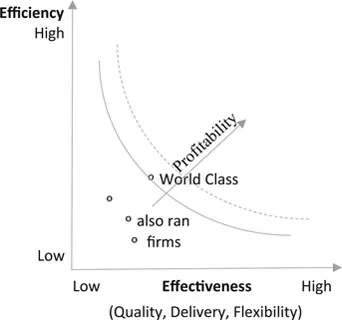
Figure 1.1 The efficiency–effectiveness frontier
Referring to Figure 1.1, a world-class firm8 is superior to any other firm in its industry on both effectiveness and efficiency. The efficiency-effectiveness frontier (solid curve) represents the best-case efficiency-effectiveness combination at a given point in time based on the existing technologies and management practices. However, through continuous improvement in both technology and management practices, it is possible to shift the frontier upwards (dotted curve).
Operations strategy: competing on operations
In 1969, Wickham Skinner argued that the “connection between manufacturing and corporate success is rarely seen as more than the achievement of high efficiency and low costs.”9 Over the years, various experts have argued about the need to go beyond just competing on efficiency. This paved the way for a field devoted to competing on operations, or simply operations strategy. Competing on operations implied that a firm could use one or more of the operations strategy elements, namely cost, quality, flexibility, and delivery. For over 40 years, Southwest Airlines has been the cost leader in the American domestic airline industry with its cost per available seat mile less than the industry by 25%.10 As mentioned earlier, the airline follows a strategy of spending very little time on the ground so that its aircraft are in the air for as much time as possible. By focussing on the sales per square foot, Costco has emerged as one of the most efficient retailers in America.11
The inroads made into the American market for sophisticated products like automobiles and electronic products by Japanese firms like Toyota and Sony brought global attention to competing on quality. David Garvin argued that while a marketing view of higher quality is better performance, enhanced features, and other improvements that increase cost, the manufacturing view of better quality is conformance to specifications and “doing it right the first time,” which helps reduction of cost.12 While making the case for quality as an important element of strategy, he proposed eight dimensions of product quality, namely, performance, features, reliability, conformance, durability, serviceability, aesthetics, and perceived quality. Apple has been an example of a firm that has built a very strong brand based on the high quality that it offers in its products like mobile phones, personal computers, and tablets. As a result, it has been able to charge a handsome premium on its products and command a high customer loyalty.
By the 1980s, more and more firms had started migrating from low-variety mass production to high variety and customization (mass customization).13 One of the examples of mass customization cited is that of National Bicycles of Japan, where a customer could choose a customized bicycle that could be from among a million variants possible. Offering higher variety and customization required a firm to be flexible in its operations. The flexibility could be on quickly changing over from one product type to another or in scaling up/down the production volume of a particular product or in introducing new products as required by the customers. While the argument till then was that being flexible would come at a high cost, firms like Toyota were able to demonstrate that it was possible to be efficient and flexible at the same time. While being an efficient car maker, Toyota was able to show that it could make changeovers from one model to another quickly as it positioned itself as a firm offering higher variety and greater customization than its competitors. In India, Asian Paints pioneered mass customization by delaying the product differentiation to the retail end. By installing colour dispensers at its retail outlets, Asian Paints has become very flexible with respect to meeting customer demand.
While quality caught the headlines in the 1970s and flexibility in the 1980s, the 1990s became the decade when firms realized the potential of competing on delivery. As the manufac...
Table of contents
- Cover
- Half Title
- Series Page
- Title Page
- Copyright Page
- Dedication Page
- Contents
- List of abbreviations
- Preface
- Acknowledgements
- 1 Operations and supply chain management: the initial journey
- 2 Inventory management
- 3 Forecasting and demand planning
- 4 Supply chain management as a competitive advantage
- 5 Supply chain coordination, contracts, and integration
- 6 Procurement and vendor management
- 7 Supply chain risk management
- 8 Managing design for supply chain management
- 9 Green and sustainable supply chains
- 10 Popular supply chain analytics
- 11 Operations and supply chain management in the digital era
- Brands, organizations, people, and places
- Index
Trusted by 375,005 students
Access to over 1.5 million titles for a fair monthly price.
Study more efficiently using our study tools.
Frequently asked questions
Yes, you can cancel anytime from the Subscription tab in your account settings on the Perlego website. Your subscription will stay active until the end of your current billing period. Learn how to cancel your subscription
No, books cannot be downloaded as external files, such as PDFs, for use outside of Perlego. However, you can download books within the Perlego app for offline reading on mobile or tablet. Learn how to download books offline
Perlego offers two plans: Essential and Complete
- Essential is ideal for learners and professionals who enjoy exploring a wide range of subjects. Access the Essential Library with 800,000+ trusted titles and best-sellers across business, personal growth, and the humanities. Includes unlimited reading time and Standard Read Aloud voice.
- Complete: Perfect for advanced learners and researchers needing full, unrestricted access. Unlock 1.5M+ books across hundreds of subjects, including academic and specialized titles. The Complete Plan also includes advanced features like Premium Read Aloud and Research Assistant.
We are an online textbook subscription service, where you can get access to an entire online library for less than the price of a single book per month. With over 1.5 million books across 990+ topics, we’ve got you covered! Learn about our mission
Look out for the read-aloud symbol on your next book to see if you can listen to it. The read-aloud tool reads text aloud for you, highlighting the text as it is being read. You can pause it, speed it up and slow it down. Learn more about Read Aloud
Yes! You can use the Perlego app on both iOS and Android devices to read anytime, anywhere — even offline. Perfect for commutes or when you’re on the go.
Please note we cannot support devices running on iOS 13 and Android 7 or earlier. Learn more about using the app
Please note we cannot support devices running on iOS 13 and Android 7 or earlier. Learn more about using the app
Yes, you can access Excellence in Supply Chain Management by Balram Avittathur,Debabrata Ghosh in PDF and/or ePUB format, as well as other popular books in Business & Business General. We have over 1.5 million books available in our catalogue for you to explore.