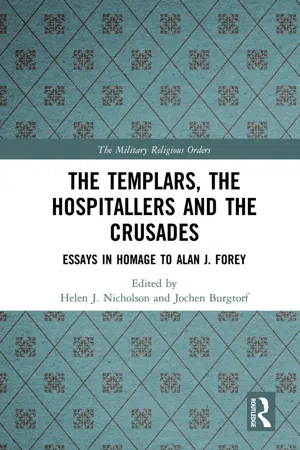
This book pays homage to the work of a scholar who has substantially advanced knowledge and understanding of the medieval military-religious orders. Alan J. Forey has published over seventy meticulously researched articles on every aspect of the military-religious orders, two books on the Templars in the Corona de Aragón, and a wide-ranging survey of the military-religious orders from the twelfth to the early fourteenth centuries. His archival research has been especially significant in opening up the history of the military orders in the Iberian Peninsula. This volume comprises an appreciation of Forey's work and a range of research that has been inspired by his scholarship or develops themes that run through his work. Articles reflect Forey's detailed research into and analysis of primary sources, as well as his work on the military orders, the crusades, the eastern Mediterranean, and the trial of the Templars. Further papers move beyond the geographical and chronological bounds of Forey's research, while still exploring his themes of the military-religious orders' relations with the Church and State.
eBook - ePub
The Templars, the Hospitallers and the Crusades
Essays in Homage to Alan J. Forey
- 244 pages
- English
- ePUB (mobile friendly)
- Available on iOS & Android
eBook - ePub
The Templars, the Hospitallers and the Crusades
Essays in Homage to Alan J. Forey
About this book
Information
Part 1
THE IBERIAN PENINSULA, ARCHIVES, AND DOCUMENTS
1
THE IBERIAN MILITARY-RELIGIOUS ORDERS IN THE EARLIEST PAPAL REGISTERS OF SUPPLICATIONS, 1342–1362
A volume in honour of Alan Forey is an appropriate place to calendar a few documents concerning military-religious orders on the Iberian Peninsula. On the other hand, twenty-nine entries from the earliest extant papal registers of supplications are not a good subject for a thrilling paper.1 The twenty-nine texts have almost nothing in common, except that they are petitions to Popes Clement VI (1342–1352) and Innocent VI (1352–1362), and they concern the Iberian military-religious orders,2 as they are usually called today, or the Spanish military-religious orders, as they would have been called in the Middle Ages – when Spain was still the name for the whole peninsula, following Roman tradition. This includes Santiago3 and Calatrava4 in the Christian kingdoms of the fourteenth-century peninsula, Montesa5 in the Crown of Aragon, plus Avis6 and Christ7 in Portugal; strangely enough, Alcántara8 is apparently not represented in these registers.
1 On supplications to earlier popes see M. Hayez, ‘Autour d’un rôle de suppliques de Jean XXII: élites avignonnaises à l’université’, in Église et culture en France méridionale (Toulouse, 2000), pp. 73–91. Many thanks are due to Philippe Josserand for his helpful suggestions; all errors remain the sole responsibility of the author.
2 C. de Ayala Martínez, Las órdenes militares hispánicas en la Edad Media (siglos XII–XIV) (Madrid, 2003); P. Josserand, Église et pouvoir dans la Péninsule Ibérique: Les ordres militaires dans la royaume de Castille (1252–1369) (Madrid, 2004).
3 Nos 1, 2, 3, 6, 7, 17, 18, 20, 21, 22, 25, 27. D. Lomax, La orden de Santiago, 1170–1275 (Madrid, 1965); J. L. Martín Rodríguez, Orígines de la orden militar de Santiago, 1170–1195 (Madrid, 1974); P. Porras Arboledas, La orden de Santiago en el siglo XV: La provincia de Castilla (Jaén, 1997).
4 Nos 5, 9, 24. J. F. O’Callaghan, The Spanish Military Order of Calatrava and Its Affiliates (Aldershot, 1975); E. Solano Ruiz, La Orden de Calatrava en el siglo XV: Los señoríos castellanos de la Orden al fin de la Edad Media (Sevilla, 1978); B. Schwenk, Calatrava: Entstehung und Frühgeschichte eines spanischen Ritterordens zisterziensischer Observanz im 12. Jahrhundert (Münster, 1992); E. Rodríguez-Picavea Matilla, La formación del feudalismo en la meseta meridional. Los señoríos de la Orden de Calatrava en los siglos XII y XIII (Madrid, 1994).
5 Nos 8, 12, 13, 14, 15, 19, 26. L. García-Guijarro Ramos, ‘The Development of a System of Commanderies in the Early Years of the Order of Montesa’, in La Commanderie, institution des ordres militaires dans l’Occident médiéval, ed. A. Luttrell and L. Pressouyre (Paris, 2002), pp. 57–73; idem, ‘The Extinction of the Order of the Temple in the Kingdom of Valencia and Early Montesa, 1307–30: A Case of Transition from Universalist to Territorialized Military Orders’, in The Debate on the Trial of the Templars 1307–1314, ed. J. Burgtorf, P. F. Crawford and H. J. Nicholson (Farnham, 2010), pp. 199–214.
6 Nos (4), 11, 28. M. C. Almeida Cunha, A ordem militar de Avis (das origens a 1329) (Oporto, 1989); M. C. Gomes Pimenta, ‘A ordem militar de Avis durante o mestrado de D. Fernão Rodrigues de Sequeira’, Militarium Ordinum Analecta, 1 (1997), 127–242; eadem, As ordens de Avis e de Santiago na Baixa Idade Média: O governo de D. Jorge (Palmela, 2002).
7 Nos 10, 16, 28. I. Morgado e Silva, ‘A Ordem de Cristo durante o mestrado de D. Lopo Dias de Sousa (1373–1417)’, Militarium Ordinum Analecta, 1 (1997), 5–126; A. Pestana de Vasconcelos, ‘A Ordem Militar de Cristo na Baixa Idade Média. Espiritualidade, Normativa e Prática’, Militarium Ordinum Analecta, 2 (1998), 5–92; I. Morgado e Silva, ‘A Ordem de Cristo (1417–1521)’, Militarium Ordinum Analecta, 6 (2002), 5–503.
8 L. Corral Val, Los monjes soldados de la orden de Alcántara en la Edad Media: Su organización institutional y vida religiosa (Madrid, 1999); F. Novoa Portela, La orden de Alcántara y Extremadura (siglos XII–XIV) (Mérida, 2000). See also Colección diplomática medieval de la orden de Alcántara (1157?–1494), vol. 1: De los orígines a 1454, ed. B. Palacios Martín (Madrid, 2000).
The sample is too small to produce any meaningful statistics. The registers of supplications have no old indexes, unlike the other papal registers, and so it is not easy to find these texts. For this reason the registers of supplications have usually been neglected by historians. Only recently has this situation begun to change. For Portugal, António Domingues de Sousa Costa has published the supplications from 1342 to 1370, and for the Crown of Aragon the invaluable Johannes Vincke has published a few entries from the papal registers of supplications,9 but such editions are not available for other realms and regions in the Iberian Peninsula. Recently, Mike Carr has worked on the registers of supplications concerning trade licences with the Muslim world.10 The supplications to Pope Urban V (1362–1370) have been calendared by Anne-Marie Hayez.11 For Urban V’s two predecessors there remain thirty-five volumes, ASV, Reg. suppl. 1–35. One has to read them page by page, either in the original or more probably now on the DVD provided by the Vatican Archives.
9 Monumenta Portugaliae Vaticana, vol. 1: Súplicas dos pontificados de Clemente VI, Inocêncio VI e Urbano V, ed. A. Domingues de Sousa Costa (Rome, Porto, 1968), with 573 numbers for Clement VI, 265 for Innocent VI and 259 for Urban V; Documenta selecta mutuas civitatis Arago-Cathalaunicae et ecclesiae relationes illustrantia, ed. J. Vincke, Biblioteca histórica de la Biblioteca Balmes, II, 15 (Barcelona, 1936).
10 M. Carr, ‘Crossing Boundaries in the Mediterranean: Papal Trade Licences from the Registra Supplicationum of Pope Clement VI (1342–52)’, Journal of Medieval History, 41 (2015), 107–29.
11 A.-M. Hayez, ed., ‘Suppliques d’Urbain V’, in Ut per litteras apostolicas [DVD], version 4 (Turnhout, 2011). See also eadem, ‘Traitement informatique des suppliques d’Urbain V’, in Genèse et débuts du Grand Schisme d’Occident (Paris, 1980), pp. 385–93; eadem, ‘Les “rotuli” présentés au pape Urbain V durant la première année de son pontificat (6 nov. 1362, 5 nov. 1363)’, Mélanges de l’Ecole française de Rome. Moyen age, temps modernes, 96 (1984), 327–94; eadem, ‘La personnalité d’Urbain V d’après ses réponses aux suppliques’, in Aux origines de l’Etat moderne. Le fonctionnement administratif de la papauté d’Avignon (Rome, 1990), pp. 7–31; eadem, J. Mathieu and M.-F. Yvan, ‘De la supplique à la lettre: le parcours des grâces en cour de Rome sous Urbain V (1362–1366)’, in ibid., pp. 171–205; eadem, ‘Les demandes de bénéfices présentées à Urbain V: Une approche géographico-politique’, in Suppliques et requêtes, Le gouvernement par la grâce en Occident (XIe–XVe siècle), ed. H. Millet (Rome, 2003), pp. 121–50.
Reading page by page is fairly time-consuming, and when working on Iberian military-religious orders one will think twice whether twenty-nine entries from nearly 7,000 folios12 or 14,000 pages are rewarding enough to justify the effort. But having the chance to spend several years in Rome during the 1980s and 1990s, the author of the present paper did read those thirty-five volumes in search of a variety of bigger and smaller subjects. These included not only the Hospitallers, for whom the results have been published in two papers,13 but also the Iberian military-religious orders. What will be presented here may of course be incomplete, partly because a few relevant entries may have been overlooked, partly because the series of extant registers is no longer entirely complete. If we can trust the author of his Vita, it was Pope Benedict XII (1334–1342) who began the series of registers of papal supplications.14 Yet no volumes from the time of Benedict XII are extant, and at least two volumes each for both Clement VI and Innocent VI are now missing.15
12 6956 folios, among them 4117 folios (171 per volume) from Clement VI and 2839 folios (258 per volume) from Innocent VI.
13 K. Bor...
Table of contents
- Cover
- Half Title
- Series Page
- Title Page
- Copyright Page
- CONTENTS
- List of figures
- Acknowledgements
- List of abbreviations
- List of contributors
- Introduction
- Part I The Iberian Peninsula, archives, and documents
- 1 The Iberian military-religious orders in the earliest papal registers of supplications, 1342–1362
- 2 Pelayo Pérez Correa and the international ambitions of the Order of Santiago
- 3 The identity of Hospitallers in the Crown of Aragon and economics (XII–XIII centuries)
- 4 Hospitallers, Templars, and the papacy in the twelfth century: the issue of historical agency
- Part II The Eastern Mediterranean
- 5 Descriptions of fighting, captivity, and ransom in the writings of Robert of Nantes, Patriarch of Jerusalem, in the mid-thirteenth century
- 6 Continuing the Continuation: Eracles 1248–1277
- 7 Some observations on Hospitaller agricultural activities in the Latin East prior to the fall of Acre in 1291
- 8 Sergeants in the Rule of the Templars
- 9 Shared worship at Filerimos on Hospitaller Rhodes 1306–1421
- Part III The trial of the Templars and its after-history
- 10 The beard and the habit in the Templars’ trial: membership, rupture, resistance
- 11 The Templar Order in public and cultural debate in France during the eighteenth and nineteenth centuries
- Part IV Beyond Forey’s foundations: the fourteenth, fifteenth, and sixteenth centuries
- 12 Cooking the books: the report of Philip de Thame and financial crisis in fourteenth-century Britain
- 13 Military order castles in the Holy Land and Prussia: a case for cultural history
- 14 A crusade against the Poles? Johannes Falkenberg’s ‘Satira’ (1412)
- 15 Die welt ist kranck. The Teutonic Order and the Prussian Union at the court of Frederick III (1452/53)
- 16 What the Hospitaller said to the bishop
- Alan J. Forey: list of publications
- Select bibliography
- Index
Trusted by 375,005 students
Access to over 1.5 million titles for a fair monthly price.
Study more efficiently using our study tools.
Frequently asked questions
Yes, you can cancel anytime from the Subscription tab in your account settings on the Perlego website. Your subscription will stay active until the end of your current billing period. Learn how to cancel your subscription
No, books cannot be downloaded as external files, such as PDFs, for use outside of Perlego. However, you can download books within the Perlego app for offline reading on mobile or tablet. Learn how to download books offline
Perlego offers two plans: Essential and Complete
- Essential is ideal for learners and professionals who enjoy exploring a wide range of subjects. Access the Essential Library with 800,000+ trusted titles and best-sellers across business, personal growth, and the humanities. Includes unlimited reading time and Standard Read Aloud voice.
- Complete: Perfect for advanced learners and researchers needing full, unrestricted access. Unlock 1.5M+ books across hundreds of subjects, including academic and specialized titles. The Complete Plan also includes advanced features like Premium Read Aloud and Research Assistant.
We are an online textbook subscription service, where you can get access to an entire online library for less than the price of a single book per month. With over 1.5 million books across 990+ topics, we’ve got you covered! Learn about our mission
Look out for the read-aloud symbol on your next book to see if you can listen to it. The read-aloud tool reads text aloud for you, highlighting the text as it is being read. You can pause it, speed it up and slow it down. Learn more about Read Aloud
Yes! You can use the Perlego app on both iOS and Android devices to read anytime, anywhere — even offline. Perfect for commutes or when you’re on the go.
Please note we cannot support devices running on iOS 13 and Android 7 or earlier. Learn more about using the app
Please note we cannot support devices running on iOS 13 and Android 7 or earlier. Learn more about using the app
Yes, you can access The Templars, the Hospitallers and the Crusades by Helen J. Nicholson, Jochen Burgtorf, Helen J. Nicholson,Jochen Burgtorf in PDF and/or ePUB format, as well as other popular books in Éducation & Enseignement des arts et des sciences humaines. We have over 1.5 million books available in our catalogue for you to explore.